
An urban NGO that salvages 7 to 10 tons of surplus produce a week from Jerusalem’s Givat Shaul wholesale market is now pushing the city to fix the system that wastes it. On June 14, Jerusalem Food Rescuers helped launch Israel’s first Urban Food Policy Forum at City Hall, where Mayor Moshe Lion signed the Milan Urban Food Policy Pact framework, joining more than 300 cities already in the network.
The launch came after 18 months of knocking on every municipality department that touches food policy and a calculation the NGO keeps returning to: the city spends roughly NIS 1,000 ($345) to haul every ton of uneaten food to a landfill that releases methane. The 39% of Jerusalem families and 51% of children below the poverty line, according to the Ministry of Welfare, is the population the forum is meant to serve.
Givat Shaul feeds a city, and landfills much of it
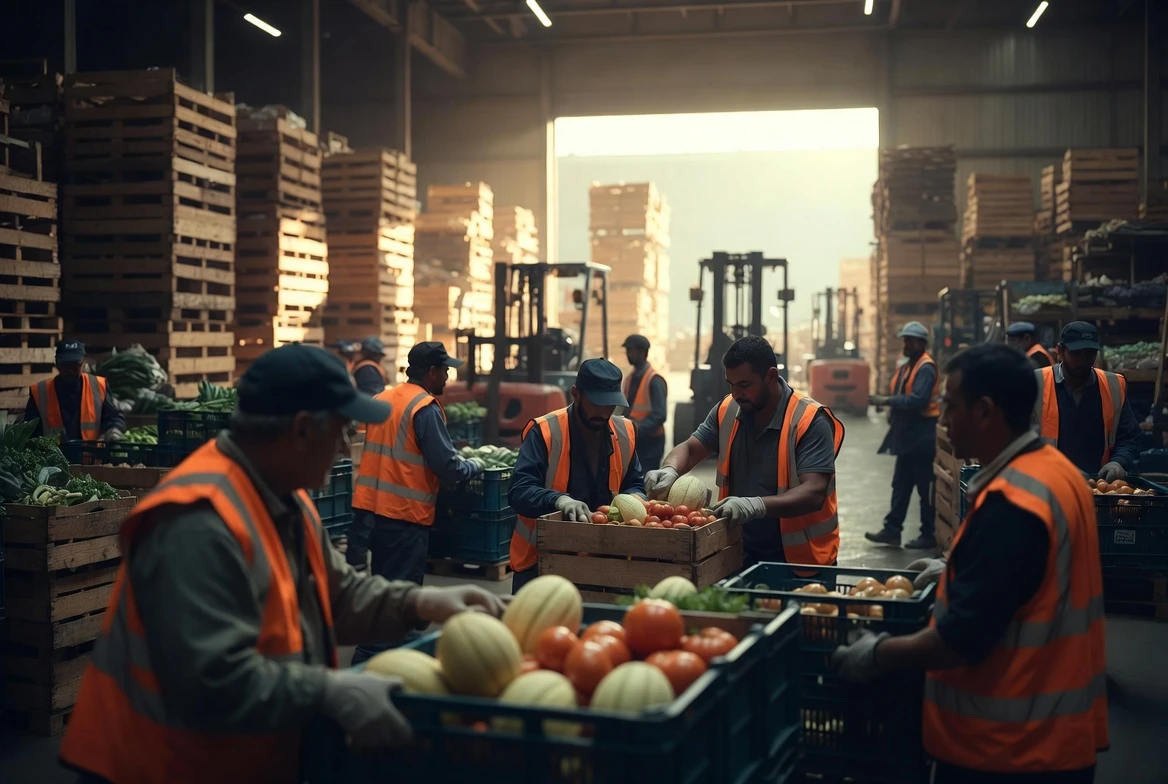
Small forklifts weave between pallets of tomatoes, cucumbers and peppers stacked six feet high alongside bulk containers of melons and pumpkins at the Givat Shaul wholesale produce market, near the city entrance. The sprawling enclave thrums around the clock, and the same Jewish and Arab families have often worked its stalls together for several generations.
The complex has seen little renovation in decades. According to co-founder and co-CEO Daniella Seltzer, it is the largest of three privately owned wholesale markets in Israel and handles 10,000 to 20,000 tons of produce each day. When the temperature climbs, much of the food spoils outside because the complex lacks enough cold rooms. Wholesale storeowners have little financial reason to pass on surplus, since their income comes from sales commissions and they pay flat municipal fees regardless of whether produce is sold or tossed. Most of the market’s roughly 20 wholesale businesses now donate to the NGO out of goodwill.
Seven to ten tons a week, sorted by hand
A couple of dozen volunteers, all wearing orange vests, sorted surplus vegetables in the warehouse on a recent morning, separating what would work for fresh produce from what would suit cooking. Waste suitable for animal feed or composting is also set aside, though the channels for distributing it further need work. The operation is lean for the scale: 14 paid staff, 6 young women doing national service, and 450 volunteers running 33 distribution points citywide. Of the distribution points, 22 are resident-led and 11 are pop-up markets run by residents or youth in schools, community centers, and gardens.
The volume, in plain figures, runs from 7 to 10 tons of food each week. About 70% of it comes from the Givat Shaul market; the rest is collected from a food aid organization with excess produce, a couple of bakeries, and a farm. Charitable food rescue has been established in Israel for years: Leket, the leading rescue organization and food bank, collects surplus food from farmers and leftover meals from institutions such as military bases and hotels, while Latet, a nonprofit that distributes $30 million worth of food annually, picks up from the big food conglomerates. Both distribute through NGO networks. By contrast, Jerusalem Food Rescuers is an urban organization that serves only the city and reaches residents through pop-up markets and partner NGOs of its own.
By the numbers: Jerusalem Food Rescuers today
- 7 to 10 tons of surplus food salvaged each week
- About 1,000 Jerusalemites fed weekly through the distribution network
- 70% of rescued food sourced from the Givat Shaul market
- 39% of families and 51% of children in Jerusalem below the poverty line (Ministry of Welfare)
- 33 distribution points citywide, including 11 pop-up markets
What one ton of food waste actually costs
The price of the broken system sits inside the trucks. According to Seltzer, the Jerusalem Municipality spends roughly NIS 1,000 ($345) to transport every ton of food waste from the city to landfill sites, where it decomposes and emits methane gas and contributes to global warming. The same trucks pass the Givat Shaul warehouse where orange-vested volunteers are sorting what could have been their cargo.
The landfill math is what Seltzer told the new forum it has to confront. From the City Hall lectern on June 14 she posed two questions that framed the launch.
How can we not see food as part of the civic infrastructure, like water? How can it be left in the hands of different city departments and private companies that manage what we eat?
She added that food security is more than access to fresh, nutritious food physically, economically and culturally; it is also about choice and dignity. The Milan Urban Food Policy Pact that Lion signed joins a network of more than 300 cities working on healthier, more equitable, and more resilient food systems. The forum is the first step toward a permanent food council that joins the city, civil society, and food businesses around one table.
The motivation behind it is a study in coordination gaps. The Jerusalem Food Rescuers team was passed between five Jerusalem Municipality departments before sitting down with the mayor’s office, and each handled some aspect of food policy without owning the whole system. Around 18 months ago, the NGO proposed a food council co-chaired by civil society and the city, modeled on similar bodies in global cities.
Eighteen months to put everyone at one table
Mayor Lion agreed and tapped Ronit Ahdut HaCohen, who holds the city council’s health portfolio, as coordinator. A neuroscience expert, she teaches at the Hebrew University’s Faculty of Medicine and the David Yellin Education College. The choice frames food policy as a public health question, with rising obesity and rising consumption of ultra-processed food, salt, and sugar behind her appointment.
Ahdut HaCohen told the Times of Israel that local authorities have an important role in encouraging healthier choices, ensuring food security, and formulating “smart, coordinated, and knowledge- and research-based urban policy.” She described the Jerusalem Food Forum as born of the understanding that real change happens when all relevant parties sit around the same table. Around 70 people from across the local food landscape attended the launch at City Hall on June 14.
Five working groups, one year to deliver
The forum voted in working groups charged with turning ideas into implementable plans within a year. Seltzer expects each to report back before the first anniversary, and the scope runs from mapping existing surplus networks to rewriting what children learn about food.
- Map every food-aid organization in the city and flag which has surplus and which has deficit, including the dense network of institutions operating within the Haredi community.
- Food aid during times of crisis, scaling emergency response when supply chains wobble.
- Formalized consultation with food-insecure residents, giving those most affected a seat at the policy table.
- Equipping schools with kitchens so meals can be prepared on site.
- Teaching about growing food and healthy eating, threading food literacy into the school day.
Seltzer named the mapping task explicitly and listed the rest as examples of the topics the working groups will research; the groups will likely add and re-prioritize items as they meet. What the working groups will not touch in this first round is the supermarket supply chain that bypasses Givat Shaul entirely and is responsible for most of Israel’s discarded produce.
A welcome that doesn’t brand the needy
The pop-up markets are the clearest expression of the NGO’s approach. Eleven of the 33 distribution points run this format, often in schools, community centers, and community gardens, and the markets give people more choice than delivered food boxes, which are pre-set bundles handed out to anyone who asks.
The pop-ups also bring neighbors together around food in a setting that isn’t branded for the needy, a deliberate choice. Produce sells at NIS 1 per kilogram, enough to buy roughly six-and-a-half pounds for a dollar. The charity also runs educational programs and generates income by catering events and organizing cooking and fermentation workshops.
The pop-up sits inside a national ecosystem: Leket and Latet handle surplus at national scale and channel food through partner NGOs into households, while Jerusalem Food Rescuers handles a fraction of that tonnage but reaches an estimated 1,000 residents weekly, and lets them pick. A profile from the group’s founding supporter traces its growth from a single communal supper cooked at the close of the Machane Yehuda market into a citywide movement reaching thousands of residents.
The approach is rooted in co-founder Itay Peled’s framing of food as “a gateway to social change.” With the municipality, Seltzer said, the NGO has been able to progress fast with different people from different backgrounds and political orientations because it works with everyone, and it does it around food. “So far,” she added, “we haven’t found anyone who disagrees that food shouldn’t be thrown away.”
Where charity has its limits
The political ceiling is the supermarket chains, which built their own farm-to-retail systems over the past two decades and now control about 60% of Israel’s produce market, according to Agriculture Ministry data. Those chains sidestep wholesale markets like Givat Shaul, use their scale to squeeze farmer prices, and discard nutritious produce long before it reaches a retail shelf. Seltzer put it plainly: in Israel, there isn’t enough public control over the food system, and a lot is left in the hands of those geared to making profits. The misshapen carrots stacked at the warehouse are the visible residue of a procurement system optimized for visual uniformity.
Peled is blunt about what the forum cannot reach. Organizations like his cannot solve food insecurity alone, he said, because low salaries, limited access to public housing, and unequal workplace opportunities feed the poverty that drives hunger. “These are policy issues,” he said. “You can’t leave everything to the market.”
The size of the gap is in the scale. Peled said the NGO was aiming to triple or even quintuple its operations within three to five years by reaching as many as possible of the city’s 2,000-plus food businesses on a list compiled by the municipality. The current weekly haul of 7 to 10 tons is the baseline for that push.
