
An Israeli drone maker that began as a gaming startup says its systems helped rescue a survivor 72 hours after twin earthquakes struck Venezuela’s La Guaira on June 24, 2026. XTEND, headquartered in Tel Aviv and Florida, was asked by the Venezuelan government to send its drones. The two countries have had no diplomatic ties since 2009.
XTEND drone deployment in the La Guaira search and rescue was confirmed by The Jerusalem Post on July 3. The deployment paired the company’s Honey Badger and XTENDER unmanned aerial systems with Mexico City’s Los Topos Tlatelolco brigade. The death toll across Venezuela has risen to over 2,300 in what the paper called “Latin America’s largest natural disaster in decades.”
A Man Pulled Alive at the 72-Hour Mark
The earthquake came in two jolts on the evening of June 24, a magnitude 7.2 foreshock followed 39 seconds later by a magnitude 7.5 mainshock. Their epicenters sat in the state of Yaracuy, west of San Felipe, and the worst damage ran through the coastal La Guaira region and into Caracas. By July 3 the overall death toll had risen to over 2,300, what The Jerusalem Post called “Latin America’s largest natural disaster in decades.”
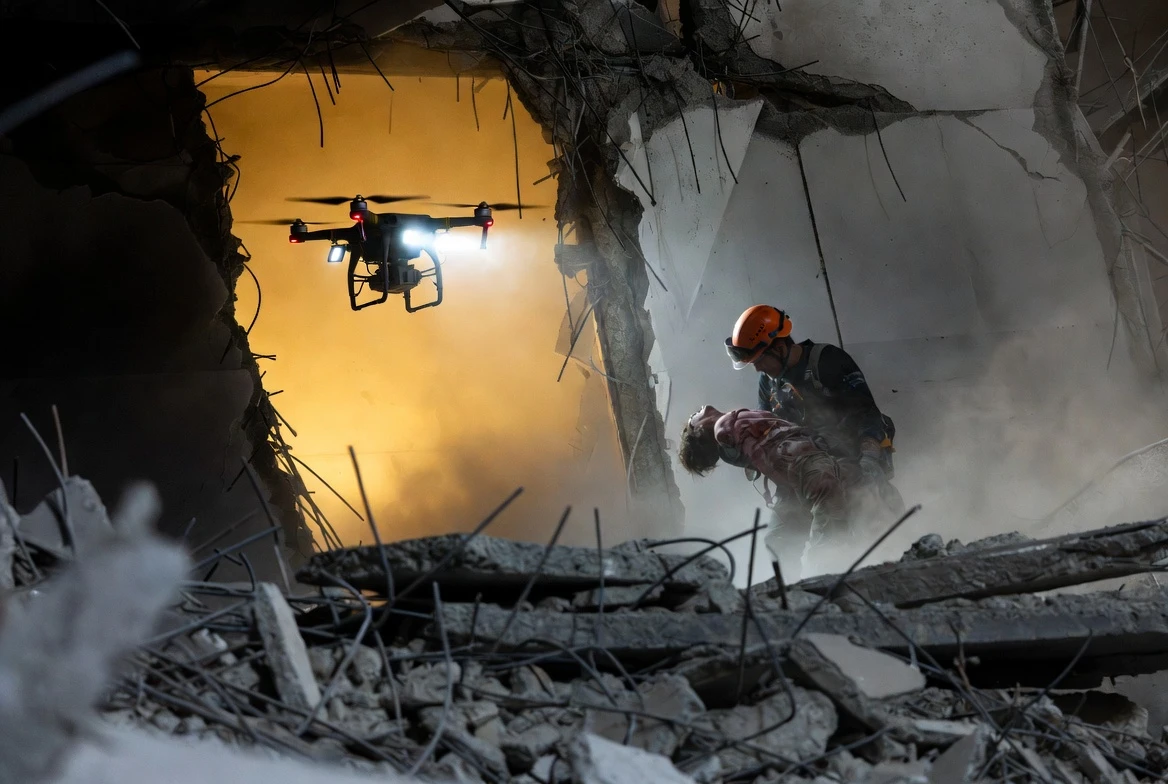
Through the first 72 hours of search, a Mexican rescue brigade worked alongside the XTEND drone team flown into La Guaira. Hidabroot reported that the Israeli crew used AI-powered drones with thermal sensors and infrared cameras to map rubble and search for signs of life. The teams worked through the night and pulled a man out alive at around 5:00 a.m. local time on Tuesday morning. The survivor had been trapped between a roof and a collapsed wall.
- 39 seconds between the magnitude 7.2 foreshock and the magnitude 7.5 mainshock on June 24, 2026
- 5:00 a.m. local time the hour a survivor was pulled alive from the rubble
- At least 38,500 people unaccounted for as of July 2, per a missing-persons tracker
- 1985 when Los Topos Tlatelolco was born, during the Mexico City earthquake
- February 1986 when the team formalised into a permanent brigade
Seventeen Years Without an Embassy
Venezuela’s ties with Israel collapsed on January 14, 2009. Then-president Hugo Chávez severed 60 years of diplomatic recognition in protest over the war in Gaza. Caracas aligned itself with the Palestinian cause, and Israel’s ambassador was expelled from the country. Venezuela’s 2009 announcement ended six decades of state-to-state relations.
The deployment in La Guaira shows none of those ties were needed. Defense and tech reporting by The Jerusalem Post said the Venezuelan government approached XTEND directly to help in “the complex environment,” and acting president Delcy Rodríguez helped secure access for the drone team. Hidabroot reported that XTEND’s Roy Levy was described as leading the drone operation on the ground, and the participants worked without a channel that does not exist.
Israel is one of dozens of countries sending personnel to the disaster zone, the same article noted, “despite not having diplomatic relations with Caracas for some 17 years.” The informal cooperation cut through where formal ties once had. XTEND deployed operators quickly, and they were assigned to a Mexican search-and-rescue brigade that, like XTEND itself, was born from a different disaster. Within 72 hours of the earthquakes, the joint Mexican-Israeli crew had pulled a survivor from the rubble.
From Video Games to Search and Rescue
XTEND was never built for this line of work. Founded in 2018 by Aviv and Matteo Shapira, Rubi Liani, and Adir Tubi, the company began as a gaming business that used drone-based extended reality and VR to simulate flight in video games.
The October 7 Hamas attack and the war that followed forced a reckoning. The founders concluded that their operator-in-the-loop drone architecture could help troops, and they began developing a new Concept of Operations, or CONOPS, in which their drones enter the battlefield ahead of soldiers. That pivot pulled the company from entertainment into defense, where it has since built its product line around human-guided autonomous systems running on its XOS operating interface.
Over 10,000 systems have been deployed worldwide since. XTEND’s $8.8 million Pentagon drone-kit contract from 2025 is documented in Israeli financial press coverage. The platform has shipped to the United States, Singapore, the United Kingdom, and Israel, with operations in “five combat zones” the company has counted toward its record.
XTEND markets its products for “defense, public safety, and private security applications,” using VR/AR and AI interfaces that let an operator control multiple air, ground, and maritime drones at once. The Venezuelan deployment drew on those public-safety capabilities rather than XTEND’s combat-grade systems. Both Honey Badger and XTENDER operate as part of a three-drone mesh team, powered by XTEND’s XOS control layer.
Honey Badger Outside, XTENDER Inside
The Honey Badger handles the outside, while the XTENDER works indoors where GPS does not reach. Both are XTEND platforms, both speak to the same XOS control layer, and both arrived in La Guaira without a reconfiguration in between.
The Honey Badger is, in XTEND’s words, “a compact multi-mission drone designed for close-range operations” in “dense urban terrain” and “areas where GPS access is disrupted.” It carries modular payloads of up to three kilograms, can be deployed “within seconds,” flies for roughly 35 minutes, ranges more than six kilometers, and integrates into a three-drone mesh that shares targeting data in real time. XTEND’s XTENDER is a “micro tactical ISR platform” built for “indoor and subterranean operations” where “GPS access is limited or unavailable.” It weighs 1.2 kilograms, flies for roughly ten minutes, ranges over 1.6 kilometers, is impact-resistant, carries floodlights, and supports encrypted communications. The XTENDER can be launched from the ground, by hand, or from another aircraft, which lets the operator reach rooms and tunnels a person cannot safely enter.
| Attribute | Honey Badger | XTENDER |
|---|---|---|
| Mission | Close-range, dense urban terrain | Indoor and subterranean operations |
| GPS environment | Areas where GPS “is disrupted” | Areas where GPS is “limited or unavailable” |
| Network | Three-drone mesh | Three-drone mesh |
| Flight time | “roughly 35 minutes” | “roughly 10 minutes” |
| Range | “more than 6 kilometers” | “over 1.6 km” |
Los Topos: Born From Another Earthquake
Los Topos Tlatelolco is no ordinary rescue outfit. The brigade was born from the 1985 Mexico City earthquake.
A group of young Mexicans rushed into the rubble with no training and no equipment, and they were so effective that the team formalised in February 1986, just five months later. The team’s defining principle, captured in an early profile, was the willingness to “go in where no one else will.” That ethic has carried the brigade through more than three decades of deployments. They travel on commercial flights, with kit capped at thirty kilograms per person, working with hand tools and rescue dogs they have trained themselves.
- 1985: Born during the Mexico City earthquake recovery; formalised in February 1986
- 1986: San Salvador, the team’s first international deployment
- 2004: Indonesia tsunami aftermath, described as their hardest assignment to date
- 2009: L’Aquila, Italy, the brigade’s first European deployment
- 2010: Haiti, where the team pulled 15 people alive from the rubble
- 2026: La Guaira, Venezuela, alongside XTEND drone operators
Now the team has added Venezuela to that record. The Mexican brigade flew into La Guaira to work the wreckage; the Israeli drone team joined them with thermal sensors, infrared cameras, and a 3D mapping layer built for collapsed structures. The arrangement pulled a survivor out at the 72-hour mark, and Spanish-language reporting tracked parallel rescues by Mexican and Spanish crews during the same window.
The Search Goes On
The survivor pulled from the rubble at 5:00 a.m. was not the only success in those first three days. Spanish-language crews ran parallel rescues in La Guaira during that window, including operations carried out by Mexican and Spanish teams. XTEND’s Roy Levy and the Los Topos crew worked through the night to coordinate a high-risk entry into a section of the building that officials hoped could yield “one or two” more rescues. The man pulled out that morning came from exactly the kind of high-risk space the drones had been mapping.
The wider toll across the country continues to climb. Casualty reporting tracked at least 2,595 deaths with more than 12,000 injured, more than 15,800 people who lost their homes, and another 28,300 whose homes were left uninhabitable. A missing-persons tracker listed about 38,500 unaccounted for as of July 2.
Venezuela’s government has described the missing-person total as “in the thousands” without publishing a figure. The UN under-secretary-general for humanitarian affairs, Tom Fletcher, said more than 50,000 people remained missing. Reporting from outside Venezuela flagged disrupted communications and what some observers called a possible media blackout. Casualty reports in more remote areas remained scarce, in part because of access constraints. The cooperation that lets XTEND operate does not run through any Israeli embassy, because none has existed since 2009.
For XTEND, the La Guaira deployment marks a humanitarian use of a defense-tech product in a country that does not formally buy Israeli anything. The arrangement echoes Israeli defense tech found in countries with limited diplomatic ties. Hidabroot reported that, for the rescue crews, each survivor pulled out alive was a sign the search was not over.
Frequently Asked Questions
Who is XTEND, the Israeli drone maker in Venezuela?
XTEND is an Israeli drone company headquartered in Tel Aviv and Florida. Founded in 2018 by Aviv and Matteo Shapira, Rubi Liani, and Adir Tubi, the firm originally used drone-based extended reality and VR to simulate flight for video games. After the October 7 Hamas attack and the war in Gaza, the founders pivoted the same operator-in-the-loop architecture toward defense work, and XTEND has since shipped over 10,000 systems to more than 30 countries.
Why is XTEND operating in Venezuela if the two countries have no ties?
Venezuela broke off diplomatic relations with Israel on January 14, 2009. The Venezuelan government nonetheless approached XTEND directly in the aftermath of the June 24, 2026 earthquakes, and acting president Delcy Rodríguez personally helped secure access for the company’s drone team. The Jerusalem Post reported July 3 that the deployment was arranged through informal channels rather than an embassy that has not existed for 17 years.
What drones did XTEND deploy in Venezuela?
XTEND sent two systems that work in tandem: the Honey Badger, a compact multi-mission outdoor drone that flies for roughly 35 minutes and ranges more than six kilometers, and the XTENDER, a 1.2-kilogram indoor drone for rooms, stairwells, and subterranean spaces where GPS does not reach. Both run on XTEND’s XOS control interface and operate as part of a three-drone mesh network.
Who are Los Topos Tlatelolco?
Los Topos Tlatelolco is a Mexican search-and-rescue brigade founded in 1985 by volunteer youths who rushed into the rubble of the Mexico City earthquake without training or equipment. The team formalised five months later and has since deployed to earthquakes and disasters in San Salvador (1986), Indonesia after the 2004 tsunami, L’Aquila in Italy (2009), and Haiti (2010), where they pulled 15 people alive from the rubble.
How large was the June 2026 Venezuela earthquake?
The June 24, 2026 event was a doublet: a magnitude 7.2 foreshock followed 39 seconds later by a magnitude 7.5 mainshock. According to The Jerusalem Post, the death toll across Venezuela has risen to over 2,300, while Wikipedia’s tally lists at least 2,595 dead and more than 12,000 injured. Tens of thousands remained missing as of early July.
