
Iran told its own state broadcaster on Saturday that it is abandoning the ceasefire it signed with Washington in June, hours into a seventh straight night of strikes. US Central Command says it hit Iranian surveillance sites and underground weapons depots overnight. Iran’s Revolutionary Guard claims it struck American forces in Kuwait, Bahrain and Jordan in return.
The template that ended the last major US-Iran shooting crisis, a single missile barrage followed by a stand-down within 48 hours, has no equivalent this time. This war has now outlasted two ceasefires and a formal peace framework signed just five weeks ago, and Saturday’s announcement was the clearest sign yet that the framework is dead rather than merely fraying.
Iran’s Guard Says It Hit US Troops Across Three Gulf States
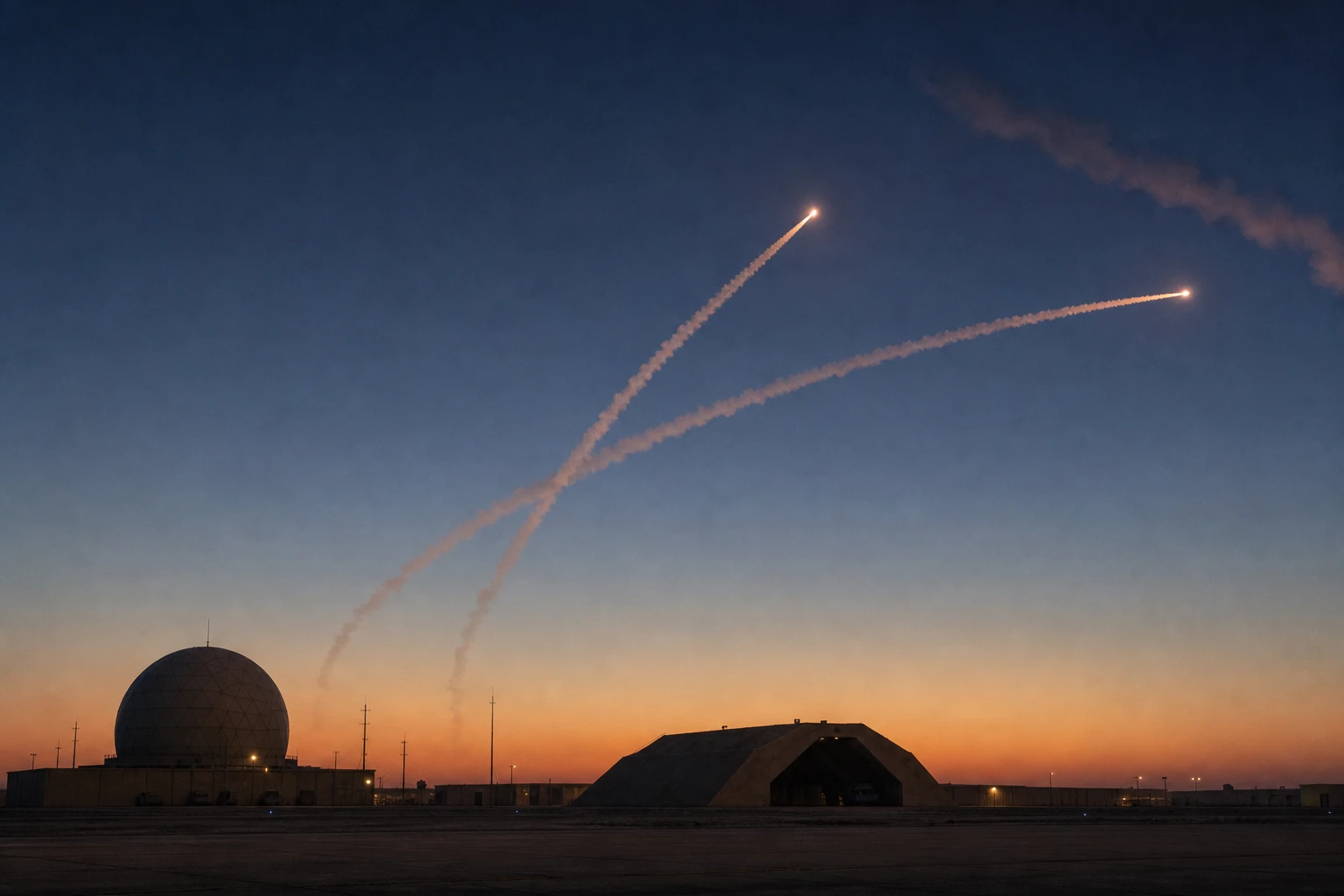
The US Central Command (CENTCOM) said American forces struck Iranian surveillance sites, military logistics infrastructure, underground weapons storage facilities and other maritime capabilities overnight. It described its forces across the region as vigilant, lethal and ready, noting more than 50,000 American troops remain deployed in the Middle East.
Iran’s response, according to the IRGC, reached three countries in a single night. Tasnim News Agency reported five explosions on the outskirts of Yazd. Iran’s Khuzestan province saw strikes around Ahvaz, according to deputy governor Valiollah Hayati, and attacks were also reported in Lar and Darab in Fars province.
The IRGC’s own list of retaliatory targets spanned three US partners in one night:
- Kuwait: a claimed strike on US troops at the Arifjan Ground Forces Support Center, a destroyed radar and a hit weapons hangar and drone shelter at Ali Al Salem Air Base, and an attack on a naval fuel facility at Al-Ahmadi port
- Bahrain: a strike on a site used to stage US aircraft at Sheikh Isa Air Base, plus an attack on a US intelligence data center identified as Batelco
- Jordan: missiles fired at Muwaffaq Salti Air Base near Al-Azraq, with explosions heard in the capital, Amman
Jordan’s military said it intercepted all 10 missiles fired at its territory, reporting no casualties. The IRGC framed the barrage as the eighteenth wave of Operation Nasr 2, a name it has given its retaliatory campaign against Kuwait specifically.
Tehran Tears Up the Truce
The strikes landed hours after Iranian official Gharibabadi, an Iranian negotiator involved in the talks with Washington, told Iran’s state broadcaster that Tehran was walking away from the agreement entirely.
We have suspended all of our commitments and are, in fact, no longer implementing them.
Gharibabadi said the collapse was not Iran’s doing. “We were in negotiations. Unfortunately, it was the Americans themselves who, in fact, took these aggressive actions, in violation of their own commitments,” he said, adding that Iran now sees itself as “defending our country.”
That statement capped a five-month arc that has moved in the same direction every time it looked like it might stabilize.
- February 28, 2026: US and Israeli strikes open what the Pentagon calls Operation Epic Fury. Iran’s Supreme Leader, Ali Khamenei, is killed within hours, along with the country’s defense minister and dozens of senior officials.
- April 8, 2026: Pakistan brokers a two-week ceasefire after Iran rejects a longer 45-day framework. Both sides violate it repeatedly in the weeks after.
- April 21, 2026: President Trump extends the truce indefinitely, even as a US naval blockade and Strait of Hormuz disputes keep tensions high.
- June 17, 2026: Washington and Tehran release a 14-point memorandum of understanding covering a permanent halt to fighting, reopening the strait and limits on Iran’s nuclear program.
- July 8 to 10, 2026: Trump declares the memorandum “over” after new strikes, then allows negotiators to keep talking anyway.
- July 18, 2026: Gharibabadi tells state media Iran has suspended every commitment under the deal, hours into the seventh straight night of strikes.
Between those last two entries, the fighting never really stopped. Iran’s Health Ministry spokesperson Hossein Kermanpour told CNN that at least 500 people have been injured in US strikes since June 27, when the ceasefire first began to fray in earnest, with five women and two children killed in the past month alone. Iran’s official news agency IRNA separately said US airstrikes between June 22 and July 16 killed 38 people and wounded about 400 others, a different window and a different count, but pointing the same direction.
Gulf Capitals Answer Back
Reaction from the countries caught in the crossfire came within hours. Jordan’s foreign minister denounced what he called “brutal Iranian attacks” and a “blatant breach of international law,” warning against a “dangerous escalation” in the wider region, according to CNN’s live coverage of Saturday’s events.
Kuwait’s foreign minister went further, issuing a “strong denunciation of recent reprehensible Iranian aggressions” against Bahrain, Qatar and Jordan. Kuwait has been named in Iranian strike claims more than any other Gulf state this year, a pattern Kuwait absorbing the brunt of the US-Iran war has tracked closely as its bases keep appearing in IRGC target lists.
Qatar, which has spent months shuttling between Tehran and Washington as a mediator, called instead for “a serious return to dialogue and negotiations.” Pakistan, the other main broker, has its own complicated stake in the outcome. It is bound by a defense pact with Saudi Arabia, a pact tested by an earlier Iranian strike on a Saudi base, even as Islamabad tries to talk Iran and the US back from the edge again.
Iran’s Parliament Speaker, Muhammad Ghalibaf, made clear on social media that Tehran does not see itself as the party retreating. “America still hasn’t learned that bullying and breaking promises are no longer cost-free,” he wrote. “Let me put it plainly: if you strike, you’ll get hit.”
The 2020 Precedent This War Broke
Every Gulf war has a reference point, and for US-Iran combat, that reference point has long been the night of January 8, 2020. Hours after a US drone strike killed Iranian general Qassem Soleimani, the IRGC fired ballistic missiles at American forces in Iraq. The Iraqi military said at the time that 22 missiles hit Al Asad air base and a base near Erbil combined.
Nobody died. President Trump said as much within a day, and Iran’s then foreign minister, Mohammad Javad Zarif, called the barrage “concluded,” adding that Iran did “not seek escalation or war.” Both sides stood down within 48 hours.
That version of events did not hold up. A later Pentagon accounting found 110 US service members had been diagnosed with traumatic brain injuries from the blasts, and a case series published in the peer-reviewed literature found 35 of 38 soldiers screened met concussion criteria. A separate reassessment by the Center for Strategic and International Studies concluded that officers at the base reported the blast doors bend like waves under the impacts, undercutting the original story of a clean, casualty-free exchange.
The gap between the two crises is now enormous by any measure available.
| Measure | January 2020 crisis | Current war (since Feb. 28, 2026) |
|---|---|---|
| Trigger | US drone strike killed Gen. Qassem Soleimani | US and Israeli strikes killed Supreme Leader Ali Khamenei |
| Length of the exchange | One night, single Iranian barrage | Ongoing; seventh straight night of this latest wave |
| Missiles in one episode | 22 missiles at two Iraqi bases combined | 119 missiles and drones fired at Jordan alone in one week |
| How it was resolved | Both sides stood down within 48 hours | Two ceasefires and a signed memorandum have all collapsed |
| Reported deaths inside Iran | Not applicable | 3,636 documented by April 7, per HRANA, a US-based monitor |
Jordan’s own experience captures the shift best. Its military has said Iran fired 119 missiles and drones at sites inside the kingdom over a single especially intense week this year, 60 missiles and 59 drones. A radar tied to Jordan’s Terminal High Altitude Area Defense system was damaged badly enough that US officials moved to replace it, even as Jordanian officials maintained that interceptions had prevented serious losses. That mismatch between official claims and quieter damage assessments is its own echo of 2020.
What Happens If the Next Round of Talks Fails
Trump’s own position has whipsawed for weeks. At a NATO summit in early July he called the memorandum “over” and dismissed the Iranian leadership as “scum.” A day later he softened, telling reporters aboard Air Force One that a return to full-scale war was not the goal and that Tehran “wants to make a deal.”
Pakistan and Qatar are again trying to force that outcome. Iranian and Qatari delegations met in Tehran and Muscat earlier this month to discuss reopening the Strait of Hormuz, and Pakistan’s government has repeated its offer to host follow-up talks in Islamabad. None of that diplomacy has stopped a single night of strikes since.
Markets are treating the pattern as background noise rather than a fresh shock. Oil climbed past $100 a barrel earlier this year from a pre-war range closer to $67 to $71, and traders are watching for Bitcoin’s shrinking reaction to renewed strikes as evidence that repeated flare-ups are losing their power to rattle investors the way the February opening salvo once did.
What has not lost its power is the war itself. Iran’s government has now told its own public, on the record, that it no longer considers itself bound by the deal Washington and Tehran spent months negotiating. The seven nights of strikes did not force that admission. They followed it.
Frequently Asked Questions
What is Operation Epic Fury?
Operation Epic Fury is the name US officials gave the campaign President Trump authorized aboard Air Force One at 3:38 p.m. EST on February 27, 2026. Strikes began the next morning and killed Iran’s Supreme Leader, Ali Khamenei, within hours, opening the war that is still going on.
Why does Jordan keep getting hit if it is not directly fighting Iran?
Jordan hosts Muwaffaq Salti Air Base, also called Al-Azraq, which is used by both the Royal Jordanian Air Force and American squadrons. Beyond Iran’s own strikes, Iraqi militia groups aligned with Tehran, including factions that have separately claimed drone attacks on Jordanian territory, have added to the pressure on the kingdom independent of any single order from Iran itself.
What does the collapsed memorandum actually require beyond a ceasefire?
Beyond halting military operations, the 14-point framework calls for the release of frozen Iranian assets abroad and conditional sanctions relief tied to further Iranian concessions, structured negotiations channeled through Pakistan, and a possible 45-day window for a permanent settlement. None of those later provisions were reached before the deal broke down.
Has Israel joined this latest round of strikes?
No. Despite fighting alongside the US when Operation Epic Fury began in February, Israel has not taken part in the strikes on Iran during this latest wave, and Iran has not targeted Israel either. The US has, however, been staging refueling tanker aircraft out of Israeli air bases to support its own operations.
