
Iran fired a ballistic missile at Prince Sultan Air Base in Saudi Arabia on Friday, Iranian state media claimed, striking the same American hub it has now targeted at least four times since February. Neither Washington nor Riyadh has confirmed the attack. Pakistan responded within hours anyway, warning Tehran that any strike on Saudi soil would be treated as an attack on Pakistan itself.
That warning rests on a defense pact signed in September 2025 that has already lived through this exact cycle twice, once as a fight over whether it secretly promised nuclear cover, and once as a real deployment of jets, air defense batteries and thousands of Pakistani troops onto Saudi soil.
Prince Sultan Air Base Is Hit Again
A report carried by Axios said Iran fired the missile at the American base in the kingdom. Clips circulating on social media purported to show a direct hit at Prince Sultan Air Base, south of Al Kharj.
Iran’s state broadcaster IRIB claimed the missiles launched moments after American refueling aircraft had taken off from the runway. Neither Washington nor Riyadh has confirmed any of it.
The same barrage reportedly sent missiles toward Kuwait, where one struck a water facility, and toward other Saudi military sites whose fate is still unclear. Saudi Arabia’s Civil Defense issued precautionary alerts for Al Kharj and the port city of Yanbu, then lifted both by Saturday.
President Trump has been given options for widening the American campaign, including sending dozens of aerial refueling aircraft and putting more than 2,000 Marines from the 11th Marine Expeditionary Unit on standby. Daily Pakistan separately reported that Islamabad had already warned Tehran that Houthi attacks on Saudi Arabia would also cross a red line, extending the warning beyond this one strike.
The Same Base, Struck Four Times Since February
Prince Sultan Air Base is not a new target. The facility, an important American hub south of Riyadh, has absorbed a string of Iranian strikes since the war began with the assassination of Iran’s supreme leader in a US and Israeli attack on February 28, whose aftermath has already reshaped the regional balance of power across the Middle East.
| Date | What Happened at Prince Sultan Air Base |
|---|---|
| March 1, 2026 | A missile strike killed one US service member |
| March 6, 2026 | Saudi Arabia’s defense ministry said it intercepted three ballistic missiles aimed at the base |
| March 27, 2026 | A missile and drone attack wounded 10 to 12 troops and destroyed an E-3 Sentry aircraft |
| July 17, 2026 | Iranian state media claimed a fresh missile strike; Washington and Riyadh have not confirmed it |
Each strike follows the same sequence: a claim from Tehran, silence from Washington, and a swift reassurance from Islamabad, a rhythm that echoes the region’s recurring coverage patterns for the Iran war.
A Pact Signed After Doha’s Warning Shot
Saudi Arabia and Pakistan signed the Strategic Mutual Defence Agreement on September 17, 2025, at Al-Yamamah Palace in Riyadh. Crown Prince Mohammed bin Salman and Pakistani Prime Minister Shehbaz Sharif signed it, with army chief Asim Munir standing beside them. The signing came about a week after Israel struck Hamas officials in Doha, an attack that rattled Gulf states already uneasy about relying on American protection.
The pact’s central clause is brief: “any aggression against either country shall be considered an aggression against both.” Analysts have compared the wording to NATO’s Article 5, though they caution it is not an automatic trigger for war.
That framing did not stop speculation about a Pakistani nuclear umbrella over the kingdom. The disarmament group ICAN warned the ambiguity risks normalizing nuclear umbrellas as a tradable service among states that officially renounce their own weapons.
Does the Pact Mean a Nuclear Umbrella for Saudi Arabia?
No, not officially. Pakistan has never formally extended nuclear protection to Saudi Arabia, and the pact’s public language never mentions nuclear weapons. But Pakistani officials muddied that answer within a day of signing, and neither government has fully explained what “all military means” is meant to cover.
Pakistan’s Defense Minister Khawaja Asif told GeoTV that Pakistan’s capabilities “will be made available” to Saudi Arabia, calling it an “umbrella agreement.” He later said the nuclear question was not on the radar, walking the comment back. Even so, researchers note the deal marks the first extended deterrence pledge by a nuclear state outside the NPT.
Analysts have split sharply over what to make of that ambiguity.
- Riad Kahwaji, a longtime Gulf defense analyst, wrote plainly that the pact puts Riyadh under Pakistan’s nuclear umbrella.
- Mohammad Salami, an analyst at the Stimson Center, said Saudi Arabia now has access to a nuclear umbrella and potentially nuclear weapons.
- Rabia Akhtar, writing for Harvard’s Belfer Center, counters that the pact is not a revolutionary shift and leaves Pakistan’s India-focused doctrine untouched.
Pakistan’s nuclear doctrine has stayed aimed at India through every round of this dispute. No evidence has surfaced that Islamabad has retargeted any of its roughly 170 warheads toward Iran or Israel on Riyadh’s behalf.
Sixteen Jets, Thousands of Troops, One Base in the Eastern Province
The rhetoric caught up to reality months before Friday’s strike. Pakistan and Saudi Arabia quietly built a real, operating alliance out of the September pact.
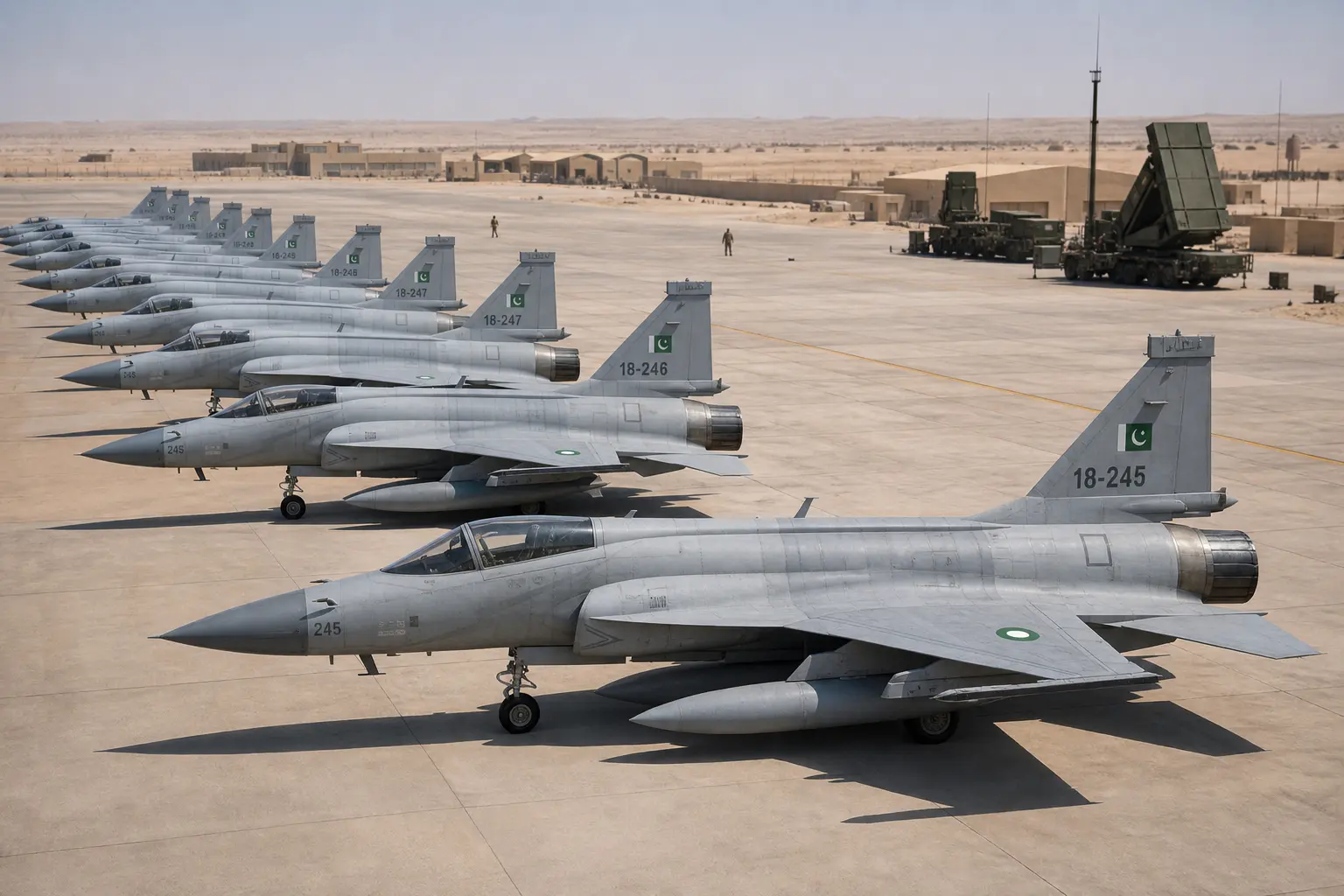
- Sixteen JF-17 Thunder Block III fighter jets landed at Saudi air bases on April 11, 2026, the same day Pakistan hosted the first round of US-Iran nuclear talks in Islamabad.
- Reuters and Haaretz reported in May that the deployment had grown to roughly 8,000 troops, plus drones and an HQ-9 air defense battery.
- The force is based at King Abdulaziz Air Base in the kingdom’s Eastern Province, not at Prince Sultan itself.
- It sits on top of a longstanding baseline of 1,500 to 2,000 Pakistani troops who have trained and advised Saudi forces for decades.
Leaked internal documents show Pakistan’s military establishment insisted on keeping its Saudi obligations conventional, fighting to keep its commitment to Saudi defense strictly non-nuclear. The same documents describe the arrangement as one-sided: Pakistan must defend Saudi Arabia, with no matching obligation running the other way.
The relationship pays economically too. Riyadh agreed to expedite a $5 billion investment package for Pakistan in April, part of the same diplomatic push that produced the military deployment.
Munir’s Tightrope Between Riyadh and Tehran
Field Marshal Asim Munir has spent the war doing two jobs that pull against each other. He has shuttled to Riyadh to coordinate the defense pact, and he has flown to Tehran as Pakistan’s chief mediator trying to end the war that pact exists to guard against.
In late March, at a meeting with Shia clerics anxious about the war, Munir reportedly delivered a blunt message.
If you love Iran, go to Iran.
Syed Ahmad Iqbal Rizvi, deputy head of the Muslim Unity Movement, an umbrella body for Pakistan’s Shia parties, pushed back in a recorded statement: “We boldly respond to the army chief’s remarks: we love our country, but this war is between right and wrong. We stand with the right, with Iran.”
The contradiction has only sharpened. Munir landed in Tehran in late May to meet Iranian officials while his own troops sat on Saudi soil, a trip that coincided with Saudi Arabia’s PAC-3 interceptor stockpile falling 86 percent since April 8. Hours after Friday’s reported strike, Daily Pakistan reported that Iran had officially suspended the Islamabad-brokered memorandum of understanding underpinning the shaky ceasefire, a sign the mediation channel Pakistan built is fraying in real time.
What Pakistan Did the Last Time Riyadh Asked
This is not the first time Saudi Arabia has asked Pakistan for more than words. In 2015, Riyadh requested fighter jets, ground troops and naval warships for its war against Yemen’s Houthi rebels. Pakistan’s parliament said no.
Lawmakers passed a resolution wanting Pakistan to stay neutral in the Yemen conflict, while promising to “stand shoulder to shoulder” with the kingdom only if its own territory or holy sites came under direct threat. No lawmaker spoke in favor of sending troops to fight in Yemen itself. Three years later Pakistan did send a contingent, but its military stated the limits plainly: those troops would not be employed outside Saudi Arabia.
Pakistani hardware now sits inside the kingdom, and Pakistani officers meet Saudi counterparts after every strike. Pakistani diplomats still fly to Tehran too. The Middle East Institute has asked whether Islamabad would risk a wider war over a one-off missile strike on Saudi Arabia, concluding there are “myriad reasons to doubt it.”
By Saturday, Saudi authorities had lifted the warnings issued for Al Kharj and Yanbu. Officials said the situation was safe.
Frequently Asked Questions
Does Pakistan’s Defense Pact with Saudi Arabia Cover Kuwait Too?
No. The Strategic Mutual Defence Agreement is a bilateral pact between Pakistan and Saudi Arabia signed in September 2025. It does not extend to Kuwait, Bahrain or other Gulf states also hit by Iranian strikes this year, so Kuwait’s water facility strike and any grounded flights fall outside the treaty’s scope entirely.
Has Pakistan’s Military Fought Iran Directly in This War?
No direct combat has been reported. Pakistani forces deployed to Saudi Arabia are described in official statements as improving joint readiness and air defense, not conducting offensive operations against Iran. Army Chief Asim Munir has instead visited Tehran multiple times as a mediator trying to end the broader war.
What Triggered the Wider Iran War Pakistan Is Trying to Mediate?
The conflict traces to February 28, 2026, when a US and Israeli strike killed Iran’s supreme leader, Ayatollah Ali Khamenei, setting off a campaign the US military called Operation Epic Fury and Iranian state media dubbed the Ramadan War.
Why Does Pakistan Have So Many Workers in Saudi Arabia?
Around 2.5 million Pakistani nationals work in Saudi Arabia, and their remittances help sustain Pakistan’s fragile economy, giving Islamabad a direct financial stake in the kingdom’s stability that runs alongside the defense pact itself.
