
Satellite imagery reviewed by BBC Verify, the broadcaster’s fact-checking unit, shows Iran struck at least 20 American military bases across eight countries since the war began in late February, with damage running into hundreds of millions of dollars and reaching far wider than Washington has publicly admitted. Three of those strikes wrecked Terminal High Altitude Area Defense (THAAD) batteries, the most advanced missile shield the United States keeps in the Gulf, each built to catch ballistic missiles high in their final descent.
The base count drew the headlines. The figure that unsettles defense planners is smaller. The United States fields only eight THAAD batteries in its entire inventory, and with three now out of service, there is no quick way to rebuild the shield if the fragile April ceasefire breaks.
Twenty Bases, Eight Countries, One Undercount
The imagery, pulled from several commercial satellite providers, maps destruction across Saudi Arabia, the United Arab Emirates, Qatar, Kuwait, Iraq, Jordan, Bahrain and Oman. Some analysts put the count higher, as many as 28 sites. The distance between what the pictures show and what the Pentagon has confirmed has become a story of its own.
At Prince Sultan Airbase in Saudi Arabia, analysts found damaged refuelling and surveillance aircraft beside smoking craters. In the UAE, batteries were hit at the Al Ruwais and Al Sader airbases. In Jordan, a third was struck at Muwaffaq Salti, where CNN’s earlier imagery work spotted debris around a blackened radar as early as 2 March.
Here is where the most consequential losses cluster.
| Base | Country | Key asset damaged |
|---|---|---|
| Prince Sultan Airbase | Saudi Arabia | E-3 Sentry surveillance plane, refuelling aircraft |
| Al Ruwais Airbase | United Arab Emirates | THAAD battery |
| Al Sader Airbase | United Arab Emirates | THAAD battery |
| Muwaffaq Salti Airbase | Jordan | THAAD battery and radar |
The Pentagon declined to confirm or deny the findings, a defense official citing “operational security.” That silence is doing a lot of work, because the hardware sitting in these photographs is neither cheap nor easily replaced.
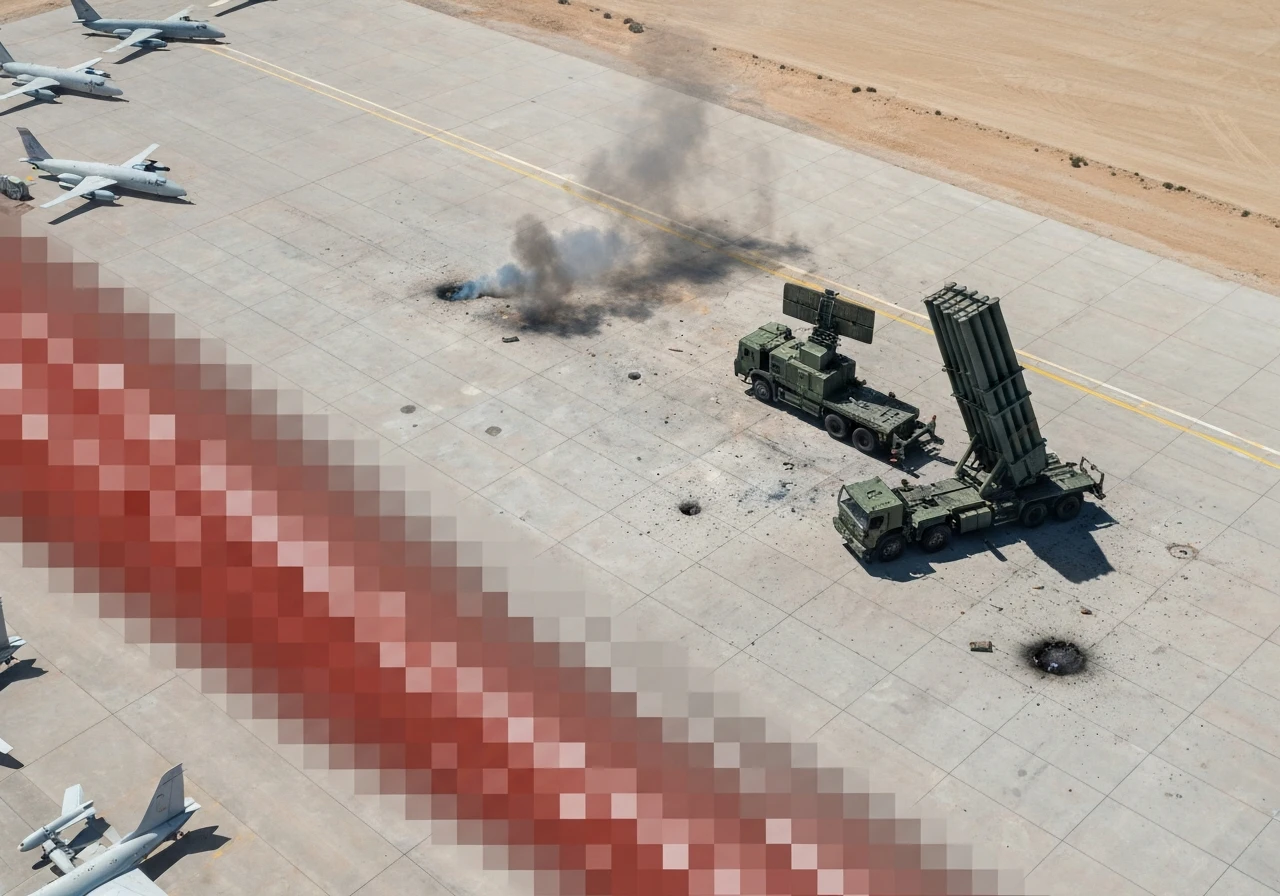
Three THAAD Batteries Gone From a Fleet of Eight
A THAAD battery is not a single launcher. It is a complex of six launcher trucks, a powerful AN/TPY-2 radar, fire-control stations and a crew of roughly 100 troops. You can see the launcher and radar setup of a THAAD battery on the prime contractor’s own product page, and losing one degrades coverage over a whole stretch of airspace.
Vice-Admiral Mark Mellett, the former head of the Irish Defence Forces, told BBC Verify the batteries sit at the core of a “highly complex” regional network that cannot be “quickly or easily replaced.”
- Eight THAAD batteries in the entire US inventory, three of them now damaged.
- $1 billion to build a single battery, by BBC Verify’s estimate.
- $13 million for each interceptor missile the system fires.
- 100 troops needed to crew one battery.
The replacement math is brutal. Interceptors come off the line in small annual batches, not by the hundreds; Lockheed Martin, the system’s prime contractor, only recently marked the milestone 700th THAAD interceptor delivery after years of production. Rebuilding three full batteries and restocking the missiles they burned through is a multi-year job, not a multi-week one.
How Iran Shifted From Barrages to Precision
Iran did not fight the whole war the same way. Early on, Tehran leaned on mass missile barrages designed to swamp defenses through sheer volume, throwing more rounds at a target than any battery could engage.
As the campaign wore on, analysts told BBC Verify, the strikes grew smaller and far more precise, picking out high-value assets one at a time. That shift caught American forces off guard, and the war had already widened by then, with Saudi Arabia carrying out its own covert air strikes inside Iran during the late-March peak.
US forces “appear to have been guilty of a degree of early-war complacency,” analysts said, by failing to disperse aircraft from exposed flight lines once Iranian targeting sharpened. Planes that should have been scattered or sheltered were still parked in neat rows when the precision phase arrived.
The cost of that lag shows up most clearly in the aircraft tally.
Forty-Two Aircraft Lost, Including a Sentry Worth $700 Million
Across the bases, at least 42 planes and drones were destroyed or damaged after February, the second half of the bill behind the missile-defense losses.
- 24 MQ-9 Reaper drones, the long-endurance unmanned aircraft used for surveillance and strike missions.
- Multiple F-15 and F-35 fighter jets.
- One A-10 ground-attack plane.
- One E-3 Sentry, the airborne warning and control system (AWACS) aircraft that analysts at MAIAR identified in the wreckage at Prince Sultan.
The Sentry alone could cost up to $700 million to replace, US media reported, and its loss strips away a flying radar that knits together the picture other aircraft rely on. Iran’s destruction of the plane was reported separately as the war intensified, an early sign that high-value assets had moved into Tehran’s crosshairs.
Washington Moved the Cameras Offline
As losses mounted, the US government worked to limit what the rest of the world could see from orbit.
Planet Labs, the commercial Earth-imaging firm behind much of the open-source picture, told customers it would indefinitely withhold imagery of Iran and the surrounding region after a direct government request. The restriction reached backward in time as well as forward, and it tightened in stages.
- An initial 96-hour delay on conflict-zone imagery.
- A 14-day delay imposed the following month.
- On 5 April, an indefinite withhold, retroactive to 9 March and set to last until the fighting ends.
“These are extraordinary circumstances,” the company told customers, describing a move to release pictures only case by case. The commercial operator that imposed the blackout stopped feeding fresh war imagery into its public library, and the Pentagon, asked about the BBC’s findings, again pointed to operational security. The result is a window that is closing on the public just as the damage becomes clear.
A Depleted Shield and a Ceasefire That May Not Hold
The ceasefire that took hold on 8 April, brokered through Pakistani mediation, remains shaky, and tensions across the Gulf have not fully cooled.
Dr Kelly Grieco, a defense analyst, warned that the thin air-defense stocks left behind leave US and partner forces badly exposed if the shooting starts again.
There is no rapid path to replenishment, meaning any renewed Iranian assault would be met with a fraction of the interceptors available when the conflict started.
That is Grieco’s read, and the numbers back it. A congressional primer on THAAD inventory limits underlines the squeeze: the system was never built in deep reserves, and three lost batteries cannot be conjured back. With Tehran having halted its messaging with Washington through mediators, the diplomatic off-ramp has narrowed too.
If the truce holds long enough for new interceptors to reach the Gulf, the gap is survivable. If fighting resumes first, the most advanced shield America keeps in the region will meet the next barrage with three fewer batteries than it had in February.
