
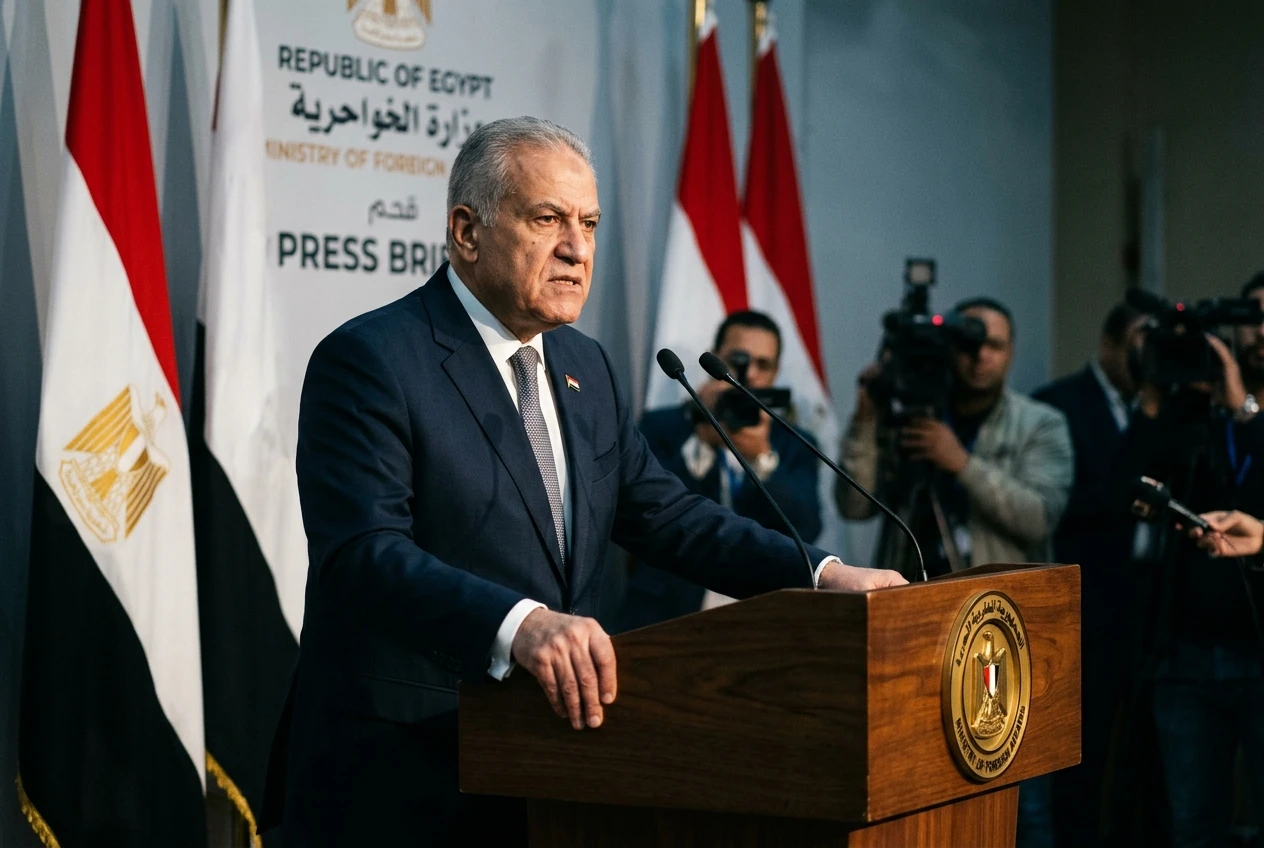
Egypt condemned Iranian strikes on Arab states on Sunday and dispatched Foreign Minister Badr Abdelatty into a fresh round of regional phone diplomacy. The Ministry of Foreign Affairs described Tehran’s attacks as a violation of the sovereignty of Arab states and a dangerous escalation that threatens regional peace and stability. Abdelatty’s outreach came hours after the US Central Command announced a third wave of strikes against around 140 Iranian military targets near the Strait of Hormuz.
In statements relayed by state media, Egypt’s foreign ministry called for an immediate halt to military escalation, respect for international law and a return to political and diplomatic solutions. Iran’s Strait of Hormuz Administration declared the waterway closed on Sunday, citing what it described as unlawful US military activities. US President Donald Trump insisted the strait remained open to commercial shipping.
Egypt Condemns Iranian Strikes on Six Arab States
The Ministry of Foreign Affairs rejected any attacks on the sovereignty or security of Arab countries, reaffirmed Cairo’s full solidarity with the affected states and called for an immediate halt to military escalation. Egypt’s readout was issued in a series of statements on Sunday. The statement came as Foreign Minister Badr Abdelatty opened phone consultations with his Gulf counterparts.
The six states named in Egypt’s Sunday condemnation were:
- Jordan
- Oman
- United Arab Emirates
- Qatar
- Kuwait
- Bahrain
Abdelatty Takes the Phones to Egypt’s Regional Partners
Egypt’s diplomatic activation on Sunday ran through Foreign Minister Badr Abdelatty‘s phone. He held a series of telephone consultations with his counterparts in Oman, Qatar, the UAE and Bahrain following mediation efforts hosted in Muscat to revive the US-Iran negotiations, the Egyptian foreign ministry said. The Egyptian foreign ministry readout stressed that any future diplomatic arrangement must keep Gulf security concerns at its center. Abdelatty’s pivot into crisis mode came the same day the ministry called for an immediate halt to military escalation. The ministers also agreed that freedom of navigation in the Strait of Hormuz had to be preserved.
The four counterparts Abdelatty reached directly were the foreign ministers of Oman, Qatar, the UAE and Bahrain. Egypt’s statement did not name Jordan and Kuwait, both on the condemnation list, as call recipients. The calls came as Iran announced retaliatory strikes against US military positions across the region.
Cairo’s statement did not name an Iranian counterpart in its Sunday readout. The phone diplomacy came amid a US-Iran framework first established by the June 17 memorandum of understanding.
CENTCOM’s Third Wave Hit Iranian Military Targets
US Central Command said it had carried out strikes against Iranian military targets, including air-defence systems, missile facilities and naval assets near the Strait of Hormuz. The operation came in response to an attack on a commercial vessel transiting the strategic waterway, CENTCOM said. The strikes are part of an ongoing US-Iran exchange detailed in US strikes on about 140 Iranian targets after the attack.
Axios, citing a US official, reported that the operation also targeted Revolutionary Guard missile-defence systems and fast attack boats. CENTCOM’s targets included missile and drone sites, naval facilities, ammunition depots, communication networks and surveillance locations, according to the US-Iran exchange of strikes with the Strait of Hormuz closure. The strikes were carried out Saturday night and Sunday morning, US forces said.
The maritime pretext was a Cypriot-flagged container ship, the GFS Galaxy, struck and disabled by Iran as it transited the strait along a southerly route next to the Omani coast. The vessel was traveling along a route the Iranians said had not been approved, according to the UK Maritime Trade Operations centre, a British military body. The ship was disabled and its crew forced to take to lifeboats. The Indian government said 10 of its nationals from the ship had been rescued but that one remained missing.
Iran had attacked three commercial vessels on Monday night before the GFS Galaxy incident, drawing US missile attacks in response and beginning almost a week of tit-for-tat exchanges. CENTCOM’s strikes on Sunday aimed ‘to degrade Iran’s ability to attack civilian mariners and commercial vessels freely transiting the strait,’ the command said in its statement. The latest strikes escalated US pressure on Iran’s missile and naval capabilities after a week of back-and-forth exchanges. Iran’s IRGC issued a statement declaring the strait closed in response, although CENTCOM said some ships were continuing to cross the waterway. The US-led Joint Maritime Information Center said traffic through the strait was transiting at ‘reduced levels.’
Iran Answered With Strikes on Five Capitals
Iran answered with a barrage of drone and missile strikes it said were aimed at US interests across the Gulf. Reports of aerial attacks came in from the United Arab Emirates, Qatar, Jordan, Bahrain and Oman, alongside the Strait of Hormuz closure and strikes on five Gulf states. The five states were all on Egypt’s condemnation list. The retaliation came hours after CENTCOM announced its strikes.
Iran also said it had targeted US military infrastructure in Jordan with ballistic missiles, per Iranian state media and alongside three Iranian missiles that landed inside Jordan on July 12. The IRGC framed the strike as the ‘first phase’ of its response to CENTCOM’s operation.
The strike came hours after Oman hosted an Iranian delegation for talks on security in the strait. Qatar, the UAE, Bahrain and Kuwait said they had activated air-defence systems and emergency security measures in response to Iran’s attacks. Qatar temporarily suspended domestic maritime activities while allowing internationally regulated commercial shipping to continue operating.
| Actor | Named strikes |
|---|---|
| US Central Command | Iranian military targets including air-defence systems, missile facilities, naval assets, Revolutionary Guard missile-defence systems, fast attack boats |
| Iran’s IRGC | Prince Hassan Air Base in Jordan; logistical support centres and refuelling facilities at Port of Duqm in Oman |
The escalation drew air-defence activations across the Gulf within hours. Egypt’s foreign ministry readout did not name specific retaliation targets. Trump’s claim of open water set up the immediate clash with Iran’s closure declaration. Egypt’s phone diplomacy was the most concrete Arab state response to the new round of escalation.
Iran’s claim of closed water and the US claim of open water set up a two-track narrative of the same 24 hours. CENTCOM headquarters, which oversees US forces in the Middle East, posted on X: ‘Iran does not control the strait. Traffic is flowing.’ The IRGC’s statement added that it would consider targeting ‘additional enemy bases in the region’ if it faced more American attacks.
The GFS Galaxy Crew and the Cost to Civilian Shipping
Iran’s attack on the Cypriot-flagged container ship GFS Galaxy turned a maritime routing dispute into a humanitarian incident. The vessel was traveling through the Strait of Hormuz on a southerly route along the Omani shoreline, according to the UK Maritime Trade Operations centre.
Oman rescued 23 crew members from the GFS Galaxy off the coast of Musandam, Oman’s Maritime Security Centre said. Search operations continued for one missing sailor. The vessel was disabled and its crew forced to take to lifeboats. Oman condemned the attack but did not confirm details on the damage to US-linked facilities at the port of Duqm that Iran’s IRGC claimed to have destroyed. The Cypriot-flagged ship’s disabling came during Iran’s retaliation across the Gulf. Iran said the ship had disregarded warnings to use an approved route and was struck by a warning shot.
It’s open. We bombed the hell out of them last night.
Donald Trump, US President, made the comments on NBC’s Meet the Press on Sunday. His statement made no mention of Egypt’s diplomatic outreach or the crew of the GFS Galaxy.
The June 17 MoU Is Now at the Edge
The Sunday exchanges pushed the US-Iran framework to the brink. A memorandum of understanding signed on 17 June had extended a ceasefire in the war by 60 days, with the goal of restoring trade through the strait and creating breathing space for talks on Tehran’s nuclear programme and sanctions relief. That breathing space has now collapsed, with Iran and the US trading strikes across the Gulf for almost a week.
The MoU started to unravel when Iran attacked three commercial vessels on Monday night as they were crossing the strait along a southern route next to the Omani coast that the Iranians said they had not approved. This drew US missile attacks in response, beginning almost a week of tit-for-tat exchanges. The latest attacks came as Qatari and Pakistani mediators intensified contacts aimed at reviving negotiations between Washington and Tehran and preserving the June framework. Iran’s Strait of Hormuz Administration cited ‘unlawful US military activities’ as its reason for announcing the waterway’s closure. Iranian Foreign Minister Abbas Araghchi accused the United States of violating previous understandings through repeated military strikes and urged the United Nations to take a firm stance against what he described as American aggression.
Iranian President Masoud Pezeshkian said Iran was confronting a combined military and economic war that required national unity. Mohsen Rezaee, a senior adviser to Iran’s supreme leader Mojtaba Khamenei, framed the strait as existential in Iranian state media: ‘This strategic passage is more important than dozens of atomic bombs, and the Islamic Republic of Iran will protect it.’
Egypt’s Sunday statement did not announce new sanctions or concrete measures against Iran, but it did reiterate a commitment to political and diplomatic solutions. Cairo’s mediation work with Tehran and the Gulf monarchies has run in fits and starts, with the most concrete result being the June 17 MoU. The framework aimed to create breathing space for talks on Tehran’s nuclear programme and sanctions relief. Both Iran and the US appear to be operating outside that framework as of Sunday. The escalation makes that diplomatic work harder, with no clear path back to the table. Brent crude was at $75 a barrel going into the weekend, well down from wartime highs of more than $120 and close to its prewar average, The Guardian reported.
How Both Sides Framed the New Round
Both sides framed the Sunday escalation as a defensive response to the other. CENTCOM said its strikes came in response to Iran’s attack on a commercial vessel in the strait, the US command said. The IRGC said it had launched strikes in retaliation for ‘US interference’ in the region. Trump said US forces were keeping the strait open by force, on NBC’s Meet the Press.
The White House did not provide any more details of Trump’s claimed deal on Saturday, and Iran did not refer to any talks, The Guardian reported. Trump said Iran had agreed to a deal on Saturday before launching a drone at a ship ‘within an hour’.
Egypt’s readout fell between the two narratives, calling for de-escalation while reaffirming solidarity with the Arab states hit by Iran’s retaliation. Cairo’s statement made no reference to CENTCOM’s strikes or to Trump’s claims about a deal. Qatari and Pakistani mediators are intensifying contacts aimed at reviving the US-Iran negotiations, according to Egypt’s condemnation of Iranian strikes on six Arab states.
