
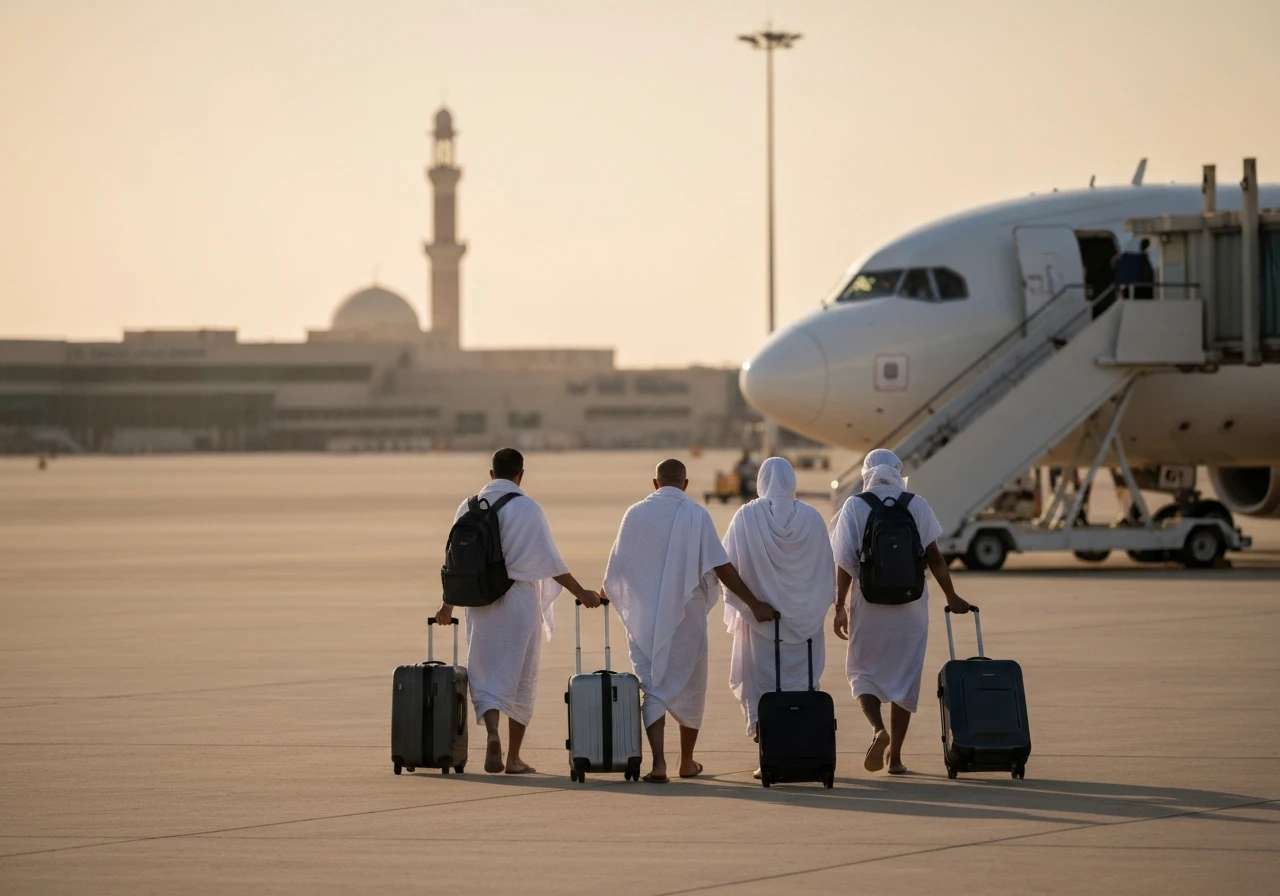
Iranian pilgrims began flying home from Saudi Arabia on Monday after performing the annual Hajj, with about 30,000 Iranian pilgrims making the journey this year, roughly one-third of Iran’s allotted quota and far below the near-90,000 the country sent the previous season. The departures, by air, are expected to continue to the end of the month.
Iranian officials described a smooth, well-serviced return. That account sits on top of a harder fact: the size of the Iranian contingent has always moved with the state of relations between Tehran and Riyadh, and this year the temperature was set by a conflict that, at one point, brought Iranian fire onto Saudi soil.
Iranian Flights Home Begin After a Quieter Hajj
Alireza Enayati, Iran’s ambassador to Saudi Arabia, accompanied the pilgrims through the season and confirmed the return had started on schedule. He put the count at roughly 30,000, said the outbound trips would run by air through the end of June, and stressed that no overland transport was needed because the flight rotation was already moving people out.
Enayati framed the experience in warm terms, the language a returning delegation usually offers after a season passes without incident.
Like all other pilgrims, they received a warm welcome and generous hospitality, and they are now returning home safe and sound, after realization of a blessed Hajj.
The ambassador’s emphasis on calm and comfort was itself a signal. For most pilgrim-sending nations, a peaceful Hajj is unremarkable. For Iran, whose citizens have died in the holy sites and whose government once kept them away entirely, a quiet season is the headline.
A Quota Barely One-Third Filled
The clearest measure of how unusual this year was sits in the gap between what Iran was allowed to send and what it actually sent. Tehran holds one of the largest national allocations on the pilgrimage calendar, yet only a fraction of those places were used.
- 87,550 places make up Iran’s official Hajj allocation, among the larger national quotas worldwide.
- About 30,000 Iranians actually performed Hajj this year, close to 34 percent of that allotment.
- Roughly 90,000 pilgrims traveled in the previous season, near a full take-up.
- 1447 AH, the Islamic year for this Hajj, marks the lowest Iranian turnout since the two countries restored ties in 2023.
A one-third figure is not a logistics footnote. It is the kind of number that, in the recent past, preceded a full rupture. You can see how each country’s allotment compares on the Hajj quota allocated to each nation, where Iran’s seat count places it among the heaviest senders even in a year it barely used.
War Reshaped Who Made the Journey
The reason the seats went empty is not religious or administrative. It is the conflict that ran through the first half of 2026, drawing Iran into direct fighting with Israel and the United States and, for a stretch, spilling onto the Arabian Peninsula.
Strikes That Reached Saudi Soil
During the worst of the fighting, Iranian missiles and drones struck Gulf targets, including Iranian strikes that hit sites inside Saudi Arabia. Direct flights between the two countries were suspended and consular work slowed, the practical machinery that a Hajj operation depends on. With the corridor frozen for months, there was little time to organize a full pilgrimage even once tensions began to ease.
A Fragile Ceasefire That Allowed a Reduced Group
A ceasefire now holds, though officials and analysts describe it as tenuous. That truce reopened just enough space for Tehran and Riyadh to agree on a scaled-down contingent rather than cancel Iranian participation outright. There had been talk of skipping the season altogether; the reduced group was the compromise that kept Iran present in Mecca without committing to a full deployment while the region remained unsettled.
The result was a delegation built for caution. Smaller numbers, tighter coordination, and an ambassador on hand to vouch publicly that the pilgrims were following Saudi rules to the letter, a posture aimed at keeping an already-delicate truce free of any incident at the holy sites.
The Pilgrimage Has Long Tracked Tehran-Riyadh Ties
None of this is new. The Hajj has served as a barometer of the Saudi-Iranian relationship for nearly four decades, and the size of Iran’s presence has risen and fallen with the politics almost every time.
From the 1987 Clashes to the 2015 Mina Disaster
In 1987, clashes between Iranian demonstrators and Saudi security forces in Mecca left more than 400 people dead, most of them Iranian pilgrims, and froze relations for years. The deeper wound came in 2015, when a crush in Mina during the stoning ritual killed thousands. Iran recorded the single highest national toll, with 464 Iranian pilgrims among the dead by the Associated Press count, and Tehran blamed Saudi mismanagement directly.
Boycott, Then a China-Brokered Thaw
The fallout produced a full Iranian boycott in 2016, the first time in decades that Tehran sent no one. That standoff held until a China-brokered normalization deal in 2023 reopened diplomatic relations and the pilgrimage pipeline, with Iranians returning in force the following year. This year’s drop is the first real test of whether that thaw can absorb a shock without snapping back to a boycott.
| Year | Context | Iranian participation |
|---|---|---|
| 1987 | Clashes in Mecca, 400-plus dead | Suspended for several years |
| 2015 | Mina crush, 464 Iranians killed | Attended, then froze ties |
| 2016 | Diplomatic rupture | Full boycott, none sent |
| 2023 | China-brokered normalization | Quota reopened |
| 2026 | Regional war, fragile ceasefire | About 30,000, a third of quota |
Inside a Record Hajj Crowd, Iran Was a Small Share
Set against the season as a whole, the Iranian delegation was a sliver. Saudi statisticians logged 1,707,301 pilgrims for this Hajj, a crowd that arrived despite the regional strain.
The official tally, published in the government’s Hajj 2026 pilgrim count, breaks down the movement of people in detail:
- 1,546,655 pilgrims arrived from outside the kingdom, with the rest citizens and residents already inside Saudi Arabia.
- 1,485,729 of the international arrivals came by air, the channel Iran used both ways.
- Male pilgrims numbered 893,396 and female pilgrims 813,905 across the full count.
The services that delegations praised did not appear by accident; the kingdom runs the operation as a national showcase, and missions compete to be recognized for it. Egypt’s team, for one, took a top honor this season, as covered in the report on Egypt’s award-winning Hajj mission. For Iran, the smoothness was less a marketing point than a relief, proof that a reduced delegation could come and go without the friction that has scarred earlier seasons.
What the Next Season Hinges On
Tehran is already looking past this year. Iranian Hajj officials have asked Saudi Arabia to raise the quota for the next season, arguing the current allocation lags a population of more than 90 million, a request that only makes sense if Tehran expects the relationship to keep warming rather than cool.
The broader pilgrimage calendar is moving in the same direction. Saudi Arabia has already opened its Umrah season for 1448 AH, signaling that the kingdom intends to keep its religious-tourism machine running at full tilt regardless of the politics around it.
If the ceasefire holds and flights normalize, next year’s Iranian quota could rebound toward the near-full numbers of seasons past, and this year reads as a one-off dictated by war. If the truce frays, the same one-third figure starts to look less like an exception and more like the new ceiling on how close Tehran and Riyadh are willing to stand.
