
Children born decades after the Holocaust to mothers who were older than five when Nazi persecution began face more than double the risk of developing schizophrenia, according to a new study from the Hebrew University of Jerusalem (HUJI). Researchers linked birth records from West Jerusalem hospitals to Israel’s National Psychiatric Registry across four decades to reach that number, publishing the results in June in the American Journal of Psychiatry.
The finding reads like a footnote to Holocaust history. Hagit Hochner, the study’s joint senior author, treats it as something closer to a forecast. She has already fielded calls from researchers in Bosnia and Herzegovina asking whether the same pattern applies to children born after their own war, and she named Rwanda, Syria, Ukraine and the October 7 attacks as populations where the same clock may already be running.
A Birthday That Doubled a Risk
The team, led by Hochner and Dr. Iaroslav Youssim of HUJI’s Braun School of Public Health and Community Medicine along with Prof. Dolores Malaspina of Mount Sinai School of Medicine in New York, built the analysis on the Jerusalem Perinatal Study, a database that recorded every birth in West Jerusalem between 1964 and 1976.
They linked those records to Israel’s National Psychiatric Registry through December 2004, tracking hospital admissions for schizophrenia decades after the children in the study were born. The analysis covered two overlapping cohorts: 14,759 children whose mothers were tracked and 18,085 whose fathers were tracked.
Parents counted as exposed if they were Jewish, born in a European country under Nazi rule, and immigrated to Israel after persecution began in their homeland. Researchers then split that group again by whether the parent was five years old or younger, or older than five, when the persecution started. The risk difference broke down along that age line:
| Parent Exposed | Age When Persecution Began | Offspring Schizophrenia Risk | After Adjusting for Other Factors |
|---|---|---|---|
| Mother | 5 or younger | No increase detected | Not significant |
| Mother | Older than 5 | More than double | Remained significant |
| Father | Older than 5 | Initially elevated | Dropped to non-significant |
| Father | 5 or younger | No increase detected | Not significant |
The paper, titled “Schizophrenia in Offspring of Holocaust Survivors: Intergenerational Effects of Preconception Parental Trauma Within the Jerusalem Perinatal Study,” is published in full in the American Journal of Psychiatry. The maternal effect held up even after adjusting for birth weight, socioeconomic background, and whether the mother herself had a psychiatric hospitalization on record.
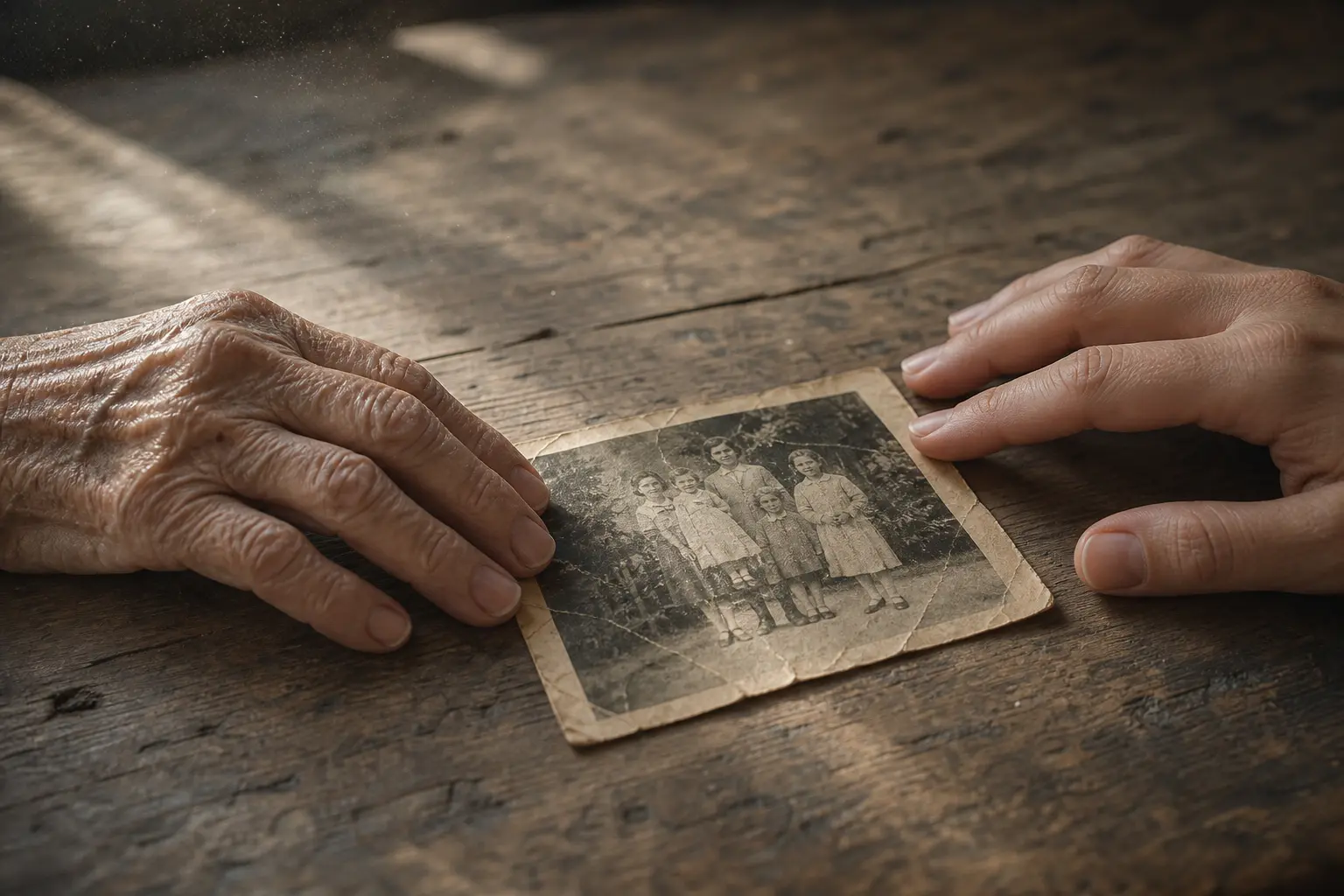
Why Are Only Some Survivors’ Offspring at Risk?
Because the danger tracks a child’s developmental stage at the time, not just exposure to the Holocaust itself. Parents who were five or younger when persecution began produced no measurable increase in their children’s schizophrenia risk. Parents who were older when it began did, and that effect survived statistical adjustment.
Researchers offered two explanations. Very young children may have been shielded from the worst of their surroundings by caregivers who absorbed the danger first. Or their cognitive development at that age simply changed how much of the threat registered. Older children, old enough to understand what was happening to their families, carried something forward that infants did not.
The Mother’s Body Carries the Signal
The study found a second divide, this one between mothers and fathers. Fathers who were older than five during persecution initially showed a higher schizophrenia risk in their children too. Once researchers adjusted for sociodemographic factors, though, that paternal link weakened and lost statistical significance.
The maternal link did not fade the same way. Researchers said the durability of that connection points to biological and environmental pathways specific to mothers, possibly the uterine environment during pregnancy, patterns of early parenting, or epigenetic changes carried in the germline.
That last mechanism has a research trail behind it. Psychiatrist Rachel Yehuda’s decades of work on Holocaust survivors found altered cortisol regulation and methylation changes on FKBP5, a gene that helps govern the body’s stress response, in survivors and their adult children alike. A 2018 review in World Psychiatry described those methylation patterns in parents and children as correlated but running in opposite directions, evidence that something measurable passes between generations without rewriting the DNA sequence itself.
A Different Verdict in 2016
This is not the first Israeli study to test schizophrenia risk against a parent’s Holocaust exposure, and it does not line up neatly with the one that came before it.
A 2016 University of Haifa study by Prof. Stephen Levine and Prof. Itzhak Levav used Israel’s National Population Register to track more than 51,000 people born to Holocaust-era parents between 1948 and 1989. That study found no overall difference in schizophrenia risk between second-generation survivors and everyone else. It did find that offspring of parents who had been babies during the Holocaust were 1.7 times more likely to face a more severe course of the illness once diagnosed.
The new HUJI study asks a different question. It measures whether a diagnosis happens at all, and it lands on a different age window: parents old enough to remember the danger, versus parents who were still infants. Nobody has yet reconciled why the vulnerable years shift depending on whether the question is who gets sick or how sick they get.
Gaza and Ukraine Inherit the Same Warning
Hochner did not wait to be asked whether the finding reaches past World War II. “There are more military conflicts in the world today than at any time since World War II,” she said. “As war has devastating effects on all populations, governments must do their utmost to make peace.”
She has heard directly from researchers in Bosnia and Herzegovina, the former Yugoslav republic that fought a war between 1992 and 1995, who want to know whether the same preconception pathway shows up in their population. Hochner named Rwanda, Syria, Ukraine and the October 7 attacks as places where the same question now applies.
- Gaza: a WHO regional review found intergenerational trauma compounding an already high prevalence of mental health disorders driven by violence, loss and displacement.
- Ukraine: peer-reviewed research comparing the current war with earlier Eastern European conflicts found lasting strain on family ties and generational bonds.
- Worldwide: schizophrenia already affects roughly 25 million people, including 70,000 in Israel, or about one in every 143 residents.
The generation being born into active conflict zones right now is already showing strain that predates any psychiatric diagnosis. Gaza’s children have faced a rare paralysis surge tied to blockade conditions, a reminder that the physical and psychological tolls of the same war are unfolding side by side. Whether that generation develops the same schizophrenia pattern documented in Jerusalem will not be known for decades.
What Hochner Won’t Claim
Hochner is blunt about what her data cannot do.
Many second-generation readers may think, ‘Does this mean I’m at high risk?’ but that’s not what the research says. This is about increased risk, not destiny.
Hochner told The Jerusalem Post. Most children of Holocaust survivors did not develop schizophrenia, she said. The disorder is uncommon enough that even a doubling of a small number leaves the overwhelming majority of people unaffected.
She is equally direct about the study’s limits.
- No proof of a mechanism: the study found a statistical association, not a confirmed biological cause, since it was observational rather than experimental.
- No third-generation data: grandchildren of survivors were not part of the analysis, though Hochner said the team might take that on next.
- A cutoff at 2004: psychiatric registry tracking stopped that year, so later-onset cases that surface after age 40 may be missing from the count.
- No personal testimony: registry data could not capture survivors’ own subjective memories of what happened to them.
Hochner is careful to separate the finding from fatalism. Most Holocaust survivors, she pointed out, married, raised children, built careers and lived ordinary lives despite what they had lived through. “They showed great human resilience,” she said.
Frequently Asked Questions
Is Schizophrenia Generally Hereditary?
Genetic epidemiologists estimate schizophrenia’s heritability at a high level, meaning genes account for most of the variation in risk across a population, though environmental triggers such as birth complications, prenatal infection and, per the new HUJI research, a parent’s early trauma also play a measurable role.
Can Trauma Actually Change a Person’s Genes?
Not in the sense of rewriting DNA sequence. Researchers describe epigenetic change as a chemical mark, such as methylation, that sits on top of a gene and changes how active it is without altering the genetic code underneath. That is the mechanism most often proposed for how a parent’s trauma might echo in a child born years later.
How Common Is Schizophrenia Worldwide?
Global prevalence has climbed from about 13.62 million cases in 1990 to more than 23 million by 2021, though most of that rise reflects population growth and longer life expectancy rather than a rising individual risk. The disorder still ranks as the third leading cause of disability worldwide.
What Makes This Study Different From Earlier Holocaust Research?
Earlier research on Holocaust survivors’ children often relied on small, self-selected clinical samples. One influential study on offspring PTSD vulnerability interviewed 100 offspring alongside 44 comparison subjects. The Jerusalem Perinatal Study instead linked official birth and psychiatric registry records across two full generations, a population-wide approach rather than a self-selected one.
Will Researchers Study the Grandchildren of Survivors Next?
Not yet. The current study stopped at the second generation, but Hochner has said the team may examine third-generation risk in future research, especially since the population of surviving second-generation Israelis is now aging and declining.
Does the Bosnia Connection Go Beyond a Passing Mention?
Yes. Researchers based in Bosnia and Herzegovina, where war killed and displaced large numbers of civilians between 1992 and 1995, contacted Hochner directly after the study’s publication to ask about replicating the analysis on their own population, a request she said reflects growing global interest in preconception trauma research.
Disclaimer: This article summarizes peer-reviewed research for general informational purposes only. It is not medical or genetic advice, and readers concerned about personal or family psychiatric risk should consult a licensed mental health professional. Figures are accurate as of publication.
