
Saudi Arabia’s International Falcon Breeders Auction sold 1,103 falcons for more than SR13 million (about $3.46 million) in 2025, a 23% jump from the year before, according to the National Center for Falcons, the Kingdom’s official falconry authority. The next edition opens August 5 in Malham, north of Riyadh, backed by a new rule that makes the auction the only legal route into Saudi falcon competitions.
The growth looks simple until the per-bird math gets done. Average sale prices, and the auction’s own record price, both still sit below where they stood at the 2021 launch. Four years in, the market is getting wider before it gets richer.
The Only Door Into Competition Falconry
Earlier in 2026, the National Center for Falcons announced that every round of its falcon competitions would open only to juvenile birds, known in Arabic falconry as Farakh, bought through this auction. Private sales and informal trades no longer count for competition entry.
That single rule reshapes who needs a seat at the auction. Falconers chasing competition titles now have one legal supplier. Breeding farms outside the official sale lose a path to that same buyer base, whatever the quality of their birds.
The Center has the standing to make that call. It operates under its charter as the Kingdom’s national falcon authority, and it is registered on Saudi Arabia’s national services portal as a government body chartered by royal decree. The auction itself has run every year since 2021, but this year’s edition carries extra weight: organizers call it the Center’s first major event under a new organizational framework, rolled out alongside a packed 2026 calendar of falconry events.
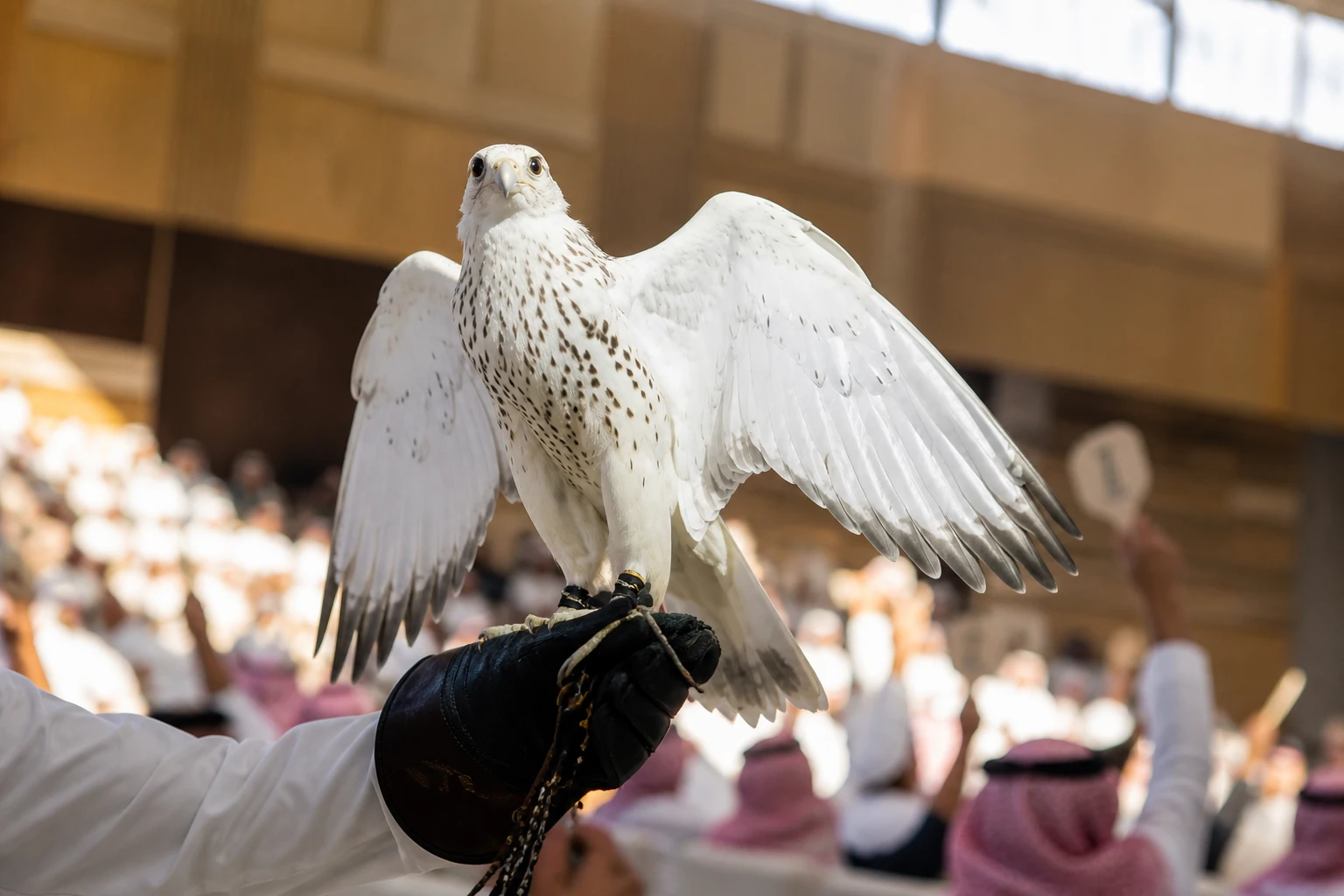
Five Auctions, One Widening Gap Between Volume and Value
The Center’s own numbers, tallied since the 2021 launch, show a market that stumbled before it climbed. That inaugural year produced more than SR8 million in sales from 443 falcons, an average north of SR18,000 a bird. The following year, 2022, sales collapsed to just over SR2.5 million on 371 falcons, an average nearer SR6,700.
Recovery has been steady since, but slower on a per-bird basis than the headline totals suggest.
| Year | Total Sales | Falcons Sold | Avg. Price per Falcon | Farms (Countries) |
|---|---|---|---|---|
| 2021 | SR8 million+ | 443 | ~SR18,000 | Not disclosed |
| 2022 | SR2.5 million+ | 371 | ~SR6,700 | 40+ (17) |
| 2023 | SR8 million+ | 642 | ~SR12,500 | Not disclosed |
| 2024 | SR10 million+ | 872 | ~SR11,500 | 56 (19) |
| 2025 | SR13 million+ | 1,103 | ~SR11,800 | 67 (23) |
Those averages are rough, calculated from the Center’s own rounded totals, which is why 2023 and 2025 land close together even though one year sold 461 more birds than the other. The National Center for Falcons has published its own tally of the 2025 results, confirming the 1,103-falcon count. What the table shows plainly: 2025’s per-bird average still runs about a third below 2021’s opening-year figure. Sales are up because more birds are changing hands, not because each one is worth more.
Why Hasn’t the Top Price Beaten 2021?
The auction’s single most expensive falcon in 2025 sold for SR1.2 million, well short of the SR1.75 million paid in 2021. Five years of growth in total sales, falcon counts and participating countries have not yet produced a new record at the very top of the market.
The 2025 top seller was a Pure Gyr Super White. The 2021 record holder was a Triple Pure Gyr Ultra White, described at the time by regional reporters as the most expensive Gyr falcon sold anywhere in the world. Gyrfalcons, the largest falcon species and native to Arctic regions, carry the heaviest price tags in Gulf falconry because of their size, hunting power and the rarity of captive-bred white color morphs. Both records belong to that same bloodline, which makes the gap between them harder to explain away as a fluke of breeding trends.
Records keep falling elsewhere in Saudi falconry, just not at this particular ceiling. A Mongolian-bred falcon’s $173,000 sale at a separate Saudi exposition last year showed buyers are still willing to chase rare bloodlines hard. At this auction specifically, the ceiling price has moved sideways since the opening year even as everything beneath it, farm counts, falcon counts, total revenue, keeps climbing.
Farms From 23 Countries Now Compete for Riyadh’s Buyers
International reach is where 2025’s growth shows up most clearly. Sixty-seven breeding farms from 23 countries took part, up 20% in farm count and 21% in country count from 2024’s 56 farms and 19 countries. Saudi Arabia supplied 19 of those farms itself, meaning 48, roughly seven in ten, came from outside the Kingdom.
Waleed Al-Taweel, the Saudi Falcons Club’s official spokesperson, said the auction has built itself into a trusted platform bringing together elite breeders and falconers from Saudi Arabia and abroad. Organizers also began publishing daily sales tallies during the 2025 event for the first time, a transparency step officials said gave buyers, breeders and investors better information while bidding was still live.
The pull extends past the sale floor. Crowds who flocked to last year’s Riyadh auction grounds came for more than bidding, working through breeder pavilions, equipment exhibitors and falconry demonstrations that have turned a trade event into a tourism draw. Falconry carries UNESCO recognition as intangible cultural heritage, and Saudi officials have folded the sport into Vision 2030 planning as both a heritage asset and a tourism product, which helps explain why a livestock auction now gets live television coverage and international streaming.
What’s Confirmed Before the Gates Open in August
The 2026 auction has not opened yet. Bidding starts August 5, which leaves a mix of settled logistics and open questions about how this edition will perform against last year’s benchmark.
What we know:
- The 2026 auction runs August 5 to 25 at the National Center for Falcons’ Malham headquarters, north of Riyadh.
- It is the Center’s first major public event since adopting what organizers describe as a new organizational framework.
- It must top a 2025 benchmark of more than SR13 million in sales, 1,103 falcons, and 67 farms from 23 countries.
- Breeder pavilions, an equipment marketplace, the Future Falconer Booth, and live television and streaming coverage all return.
What’s unconfirmed:
- How many breeding farms and countries will register for 2026; organizers have not released a participant count ahead of the opening.
- Whether any 2026 sale will beat the SR1.75 million paid for the Triple Pure Gyr Ultra White in 2021, still the auction’s high-water mark.
- How the new competition-eligibility rule will move bidding once falconers who need a Farakh falcon for the circuit compete for a fixed supply.
A 120-Day Calendar Follows the Opening Bell
The auction is the first stop on a much longer 2026 calendar for the Center, which is presenting roughly 120 days of falconry and hunting events across the year.
- August 5 to 25: International Falcon Breeders Auction, Malham
- October 1 to 10: International Saudi Falcons and Hunting Exhibition
- October 4 to 9: Melwah Race
- October 1 to November 30: National Falcon Center Auction
- November 17 to 30: King Abdulaziz Falconry Festival
Stacking that many events into one year gives the Center repeated chances to test its new competition rule and its new organizational structure in public, with the August auction setting the tone. Bidders will find out starting August 5 whether four years of growth finally buy back the price tag Saudi Arabia’s falcon market set for itself in 2021.
Frequently Asked Questions
What does Farakh mean in Saudi falconry?
Farakh is the Arabic term for a juvenile, first-season falcon. It marks an age category, separate from breed labels like Pure Gyr or Ultra White, which describe bloodline and color rather than age. Under the Center’s new rule, a falcon needs Farakh status and an auction receipt to enter competition.
Why do Gyr falcons dominate the top sale prices?
Gyrfalcons are the largest falcon species, native to Arctic regions, and Gulf falconers have long prized them for hunting power. Captive-bred white color morphs are especially rare, which is why both the 2021 and 2025 record sales at this auction were Gyr variants.
Do international buyers bid, or only sell, at the auction?
Both. The Center’s participation figures track breeding farms as sellers, but coverage of the record 2025 sale described bidding drawn from across the world, meaning the marketplace runs in both directions, international farms consigning birds and international buyers competing for them.
Where is Malham, and can visitors attend?
Malham houses the National Center for Falcons’ headquarters north of Riyadh. The event is open beyond registered bidders, with breeder pavilions, an equipment marketplace, interactive displays and the Future Falconer Booth built for visitors, alongside television and livestream coverage for audiences who cannot attend in person.
