
Egypt’s offshore oil fields in the Sinai Peninsula have reached their highest daily production level since 2017, averaging around 27,000 barrels per day under an optimization programme led by Italy’s Eni and the state-owned Egyptian General Petroleum Corporation. The Ministry of Petroleum and Mineral Resources announced the figure this week, alongside a separate disclosure that production from the area has climbed more than 50% since the start of 2025.
The milestone, real as it is, is set against a domestic refining shortfall of more than 100,000 barrels per day and a record petroleum import bill, both swollen by the war in Iran.
A 9-Year High in Old Fields
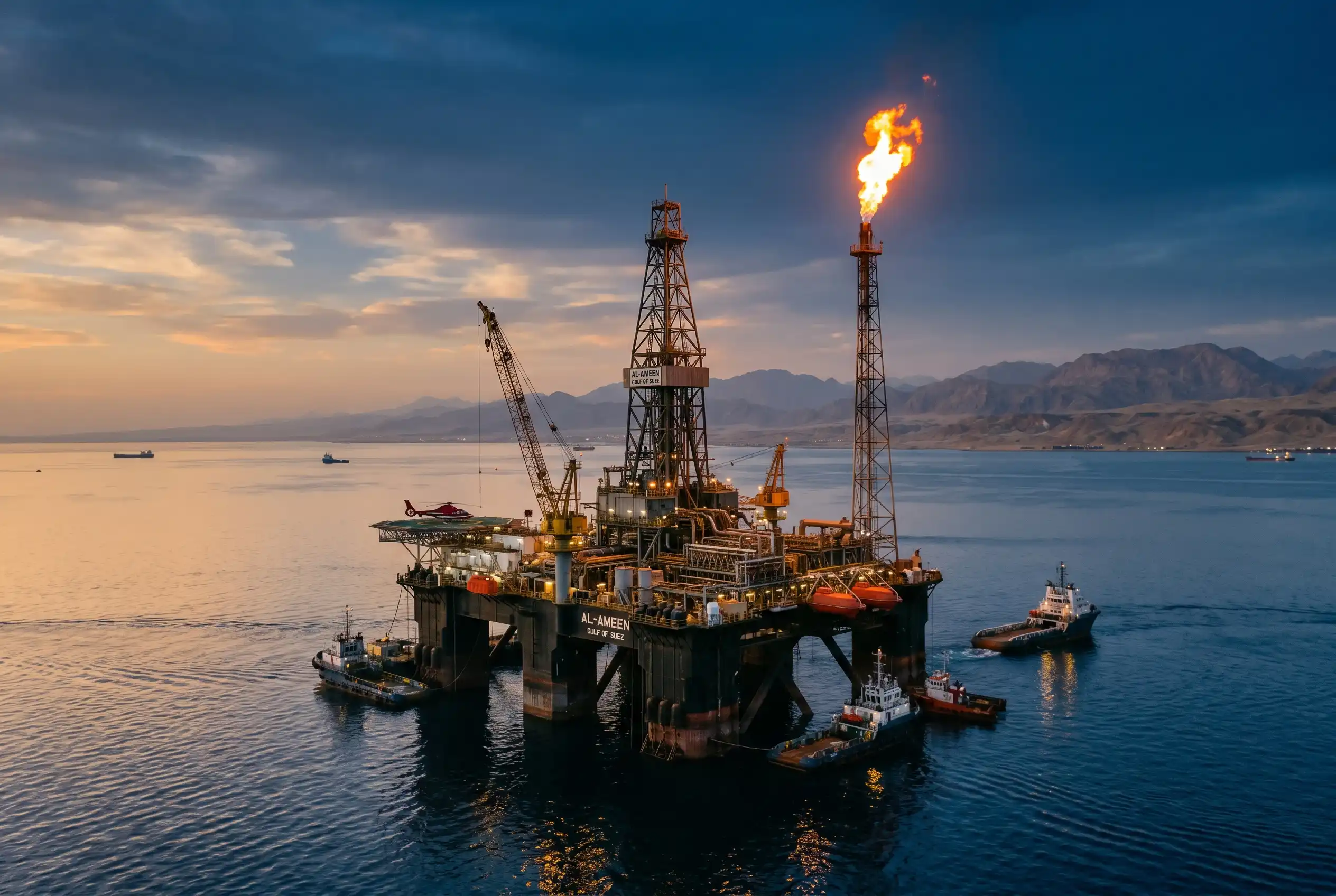
Crude oil production from the Sinai offshore fields has climbed to its highest daily level since 2017, with output averaging around 27,000 barrels per day, per the Sinai fields hitting their highest daily output since 2017. The ministry said the gains were achieved through an intensive production-enhancement programme built on advanced technologies, improved operational efficiency, and reduced downtime. The Sinai fields are operated by Italy’s Eni in collaboration with the Egyptian General Petroleum Corporation. The ministry described the increase as an exceptional achievement compared with the natural decline rates typically expected from producing fields.
Production from the area has climbed more than 50% since the start of 2025, the ministry said, marking one of the strongest growth rates in decades. The surge has generated a surplus exceeding 10,000 barrels per day and contributed to cumulative output of more than 2.8 million barrels since January 2025. Several of the fields have been in operation for more than sixty years, which would normally point to declining output rather than expansion.
The improvement followed incentive measures introduced in recent months, foremost the extension of exploration and production agreements, a step the ministry said encouraged international companies to inject new investment and intensify drilling. Resumption of drilling in 2026 reinforced output, with wells BM-133 and 113-M-131 delivering more than 3,200 barrels per day of oil with almost negligible water content. Eni has adopted an ambitious investment programme across the Gulf of Suez, Sinai, and the Nile Delta aimed at boosting production and maximising the value of existing assets.
The Deficit Surrounding the Milestone
The Sinai gains, while real, are set against a structural shortfall in Egypt’s energy balance that is far larger. A senior Egyptian General Petroleum Corporation official told Al Manassa that Egypt’s domestic crude production currently stands at between 500,000 and 515,000 barrels per day, while the country’s refineries require between 620,000 and 650,000 barrels daily to operate at current capacity. The gap of more than 100,000 barrels per day is covered by imports, the 100,000 bpd refining gap driving Egypt’s import push.
Egypt has been steadily losing ground in domestic crude production. Output fell to around 519,000 barrels per day in October 2025, a low for the cycle. Between 1994 and 2025, average daily output stood at 675,050 barrels per day, with a peak of 930,000 barrels per day in November 1996. Production hit a low of 486,000 barrels per day in July 2025, the weakest reading in decades.
The 27,000-barrel-per-day Sinai production level remains small against the national picture, where domestic crude output of between 500,000 and 515,000 barrels per day sits well below the 620,000 to 650,000 barrels per day refining demand. At 70% domestic coverage of petroleum product needs, the rest has to be sourced from abroad at a cost Egypt can no longer easily absorb.
Total refining capacity across Egypt’s facilities in Cairo, Mostorod, Suez, Alexandria, and Assiut stands at between 750,000 and 800,000 barrels per day, leaving significant headroom for expansion if feedstock supply can be secured. The official said Egypt is negotiating with Greece, Libya, and other suppliers to plug a refinery feedstock gap that could account for as much as 20% of domestic market needs. Cairo is also working on accelerated delivery schedules and favourable payment terms, targeting an annual refining capacity increase of up to 10% through 2028.
- 27,000 bpd: Sinai offshore production, the highest since 2017
- 100,000+ bpd: Egypt’s structural crude deficit
- 519,000 bpd: Egypt’s national crude output in October 2025
- 930,000 bpd: Egypt’s all-time peak, set in November 1996
- 750,000 to 800,000 bpd: Egypt’s total refining capacity
Eni’s Expansion in Sinai and the Gulf of Suez
The Sinai production push rests heavily on Eni. In February 2026, the company’s Belayim Offshore 133 well began production in the Sinai fields at an initial rate of 1,500 barrels per day, the Ministry of Petroleum and Mineral Resources said. The well was drilled and placed on the production map by Petrobel, a joint venture between Eni and EGPC, using the Trident 16 rig.
Petrobel is investing $460 million to modernise its ageing fields in Sinai and the Gulf of Suez, with a target of lifting production to 144,000 barrels per day across the broader operation. The BM-133 well and a companion well, 113-M-131, together deliver more than 3,200 barrels per day of oil with almost negligible water content, a metric the ministry highlighted as evidence that the modernisation programme is working. Egypt has also reported a series of new discoveries in the Western Desert and Gulf of Suez over the past year, adding to the inventory of development targets.
The strategy leans on the unconventional playbook of coaxing more oil from mature assets, including horizontal drilling and intensive reservoir development. The fields in question have been producing for more than sixty years, the ministry said, which would normally have signalled decline. That production has grown rather than fallen in 2025 and 2026 is the result of those modern recovery techniques working on legacy reservoirs.
Cairo’s 2030 Production Target
Egypt has told international oil companies to double production by 2030. The directive was reported by Energean International CEO Nicolas Katcharov.
The Ministry of Petroleum is preparing a revised contractual and technical framework between EGPC and international companies to streamline field development, and Egypt Oil & Gas reports that Minister of Petroleum and Mineral Resources Karim Badawi has directed that the framework for doubling Egypt’s crude output by 2030 be finalised by the end of February. The current terms are not attractive enough to spur the investment needed, Egyptian authorities argue, and the widening gap between domestic and imported gas prices has reinforced the case for revision. International service companies including SLB, Baker Hughes, Weatherford, Halliburton, National Energy Services Reunited, and Expro have said they are ready to support the plan with the necessary technologies. The state is also pressing ahead with an arrears repayment programme to restore investor confidence.
At the end of January, the Egyptian government announced a phased plan to settle arrears owed to foreign partners in the oil and gas sectors, with the aim of reducing them to about $1.2 billion by mid-2026. Katcharov confirmed the production-doubling target in a Reuters interview. The strategy rests on the assumption that contract revisions and fresh capital, not new discoveries alone, can pull Egypt back toward its mid-1990s production peak.
The Import Bill Eating the Gains
The financial backdrop is unforgiving. Egypt’s energy import bill has more than doubled since the start of 2026, Prime Minister Mostafa Madbouly said in March. He attributed the surge to rising global fuel prices tied to the war in Iran and disruption to traffic through the Strait of Hormuz.
Madbouly said natural gas import costs had nearly tripled, rising from $560 million per month in January to $1.65 billion per month in March, as detailed in the energy-saving measures he announced. The country’s overall petroleum bill more than doubled in the same period, from $1.2 billion per month in January to $2.5 billion per month in March. Egypt imports liquefied natural gas from the United States and Qatar, and recently signed a deal with Israel for gas to be delivered via pipeline. Cairo has also enacted energy-saving measures, ordering stores and malls to close by 9 p.m. five nights a week, dimming street lighting by 50%, and requiring government vehicles to cut fuel use by 30%.
Since January, natural gas imports costs tripled from $560 million per month in January to $1.65 billion per month in March and the petroleum bill more than doubled in the same time period from $1.2 billion per month to $2.5 billion per month.
Mostafa Madbouly, the Egyptian prime minister, made the remarks at a March press conference in Cairo. Egypt’s petroleum import bill for the full fiscal year 2024 to 2025 reached a record $21 billion, up from $7.6 billion the year before, against the broader backdrop of how the Iran war is reshaping Egypt’s economy. Sinai’s additional 10,000 barrels per day offsets a fraction of that bill, but only a fraction.
The Money Behind the Drilling
Behind the Sinai production gains sits a small but widening pool of capital. Petrobel is investing $460 million to modernise ageing fields in Sinai and the Gulf of Suez, with a 144,000-barrel-per-day production target. The Egyptian government is working through a backlog of arrears owed to foreign oil and gas companies, a chronic irritant that has slowed investment decisions. Cairo announced at the end of January a phased plan to settle those arrears, with the goal of reducing them to about $1.2 billion by mid-2026.
International service companies have lined up behind the plan. SLB, Baker Hughes, Weatherford, Halliburton, National Energy Services Reunited, and Expro have said they are ready to supply horizontal drilling and intensive reservoir development technologies, the techniques on which the Sinai gains depend. Egypt’s wider plan is to revise existing contracts so that the fiscal terms better reflect current market conditions, with the Ministry of Petroleum preparing a new framework between EGPC and its international partners. Egypt’s national crude output has hovered around the 500,000-barrel-per-day line for years, and the Sinai production data is the first concrete measure of what the new combination of fresh capital, contract revisions, and modern drilling can deliver.
