
Jared Kushner and Nickolay Mladenov sat down in Egypt on 16 August with Egyptian, Qatari and Turkish mediators, and with Hamas leaders including Khalil al-Hayya, to push Phase Two of the Trump administration’s Gaza roadmap. No breakthrough emerged. The core fight stays the same: Hamas disarmament before any full Israeli withdrawal, or linked steps verified together.
That sequencing gap does more than stall another round of diplomacy. It leaves the National Committee for the Administration of Gaza, the planned International Stabilization Force and the reconstruction pipeline locked in place while low-level strikes continue and civilian administration never fully takes over.
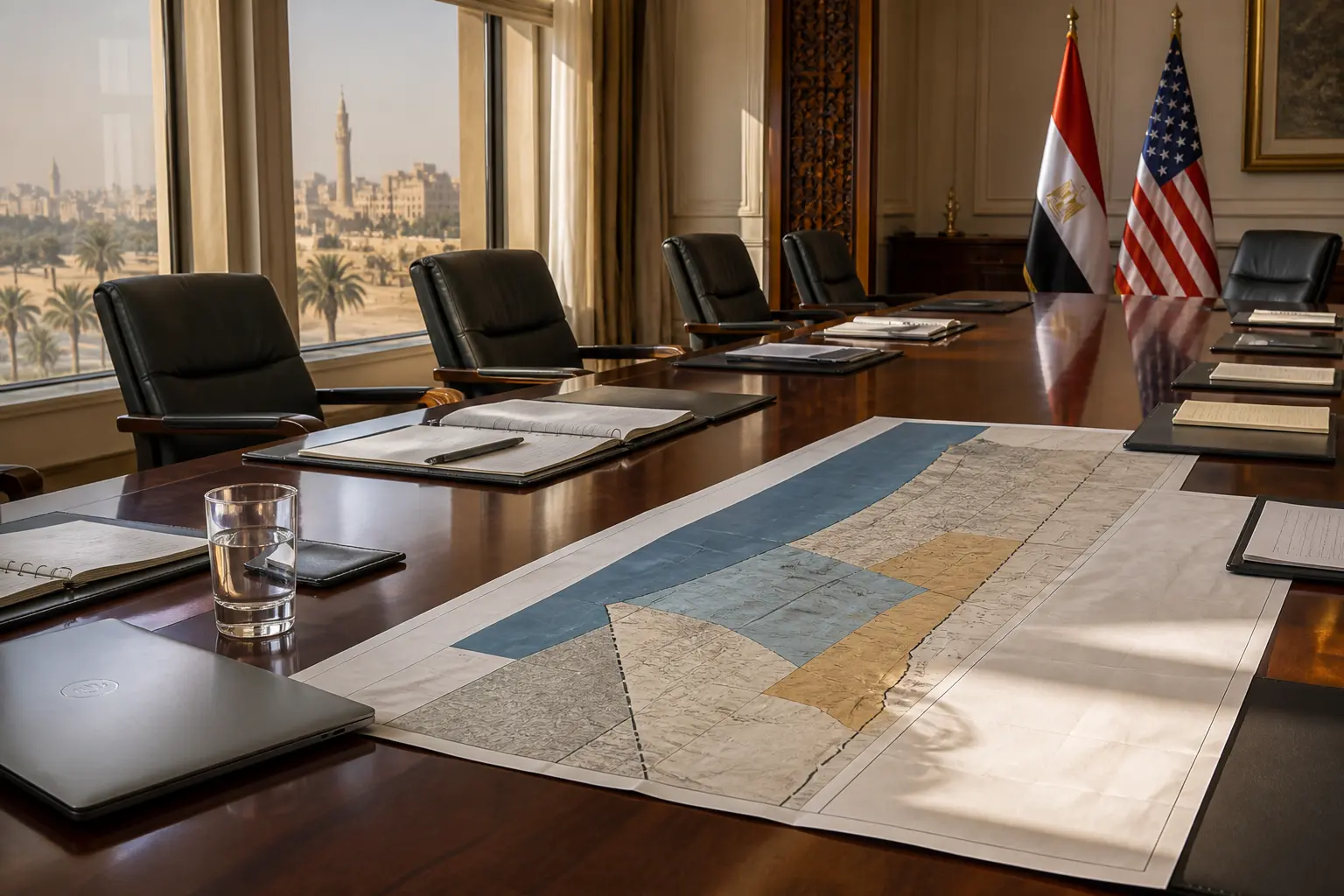
Mediators Gather in Cairo and El-Alamein
Peace Council member Jared Kushner met ceasefire mediators and High Representative for Gaza Nickolay Mladenov on Sunday. The session included Egypt, Turkey and Qatar. They restated support for U.S. efforts to lock in stability in Gaza and warned against moves that could undo gains from the Sharm El-Sheikh agreement.
Kushner also held a rare direct meeting with Hamas leadership. Khalil al-Hayya, head of the political bureau, attended along with Egyptian intelligence chief Hassan Rashad, Qatari diplomat Ali Al Thawadi and a senior Turkish official. Former British prime minister Tony Blair, another Board of Peace member, joined as well. The talks took place in the El-Alamein area.
A Palestinian source said Hamas briefed Kushner on what it called Israeli ceasefire violations. Kushner in turn stressed that the United States rejects any plan to displace Gaza residents. An official familiar with the meeting said the goal was turning roadmap obligations into concrete, verifiable steps: maintain the ceasefire, start transferring governing responsibilities to the National Committee for the Administration of Gaza, and ensure Hamas has no future administrative role.
After the Hamas session Kushner met Egyptian President Abdel Fattah el-Sisi. The presidency said they discussed implementation of the Gaza ceasefire and broader Egypt-U.S. ties. El-Sisi stressed the need for all parties to meet their obligations.
What the 15-Point Roadmap Requires
Trump’s Board of Peace released a 15-point roadmap in late July after announcing Hamas agreement to complete disarmament. Phase One covers principles and remaining Sharm El-Sheikh commitments. Phase Two is security: full demilitarization, handover to a technocratic body, and the start of Israeli phased withdrawal.
| Phase | Core Steps | Verification |
|---|---|---|
| Principles (Phase 1) | Cease military operations per Sharm El-Sheikh; prepare timetable; NCAG enters and assumes responsibilities | International Verification Committee certifies completion before Phase 2 |
| Security (Phase 2) | Hamas and other groups disarm completely; heavy weapons, tunnels, depots to NCAG; police weapons transferred; new vetted police; ISF deploys to separate forces | IVC monitors; linked to Israeli phased withdrawal |
| Withdrawal and reconstruction | Israeli forces complete phased pullout on agreed timetable; NCAG runs internal security and governance under “One Authority, One Law, One Weapon” | IVC certification; three-year NCAG timeline for full transition |
The temporary International Stabilization Force is meant to separate Israeli troops from NCAG areas, monitor the ceasefire, train Palestinian police and secure aid without performing police duties itself. Israeli withdrawal is phased and tied to the decommissioning process. Personal weapons fall under Palestinian law once NCAG is in charge. Progression between phases depends on verified completion.
Hamas publicly reaffirmed acceptance of the Phase Two roadmap after the Cairo meeting. It said the group had fully implemented its first-phase obligations and called on mediators and the Board of Peace to compel Israel to meet its own first-phase duties, end violations and accept the second-phase timetable.
Netanyahu’s Public Rejection Sets the Hard Line
Israeli Prime Minister Benjamin Netanyahu rejected the 15-point document in early August. He told his cabinet Israel does not accept it and that the military “will not withdraw at all until Hamas is genuinely disarmed.” He added that forces would keep thwarting threats against Israeli troops and civilians.
That position collides with the roadmap’s linked structure, in which withdrawal begins as disarmament proceeds under verification rather than only after total completion. White House and Board of Peace officials have treated the public rejection as something short of a final rupture, noting ongoing separate discussions with Israel. Kushner and Mladenov were expected to meet Netanyahu on Monday after the Cairo stop.
Domestic Israeli politics feed the stance. Netanyahu faces coalition pressures that have coalition pressures that stalled prior mediator sessions before. Hardline partners resist any withdrawal that leaves residual military capacity in Gaza. Israeli officials have also voiced concern that Washington wants an end to targeted operations against remaining militants.
Hamas Channel Opens While Strikes Continue
The direct Kushner-Hamas contact marks a practical shift. The United States has long listed Hamas as a terrorist organization and avoided open talks. The Trump Board of Peace approach now treats the group as a necessary counterpart for demilitarization and governance handover.
Hamas statement language after the meeting valued Trump’s role in the original ceasefire and the roadmap while insisting Israel had escalated and rejected the plan. Sources said Hamas told Kushner it was serious about implementing commitments in practice, not only on paper, and ready to move toward political-party status once the process advanced.
On the ground the ceasefire remains incomplete. Israeli strikes injured Palestinians in a Khan Younis tent encampment and an apartment in the Nuseirat refugee camp on the day of the talks, according to medics cited by multiple outlets. Palestinian sources put the death toll since the October 2025 ceasefire announcement above 1,250. The broader war death toll since October 2023 exceeds 73,300 by the same counts. Israel says operations target militants who still threaten its forces.
- Hamas demand: Israel fulfills first-phase commitments, ends attacks and withdrawals, then implements the linked Phase Two timetable.
- Israeli demand: Genuine complete disarmament of Hamas before any meaningful withdrawal.
- U.S./Board position: Concrete verifiable steps from both, ISF and NCAG entry, phased linked process under International Verification Committee oversight.
- Mediator role: Egypt, Qatar and Turkey keep channels open and press both sides against backsliding.
Eight foreign ministers from Egypt, the UAE, Qatar, Jordan, Indonesia, Pakistan, Turkey and Saudi Arabia condemned Israel’s rejection of the roadmap as a direct assault on U.S.-led efforts and Palestinian statehood. They urged Washington to enforce compliance and called for swift Board of Peace action against obstruction.
The Institutions Waiting on the Sidelines
The second-order cost sits with the bodies already named and partially staffed. The NCAG led by Dr. Ali Sha’ath is the designated technocratic transitional administration. It is meant to restore public services, audit finances up to a $400 million supplier claim cap, run civil institutions and hold the sole weapons authority under the “One Authority, One Law, One Weapon” principle. Its three-year implementation window cannot start until the entry conditions are met.
Major General Jasper Jeffers has been named commander of the International Stabilization Force. Planning has contemplated roughly 20,000 ISF troops and 12,000 police, sector-by-sector expansion beginning in the south, and training support from Egypt and Jordan. None of that deploys while the sequencing fight blocks certification of Phase One completion.
Reconstruction money is also parked. The World Bank estimated more than $70 billion to rebuild Gaza in earlier assessments. Board of Peace pledges have included a U.S. commitment around $10 billion and roughly $7 billion from other countries, with some Gulf states expected to contribute significant shares. Later Board reporting has projected total reconstruction investments above $30 billion under full implementation. Those figures remain paper commitments until demilitarization and governance transfer clear the way for large-scale work.
Khalil al-Hayya’s arrival for the talks gave mediators a direct line. Earlier Cairo rounds on the same framework had already tested the same issues without resolving the order of steps. The pattern is now familiar: high-level visits keep the process visible while the institutional machinery stays idle.
Regional Stakes and the Monday Test in Israel
Egypt’s role remains central. Cairo hosts the talks, manages the Rafah crossing dimension and has trained or pledged to train Palestinian police. Prolonged stalemate raises border security and refugee pressures for Egypt. Qatar and Turkey have invested political capital as guarantors and mediators. Their joint presence with Kushner signals continued buy-in even after Netanyahu’s rejection.
For Palestinians in Gaza the freeze means delayed large-scale reconstruction, continued vulnerability to strikes framed as counter-militant operations, and no clear date for a civilian administration free of both Hamas governance and Israeli military presence. For Israel the question is whether any withdrawal can occur without irreversible loss of the ability to act against residual threats. For the Trump administration the credibility of the Board of Peace itself is on the line after the public Israeli rebuff.
Kushner and Mladenov’s expected meeting with Netanyahu is the immediate next checkpoint. Israeli officials have prepared for possible U.S. pressure to curb certain targeted actions. Hamas has restated willingness to begin verifiable steps if Israel moves in parallel. Mediators continue to warn against undermining the Sharm El-Sheikh gains.
The talks themselves have already produced one structural change: open U.S. envoy contact with Hamas leadership inside the Board of Peace framework. That channel exists. The NCAG statutes, ISF command appointments and funding pledges also exist. None of them activate until the International Verification Committee can certify the linked steps that Netanyahu has so far refused and that Hamas conditions on Israeli compliance.
Until that sequence is written down and accepted, the second-order reality holds. Low-level violence continues, the technocratic handover stays on hold, and the reconstruction money remains a future promise rather than a present program. Cairo kept the conversation alive. It did not unlock the institutions.
