
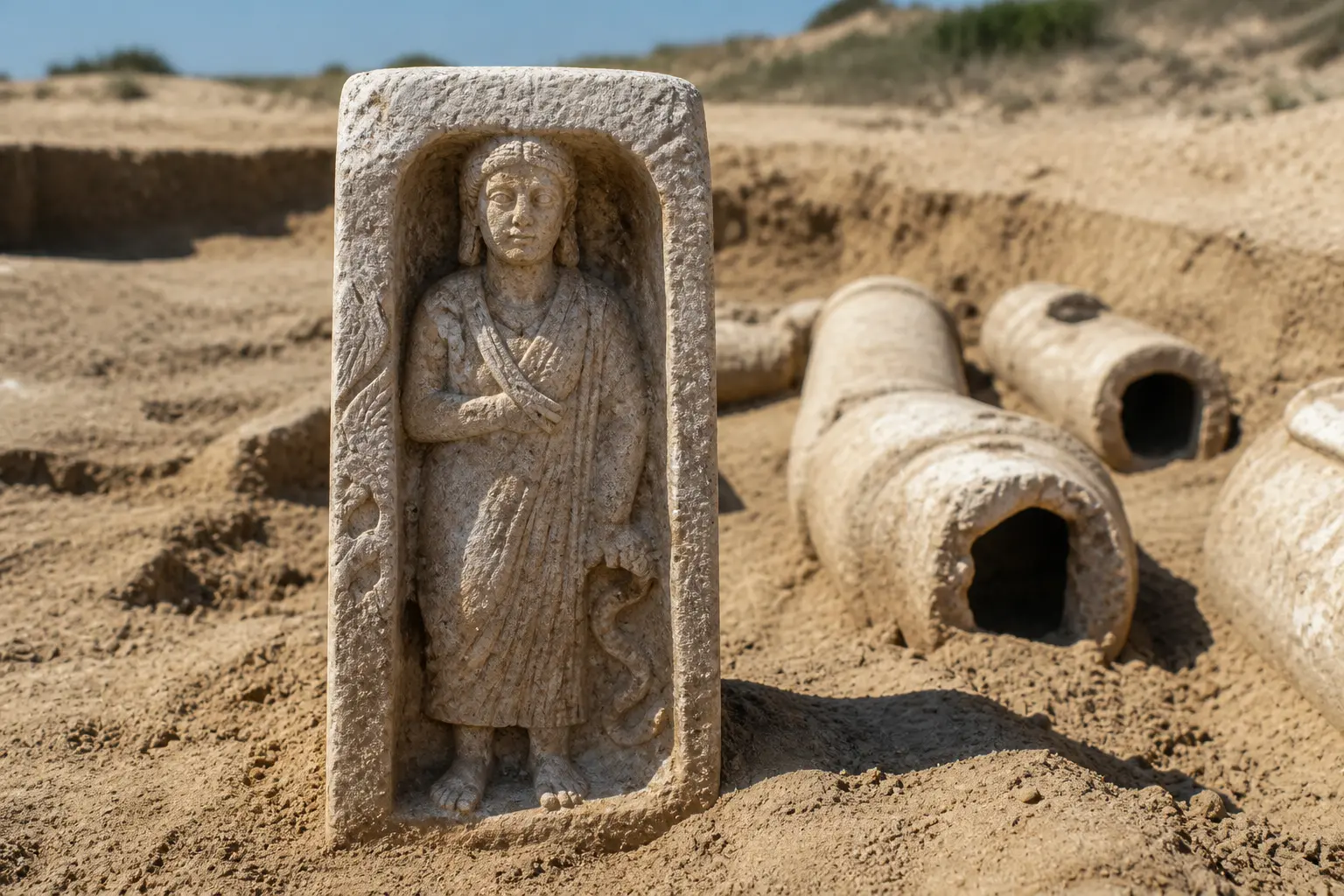
Egyptian archaeologists have recovered about twenty finely carved limestone funerary stelae at Tell El-Deir in Damietta governorate, part of a complex used from the Late Period through the end of Roman rule. The stelae depict human figures and carry side and back carvings that mix Egyptian and Greco-Roman symbols, including the griffin, Agathodaemon and Isis Thermouthis.
The Supreme Council of Antiquities mission also brought up pottery incense burners, decorated oil lamps, barrel-shaped anthropoid coffins and funerary amulets. Officials say the site functioned as a full funerary center rather than a simple cemetery.
What the Mission Uncovered This Season
Hisham El-Leithy, Secretary-General of the Supreme Council of Antiquities, described Tell El-Deir as far more than a burial ground. It served as a developed complex with a distinct social, cultural and religious identity. Mohamed Abdel Badie, head of the Egyptian Antiquities Sector, detailed the assemblage recovered in the current season.
| Object type | Material / form | Notes from officials |
|---|---|---|
| Funerary stelae | Limestone, human-figure shape | About 20 pieces, finely carved; sides and backs hold religious imagery |
| Coffins | Pottery, barrel-shaped anthropoid | Multiple examples linked to burial rites |
| Incense burners | Pottery | Used in offerings and scent rituals |
| Oil lamps | Decorated pottery, varied forms | Part of ceremonial equipment |
| Amulets | Funerary types | Placed with the dead |
The quality of the stelae carving points to elevated social standing for those commemorated. The full set of ritual objects shows repeated ceremonial activity across centuries.
- Limestone stelae with human figures and hybrid divine symbols
- Anthropoid barrel pottery coffins
- Ceramic incense burners and multi-form oil lamps
- Funerary amulets recovered alongside the larger pieces
These items together map the practical side of burial: offerings, light, scent and protective charms.
Symbols That Bridged Egyptian and Greco-Roman Belief
The stelae sides and backs carry the griffin, Agathodaemon and Isis Thermouthis. Officials note that this combination illustrates long cultural and religious interaction in the eastern Delta. The griffin is a protective hybrid familiar from wider Mediterranean art. Agathodaemon appears as a beneficent serpent spirit tied to good fortune in Greek tradition and later adopted in Egypt. Isis Thermouthis fuses the Egyptian goddess Isis with Renenutet, the cobra harvest deity, producing a serpentine form that Greeks linked to Agathodaemon.
A comparable mixing appears on a Ptolemaic plaque pairing Isis with Thermouthis and Agathodaimon held at the Metropolitan Museum. Such pieces show how local workshops absorbed incoming forms without discarding core Egyptian protective and fertility roles. The high craftsmanship on the Tell El-Deir stelae suggests patrons who could afford skilled carvers familiar with both visual languages.
A Site Used for More Than a Thousand Years
Archaeological layers place continuous activity from Egypt’s Late Period (beginning roughly 712 BC) through the end of the Roman era (to about AD 641). That span covers the last native dynasties, Persian interludes, the Ptolemaic kingdom and full Roman provincial rule. Abdel Badie said the evidence makes the site an exceptional record of social, religious and funerary change in the Nile Delta.
- Late Period onward: earliest confirmed layers and native dynastic material
- Ptolemaic centuries: gold sheets, coin hoards and hybrid iconography already present in earlier seasons
- Roman period close: continued use of the same funerary zone with pottery coffins and lamps
The longevity itself is the pattern. Communities kept returning to the same ground even as political control shifted repeatedly.
Earlier Seasons Already Pointed the Same Direction
Systematic work at Tell El-Deir resumed in 2007. Previous campaigns produced thousands of pieces, many tied to the 26th Dynasty, Egypt’s last native royal house before the Persian conquest of 525 BC. In 2024 the mission announced 63 mud-brick tombs with gold pieces, jewelry, statues, amulets and a pottery vessel holding 38 bronze Ptolemaic coins. Some earlier limestone sarcophagi with human faces now sit in the Egyptian Museum in Cairo; other material is slated for the Grand Egyptian Museum.
The new stelae and coffins therefore sit on top of a long sequence already documented at the same necropolis. Each season adds layers rather than isolated surprises. Specialists circulating excavation photographs on X have zeroed in on the crisp human figures and the side motifs as the clearest proof yet of sustained high-status hybrid practice at the site.
Why the Eastern Delta Keeps Rewriting the Map
Damietta sits near the Mediterranean mouth of a major Nile branch. That geography made the area a natural zone of contact for centuries. Trade, garrisons and settlement brought Greek and later Roman populations into daily proximity with Egyptian communities. Funerary art became one place where the exchange left visible traces. The same coastal reach later hosted other economic layers, including recent energy finds off Egypt’s Mediterranean coast, but the ancient pattern is older and deeper.
Scholars mapping Mediterranean encounters in the Nile Delta have long noted ports and inland centers where Greek, Carian and Egyptian populations lived side by side from the Late Period forward. Tell El-Deir now supplies a dense funerary archive from exactly that contact zone. El-Leithy said the finds can reshape understanding of settlement patterns, necropoleis and the history of Damietta in antiquity.
Local Identity Held Through Political Change
The continuous use of one complex across native, Ptolemaic and Roman centuries shows that funerary practice did not reset with each new ruler. Egyptian core forms (human-figure markers, amulets, incense rites) stayed in place while new protective and fertility symbols entered the repertoire. The result is neither pure Egyptian survival nor wholesale Greco-Roman replacement. It is a working hybrid that served local elites and their communities for generations.
This discovery demonstrates that Tell El-Deir was far more than a burial ground. Instead, it served as a fully developed funerary complex reflecting a distinct social, cultural, and religious identity.
Hisham El-Leithy made that assessment when the finds were announced. The statement matches the material: high-quality carving, repeated ritual equipment, and iconography that only makes sense in a place where Egyptian and Mediterranean traditions had already lived together for centuries. Future study of manufacturing techniques and styles will add detail, but the broad pattern is already clear. The eastern Delta kept its own funerary center running while empires rose and fell around it.
Frequently Asked Questions
What exactly was found at Tell El-Deir in 2026?
The mission recovered approximately twenty limestone funerary stelae carved as human figures, plus pottery incense burners, decorated oil lamps in varied shapes, barrel-shaped anthropoid pottery coffins and a group of funerary amulets. The stelae carry additional religious imagery on their sides and backs.
Which historical periods does the complex cover?
Officials date continuous use from the Late Period of ancient Egypt (starting around 712 BC) through the end of the Roman Period (to roughly AD 641). Earlier seasons also produced clear 26th Dynasty and Ptolemaic material at the same site.
What do the griffin, Agathodaemon and Isis Thermouthis symbols mean?
They form a hybrid set: the griffin as a protective composite creature, Agathodaemon as a Greco-Roman good-fortune serpent, and Isis Thermouthis as the fusion of Isis with the Egyptian cobra goddess Renenutet. Together they show Egyptian protective and fertility roles expressed with Mediterranean visual forms.
Had Tell El-Deir produced finds before this season?
Yes. Work resumed in 2007. A 2024 announcement covered 63 mud-brick tombs containing gold items, jewelry, statues, amulets and 38 bronze Ptolemaic coins. Earlier limestone sarcophagi from the site are already in the Egyptian Museum.
Why is the Damietta location significant?
The site lies in the eastern Nile Delta near the Mediterranean coast. That position placed local communities on major water routes open to long-term contact with Greek and Roman populations, which left lasting marks on funerary art and ritual equipment.
