
Egypt is converting Nabq Nature Reserve into a test case for a single destination management entity that mixes private eco-investment with state conservation rules, aiming to fund protection from tourism revenue itself. Minister of Local Development and Environment Manal Awad reviewed the integrated model with the Green Sharm team and an investment firm this week as part of a push to close long-standing gaps across the country’s protected areas.
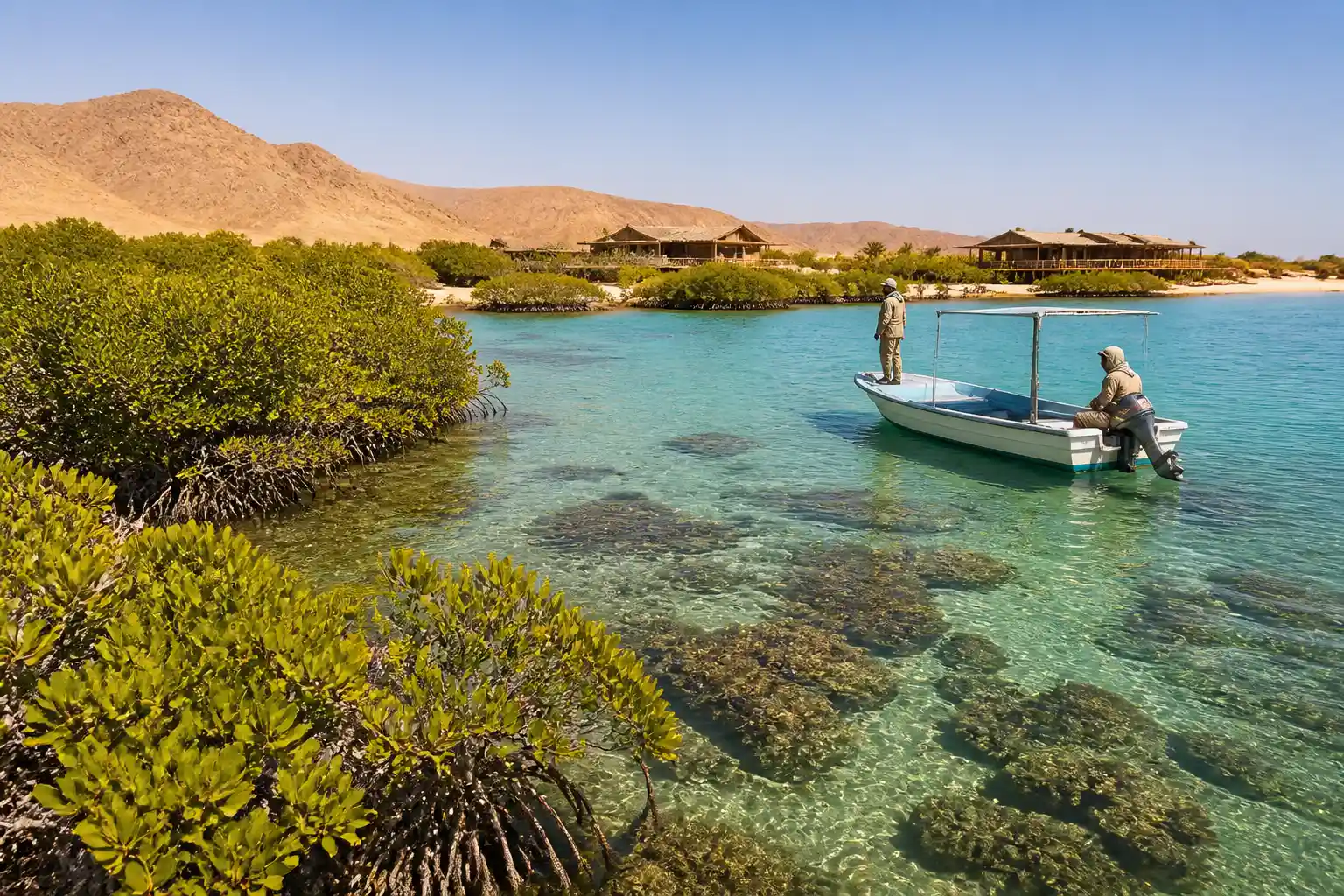
The reserve covers about 600 square kilometers at the southeastern tip of the Sinai Peninsula on the Gulf of Aqaba. It holds mangrove forests, coral reefs, desert habitats and high biodiversity that already draws divers. The plan treats that mix as the foundation for a replicable Egyptian ecotourism brand.
A Single Entity Runs Tourism and Protection
The core change is institutional. One destination management body would coordinate tourism operations, environmental rules, community programs and investment under one strategy. The Egyptian Environmental Affairs Agency keeps licensing, regulation and final approval of plans. Private operators gain clearer operational room inside those limits.
Awad described Nabq as the right place to start because it already combines marine and desert systems with strong visitor potential. The model seeks capital that accepts sustainability standards and long-term returns rather than quick extraction.
Nabq Nature Reserve provides an outstanding setting for applying this approach because of its exceptional environmental and tourism value. It combines marine and desert ecosystems, mangrove forests, coral reefs and unique biodiversity, making it one of the country’s most important natural destinations and well placed to offer a leading Egyptian model for sustainable ecotourism.
Awad said that in the ministry statement released Tuesday.
Three Stages From Setup to Global Brand
Officials laid out a clear sequence.
- Years one and two: stand up the institutional entity, build basic infrastructure and launch quick-impact projects such as eco-hotels and guided tours.
- Middle phase: activate larger private investments and expand local community programs that put residents into the value chain.
- Final phase: reach financial self-sufficiency, scale the offer and turn Nabq into a recognized international eco brand.
Earlier this summer the ministry reviewed roughly 41 investment opportunities inside the reserve. They range from coastal and mountain eco-lodges and sustainable accommodation to camping sites, educational experiences, community-based activities and adventure tourism. Some projects can go fully private; others may pair investors with local groups. All face strict environmental standards.
Infrastructure comes first. Plans call for car parks outside the reserve boundary, electric transport inside, environmental monitoring systems, surveillance cameras and an integrated waste system. Marine mooring buoys will be installed and maintained by a specialized firm so boats stop dropping anchors on coral. Waste handling at marinas is also under review for Nabq, Abu Galum and Ras Mohammed.
Why the Partnership Structure Matters Now
Protected areas have long faced thin budgets and fragmented oversight. Older assessments put average spending far below regional norms. Human activity has already shifted species dominance in parts of Nabq. Red Sea destinations absorb the bulk of Egypt’s leisure travel, raising pressure on reefs and coasts. Legal frameworks for commercial ecotourism inside reserves have been incomplete.
The new entity is meant to fix those gaps by creating a unified vision and a revenue loop that returns money to conservation. Lower-carbon operations and sustainable financing for protection are listed as direct environmental gains. The approach also sits inside the broader Green Sharm project technical assistance, a multi-year UNDP and GEF-backed effort running to 2028 with a total budget near $63 million. That work has already delivered strategic environmental assessments for Nabq, Ras Mohammed and Abu Galum, a local biodiversity plan, an electronic ticketing system, community housing and handicraft workshops in Gharqana village inside Nabq, and a completed ecotourism development plan for the reserve.
- Single destination management entity for coordination
- EEAA retains regulation and licensing power
- Private capital selected for sustainability track record
- Local communities integrated into employment and supply chains
- Digital platform for environmental and financial transparency
- Unified international branding for Egypt’s eco sites
Awad called for finalizing the legal framework that will govern the model before full rollout.
Local Communities Sit Inside the Value Chain
The design puts residents at the center rather than on the sidelines. Bedouin and other local groups are to become partners in tourism services, guiding, handicrafts and supply. Sustainable jobs and direct benefit sharing are explicit goals. Green Sharm has already run sewing workshops for women in Nabq and opened housing units plus an NGO handicraft space in Gharqana.
Social returns listed by the ministry include better living standards and both direct and indirect employment. Economic returns include longer visitor stays and a wider menu of experiences beyond classic beach and cultural packages. That diversification supports the national target of 30 million tourists by 2030.
Visitor Growth Makes Diversification Urgent
Egypt recorded 15.7 million arrivals in 2024. Numbers rose 20.5 percent in 2025. The first four months of 2026 brought 6.1 million visitors, up 7 percent from the same stretch a year earlier. Q1 alone was up 15.6 percent. The Travel and Tourism sector contribution to GDP hit EGP 1.4 trillion in 2024, or 8.5 percent of the economy, supporting 2.7 million jobs. International visitor spending that year reached EGP 726.9 billion.
| Period | Arrivals or Metric | Change or Share |
|---|---|---|
| 2024 full year | 15.7 million visitors | Record contribution EGP 1.4 tn (8.5% GDP) |
| 2025 full year | +20.5% vs 2024 | Strong recovery baseline |
| First 4 months 2026 | 6.1 million visitors | +7% vs same period 2025 |
| 2030 target | 30 million annual visitors | Roughly double recent levels |
Mass Red Sea beach tourism still dominates. Adding high-value, lower-impact eco stays at places like Nabq spreads load and lifts overnight spend. Parallel hotel projects elsewhere, including new hotel capacity near the pyramids, show the broader capacity push. Red Sea infrastructure work such as Red Sea marina development plans aims at the same higher-yield visitor.
Replication Across Egypt’s Protected Network
Egypt has about 31 nature reserves under the Egyptian Environmental Affairs Agency. Several already draw divers, safari travelers and nature visitors: Gabal Kamel in New Valley, Wadi al-Gemal on the Red Sea, Siwa in Matrouh, and Wadi al-Rayan plus Lake Qarun in Fayoum. Success at Nabq is meant to supply a template that can be copied, creating a national web of sites that earn their keep while staying conserved.
That second-order shift matters more than any single lodge. Conservation stops being a pure cost center. Revenue from carefully controlled tourism can pay for rangers, monitoring, restoration and community benefits. The same logic appears in other African nature destinations that pair protection with visitor income; readers looking for broader context can start with lists of top African destinations for nature lovers.
Execution risks remain real. Earlier studies documented damage from uncontrolled access and anchoring. Overcrowding, waste and reef stress are the usual complaints whenever tourism expands into fragile coasts. The ministry’s insistence on outside parking, electric vehicles, fixed moorings, continuous monitoring and investor screening by environmental track record is the direct response. Whether the single entity keeps private incentives aligned with those rules will decide if the model spreads or stalls.
Awad said the Nabq approach can deliver environmental funding, social gains and economic diversification at once. The next concrete steps are finishing the legal wrapper, building the first infrastructure tranche and selecting the initial round of operators who meet the sustainability bar. If those pieces land cleanly, Egypt gains a working prototype for turning its protected map into a productive, self-supporting asset rather than a set of under-resourced islands.
