
A 5.6-magnitude earthquake struck 38 kilometers north of Suez just after 3 a.m. on August 3, 2026, rattling Cairo and several Egyptian governorates plus southern Israel. Egypt’s National Research Institute of Astronomy and Geophysics recorded the event; the USGS page for the Suez event listed it near magnitude 5.0 at 10 km depth. Authorities reported no significant casualties or damage.
The mild shake fits a longer Middle East pattern. The African, Arabian and Eurasian plates meet here along the Dead Sea Transform and Red Sea Rift. Long quiet stretches end in sudden rupture. Cities that have grown denser since the last major events now sit astride the same mapped gaps.
Where the Plates Slide and Stretch
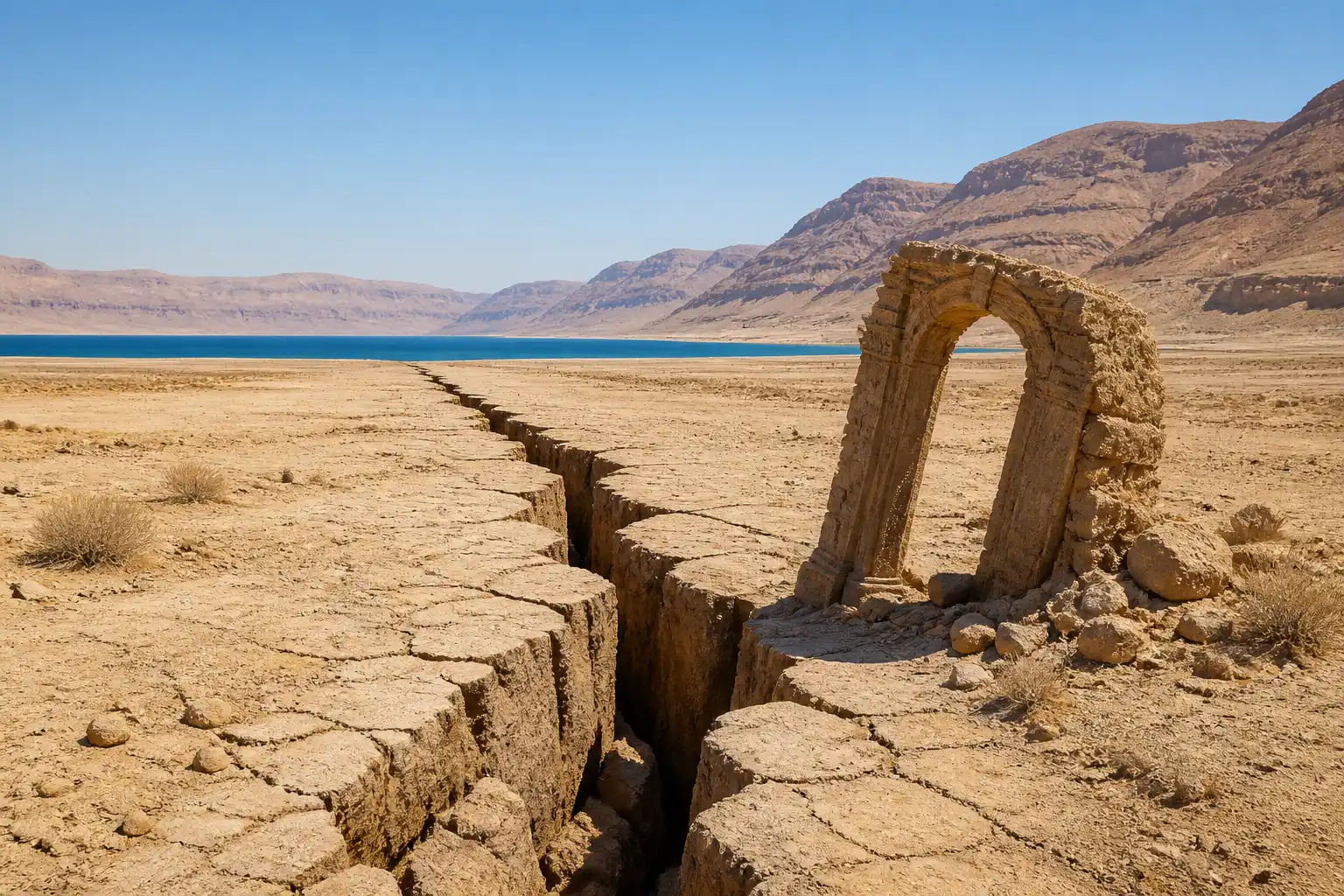
The Dead Sea Transform is a roughly 1,000-kilometer left-lateral strike-slip boundary. Arabia moves north relative to Africa at about 4 to 6 millimeters per year. That slow creep stores elastic energy for decades or centuries before releasing it in large earthquakes.
Pull-apart basins along the system created the Dead Sea and the Gulf of Aqaba. The Red Sea Rift adds extensional faulting that reaches toward the Gulf of Suez and Cairo’s diffuse zone. A Dead Sea fault imaging study by USGS and Israeli partners mapped deep structure under the Sea of Galilee to refine hazard models for the continental transform.
- Dead Sea Transform: main left-lateral boundary from Red Sea to Turkey triple junction
- Slip rate: roughly 4-6 mm per year on central segments
- Recurrence: major events often centuries apart on individual segments
- Gulf of Aqaba: southern pull-apart basins that hosted the 1995 rupture
Background seismicity stays low for long periods. Swarms and moderate shocks then signal stress that eventually produces the big ones.
Two 1759 Shocks and the 1927 Jericho Rupture
On October 30, 1759 a magnitude about 6.6 quake hit the Levant. A stronger magnitude 7.4 event followed on November 25. Villages in the Bekaa Valley collapsed. Baalbek, Damascus and Safed suffered severe damage. Landslides and structural failure killed thousands; estimates range from 2,000 to 20,000. The pair permanently altered parts of the landscape along the northern Dead Sea Transform.
July 11, 1927 brought a magnitude 6.2-6.3 shock near Jericho. Jerusalem, Nablus, Salt and Amman saw historic buildings, churches and mosques fail. Landslides hit the Jordan Valley. Seiches formed in the Dead Sea. Deaths totaled between 285 and 500, with hundreds injured. It remains one of the best-documented 20th-century Levant events.
| Event | Magnitude | Deaths (approx.) | Key areas hit |
|---|---|---|---|
| 1759 Near East pair | 6.6 & 7.4 | 2,000-20,000 | Bekaa, Damascus, Safed, Baalbek |
| 1927 Jericho | 6.2-6.3 | 285-500 | Jerusalem, Nablus, Amman, Jericho |
| 1992 Cairo | 5.8-5.9 | 561 | Greater Cairo, Giza, Delta |
| 1995 Gulf of Aqaba | 7.3 | 9-12 | Nuweiba, Eilat, Aqaba coasts |
| 2023 Turkey-Syria | 7.8 & 7.5 | 59,000-62,000 | southern Türkiye, northern Syria |
These numbers come from historical catalogues and modern reassessments. They show the same fault system delivering both moderate and great shocks when segments finally break.
Why a Moderate 1992 Shock Killed Hundreds in Cairo
October 12, 1992 produced a magnitude 5.8-5.9 earthquake near Dahshur, about 35 km southwest of Cairo. Depth was around 22 km. The event killed 561 people and injured more than 12,000. Over half a million people became homeless. Roughly 129,000 residential buildings suffered damage across 16 governorates; more than 12,000 collapsed or required demolition.
Historic Cairo, Old Cairo and Bulaq took heavy hits to older masonry and adobe. A modern reinforced-concrete building in Heliopolis that had illegal extra floors collapsed and killed 79. A block fell from the Great Pyramid. Liquefaction appeared near the epicenter. Panic amplified the toll inside the dense capital.
- 561 confirmed dead
- 12,392 injured
- 129,000+ buildings damaged or destroyed
- 216 mosques and 350 schools badly hit
Egypt had no comprehensive seismic design code before 1992. Most stock was never designed for earthquake loads. The disaster forced new standards and emergency planning. Enforcement and retrofitting of older stock remain incomplete three decades later.
Offshore Luck in the 1995 Gulf of Aqaba Event
November 22, 1995 produced a magnitude 7.3 earthquake under the central Gulf of Aqaba. It was the largest instrumental event on the Dead Sea Transform in the 20th century. Shaking reached Cairo and Riyadh. Small tsunami waves formed in the gulf.
Nuweiba on Egypt’s Sinai coast saw buildings collapse and roads crack. Eilat and Aqaba recorded hotel and sidewalk damage plus liquefaction. Deaths stayed low at 9-12 and injuries in the dozens because the epicenter lay offshore and population density was still modest. Aftershocks stretched for more than a year. Remote triggering produced small shocks hundreds of kilometers north near Syrian restraining bends.
The rupture only partially broke the gulf system. Later modeling shows stress loading on unbroken southern segments that have stayed quiet since the late 1500s. Coastal resorts and infrastructure have grown substantially since 1995.
February 2023 Delivered the Pattern’s Costliest Modern Turn
A magnitude 7.8 earthquake struck near Gaziantep at 04:17 local time on February 6, 2023. A magnitude 7.5-7.7 event followed nine hours later. Both involved strike-slip rupture on the East Anatolian Fault and related strands that connect to the northern Dead Sea Transform. More than 30,000 aftershocks followed.
Confirmed deaths reached at least 53,537 in Turkey and 5,951-8,476 in Syria, for a combined toll near 59,000-62,000. Over 120,000 people were injured. Roughly 1.5 million people lost homes. Damage estimates hit about $150 billion in Turkey (9 percent of GDP) and $9 billion in Syria. Entire neighborhoods, hospitals, schools and cultural sites collapsed across a zone the size of Germany.
Winter weather, damaged roads and communication blackouts slowed rescue. International teams from dozens of countries joined. The events exposed the gap between modern Turkish building codes (comparable to California standards) and actual enforcement, especially outside major cities and on older or informal stock.
Cities Grew While Segments Stayed Quiet
Many Dead Sea Transform segments have not produced major surface-rupturing earthquakes for centuries. Paleoseismic work points to gaps after events in 1033, 1202 and other medieval centuries. Slip deficits on some stretches are large enough for magnitude 7-class shocks. Awareness fades between cycles. Population and building stock do not.
Cairo’s metro area now holds more than 20 million people. Amman, Beirut, Damascus, Aleppo, and the Gulf of Aqaba resorts have expanded dramatically since 1927 and 1995. Informal construction and uneven code application remain common across the region. A moderate event like 1992 becomes deadly when soft soils amplify shaking under poorly built multi-story housing.
Critical infrastructure faces the same exposure. Middle East power grid interconnections and Red Sea energy routes sit near active rift and transform segments. A larger coastal or inland rupture would test both buildings and the systems that keep cities functioning.
What Codes and Practice Have Changed Since the Last Cycles
Egypt introduced seismic provisions after 1992. Design codes now include acceleration maps and structural requirements. Retrofitting of older public and residential stock proceeds slowly. Enforcement quality still varies by governorate and project type.
Turkey updated codes after the 1999 Marmara earthquakes and again later. The 2023 sequence showed that paper standards fail when supervision is thin, materials are substandard, or illegal additions go unchecked. Syria’s long conflict left even less capacity for code work.
Earthquakes don’t kill people, buildings do.
That FEMA observation captures the practical lever. Up-to-date seismic building code guidance only protects when jurisdictions adopt the latest editions and enforce them on every new and renovated structure. Paleoseismic records already map the high-risk segments. The next rupture will test whether the denser cities that now occupy those segments learned the pattern’s earlier lessons.
The August 2026 Suez tremor caused little harm. It still belongs to the same slow accumulation of strain that produced 1759, 1927, 1992, 1995 and 2023. History supplies the recurrence. Density supplies the higher potential cost.
Frequently Asked Questions
What magnitude was the August 2026 earthquake near Suez?
Egypt’s National Research Institute of Astronomy and Geophysics reported magnitude 5.6 with an epicenter roughly 38-41 km north of Suez at about 10 km depth; USGS listed a nearby event near magnitude 5.0. No significant casualties or structural damage were confirmed.
Which fault system produced most of the historic Levant earthquakes?
The Dead Sea Transform, a left-lateral strike-slip boundary between the African and Arabian plates, generated the 1759 pair, the 1927 Jericho shock, the 1995 Gulf of Aqaba event and many earlier historical ruptures. The 2023 sequence mainly broke the East Anatolian Fault where it links to the northern transform.
How many people died in the 1992 Cairo earthquake?
Official tallies record 561 deaths and 12,392 injuries. More than 129,000 buildings were damaged and over half a million people were left homeless, making it Egypt’s deadliest modern seismic disaster despite the moderate magnitude.
What was the combined death toll of the 2023 Turkey-Syria earthquakes?
Confirmed figures stand at least 53,537 in Turkey and between 5,951 and 8,476 in Syria, for a total in the range of 59,000-62,000. More than 120,000 people were injured and roughly 1.5 million lost homes.
Did Egypt change building rules after 1992?
Yes. Post-1992 codes added seismic design requirements, zoning maps and structural standards. Older masonry and informal buildings still form a large share of the stock, so full protection depends on both new construction compliance and long-term retrofitting.
