
Israel’s basketball team lost 103-75 to Croatia in Osijek on Monday, closing the first stage of FIBA Basketball World Cup 2027 European qualifying at 2-4 and entering Group K at the bottom of the standings. The blue-and-white never led after Croatia opened with a 9-0 run and pushed the gap to 25-12 by the end of the first quarter. The loss caps a July window in which head coach Ariel Beit Halachmi’s squad was thoroughly outplayed by a bigger, more physical Croatian side.
Beit Halachmi called the game “completely under” Croatian control in his postgame remarks, language that doubled as a description of the box score and the wider state of his roster. The deeper story is who never made it onto the floor at the Sports Hall Gradski Vrt. Deni Avdija, Ben Saraf, and Danny Wolf stayed with their NBA clubs as the Israel Basketball Association failed to secure their release, leaving a national team that was never equipped to compete at the highest level.
How Croatia Built a 47-31 Halftime Lead Israel Could Not Touch
The opening minutes put Israel in a hole Croatia would maintain for the next three quarters. Israel fell behind 9-0 before Khadeen Carrington finally scored, the first Israeli points of the game. The Croatians pushed the gap to 25-12 by the end of the first quarter and to 47-31 by halftime, a margin built on second-chance points and a half-court offense that Israel could not slow.
Croatia’s size dictated the glass. The official box score from the Osijek qualifier shows Croatia shooting 59 percent from the field to Israel’s 41.7 percent, and the rebounding edge gave the Croatians second-chance possessions that the Israeli defense could not cut off across all four quarters.
Croatia continued to control play throughout the second half. Ivica Zubac finished with 18 points and 10 rebounds, Dario Šaric added 17 points, 11 rebounds, and seven assists, and David Škara and Antonio Jordano each scored 13 in a balanced attack that never let Israel string together consecutive stops. Dario Šaric’s efficiency rating of 32 led all players on either side, with Yam Madar’s 21 the top mark for Israel.
- Q1: Croatia 25, Israel 12
- Q2: Croatia 22, Israel 19
- Q3: Croatia 27, Israel 20
- Q4: Croatia 29, Israel 24
- Final: Croatia 103, Israel 75
Madar and Ariel Tried, but the Bench Was Empty
Yam Madar led Israel with 21 points. Adam Ariel added 17 off the bench, a national-team career high, and Netanel Artzi chipped in 10. The production came from a thin layer of the roster, and the burden fell on the same names that carried the offense in Friday’s earlier loss in this window.
The output came in bursts rather than the sustained runs that Croatia’s depth could generate. Croatia put four players in double figures, with Zubac, Šaric, Škara, and Jordano all reaching the mark, and the bench and starting unit scored without separation. Madar, Ariel, and Artzi provided the bulk of Israel’s scoring, but the rest of the roster went quiet against a Croatian defense that could rotate fresh legs onto the floor.
The Croatia game was the second straight loss in a window where Israel was already missing the players it needed most. Coming on the heels of Friday’s loss to Germany in Riga, the 2-4 mark now carries into Group K, the second round. Israel begins that pool at the bottom of the standings before it plays a single second-round game, with the August window opening the schedule at the end of next month.
The NBA Trio Israel Never Got on the Floor
Three NBA players who would normally anchor the rotation never made it onto the floor in Osijek. Portland Trail Blazers All-Star Deni Avdija was not released by his club. Brooklyn Nets rookies Ben Saraf and Danny Wolf were also held back. The three NBA players most capable of changing the gap against Croatia never stepped on the court at the Sports Hall Gradski Vrt, and their absence defined the result as much as anything Croatia did on offense.
The losses did not stop at the NBA tier. Numerous other players were unavailable because of injuries, the full window recap that detailed the absences reported, whether those injuries were legitimate or otherwise. The result was a national team that was never equipped to compete at the level the schedule demanded.
The Israel Basketball Association could have pressed the Trail Blazers harder on Avdija and continued to push the Nets on Saraf and Wolf. The answer might still have been no. Making every possible effort would have sent an important message to the players and the fans that wearing the national jersey remains the organization’s highest priority, even when the clubs that pay the players see things differently.
Portland kept Avdija home to preserve its roster through the NBA offseason. The Nets held their two Israeli rookies out on the same logic. Israel did not lose three starters by accident. The team lost them to a calendar the IBBA failed to negotiate against early enough, and the cost of that delay showed up on the scoreboard in Osijek.
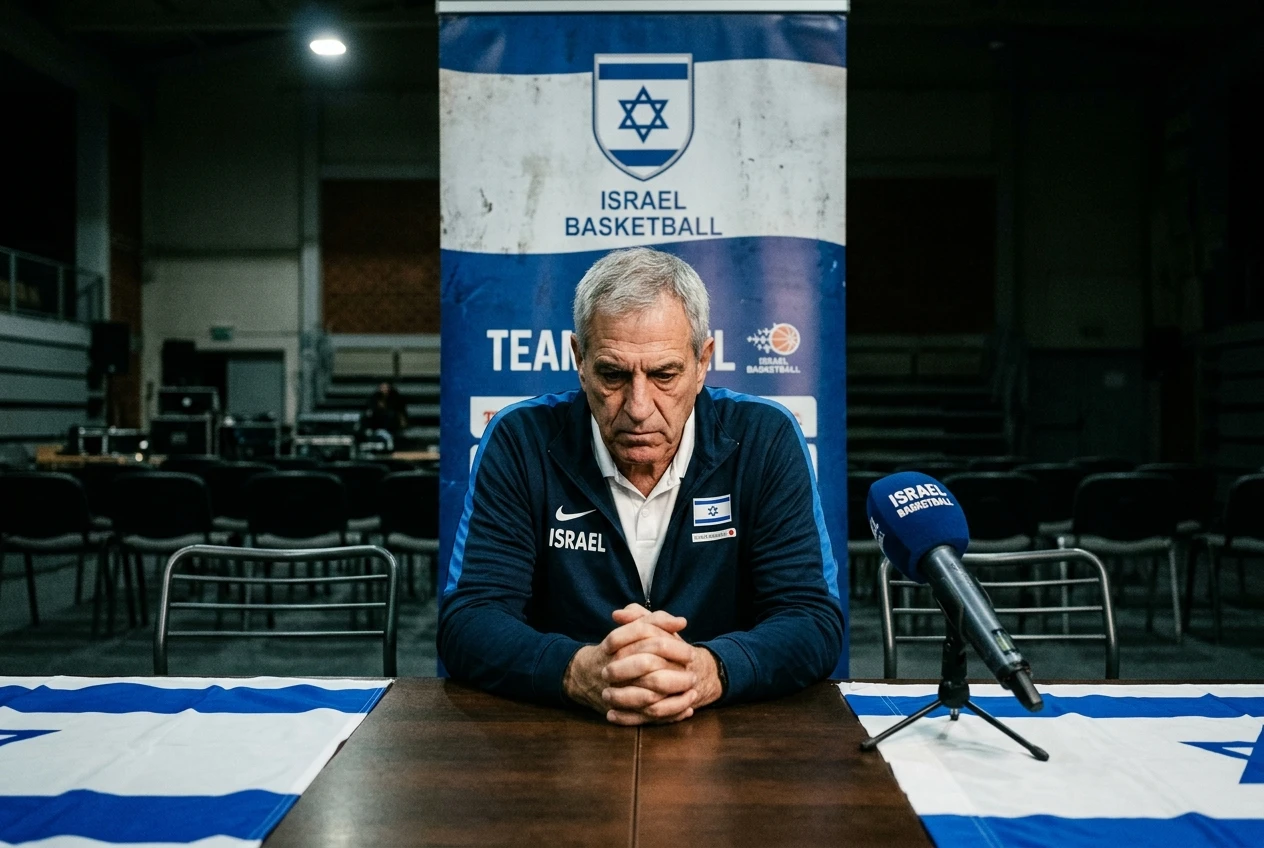
This loss is disappointing and unacceptable, and it’s time for the players to take responsibility for this as well.
The comments came from Beit Halachmi in the postgame press conference in Osijek, after a game he described as “completely under” Croatian control.
Off-Court Dysfunction That Traveled With the Team
The window’s problems extended beyond the box score. A paperwork error prevented Noam Yaacov from suiting up against Germany in Riga, and a public dispute over Omer Mayer’s participation in the Under-20 European Championships pointed to an organization struggling with both on-court and off-court issues at the same moment.
The decision-making structure added another layer of concern. Beit Halachmi serves as both head coach and general manager, a dual role that mixes selection authority with on-court leadership in ways that have only complicated matters further. The arrangement concentrates power in one figure during a window where the program needed broader coordination across the federation, the clubs, and the players.
Dysfunction of that kind does not stay off-court. It shapes who is on the roster, who travels for the next window, and what message the IBBA sends to the players it asks to report.
What Group K Demands From a 2-4 Israel
The 2-4 mark now carries into Group K, the second round, where Israel begins at the bottom of the standings before a single second-round game tips off. The path forward is six games against four opponents drawn from the group that ran parallel to Israel’s in the first stage. Those opponents are Poland, the Netherlands, Latvia, and Austria, with Croatia joining as the other carryover from Group E. Croatia finished the first stage at 5-1 and brings the strongest record in the pool.
- Poland
- Netherlands
- Latvia
- Austria
Poland went undefeated through its opening group, Croatia finished 5-1, and the remaining three teams round out a six-side pool where every game will now carry qualifying weight. The August window, at the end of next month, opens the second round.
November and February then complete the three remaining windows. Convincing players to report for games that have very little impact on Israel’s qualification hopes will be the IBBA’s harder fight. A player nursing a minor injury or facing a reluctant club has little incentive to travel for matches that may not move the standings, no matter what the federation says in a press release.
The IBBA’s first task in August will be the one it has not done well at since the first window in late 2025: convince the league’s best players to show up. The federation will also need to fix the off-court issues that surfaced in this window, from paperwork errors to player disputes. Without those fixes, the qualifying picture will not move in any direction, no matter how many players the IBBA eventually secures.
Where the IBBA Stands Before August
Beit Halachmi used the postgame platform to make the case that the national team cannot compete without its best players, saying the obligation to represent Israel does not pause for offseason priorities. He framed the absences as a matter the players themselves must resolve before August.
The argument that the national team’s best players must represent Israel regardless of circumstances runs into the IBBA’s own choices. The organization allowed the situation to deteriorate rather than establishing from the start that every qualifying window mattered and that representing the national team was a priority. Players do not show up for an association that treats availability as optional, and the federation’s public posture in the months before this window did little to change that perception.
EuroBasket and other future tournament opportunities sit beyond this World Cup cycle, and those are the contests the IBBA will ultimately be judged on. The July window’s scoreboard will move on; the institutional memory of which players showed up and which association fought for them will not. The IBBA’s failure to secure its best players did not start in Osijek, and the consequences will not end with the 2-4 first stage either. The next move belongs to the federation that has not yet secured its best players for the qualifying run that resumes in August.
Frequently Asked Questions
When does Israel play next in FIBA World Cup qualifying?
The second round of FIBA Basketball World Cup 2027 European qualifying resumes at the end of August. Israel plays six games across the August, November, and February windows against Poland, the Netherlands, Latvia, and Austria, with Croatia joining the Group K pool as the other carryover from Group E.
Which teams are in Group K alongside Israel?
Israel enters Group K with Poland, the Netherlands, Latvia, and Austria, the four teams from the parallel group that ran alongside Group E in the first stage. Croatia joins as the other Group E carryover, having finished the opening round at 5-1.
Why was Deni Avdija not released by the Portland Trail Blazers?
The Trail Blazers held Avdija out to preserve their roster through the NBA offseason, the same logic the Brooklyn Nets applied with Ben Saraf and Danny Wolf. The Israel Basketball Association was unable to secure releases for any of the three despite public calls to fight harder for them ahead of the July window.
What did Ariel Beit Halachmi say after the loss to Croatia?
Beit Halachmi said the game was “completely under their control” and that “our chances are slim, but we can’t give up.” He also said the national team needs its best players available for the next window and that the time for excuses is over.
What was the final score of the Croatia vs Israel game?
Croatia defeated Israel 103-75 at the Sports Hall Gradski Vrt in Osijek on Monday, July 6, closing the first stage of FIBA Basketball World Cup 2027 European qualifying with Israel at 2-4.
