
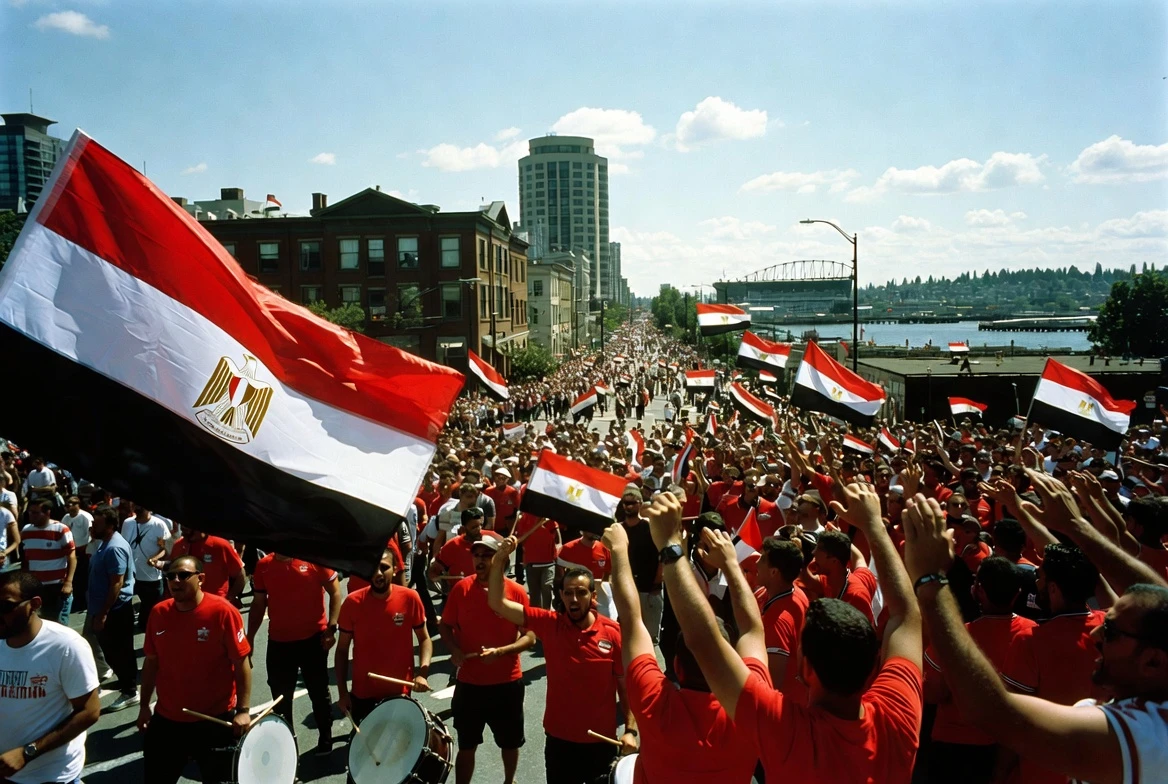
Egyptian fans flooded Seattle’s waterfront in red on June 15, 2026, hours before the country’s World Cup opener against Belgium at Seattle Stadium. Sada Elbalad dispatched photographer Mohamed Abu Dashish to the streets, where supporters from across the United States marched in organised processions toward the gates. The publication called the scene a vibrant Egyptian carnival that “spilled over into the stadium’s surroundings,” and described the energy as a uniquely festive atmosphere that drew in Belgians, tourists, and curious Seattleites alike.
Inside the bowl, 66,775 spectators watched Egypt and Belgium draw 1-1. Egypt came in on the back of its first World Cup campaign since 2018, with Mohamed Salah marking his 34th birthday. The score, Emam Ashour’s first-half opener, and Romelu Lukaku’s instant impact off the bench are all part of the match’s record. But the lasting image of the day came from outside the stadium, where the carnival ran from noon into the night.
The Red Sea at Seattle Stadium
Hours before kickoff, the streets around Seattle Stadium started filling with red. Egyptian supporters, draped in replica shirts and scarves, moved in processions toward the gates with flags held high and drums providing the rhythm. Sada Elbalad’s account of the Seattle waterfront carnival noted that fans “raised national flags and chanted patriotic anthems, drawing a massive turnout of families and supporters who traveled from various U.S. states.” Tourists, Belgian fans in their team colors, and curious Seattleites joined the chants and the photo-taking. By the time the gates opened, the waterfront had become a football festival in its own right.
The drumbeat held together for blocks, a soundtrack that distinguished this gathering from a typical American tailgate. Local outlet MyNorthwest confirmed the mood on the ground, reporting that “Egyptian fans were dancing in the street on Monday afternoon.” One Seattleite, Molly, told the outlet the scene through Pioneer Square “looks awesome” to outsiders. The match ended honours even at 1-1, but for the supporters in red, the result was almost secondary to the performance they put on.
The Belgian supporters, smaller in number but present, joined the broader carnival. Sada Elbalad described the encounter as a “friendly and engaging environment with Belgian fans and tourists,” a phrase the publication framed as proof of football’s unifying power. For Seattle residents who came down to watch the spectacle, the visual of fans marching in lockstep under the Space Needle was a fitting welcome to the tournament. The carnival ran for hours and showed no sign of slowing as kickoff approached.
What started as a tailgate of sorts took on the structure of a full cultural event, with families, replica shirts, and travelling supporters forming visible subgroups. The drums, in particular, gave the march a heartbeat that held together for blocks. By the time the players emerged from the tunnel inside, the noise had been rolling for hours.
Ashour Opened, Lukaku Replied
Inside Seattle Stadium, a Group G opener lived up to the World Cup billing. Emam Ashour put Egypt ahead in the first half, and the travelling support had its loudest moment of the afternoon. Mohamed Salah, marking his 34th birthday, supplied the assist and became what The Athletic’s live blog called “the first African player to register a FIFA World Cup goal involvement on his birthday.” The travelling support, draped in red, sang through the final whistle and long after.
Belgium, who had a marginal edge in the underlying numbers, found its answer from the bench. Romelu Lukaku’s introduction changed the game, and the equaliser arrived in a matter of seconds. Egypt’s relentlessness was a feature of the game, per The Athletic’s live blog, with the Pharaohs holding their shape in the Seattle heat. Belgium’s head coach Rudi Garcia said after the match that the conditions had made it harder than they needed to be. The match finished level, leaving Egypt still waiting for a first World Cup win since their 1934 debut.
The pitch needed a drink was well, it was a very dry, and the ball wasn’t moving as well as it should have been because of the pitch.
Rudi Garcia, Belgium’s head coach, said this in his post-match press conference at Seattle Stadium, in response to a question about the hydration break, per The Athletic’s live coverage. The comment was part of a longer exchange about how the conditions affected the match.
By the Numbers: Egypt 1-1 Belgium
- Attendance: 66,775, with fewer than 200 empty seats in the bowl (MyNorthwest)
- Kickoff: Noon, Seattle time (GeekWire)
- Game-time temperature: Near 90 degrees (The Athletic)
- Standout tackler: Mohanad Lasheen of Pyramids, 8 tackles, the most by any player at the 2026 World Cup (The Athletic)
- Egypt’s World Cup drought: No win since the 1934 debut, first tournament since 2018 (The Athletic, SWX Local Sports)
How the Diaspora Built the Carnival
The fan culture on display in Seattle did not arrive by accident. Sada Elbalad’s reporting stressed that supporters had traveled from various U.S. states, a phrase that captures the breadth of the Egyptian-American fan community. From the early-morning processions to the post-match singing, the day was the product of months of coordination among supporter groups across the country.
The visual code of the day was unmistakable: red, white, and black Egyptian flags, replica home shirts, and scarves passed from hand to hand. Sada Elbalad’s report described the city’s atmosphere as “painted in red as fans marched in organized processions toward the stadium, carrying flags and beating drums.” It was a level of pageantry more commonly associated with club football’s most intense rivalries, transplanted to a U.S. group-stage match. The result, the publication argued, was a “highly civilized image” that stood in contrast to scenes at some other major tournaments.
The crowd that filled Seattle Stadium was nearly a sellout, with MyNorthwest reporting fewer than 200 empty seats in the 66,775-seat bowl. The noise was the kind Seattle Stadium is built for.
The traveling contingent, many wearing the same replica shirts worn at club grounds back home, found Seattle’s waterfront an ideal stage. The city, with its summer light lasting past 9 p.m., gave the post-match singing room to run for hours. The carnival did not need a result to justify itself.
After the Whistle, Drones Over the Space Needle
The day did not end when the final whistle blew. At 10:05 p.m. local time, 400 drones took off near the Space Needle and formed what Visit Seattle called the first-ever drone scoreboard. The display ran for 2 minutes and 45 seconds and showed the 1-1 scoreline to the city, a Seattle-specific piece of tournament theatre. The drones are flown by Sky Elements, a Fort Worth-based company that has staged similar shows at T-Mobile Park and Lumen Field for the Mariners and Seahawks.
GeekWire reported that Visit Seattle plans to repeat the drone scoreboard for five more matches hosted at Seattle Stadium, including the upcoming USA-Australia fixture on June 19 and the Egypt-Iran group finale on June 26. The drone show was the punctuation mark on a day Seattle locals are unlikely to forget.
The Rest of Seattle’s Tournament Calendar
Seattle’s role in the 2026 World Cup is not a one-match cameo, with five more matches scheduled at the stadium and another Egypt appearance against Iran on June 26. The Group G schedule gives Egypt a short hop to Vancouver for the New Zealand match on June 21, then a return to Seattle. The full Seattle Stadium schedule, per GeekWire, is below.
Seattle Stadium’s 2026 World Cup schedule
- June 15: Belgium 1-1 Egypt, 12 p.m. (completed) (the stadium’s Belgium-Egypt event page)
- June 19: USA vs. Australia, 12 p.m.
- June 24: Bosnia-Herzegovina vs. Qatar, 12 p.m.
- June 26: Egypt vs. Iran, 8 p.m.
- July 1: Round of 32 (Match 82), 1 p.m.
- July 6: Round of 16 (Match 94), 5 p.m.
For Egypt, the result against Belgium kept Group G competitive, with the Pharaohs set to face New Zealand in Vancouver on June 21 and Iran back in Seattle on June 26, per the Egypt team’s 2026 World Cup schedule. The Pharaohs’ New Zealand match in Vancouver, Salah’s World Cup moment against New Zealand, is part of the Group G picture. The Pharaohs’ last World Cup campaign was 2018, with the team chasing its first win in the tournament’s history. The Iran match on June 26 will be the group finale for Egypt.
Belgium’s path runs through Los Angeles next, where it plays Iran on June 21, before finishing the group in Vancouver against New Zealand on June 26. The Red Devils have failed to win their last three World Cup games, a run The Athletic noted is “as many winless outcomes as in their previous 15 games in the competition combined.” The American and Iranian fans now have Seattle to look forward to, with the U.S. side’s Friday match at noon set to draw another full house to the Seattle waterfront.
Frequently Asked Questions
When did Egypt play Belgium at the 2026 World Cup?
Monday, June 15, 2026, was Egypt’s first World Cup match since the 2018 tournament in Russia. The Group G opener kicked off at noon at Seattle Stadium, the temporary name for Lumen Field, and ended 1-1, per the SWX Local Sports match report.
How many fans attended the Egypt-Belgium match in Seattle?
Seattle Stadium was packed with 66,775 fans, per local outlet MyNorthwest, with fewer than 200 empty seats reported in the bowl.
What was the final score of Egypt vs Belgium?
Emam Ashour gave Egypt a first-half lead with an assist from Mohamed Salah, who on his 34th birthday became the first African player to register a World Cup goal involvement on his birthday, per The Athletic’s live coverage. Romelu Lukaku, introduced as a substitute, forced the Mohamed Hany own goal that brought Belgium level.
Why were Egyptian fans at the center of the Seattle atmosphere?
Egyptian-American supporters from across the United States filled the streets around Seattle Stadium with flags, drums, and chants hours before kickoff, creating what Sada Elbalad’s coverage described as an Egyptian carnival on the waterfront.
What other World Cup matches will be played at Seattle Stadium?
GeekWire’s published schedule lists five more matches at Seattle Stadium: USA vs. Australia on June 19, Bosnia-Herzegovina vs. Qatar on June 24, Egypt vs. Iran on June 26, a round-of-32 match on July 1, and a round-of-16 fixture on July 6. Visit Seattle plans to fly its drone scoreboard above the Space Needle after each.
