
China’s ROX Motor has signed a deal to start building range-extended electric SUVs in Egypt in June 2027, in what the company calls its first direct investment in the country. The plan, signed in Cairo on June 15, sets up a joint venture named ROX ESI Egypt with local manufacturer Ezz El Arab Elsewedy Investments, targeting initial output of around 3,000 vehicles a year before ramping to 5,000 within three years. Roughly half of the early production is earmarked for export to African and Gulf markets.
The signing drew Egypt’s Industry Minister Khaled Hashem and Investment Minister Mohamed Farid, alongside ROX founder and CEO Jarvis Yan and Ezz El Arab Elsewedy Investments chairman Hisham Ezz El Arab. The deal is the latest in a string of new-energy vehicle investments Egypt has courted under its Automotive Industry Development Program, the policy framework that targets 100,000 locally built vehicles a year by 2030.
The Deal Signed in Cairo
The agreement was signed at Abdeen Palace, the seat of Egypt’s presidential ceremonies, in the presence of both ministers and the senior executives of both companies. ESI Group CEO Mohamed Saleh and ROX Chief Financial Officer Harry Wang signed on behalf of the two parties. Ezz El Arab Elsewedy Investments (ESI), a 50-50 partnership between Elsewedy Industries and the Ezz El Arab Automotive Group, was established in 2023 and already runs two factories in Sixth of October City.
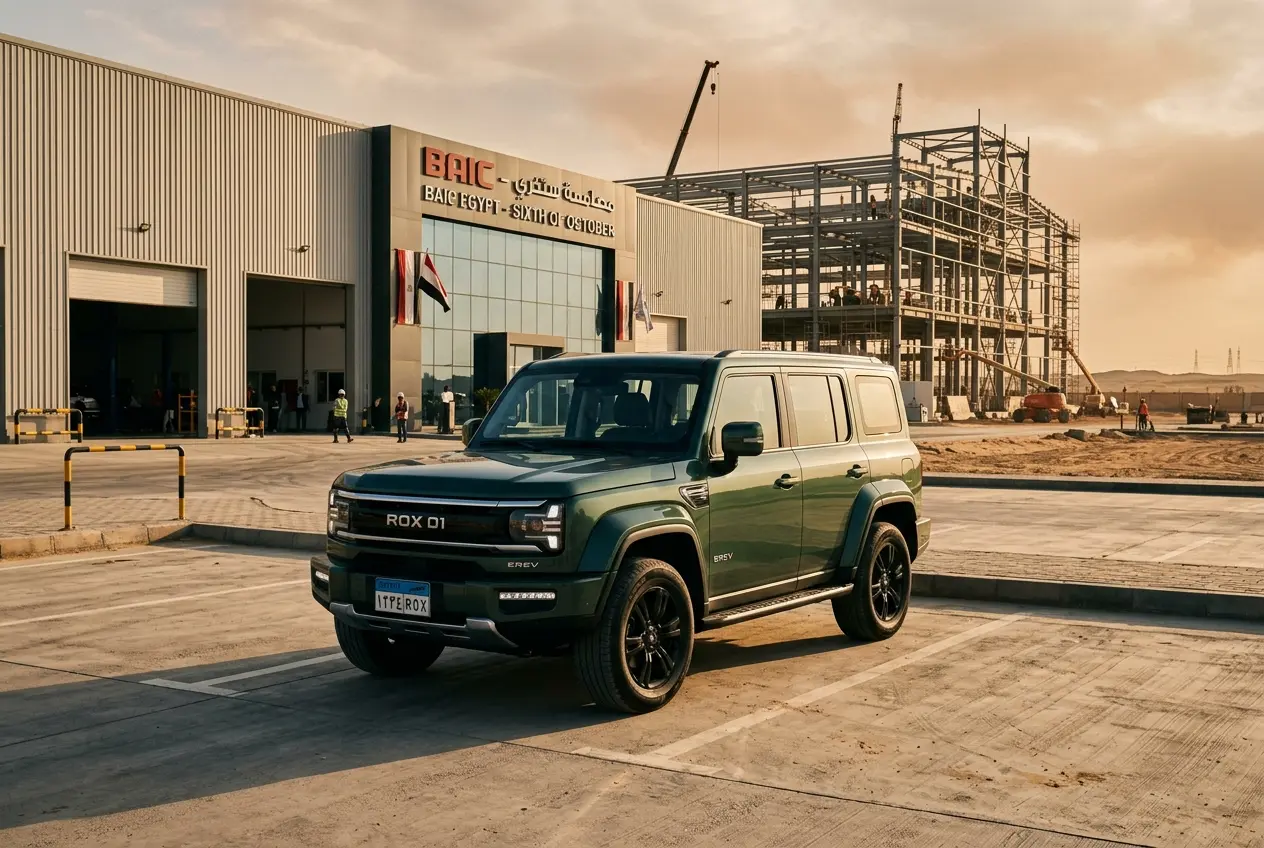
The new entity will produce what its backers call the first luxury passenger EV to be manufactured in Egypt, a range-extended electric vehicle (REEV) that pairs a small combustion generator with a battery-driven electric motor. ROX entered the Egyptian market in 2025 with its ROX 01 luxury SUV, the same model family the local joint venture will produce. Industry Minister Hashem described the agreement as a tangible success of the National Automotive Industry Strategy and evidence of “a fundamental transformation in the country’s investment environment.” Investment Minister Mohamed Farid called the partnership “a sophisticated model of technology-driven investment and knowledge transfer” that reflects growing confidence among global companies in Egypt’s economic prospects.
Three Thousand Cars, Then Five Thousand
Production is scheduled to begin at ESI’s Sixth of October complex, an industrial zone in the Giza governorate. The chairman, Hisham Ezz El Arab, put the ramp plainly to EnterpriseAM: “We’ll start at roughly 3k cars and reach 5k within three years. In June 2027, the first Egyptian made Rox will roll off the production line.” The joint venture will produce range-extended electric vehicles, the same powertrain family ROX already sells in Egypt as the ROX 01.
AGBI’s coverage of the same deal put the local content target at 45 to 52 percent. ESI’s industrial platform in Sixth of October is being expanded to accommodate the new ROX line and other contract work. The local content ratio will sit within the Industrial Development Authority’s 45 percent requirement. Zawya’s press release values the vehicles to be manufactured in Egypt at up to USD 500 million.
ESI Group CEO Mohammed Saleh disclosed plans to double the group’s automotive investment to EGP 10 billion, or about USD 192 million, in bourse statements quoted by AGBI. The deal is the Chinese brand’s first direct investment in the country, confirmed in the ROX ESI Egypt joint venture announcement.
Why a Parent Company Just Took Equity
It’s very rare for parent companies to come here themselves.
That is the unusual line in a market that runs on importers and badge-assembly deals. Foreign brands ship kits, local partners assemble them, and the parent never signs a cap-table document. ROX has now signed one, and it is bringing its brand into the joint venture.
The argument Hisham Ezz El Arab made to the press was pragmatic. Locally built cars don’t seize up when the dollar stalls and imports jam up, he said, and the joint venture will offer “the same Chinese quality vehicle at a better price.”
The market for ROX is already there. The Chinese company entered Egypt in 2025 with the ROX 01 range-extended electric SUV and now runs three showrooms in Cairo and Alexandria through distributor Nour El Din El Sherif, with more than 20,000 owners across the MENA region and the UAE as the single biggest market globally. Ezz El Arab argues that ROX was built for an international audience, not a Chinese domestic one.
“It is made to appeal to international tastes,” he said. The partnership is a manufacturing deal that adds local production to ROX’s existing import business. The deal is ROX’s first direct investment in the country, with the parent taking direct equity in the joint venture. The local-content argument cuts both ways: the AIDP ties preferential tariffs to local-content thresholds, with the 45 percent IDA floor as the threshold manufacturers must meet to access the incentive regime.
How the Cars Will Reach Africa
Africa is the export target. ROX founder and CEO Jarvis Yan laid out the joint venture’s export plan, naming the first-wave markets and a separate facility for a different part of the continent.
- Nigeria
- Angola
- Ghana
- A planned right-hand-drive plant serving East and Southern Africa
Daily News Egypt reports that more than half of the first phase of production will go to export, with Gulf and African markets absorbing the bulk starting in the second half of 2027. AGBI’s report quotes Mohammed Saleh saying nearly half of the production will be exported and the volume will be doubled within three years. Egypt’s network of free trade agreements gives the country preferential access to both African and Gulf markets, a structural advantage the Chinese EV makers’ push into global markets is trying to capture.
Yan said the combination of global technology and local industrial capabilities will be the foundation for “long-term growth, innovation and value creation in Egypt and across Africa.” A 50-50 partnership structure means ESI and ROX will share both the upside and the supply-chain risk that comes with ramping a new production line. Zawya’s press release frames Egypt as ROX’s primary regional manufacturing and logistics hub for the Middle East and Africa. The deal also includes training programmes for engineers and technicians on digital manufacturing and smart EV maintenance, the press release adds.
Built for Egyptian Roads
The first made-in-Egypt ROX will be a localised version of the existing ROX 01, a mid-size range-extended electric SUV whose boxy profile resembles the Land Rover Defender. The local product will carry modifications designed specifically for Egypt: heavier-duty air-conditioning tuned for desert heat, chassis adjustments for local road conditions, and Arabic voice control adapted to the Egyptian dialect. Distribution of the made-in-Egypt version will stay with Nour El Din El Sherif, the same partner that has run the import-only ROX business since 2025. The base ROX 01 pairs a 1.5-litre petrol range extender with a 56 kWh battery from CATL, claiming 235 km of electric-only range and more than 1,000 km in combined mode.
| Vehicle | Powertrain | Approx. Egypt price |
|---|---|---|
| ROX 01 (imported) | Range-extended EV (1.5L petrol generator, 56 kWh CATL battery) | EGP 3.5 million |
| Land Rover Defender | Petrol / diesel | EGP 10 million |
The Defender is the visual reference in the Egyptian showroom. The local production is set to widen the price gap the imported ROX 01 already enjoys in Egypt, a goal Ezz El Arab flagged when he promised the joint venture will offer “the same Chinese quality vehicle at a better price.” For ROX, the Egypt-made cars will use the same range-extended electric architecture the brand already sells elsewhere, pairing a small petrol generator with a battery-driven electric motor.
The Industrial Base Behind the Deal
Ezz El Arab Elsewedy Investments is a 50-50 joint venture between Elsewedy Industries, part of the broader Elsewedy Electric Group, and the Ezz El Arab Automotive Group, the long-time Egyptian distributor of premium brands. The combined platform gives ROX ESI Egypt access to an established industrial footprint. ESI was set up in 2023 to bring Elsewedy’s industrial scale together with Ezz El Arab’s automotive distribution know-how, and the EGA’s Sixth of October production expansion is the kind of contract-manufacturing footprint ROX is plugging into.
The Ezz El Arab Group has run automotive distribution in Egypt for five decades, the company’s official materials note. The new entity will “actively develop the local automotive supply chain and component manufacturing sector,” the Zawya press release says.
- Capacity: 40,000 vehicles annually today, rising to 80,000 with a second car plant
- Complex size: 100,000 sqm in Sixth of October City
- Automotive investments: exceeding USD 100 million
- Elsewedy footprint: 80+ years, 31 production facilities worldwide
- Brand portfolio: Mercedes-Benz, Jeep, Volvo, Ferrari, Maybach, Aston Martin
The Proton line gives ESI mass-market scale at around EGP 650,000 per car, a structure ROX will inherit when the new joint venture starts running in 2027. ESI also manufactures Chinese Jinbei trucks for third parties, a contract line that has brought in additional volume and engineering experience. ROX is buying into the combination of premium distribution experience and mass-market assembly capability that ESI offers. The new joint venture inherits ESI’s training and supplier base, an established foundation that brings a working production line to the new ROX models. The Proton’s Malaysian provenance and EGP 650,000 entry price put it well below the premium tier Ezz El Arab’s brand portfolio normally covers, but it gives ESI the production volume a luxury-only line cannot.
Where Egypt’s Auto Industry Stands
The ROX deal fits the Automotive Industry Development Program, the policy framework unveiled in 2022 that aims to lift domestic production to 100,000 vehicles a year by 2030. The 100,000-vehicle target sits alongside a 60 percent local content aspiration. Industry Minister Hashem used the signing to argue the program is now producing the direct investments it was designed to attract.
After years of intensive efforts to present visions and plans to convince global companies that Egypt is the ideal regional hub for investment, we are now witnessing an influx of major international companies for direct investment and the establishment of genuine partnerships.
The same week as the ROX signing, China National Tire and Rubber Corporation announced a USD 550 million tyre plant in Alexandria, and Geely had earlier opened what AGBI called MENA’s first car assembly plant in Egypt. The deal fits the broader Egypt’s automotive industry development strategy, with the Automotive Industry Development Program designed to use direct investment to deepen local manufacturing. Chinese companies have invested more than USD 8 billion across Egyptian industries, Investment Minister Hassan El-Khatib said at an Egyptian-Chinese forum in November, and Cairo has begun allowing Chinese companies to settle transactions in yuan when establishing branches. The ROX joint venture is the first time a Chinese carmaker has taken parent-level equity in an Egyptian factory, breaking from the badge-assembly pattern Hisham Ezz El Arab says the local market runs on.
