
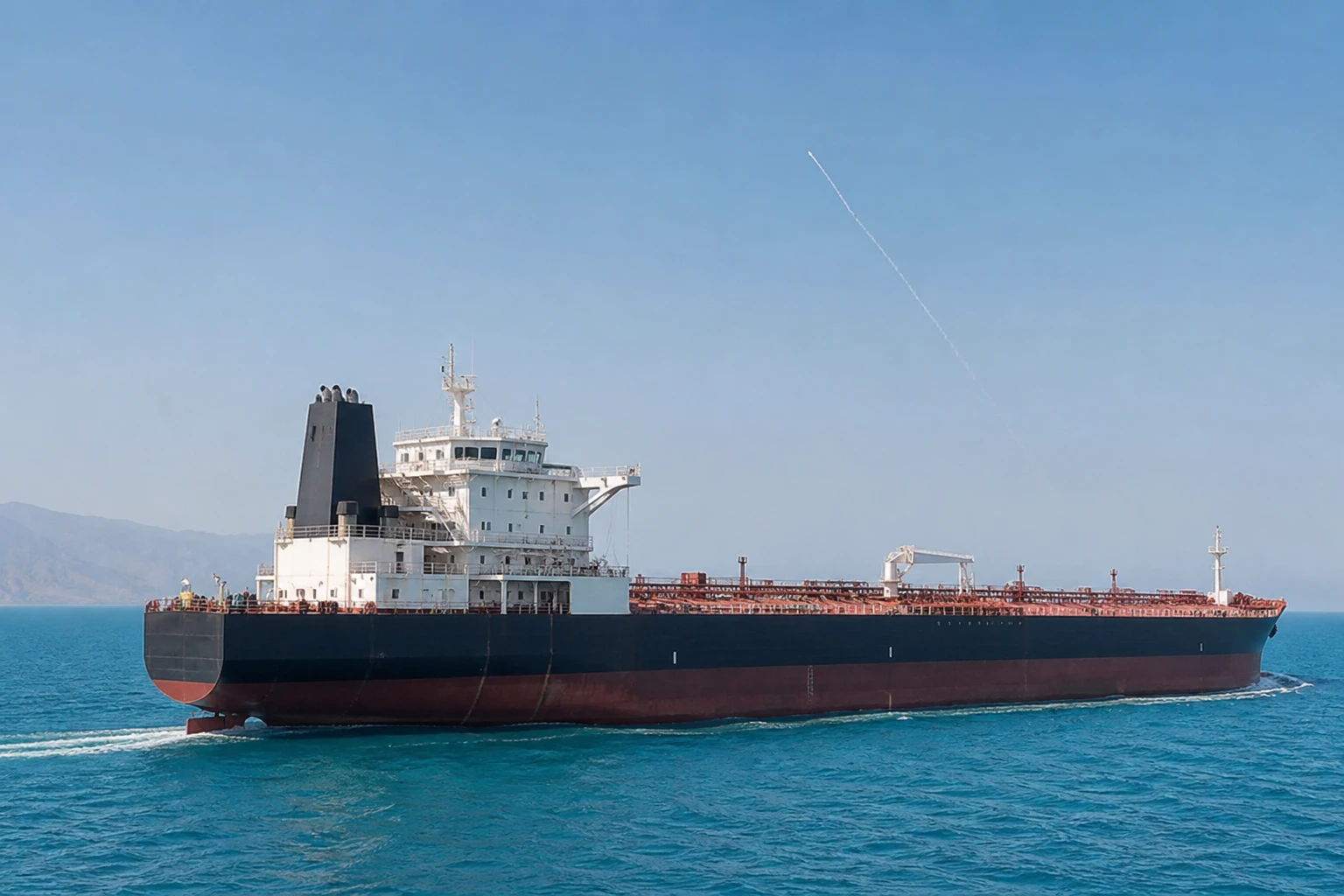
An ADNOC oil tanker took a missile strike in the Strait of Hormuz early on August 8 with no injuries reported, prompting Saudi Arabia, Yemen’s internationally recognised government and a string of Arab states to condemn Iran. The hit is the 16th on an ADNOC vessel since the US-Israel war with Iran began on February 28.
UAE officials called the attack an act of piracy by Iran’s Revolutionary Guard Corps and a violation of international rules on free navigation. The pattern already goes well past any single incident.
Sixteen Hits and Counting for ADNOC
State news agency WAM reported that an ADNOC-operated vessel was targeted by a missile while transiting the strait. The company said the situation was brought under control. No details emerged on damage, cargo or the tanker’s exact name.
ADNOC had already disclosed on Friday that 15 of its vessels had faced missile and drone attacks since the conflict started, including three that week. One crew member was killed and 20 injured in the earlier strikes. This latest incident pushes the company total to 16.
- 16 ADNOC vessels attacked since February 28
- 3 vessels hit in the week before the August 8 strike
- 1 crew member killed and 20 injured in prior incidents
- 0 casualties on the latest tanker
The pace itself is part of the story. Three hits in the week before August 8 show the pressure did not ease as talks continued elsewhere. A zero-casualty outcome on the latest tanker does not reverse the human cost already recorded.
The UAE Foreign Ministry described the strike as a “hostile Iranian attack” and “acts of piracy.” It urged Tehran to halt the attacks and reopen the strait fully and unconditionally.
That demand for unconditional reopening collides with the tally above. Sixteen vessels in roughly five months turn each new statement into a response to a running campaign rather than to an isolated event.
Saudi Arabia and Yemen Lead the Regional Chorus
Saudi Arabia’s Foreign Ministry condemned the targeting “in the strongest terms.” It called Iran’s continued attacks a grave breach of international law and Security Council Resolution 2817 on navigation. Riyadh held Tehran responsible for the consequences and demanded an immediate stop.
Yemen’s internationally recognised government issued a parallel statement. It labelled the incident a serious threat to maritime navigation and commercial shipping and called for an end to attacks on vessels in the region.
Other voices joined quickly:
- Qatar rejected use of the strait as a pressure tool and demanded unconditional reopening
- Bahrain, Jordan, Kuwait and Syria expressed solidarity with the UAE
- GCC Secretary-General Jassim Mohammed al-Budaiwi called the attack a dangerous escalation
- Arab League chief Nabil Fahmy held Iran fully responsible for targeting Arab assets
The statements repeatedly cited Resolution 2817 and freedom of navigation principles. The unified language masks how little the waterway still functions as an open route.
Shared wording on piracy, escalation and full responsibility gives the record a single legal spine. It does not, by itself, move a single tanker through the strait under the old Traffic Separation Scheme.
Why the Numbers Still Matter
Before the war, the Strait of Hormuz carried roughly one-fifth of global petroleum liquids consumption and a quarter of seaborne oil trade. EIA data show total oil flows averaged 20.9 million barrels per day through Hormuz in the first half of 2025, with 14.7 million b/d crude and condensate plus 6.1 million b/d products. LNG volumes ran at 11.4 billion cubic feet per day, more than 20 percent of global seaborne trade.
| Route / Metric | Volume (1H25) | Share / Note |
|---|---|---|
| Strait of Hormuz oil | 20.9 million b/d | ~20% global liquids, ~25% seaborne oil |
| Hormuz crude + condensate | 14.7 million b/d | 89% headed to Asia |
| Hormuz LNG | 11.4 Bcf/d | >20% global LNG trade |
| Saudi + UAE bypass pipelines | ~4.7 million b/d capacity | Partial alternative only |
Most crude still headed for China, India, Japan and South Korea. US imports via the strait had already fallen to about 0.4 million b/d. Since February the waterway has seen repeated mining, militarisation and attacks. Traffic collapsed. Insurance became scarce or prohibitive. Seafarers grew unwilling to transit.
Those pre-war shares explain why each ADNOC strike registers beyond the Gulf. When a route that once moved 20.9 million b/d becomes conditional, the first pain lands on the Asian buyers who took the bulk of the crude and condensate.
The 0.4 million b/d US figure shows how exposure already differed by destination before February 28. Collapse in traffic therefore hits unevenly, even as the legal claims in every condemnation stay universal.
Iran Sets Conditions for Any Reopening
Iran has not publicly claimed the August 8 strike. Its officials continue to frame control of the strait as leverage. IRGC spokesman Hossein Mohebbi said any reopening depends on Washington accepting Tehran’s terms and is unrelated to Oman-brokered talks in Muscat.
The US had breached the Strait of Hormuz clause in the memorandum of understanding, and we responded to them in turn.
Iranian President Masoud Pezeshkian made that statement alongside Foreign Minister Abbas Araghchi. Araghchi said Tehran was close to a legal framework with Oman but reopening still required US “compensation” for alleged breaches of an earlier understanding. He added that the old Traffic Separation Scheme was no longer acceptable and that a new route would be needed.
The practical result is selective transit at best, often described as a de facto toll system enforced by the Guards. Vessels linked to adversaries or failing Iranian directives face threat.
Conditionality is the mechanism. Talks in Muscat, a possible legal framework with Oman, and public demands for US compensation all sit on one side. Missile and drone pressure on commercial hulls sits on the other. Passage becomes a bargained outcome rather than a right under Resolution 2817.
Logistics Have Already Moved On
Saudi Arabia’s East-West pipeline and the UAE’s Abu Dhabi pipeline together offer about 4.7 million b/d of bypass capacity. The UAE plans another 1.5 million b/d line to Fujairah by 2027. Iran’s own Goreh-Jask pipeline adds limited export options on the Gulf of Oman side. None of these fully replace the strait for the full pre-war volume.
Freight rates spiked early in the conflict. Tankers clustered outside the passage or took far longer Cape of Good Hope routes. Asian importers felt the squeeze first. Egypt experienced an energy shock that dimmed Cairo nights as regional supply chains tightened. The same pressure appears in higher delivered costs and inventory draws across South and East Asia.
ADNOC itself said the attacks had significantly affected operations while it continued to meet customer needs in an “exceptionally challenging environment.” That language understates how normal commercial transit has been replaced by risk calculation and political clearance.
Clustering outside the passage and Cape routings are the visible workarounds. They buy continuity at the price of time, freight and insurance, and they leave the underlying chokepoint unresolved.
The Costs That Outlast the Statements
Each new condemnation restates principles that Iran has already rewritten on the water. The second-order effects are clearer than the diplomatic scorecard:
- Insurance markets priced many Hormuz transits out of reach for ordinary commercial operators
- Crews and shipowners diverted or delayed cargoes, lengthening supply chains
- Asian refiners paid higher freight and faced tighter crude availability
- Bypass infrastructure projects gained urgency even if they cannot match full strait capacity
- Norms of free navigation under Resolution 2817 eroded into conditional access
Yemen’s internationally recognised government has its own stakes. Its condemnation sits alongside the complex fighting that includes Yemen’s three-front war dynamics and Houthi actions elsewhere. Regional solidarity against Iranian pressure does not erase those internal fault lines.
On X and maritime tracking channels, observers noted the latest hit fits a pattern of southern-route targeting and tallied dozens of incidents since March. The crowd read is blunt: the strait is no longer a neutral highway. It is a controlled zone where passage is bargained.
Bypass Pipelines Cover Only a Fraction
The arithmetic of alternatives is blunt when set beside the pre-war baseline. Pipelines move oil. They do not restore a quarter of seaborne trade or more than a fifth of global LNG movements.
| Pathway | Capacity or flow | Relation to Hormuz baseline |
|---|---|---|
| Pre-war Hormuz oil (1H25) | 20.9 million b/d | Reference volume |
| Saudi + UAE bypass pipelines | ~4.7 million b/d | Partial cover only |
| Planned UAE line to Fujairah | 1.5 million b/d by 2027 | Future add-on, still partial |
| Iran Goreh-Jask pipeline | Limited export option | Gulf of Oman outlet, not a full substitute |
Even if every listed pipe ran flat out, the gap against 20.9 million b/d would remain wide. The 1.5 million b/d Fujairah project matters for UAE flexibility after 2027. It does not reopen the strait for third-party cargoes or for LNG at 11.4 Bcf/d.
That gap is why freight spikes, Cape diversions and inventory draws showed up so fast in Asia. Bypass steel absorbs some barrels. It cannot absorb the full commercial system that once treated Hormuz as routine.
Selective Access Becomes the Working Rule
From February 28 onward the sequence of pressure and response has been steady enough to map.
- February 28 – US-Israel war with Iran begins; ADNOC vessel attacks start to accumulate across the following months.
- Friday before August 8 – ADNOC discloses 15 vessels hit since the conflict started, three of them that week, with one crew member killed and 20 injured.
- August 8 – Sixteenth missile strike on an ADNOC tanker in the strait; situation brought under control; no casualties reported.
Iran’s public line ties any full reopening to US acceptance of Tehran’s terms and to compensation for alleged breaches of an earlier understanding. Mohebbi separated that stance from the Oman-brokered track in Muscat. Araghchi kept both the legal framework talk and the rejection of the old Traffic Separation Scheme in view at once.
On the water the result is selective transit enforced by the Revolutionary Guard Corps. Vessels that fit Iranian directives may move. Others face threat. Arab capitals answer with Resolution 2817 and piracy language. The working rule in the strait is already the conditional one.
ADNOC’s own description of an “exceptionally challenging environment” fits that rule. Meeting customer needs while absorbing sixteen hull attacks is commercial continuity under political clearance, not a return to open navigation.
A Chokepoint Remade in Real Time
The August 8 strike produced no casualties and no immediate oil-price spike of the scale seen earlier in the war. That relative calm is itself evidence. Markets and shipowners have already adapted to a higher baseline of risk. Condemnations from Riyadh, Sanaa’s recognised authorities and their neighbours keep the legal and political record clear. They do not restore the volumes or the certainty that once defined the world’s most important oil chokepoint.
Further incidents will test whether Oman-mediated talks can produce a durable arrangement or whether selective enforcement and bypass construction simply become the new normal. For now the pattern is set. One more tanker hit, one more round of statements, and the logistics keep adjusting around a strait that no longer operates under the old rules.
