
On 12 August 2026 the UK will see its deepest solar eclipse since 1999, with the Moon covering 90 to 96 percent of the Sun and experts already flagging the same preventable eye injuries that followed the last big event.
First contact begins around 6.08pm in Scotland and 6.17pm in London. Maximum arrives near 7.10pm across most of England and Wales as the Sun sits low in the west. The sky will dim like a cloudy afternoon rather than night, yet the remaining sliver still packs enough radiation to burn the retina without proper protection.
The timing places the whole show in the evening commute and the early supper hour. People already outdoors will glance up. That casual habit is exactly what drove the injury numbers a generation ago.
City Coverage Peaks in the Southwest
Coverage climbs the farther southwest you stand. Cornwall and the Isles of Scilly reach roughly 95 to 96.5 percent. London sits near 91 percent. Even Shetland still sees close to 88 percent.
| Location | First contact | Maximum | End | Approx coverage |
|---|---|---|---|---|
| Edinburgh / Glasgow | 6.08pm | 7.05pm | 8.00pm | 90-91% |
| Manchester / Liverpool | 6.13pm | 7.10pm | 8.03-04pm | 91-92% |
| London / Bristol / Cardiff | 6.17pm | 7.12-13pm | 8.06-07pm | 91-93% |
| Truro, Cornwall | 6.18pm | 7.16pm | 8.10pm | ~95% |
| SW tip of Ireland | ~6.12pm | ~7.10pm | ~8.05pm | up to 97.5% |
The full Royal Observatory Greenwich timings table lists small local variations and confirms the southwest edge wins the deepest bite.
From Shetland to Cornwall the coverage gain is only a few percentage points on paper. On the ground those points decide how thin the remaining crescent looks and how dramatic the late daylight feels. Irish observers on the southwest tip push even higher, past the best English figures.
First contact itself slides later as you move south. Scotland starts the show while London still waits. By the time maximum arrives the whole country is watching together, staggered by only a few minutes.
1999 Still Sets the Benchmark
The last time the British Isles saw anything close was the 11 August 1999 total eclipse that raced across Cornwall and Devon. Most of the rest of the country watched a deep partial. Public excitement was huge. So were the medical reports.
The Royal College of Ophthalmologists logged around 70 cases of solar retinopathy after that event. Roughly 40 percent of those people had looked for less than a minute. The dimmed disc lulled the natural blink reflex, letting ultraviolet and infrared light cook the retina without pain. Many only noticed the blind spot or distorted vision hours later.
| Factor | 11 August 1999 | 12 August 2026 |
|---|---|---|
| Deepest UK view | Total in Cornwall and Devon | 95 to 96.5% in Cornwall |
| Rest of country | Deep partial | 90 to 93% for most cities |
| Time of day | Daytime path | Low evening Sun near sunset |
| Documented eye injuries | Around 70 solar retinopathy cases | Risk profile flagged as similar |
This week’s partial sits in the same danger zone. Over 90 percent covered still leaves a bright crescent. The geometry again favours the southwest. And the event again falls near sunset, when people are already outdoors and inclined to glance up.
The short glances that caused so much harm in 1999 remain the core warning. A few seconds felt harmless then. The retina disagreed hours later. Nothing in the 2026 geometry changes that basic trap.
Why the Remaining Light Still Burns
Partial eclipses trick the eye. The overall scene darkens, so the pupil opens. The leftover photosphere continues to deliver full solar intensity through that wider aperture. Damage is photochemical and thermal. It is permanent in the worst cases.
Ordinary sunglasses, smoked glass, CDs, or camera filters fail completely. They cut visible glare but pass the wavelengths that destroy photoreceptors.
- Certified eclipse glasses that carry the ISO 12312-2 or ISO 12312-2:2015 mark block the full spectrum to safe levels.
- Handheld solar viewers built to the same standard work the same way.
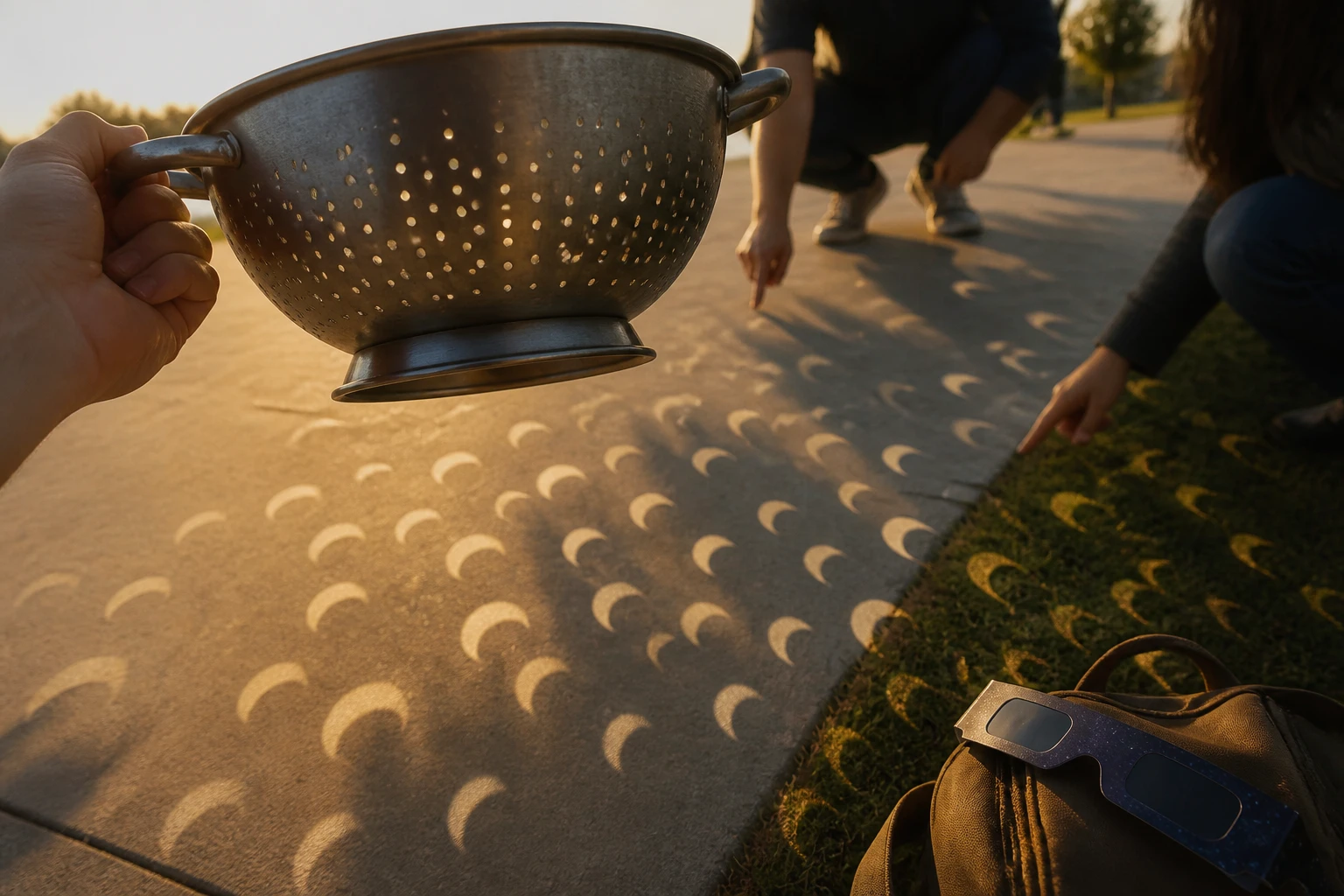
- Pinhole or colander projection lets you watch the crescent images cast on the ground or a card with your back to the Sun.
- Properly filtered telescopes or binoculars at local astronomy society events give magnified views.
The UKHSA warning on 1999 eye cases stresses that old or scratched glasses from previous eclipses are no longer reliable. Fresh pairs only. Children need constant supervision. Never stack eclipse glasses with cameras or binoculars; the focused beam burns through the filter.
NASA’s guidance is identical: during any partial phase it is never safe to look with the naked eye. Their page on NASA rules for ISO 12312-2 viewers spells out the exact inspection steps and the pinhole box method for households without glasses.
Projection methods remove the risk entirely because the eye never faces the Sun. A colander, a punched card, or a simple pinhole box turns the crescent into a safe ground image. When certified glasses sell out, those kitchen options still work.
It’s not a total eclipse, but over 90% is really exciting. We’re not going to get one this good for a really long time. So it’s important not to miss it, and to be prepared. You can’t just go out and expect to have a look because it’s really dangerous for your eyes.
Imo Bell, planetarium astronomer at the Royal Observatory Greenwich, told the Press Association that simple kitchen tools still deliver a safe show if glasses run out.
The Western Horizon Becomes the Real Gatekeeper
Maximum eclipse hits when the Sun is already low, between about 9 and 13 degrees above the west-northwest horizon depending on latitude. By last contact the disc sits only a degree or two up in the south-east of England, minutes before sunset.
Buildings, trees and hills cut the view instantly. Clouds hundreds of miles away on the horizon line can erase the whole event even if the sky overhead looks clear. Long-term mid-August statistics give any UK site roughly a 30 percent chance of clear skies. The low altitude multiplies that risk.
Crowds on X have spent the past week trading favourite coastal cliffs and hilltops while worrying about the forecast. Many still hunt for certified glasses after prices climbed and stocks thinned. The practical pattern is clear: treat the afternoon like a special sunset watch. Scout the western sightline the evening before. Arrive early. Have a backup projection method ready.
A clear overhead sky is not enough. The Sun’s path hugs the horizon, so any ridge, roofline or distant bank of cloud can end the show early. Coastal west-facing spots and open hilltops give the longest clean sightline. Inland streets lined with buildings often lose the disc before maximum even arrives.
- Scout the exact western view the evening before
- Arrive early enough to claim a clear sightline
- Keep a colander or pinhole card as backup
- Accept that a 30 percent clear-sky chance still leaves room for gaps
Totality Passes Just Offshore
The Moon’s full shadow clips Greenland, the western tip of Iceland and a band across northern Spain into the Balearics. Longest totality reaches 2 minutes 18 seconds off Iceland. Spanish cities inside the path include A Coruña, Oviedo, Bilbao, Zaragoza and Valencia. Madrid and Barcelona sit just outside.
For UK observers the near-miss produces the dramatic downward-pointing crescent at maximum. The same geometry that denies totality also keeps the event long: nearly two hours from first to last contact. That window raises the odds of catching at least part of it through gaps in cloud.
Spain’s path cities will see true darkness and the corona. The UK will not. What the UK gains instead is duration. A two-hour partial gives repeated chances if cloud drifts. A two-minute total path offers no second try.
The downward crescent is the visual signature of that near-miss. Observers farther north see a slightly different orientation, yet the thin bright arc remains the same hazard at every latitude.
Decades Until the Next Deep One
The next total solar eclipse visible from the UK mainland arrives only in 2090, when the south coast from Hastings to Bideford falls inside the path for up to two and a half minutes. The closest interim deep partial comes on 3 September 2081, when Cornwall and the south coast reach about 99 percent.
- 2030, roughly 50 percent partial
- 2053, about 40 percent
- 2066, around 60 percent
- 2075 and 2082, both near 70 percent
- 2081, up to 99 percent in the south-west
- 2090, next UK total
The long gap explains the public scramble for glasses and west-facing viewpoints. Nothing in the 2030s or 2040s will match the 90-plus percent coverage of 2026. Even the stronger mid-century partials stay well below this year’s figures until 2081.
After the solar show ends, the night of 12-13 August delivers a second free gift. The Perseid meteor shower peaks under moonless skies. Typical UK rates run 20 to 40 meteors per hour from a dark site. Many plan to watch the crescent Sun set, then relocate for the meteors after midnight.
Two weeks later a 90 percent partial lunar eclipse rises in the early hours of 28 August, giving a bookend blood-Moon view for anyone still looking up.
Why the Southwest Wins the Deepest Bite
The coverage map is not random. The Moon’s shadow track runs west of the British Isles, clipping Iceland and then Spain. The UK lies just outside that track, so the farther west and south an observer stands, the closer they come to the edge of totality.
That single geometric fact produces the gradient in the timings table. Shetland at roughly 88 percent, London near 91 percent, Cornwall at 95 to 96.5 percent, and the southwest tip of Ireland up to 97.5 percent all follow the same rule: proximity to the offshore path deepens the bite.
The evening timing reinforces the southwest advantage. Maximum arrives with the Sun already low in the west-northwest. Western coasts and open Atlantic horizons keep the disc in view longer than inland or eastern sites blocked by terrain.
Ireland’s southwest tip therefore outranks every listed UK city. Cornwall follows close behind. For anyone choosing a viewing site inside the UK, the table and the shadow path both point the same way.
How the Perseids and Lunar Eclipse Join In
The solar eclipse is only the first act. Once the crescent Sun sets, the same night opens onto the Perseid peak. Moonless skies remove the usual wash of light, so the typical UK rate of 20 to 40 meteors per hour becomes easier to catch from any dark site.
The practical sequence is simple. Watch the partial with proper filters or projection until the Sun drops. Then move to a darker location after midnight for the meteors. No special equipment is required beyond warm clothes and patience.
Two weeks later the 90 percent partial lunar eclipse on 28 August closes the sequence. A blood-Moon rise in the early hours needs no eye protection. The same households that hunted eclipse glasses for 12 August can step outside again with nothing more than a clear eastern horizon.
Three linked events inside a fortnight turn a single calendar date into a short season of skywatching. The solar partial carries the only real safety burden. The meteors and the lunar eclipse ask only for clear weather and a willingness to stay up late.
The 2026 partial will not darken the day like 1999’s total path did in Cornwall. It will, however, recreate the same public scramble, the same southwest advantage, and the same quiet medical risk. Glasses, a colander, a clear western skyline and a bit of luck are the only requirements. The next comparable chance sits more than half a century away.
