
Fourteen countries signed onto Saudi Arabia’s Multinational Maritime Defense Alliance after a late-July meeting in Riyadh, aiming to break the Houthi grip on Red Sea shipping lanes that now carry a heavy share of the kingdom’s oil exports. Retired U.S. Adm. James Stavridis, former NATO supreme allied commander, argues the mix of local fleets and Red Sea bases can restore order if Riyadh leads firmly and draws limited U.S. and European support.
The move comes as Houthi attacks and a declared blockade force Saudi crude onto the East-West pipeline to Yanbu and through Bab el-Mandeb, raising the stakes far beyond Yemen’s long civil war.
Fourteen Nations Back the Riyadh Framework
Saudi Arabia’s Ministry of Defense hosted representatives from 43 of 51 invited countries and an EU delegation on July 30. Fourteen states issued a joint founding statement for the Multinational Maritime Defense Alliance. Headquarters sit in Riyadh; Saudi Arabia is named founding and leading state.
The roster spans heavy naval powers and smaller maritime forces:
- Egypt, Turkey and Pakistan supply blue-water depth
- Kuwait, Bahrain, Qatar and Jordan add Gulf Arab experience
- Djibouti, Somalia, Sudan, Bangladesh, Comoros and the Yemen Presidential Leadership Council bring geographic reach and local knowledge
- Saudi Arabia anchors logistics from Jeddah
The charter stresses shared responsibility for freedom of navigation through Bab el-Mandeb, the Red Sea and the Gulf of Aden. It calls the alliance purely defensive and leaves the door open for later accessions. Activities listed include intelligence sharing, joint exercises and maritime operations. No fixed ship contributions were announced.
One early practical signal came with reports of a named coalition commander, though operational details remain thin weeks later. The open accession clause and the defensive framing both serve a political purpose: they lower the bar for hesitant capitals while keeping the mission language tight enough for Riyadh to claim ownership.
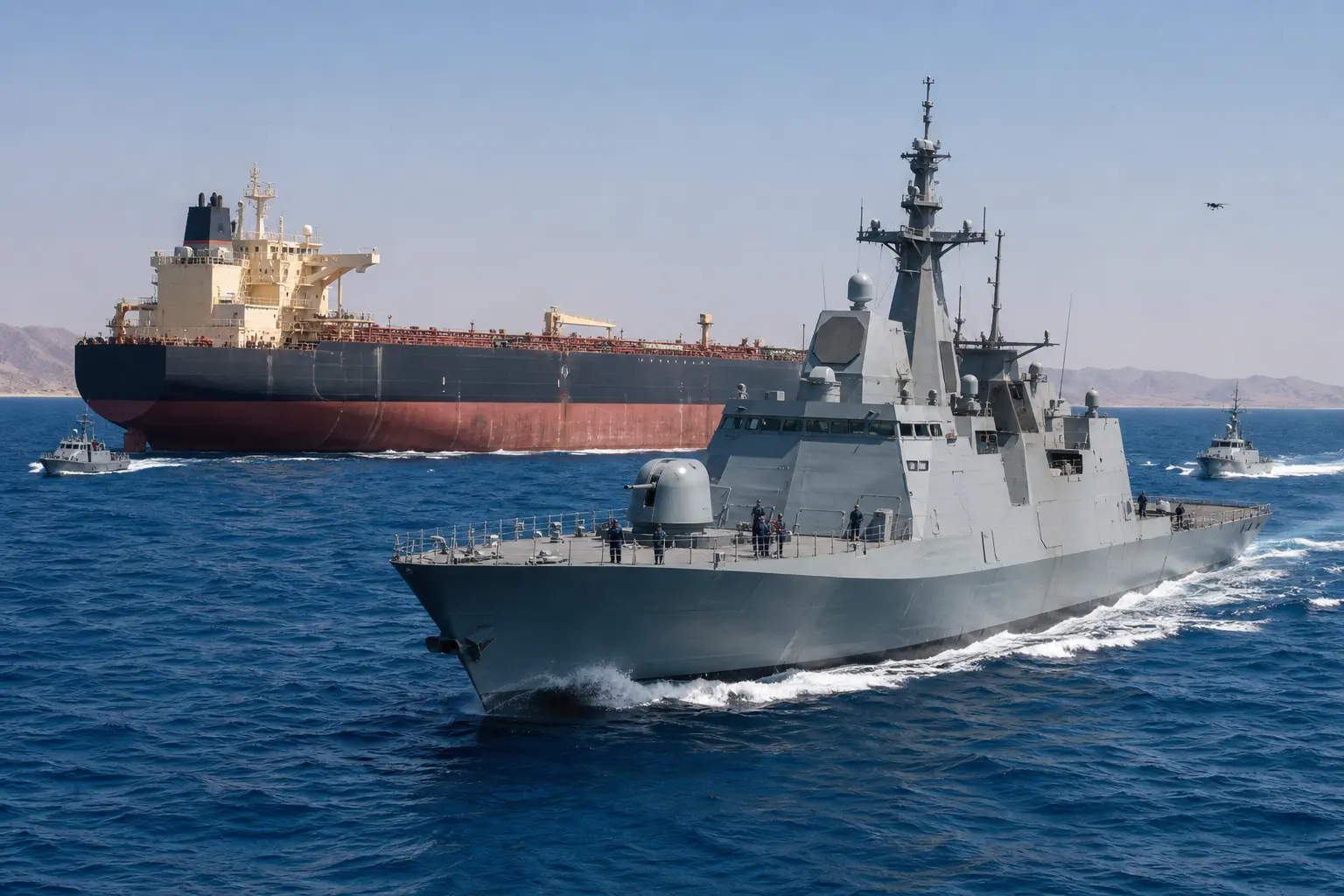
Why the Red Sea Became Critical Again
The civil war in Yemen has run more than a decade. Saudi Arabia and the UAE fought Houthi forces for years before a fragile truce. The current surge tracks the broader Iran confrontation: with the Strait of Hormuz under heavy pressure, Riyadh routes more oil west through the Red Sea. Stavridis notes these tankers now move up to 15 percent of the world’s petroleum products since the Hormuz crisis began, while the route still handles up to 30 percent of containerized shipping.
| Traffic Type | Share on Red Sea Routes |
|---|---|
| Petroleum products | Up to 15 percent since the Hormuz crisis |
| Containerized shipping | Up to 30 percent |
Houthis announced a naval blockade of Saudi Arabia around July 20 and claimed missile and drone hits on tankers and coastal facilities, including strikes reaching toward Yanbu. Traffic data showed sharp drops; one day recorded just eleven commodity vessels through Bab el-Mandeb. Saudi crude bound for Asia and Europe suddenly faced higher risk and longer or costlier alternatives.
Key dates in the latest squeeze form a short chain:
- Around July 20: Houthis announced a naval blockade of Saudi Arabia and claimed hits on tankers and coastal sites.
- Late July: Riyadh convened the multinational meeting to answer the shipping crisis.
- July 30: Fourteen states issued the joint founding statement in the Saudi capital.
Egypt has direct skin in the game through Suez Canal tolls. Turkey and Pakistan maintain long military ties with Gulf states. Smaller partners gain diplomatic weight and potential security cover. The alliance therefore sits inside both oil-market urgency and existing regional defense relationships.
What the Combined Fleets Bring
Stavridis, who sailed the Red Sea as a destroyer captain, inventories the hardware that could matter.
| Navy | Key Assets | Notable Constraint |
|---|---|---|
| Saudi Arabia | More than 30 modern warships (guided-missile frigates, corvettes, patrol craft); maritime air and helicopter wing | Fleet split east (Gulf) and west (Jeddah); western force must carry the load |
| Egypt | Largest Arab navy: two Mistral-class helicopter carriers, eight submarines | Suez revenue dependence drives strong interest |
| Turkey | At least 10 diesel submarines, 17 frigates, nine corvettes; TCG Anadolu drone carrier with strong C2 | Anadolu could serve as flagship after Suez transit |
| Pakistan | Around 10 air-defense frigates, five modern diesel-electric submarines, maritime patrol aircraft | Distance and other commitments |
| Kuwait / Bahrain | High-speed patrol craft; two former U.S. Oliver Hazard Perry frigates (Bahrain) | Hormuz constraints limit easy redeployment |
Gulf Arab navies already train together in U.S.-led and GCC exercises. Jeddah’s bases supply the logistical backbone. The western Saudi fleet, though smaller than the full inventory, sits closest to the threat.
Blue-water depth from Egypt, Turkey and Pakistan pairs with the high-speed patrol craft that Gulf partners already operate. That mix matches the convoy model Stavridis outlines: smaller hulls close to the merchant ships, heavier frigates holding the outer screen. Distance still limits how fast Pakistan can surge units, and Hormuz pressure keeps some Gulf craft tied farther east, so the Jeddah logistics node becomes the practical hinge for any sustained patrol cycle.
How Stavridis Sees the Operation Unfolding
The plan breaks into clear layers.
- Intelligence mapping of Houthi launch patterns from Bab el-Mandeb north into the central Red Sea. U.S. satellite coverage and the EU’s existing Operation Aspides task force would fill gaps the coalition cannot cover alone.
- A central operations hub, either aboard TCG Anadolu or ashore at Jeddah, staffed by coalition officers with U.S. and EU liaisons. That center would handle real-time responses, longer planning and air-traffic control for patrol aircraft.
- Convoy escort on the water: high-speed patrol craft shepherd tankers, each group screened by at least one guided-missile frigate. Commercial ships could embark small defense teams of roughly a dozen sailors or marines with shoulder-fired air-defense weapons and.50-caliber machine guns against boarders or low drones.
Stavridis writes that this “unlikely coalition should be capable of all these tasks, if it is well led by the Saudis with some help from the U.S. and EU.” The second-order question is whether the mere presence of regional hulls under Saudi command changes Houthi and Iranian calculations more than rotating Western destroyers have done.
Command arrangements matter as much as hull counts. A hub that blends Saudi lead officers with U.S. and EU liaisons can move targeting data faster than ad hoc ship-to-ship calls. Anadolu’s command-and-control suite, if it transits Suez and takes the flag, would give the coalition a mobile node already built for that role. Without that clarity, the founding statement risks remaining a roster rather than a working force.
Who Stayed Out and Why It Matters
The United Arab Emirates did not join. Stavridis notes the UAE fields several dozen warships well suited to Red Sea patrol yet remains locked in a multi-year feud with Riyadh and is absorbing its own Iranian drone and missile attacks. Oman, traditional mediator, also stayed outside.
Those absences leave gaps in both hull numbers and political cover. Egypt’s participation is real but careful; Suez revenues make disruption painful, yet Cairo has hesitated on full operational plunge in some reporting. Pakistan and Turkey bring capable ships, yet crowd reaction on X quickly labeled the pact a “paper agreement” until concrete deployments appear. One high-visibility scoop before the announcement warned the scheme was “unlikely to succeed without US backing.”
Bangladesh’s participation, confirmed in parallel coverage of Bangladesh joining the Saudi Red Sea pact, extends the map into South Asia and underscores how far the invitation list reached.
UAE hulls would have thickened the patrol craft layer that convoy work demands. Their absence forces greater reliance on the western Saudi force and on whatever Egypt and Turkey choose to sail. Oman’s decision to remain outside preserves its mediator role but removes another regional voice that might have broadened political cover for the defensive charter.
The Deeper Stakes Beyond Convoys
Success would do more than protect VLCC schedules. It would demonstrate that Saudi Arabia can organize a multinational maritime force with real local skin in the game while the United States remains heavily committed farther east. That outcome would ease pressure on Western navies, reassure oil markets that an alternative to Hormuz exists, and complicate Iran’s ability to squeeze Riyadh through proxies.
Failure or stalemate would reinforce the opposite lesson: only heavy U.S. and European combat power still deters. Shipping companies already reroute or pay higher insurance. Oil price spikes after recent Houthi claims showed how fast the market prices Red Sea risk. Wider wider Middle East energy interconnection risks rise when both Hormuz and Bab el-Mandeb look contested.
Baseline oil flows through Bab el-Mandeb routes and longer-term EIA world oil transit chokepoint data put the volumes in context: even before the latest surge, the corridor moved millions of barrels daily and a large slice of global containers. Post-Hormuz diversion made Saudi reliance acute.
Geographic Reach Backs the Defensive Charter
The founding roster is not only a list of flags. Djibouti, Somalia, Sudan and Comoros sit on or near the very waters the charter names: Bab el-Mandeb, the Red Sea and the Gulf of Aden. Their local knowledge and port access give the alliance eyes and berths that rotating Western destroyers rarely hold for long.
Bangladesh extends that map into South Asia, while the Yemen Presidential Leadership Council supplies a political claim on the shoreline where launches originate. Shared responsibility language in the charter turns those positions into a collective stake rather than a Saudi solo patrol.
Activities already listed fit that geography:
- Intelligence sharing across partners who watch different stretches of the same corridor
- Joint exercises that can rehearse convoy screens before commercial traffic returns in volume
- Maritime operations staged from Jeddah and from ports the smaller members control
No fixed ship contributions were announced, so the early test is whether geographic partners move sensors and small craft first while the heavier frigates from Egypt, Turkey and Pakistan follow. That sequence would match the defensive framing and keep the mission inside the charter’s stated bounds.
Limited Outside Help Still Shapes the Odds
Stavridis argues the mix works if Riyadh leads firmly and draws limited U.S. and European support. The plan itself already assigns those outsiders clear, bounded roles: satellite coverage the coalition cannot generate alone, the EU’s Operation Aspides task force as a gap filler, and liaisons inside the central hub rather than a U.S. flag in overall command.
That design answers the pre-announcement warning that the scheme was unlikely to succeed without U.S. backing. Backing here means data and staff, not a full Western destroyer rotation carrying the escort load. Jeddah or Anadolu would still run the day-to-day picture under Saudi lead.
Market confidence tracks the same distinction. Shipping firms that already reroute or pay higher insurance will watch for coalition hulls on the water, not for another round of founding statements. Limited outside help that arrives as sensors and liaisons can shorten the time between a launch report and a screen response. Whether that is enough depends on how fast the named commander turns the July 30 roster into sailing orders.
Escalation Remains the Unresolved Trap
Maritime escort alone may not stop launches from Houthi-held coast. Stavridis flags the next step plainly: air attacks on bases ashore. That risks retaliation against Saudi cities, oil facilities or coalition ships and could pull the western front of the Iran war hotter.
Recent Houthi drone strikes near the border and claimed tanker hits hundreds of kilometers north of Bab el-Mandeb already show the group’s reach. Iranian officials have publicly dismissed paper pacts with Turkey and Pakistan as insufficient security. On X, reactions mixed official Saudi announcements with dark jokes about yet another Yemen intervention and questions over whether Ankara or Islamabad will actually sail into harm’s way.
The coalition’s early test is therefore twofold: can it put enough hulls and sensors into the water fast enough to restore commercial confidence, and can Saudi leadership keep the mission defensive enough to avoid a wider shooting war it does not want. Stavridis leaves the answer open but tilts toward capability if the command arrangements hold. The coming weeks of actual deployments, not founding statements, will decide whether the second-order bet on regional ownership pays off.
