
Yemen’s Houthis claimed a drone strike Sunday on Saudi Aramco’s Jazan refinery, where firefighters extinguished a blaze with no injuries reported. The 400,000-barrel-per-day plant had already been shut since a late-July attack, and the hit landed two days after Riyadh signed a mutual defense pact with Turkey and Pakistan.
Houthi military spokesperson Yahya Saree said the remote-controlled drone scored a precise hit in response to Saudi drone flights over Saada and Hajjah provinces. Saudi Arabia’s energy ministry confirmed only that industrial security teams put out the early-morning fire at a Jazan facility and that authorities were handling the incident.
A Fire Put Out at an Already Idle Plant
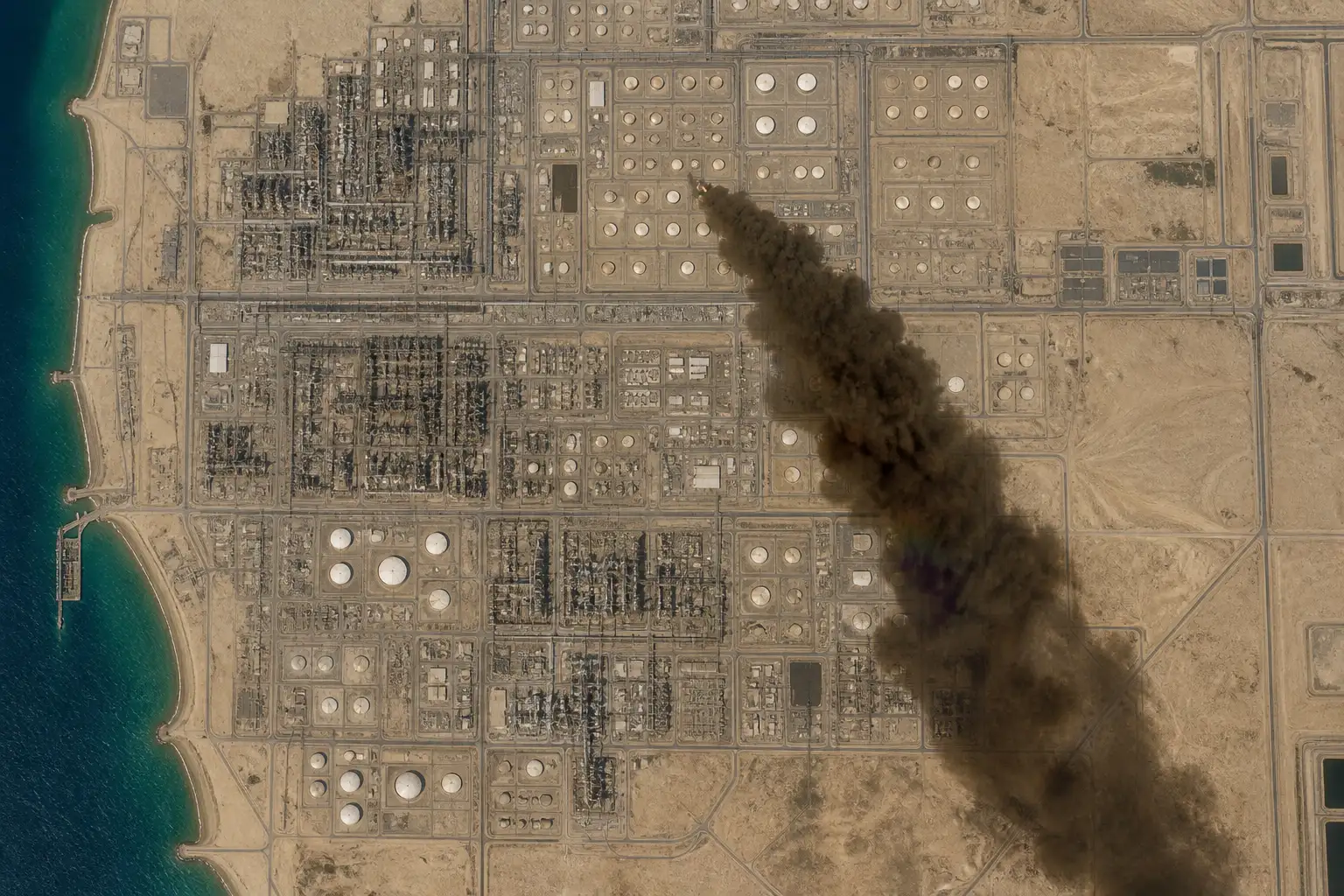
The Jazan complex sits in southwestern Saudi Arabia near the Yemen border and the Red Sea. It processes roughly 400,000 barrels of crude a day when running, about 4 percent of Aramco’s liquids output. Satellite imagery from the prior strike had shown thick smoke columns drifting inland.
Saudi teams moved fast this time. The ministry’s statement on X noted no casualties and that procedures continued after the fire was controlled. Saree’s claim framed the operation as defensive and successful.
With the use of a drone manipulated by remote control, the Yemeni armed forces launched a precise defensive attack on the Aramco refinery in Jizan, hitting their target with total precision.
Yahya Saree posted the line on the group’s channels. Independent verification of fresh structural damage beyond the fire remains limited; the plant’s offline status meant any new hit carried more signaling value than immediate volume loss.
An idle unit still offers a useful target. A fire at a shut plant forces security teams to respond, keeps restart crews on hold, and keeps the outage in the news cycle. The Houthis gain the claim of a precise defensive hit. Riyadh gains the ability to report a contained incident with no injuries. Both sides walk away with a usable message from the same early-morning blaze.
The plant’s location near the border and the Red Sea also keeps the episode inside a familiar geography. Prior smoke plumes had already mapped the site for outside observers. Sunday’s fire did not need to destroy new units to register. It only needed to confirm that the complex remained inside the range of remote-controlled drones.
The Pact Signed Two Days Earlier
On Friday in Mecca, Saudi Crown Prince Mohammed bin Salman, Turkish President Recep Tayyip Erdoğan and Pakistani Prime Minister Shehbaz Sharif signed the Mecca Joint Defence Agreement. The text treats an armed attack on any one of the three as an attack on all and calls for deeper defense cooperation.
Turkish Foreign Minister Hakan Fidan said the alliance was not aimed at Iran or any specific country. It served as a general security pledge. The three would consult on the degree and form of support if one came under attack. No public statement from Ankara or Islamabad followed Sunday’s claim.
The timing turns the document into an immediate public test. Crowds watching the region noted the absence of automatic military movement and the reliance on consultations. For more on the Mecca joint defence agreement details, the summit language stays high-level on triggers.
- Collective defense clause: attack on one equals attack on all
- Explicit call to enhance all aspects of defense cooperation
- Consultations to decide support format and scale
- Public framing as deterrence, not directed at any named state
The pact arrived amid the wider US-Israel war with Iran that began in late February and has drawn in proxies across the Gulf and Red Sea.
Consultation language buys time and flexibility. It also creates a visible gap between the signature ceremony and any concrete response. A drone strike that produces a contained fire does not force an automatic troop movement. It does force the new partners to decide how loudly, and how quickly, they will speak. Silence itself becomes part of the first test.
400,000 Barrels Still Offline
The July 25-26 Houthi missile and drone barrage damaged Jazan’s integrated gasification combined-cycle complex and parts of the tank farm. Aramco suspended operations on July 27. Industry notes seen by Reuters pointed to a tentative restart window around mid-August, though that date now sits under fresh pressure.
| Facility | Capacity | Status mid-August | Recent hits |
|---|---|---|---|
| Jazan refinery | 400,000 bpd | Shut since July 27 | July 25-26 damage; Aug 9 fire |
| Yanbu export hub | Major Red Sea terminal | Operating under heightened alert | Prior Houthi claims |
| Jazan IGCC power unit | Integrated with refinery | Damaged July | Key bottleneck for restart |
Crude can often be rerouted or stored. Finished products cannot. Gasoline, diesel and jet inventories were already tight before the July outage. Removing Jazan capacity hit product balances harder than raw crude volumes. A successful mid-August restart would have eased some of that; another fire resets the clock.
Earlier Houthi activity included a fourth Houthi strike on a Saudi tanker and repeated claims against Red Sea infrastructure.
The IGCC unit remains the practical bottleneck. Power and process heat must return before full crude runs resume. Tank-farm repairs matter, yet without the integrated power block the complex cannot simply flip back online. Each new fire claim, even one extinguished without injuries, adds another day of delay to that sequence.
Mokha Takes the Parallel Hits
The same day, Saree announced missile and drone strikes on the Yemeni Red Sea port of Mokha, held by the Saudi-backed government based in Aden. Yemeni military sources said seven people were killed. The transportation ministry reported severe damage to commercial quay and storage infrastructure.
Yemeni government sources told Reuters that air defenses engaged drones headed for the port. Mokha sits close to the Bab el-Mandeb strait, the southern gateway linking the Red Sea to the Gulf of Aden and Indian Ocean. Closing or degrading that chokepoint would remove one of Saudi Arabia’s remaining workarounds if Hormuz stays constrained.
- Casualties: at least 7 killed at Mokha per Yemeni military
- Infrastructure: commercial pier and storage hit hard
- Targets claimed: Saudi troops and weapons sites in the area
- Strategic stake: proximity to Bab el-Mandeb transit
Rashad al-Alimi, head of Yemen’s presidential council, briefed the US chargé on the developments and called for the international community, led by the United States, to move beyond containment of the Houthi threat to its sources.
The port strike and the refinery claim arrived on the same calendar day. One hit a Saudi industrial asset already offline. The other hit a government-held commercial gateway near the strait. Together they keep pressure on both processing capacity and the coastal routes that move fuel and goods.
Turkey and Pakistan Stay Quiet for Now
Requests for comment to Pakistani military, air force, prime minister’s office and foreign ministry went unanswered Sunday. The Turkish government likewise issued no immediate reaction to the refinery claim. Fidan’s earlier remarks left room for case-by-case decisions rather than automatic deployment.
Analysts and regional voices on X framed the silence as the first practical limit of the new arrangement. The pact strengthens deterrence on paper. In practice it requires political will and consultation time that a fast drone strike does not grant. Neither Ankara nor Islamabad has signaled readiness for direct involvement against Houthi or Iranian assets.
Saudi Arabia has long balanced US security ties with efforts to diversify partners. The Mecca step fits that pattern. Its first live test arrived before the ink was dry.
Quiet does not equal collapse of the pact. It does show that the consultation clause is doing real work. Partners can affirm the text on Friday and still choose silence on Sunday when the incident is a contained fire at an already idle plant. The next test will come if a strike produces casualties, longer outages, or a clearer demand for material support.
Red Sea Pressure Compounds Hormuz Limits
Iran has kept the Strait of Hormuz under tight control or closure conditions since the February escalation, issuing fresh demands that the United States end threats, withdraw forces, compensate for damage, lift sanctions and release frozen assets. Oman mediates talks that remain incomplete. Ship traffic has dropped sharply on some days.
The Houthis declared a naval blockade against Saudi Arabia in the Red Sea last month, citing a siege they say Riyadh maintains. Riyadh denies the charge. Combined with the Jazan and Yanbu pressure, the dual-chokepoint risk is clear. A drone claim that closed Najran airport and earlier strikes on the Yanbu pipeline fit the same pattern of probing Saudi western infrastructure.
- Late February 2026: US-Israel strikes on Iran open major escalation; proxies activate
- July 25-26: Houthi missiles and drones hit Jazan and Yanbu; large smoke plumes; Jazan shut July 27
- Last month: Houthis announce Red Sea naval blockade on Saudi shipping
- August 7: Mecca defense pact signed by Saudi Arabia, Turkey, Pakistan
- August 9: Houthi drone claim on Jazan; fire extinguished; Mokha port struck, 7 dead
Oil prices have swung with every Hormuz headline and Red Sea incident. Brent has traded in the low-to-mid $80s recently after larger spikes earlier in the conflict. Product cracks remain elevated because refining capacity, not just crude barrels, is the tighter constraint.
Same Day Strikes Link Refinery and Port Goals
Sunday’s claims paired an industrial target inside Saudi Arabia with a commercial port inside Yemen. The pairing is not accidental. One episode keeps the Jazan restart clock under pressure. The other damages quay and storage near Bab el-Mandeb and produces confirmed casualties.
The two locations sit on opposite sides of the same coastal theater. Jazan processes crude when it runs. Mokha handles commercial traffic near the southern gateway. Hitting both on one day multiplies the message without requiring a single massive strike on a fully operating mega-refinery.
- Jazan: already idle 400,000 bpd complex, fire controlled, no injuries, signaling value high
- Mokha: government-held port, commercial pier and storage damaged, at least 7 killed
- Shared day: one claim cycle, two fronts, one set of Houthi statements
- Shared geography: Red Sea corridor under parallel stress
Air defenses engaged drones near Mokha, according to Yemeni government sources. That detail shows the port was not an undefended soft target. It also shows that interceptions did not prevent the reported damage or the loss of life. The refinery side produced a contained fire and a ministry statement. The port side produced bodies and a damaged commercial quay. The contrast itself forms part of the pressure.
Rashad al-Alimi’s briefing to the US chargé framed the wider ask: move beyond containment to the sources of the threat. That language treats the Sunday hits as evidence that current measures have not stopped the drones or the missiles. The dual-target day gives that argument fresh material.
Finished Fuels Stay Tighter Than Crude Stocks
The July outage already removed a slice of regional refining capacity. Sunday’s fire did not need to add large new structural loss to matter. It only needed to push the tentative mid-August restart further out. Crude can move to other plants or into storage. Gasoline, diesel and jet fuel cannot be conjured from idle units.
Product cracks stay elevated for that reason. The market is not only counting barrels of raw oil. It is counting working distillation and conversion capacity that can turn those barrels into finished fuels. Jazan’s 400,000 barrels a day of potential throughput, plus the damaged IGCC block that supports it, sit inside that tighter constraint.
| Constraint type | Flexibility | Current pressure point |
|---|---|---|
| Crude oil | Can reroute or store | Hormuz traffic swings, Red Sea blockade claims |
| Finished products | Harder to replace quickly | Jazan offline since July 27, restart delayed |
| Export logistics | Depends on open terminals and ports | Yanbu on alert, Mokha quay damaged |
Brent in the low-to-mid $80s already reflects earlier spikes and partial calm. Product markets remain the more sensitive gauge. Each day the complex stays dark keeps local and regional balances tighter than crude stock numbers alone would suggest. Another contained fire is enough to reset expectations for when that capacity returns.
The Jazan fire is out. The plant remains offline. The new allies are consulting. And the proxies keep flying drones.
