
Israeli authorities opened tenders for 627 new housing units in the Kokhav Yaakov settlement on August 6, giving construction firms until November 30 to bid on a high-density project covering 253.7 dunams (about 63 acres) in the Ramallah and al-Bireh governorate.
The Israel Land Authority move, tracked by the Palestinian Colonisation and Wall Resistance Commission, shifts a plan approved on April 27, 2025, into the marketing phase after 15 months. The settlement sits squarely between northern Jerusalem and the twin cities of Ramallah and al-Bireh inside the area Israel calls the Binyamin bloc.
That shift from approval to open bidding marks the point at which paper plans become contracts. Once firms submit and win, the units move from a planning ledger into a construction queue that is far harder to reverse.
What the Tender Puts on the Ground
The commission identified the bid package as tender number 177/2026. It covers residential plots that will expand Kokhav Yaakov’s built-up area and tighten road links to neighboring settlements. Companies must submit by noon on November 30.
According to tender number 177/2026 details from the commission, the project forms part of a broader pattern. In the first half of 2026 alone authorities issued 12 settlement tenders covering 1,138 housing units across five main areas, plus separate bids for industrial zones, offices, nursing homes and tourism sites.
- 627 units in this single high-density package
- 253.7 dunams of land allocated
- 15 months from plan approval to tender
- November 30, 2026 bid deadline
Palestinian officials say the homes will push the settlement’s footprint outward while reinforcing its place in the Binyamin network. The high-density design packs more housing onto the same ridge, raising the permanent population that any future map would have to accommodate.
Road links matter as much as the units themselves. Each new internal road and connector shortens travel time to neighboring settlements and lengthens the detour Palestinians must take around the growing built-up zone.
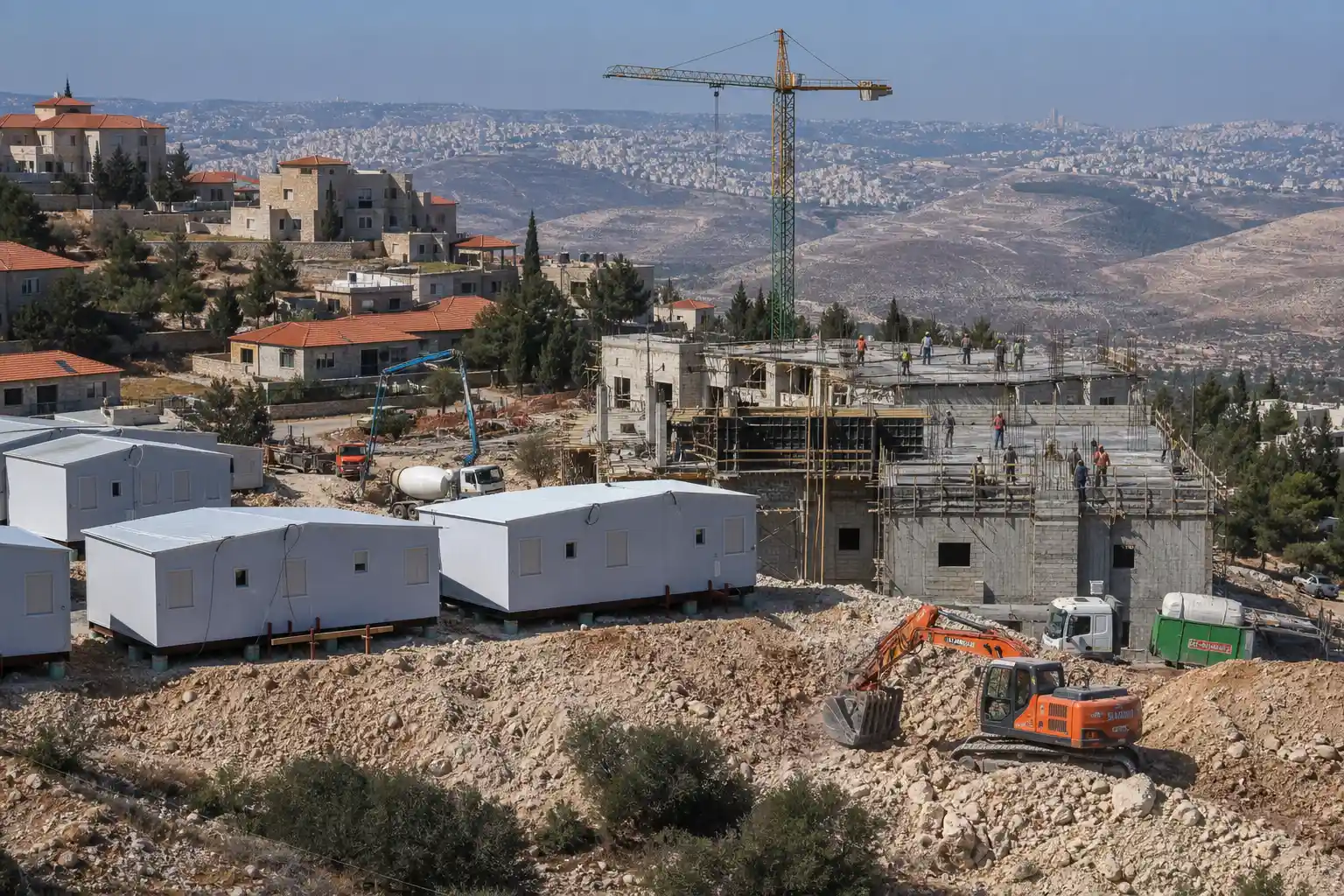
The Corridor Closing Between Two Cities
Kokhav Yaakov was established in 1985 by the Amana movement on land taken from the Palestinian villages of Kafr ‘Aqab and Burqa. It now holds a 2024 population of 4,093 and falls under the Mateh Binyamin Regional Council. A 2023 decision recognized its Tel Zion neighborhood as a separate settlement.
Its location turns every expansion into a geographic statement. The settlement and its neighbors already form a belt that narrows the open space Palestinians use to move between Ramallah and the northern approaches to Jerusalem. Strengthening those links with new housing and roads makes a future continuous Palestinian urban area harder to draw on any map.
Similar pressure appears farther east. Recent government steps around Geva Binyamin (Adam) and the long-contested E1 zone near Ma’ale Adumim aim at the same northern and eastern edges of Jerusalem. Together they convert scattered settlements into connected facts on the ground.
The effect is cumulative. One tender does not seal the corridor. Repeated tenders, each adding hundreds of units and new road stubs, steadily reduce the width of the remaining Palestinian passage until the open land functions more as a gap than a viable urban link.
Record Numbers Feed the Momentum
The 627 units arrive after a peak year for settlement planning. Peace Now recorded record 9,629 housing units tendered in 2025 and 27,941 units advanced through the Higher Planning Council. Kokhav Yaakov itself appeared in those plans with 1,247 units.
| Period | Housing units advanced or tendered | Key focus |
|---|---|---|
| Full year 2025 | 27,941 planned; 9,629 tendered | E1, Ma’ale Adumim, multiple blocs |
| H1 2026 | 1,138 units in 12 tenders | Five main settlements plus infra |
| Kokhav Yaakov 2025 plans | 1,247 units | Local expansion inside Binyamin |
| This tender Aug 2026 | 627 units | High-density residential |
Those figures sit beside 54 new official settlements approved in 2025 and 86 outposts, many agricultural farms that later seek regularization. The pace has left little pause for diplomacy.
The 627 units in the current package represent roughly half of the 1,247 units earlier advanced for Kokhav Yaakov alone. That ratio shows how planning totals convert, step by step, into marketable bids rather than remaining abstract council figures.
Palestinian Ground Lost in Parallel
While tenders move forward, monitors document rising friction. Palestinian sources tallied more than 11,000 attacks by Israeli forces and settlers in the West Bank since January 2026. Demolitions of Palestinian structures in Area C hit 1,269 in 2025, according to OCHA figures cited by Peace Now.
Twenty-two Palestinian communities faced full or partial displacement that year under settler pressure. The same hills that receive new Israeli housing lose olive groves, access roads and grazing land on the other side of the fence.
Local residents around Kafr ‘Aqab and Burqa have watched the settlement grow for four decades. Each new neighborhood reduces the remaining open land that once connected their villages to Ramallah’s economic core.
The parallel tracks reinforce each other. New Israeli units claim space at the same time demolitions and displacement remove Palestinian structures and access. The net result is a one-way transfer of usable ground.
- 1985: Kokhav Yaakov established by the Amana movement on land from Kafr ‘Aqab and Burqa
- 2023: Tel Zion neighborhood recognized as a separate settlement
- April 27, 2025: plan for the current expansion approved
- Full year 2025: record planning and tender totals recorded across the West Bank
- August 6, 2026: tender 177/2026 opened for 627 units
- November 30, 2026: bid submission deadline
International Law Meets Finished Concrete
UN Secretary-General António Guterres has stated repeatedly that Israeli settlements hold no legal validity. The International Court of Justice reached the same conclusion in its 2024 advisory opinion on the occupation, finding Israel’s continued presence in the Occupied Palestinian Territory unlawful and calling for it to end as rapidly as possible.
All Israeli settlements in the occupied West Bank, including East Jerusalem, and their associated regime and infrastructure, have no legal validity and are in flagrant violation of international law.
Guterres restated that position in later remarks. Israel disputes the characterization and continues the planning process under its own domestic rules. The tender process itself treats the land as available state property ready for private development.
Two years after the ICJ opinion, the practical result on this ridge is more units moving from paper to bid packages. Construction companies that win will pour foundations regardless of the legal debate in The Hague or New York.
The gap between legal findings and ground activity continues to widen. Advisory opinions and repeated statements set a clear international standard. The marketing of 627 units under tender 177/2026 shows how domestic administrative machinery keeps advancing projects on its own timetable.
Housing Is Only the Visible Layer
The Colonisation and Wall Resistance Commission notes that 2026 tenders extend past apartments. Bids have gone out for industrial zones, office space, nursing homes and tourism facilities. The pattern points to permanent economic infrastructure rather than temporary housing spikes.
Once factories, clinics and hotels open, the settlement becomes harder to reverse. Residents gain jobs and services inside the bloc. Israeli firms gain long-term contracts. The Binyamin regional council gains tax base and political weight.
Commercial platforms already list settlement properties for short-term stays, a practice that normalizes the locations for international visitors. That market exists alongside the new residential tenders.
Recent cabinet decisions added 13 new settlements approved along Route 60 inside the same broader zone, tightening the north-south Israeli presence further.
- Industrial zones and office space create local employment inside the bloc
- Nursing homes and tourism facilities add services that anchor long-term residency
- Route 60 approvals reinforce the north-south spine linking multiple settlements
- Short-term rental listings bring outside visitors into the same locations
Housing supplies the population. The accompanying commercial and service bids supply the economic reasons for that population to stay and expand.
The Binyamin Network Tightens Its Grip
Kokhav Yaakov does not stand alone. It belongs to the Mateh Binyamin Regional Council and forms one node in a chain that already includes Geva Binyamin (Adam) and points toward the E1 zone near Ma’ale Adumim. Each node’s growth strengthens the others by shortening the open stretches between them.
The 2024 population of 4,093 already gives the settlement demographic weight. Adding 627 high-density units raises that weight and increases demand for the very industrial, office and tourism facilities now going out to bid. Population and infrastructure feed each other.
Recognition of Tel Zion as a separate settlement in 2023 further multiplies administrative footholds on the same ridge. More named localities mean more planning files, more council seats and more claims on surrounding land.
Route 60 approvals supply the transport spine. New housing and commercial tenders supply the destinations along that spine. Together they convert a scatter of points into a continuous Israeli presence that Palestinian traffic must navigate around rather than through.
Who Gains Control and Who Loses Options
Settlers and the government gain contiguous territory and demographic depth north of Jerusalem. Construction firms gain contracts. The Mateh Binyamin council gains expanded jurisdiction.
Palestinians in Ramallah, al-Bireh and the surrounding villages lose the remaining physical space that could support a contiguous urban and agricultural zone. Future negotiators inherit a map where the shortest route between Palestinian population centers already runs through Israeli-controlled corridors.
The tender will not finish the corridor by itself. It adds another irreversible block. With bids due at the end of November, the next concrete pours will begin soon after contracts are signed. The gap between northern Jerusalem and Ramallah grows narrower with every unit that leaves the drawing board.
Online listings already treat some of these neighborhoods as ordinary places to rent. That quiet market acceptance runs in parallel with the official tenders and the commercial listings of settlement homes that keep the locations visible to outsiders.
Control accumulates through layered decisions: plan approval, tender release, contract award, foundation pour, and commercial listing. Each layer makes the previous one harder to undo. The 627 units now on offer form one more layer on a ridge that has been accumulating them since 1985.
