
The Egyptian Meteorological Authority forecasts feels-like temperatures of 47°C in southern Upper Egypt on Sunday as the Indian Seasonal Low lifts humidity across the country. Actual highs there will run 43-46°C; Greater Cairo and Lower Egypt sit at 37-39°C with a 42°C feels-like peak the same day.
The warning covers Friday 31 July through Tuesday 4 August 2026. Fog risks roads before dawn and intermittent winds sweep several regions. The numbers matter less for their novelty than for the pressures they immediately tighten.
Sunday’s Peak Hits Hardest in the South
EMA maps show a clear north-south gradient. Northern coasts stay milder. The real load falls on Upper Egypt, where humidity turns already extreme air into a heavier burden.
| Region | Fri max / feels | Sun max / feels | Tue max / feels |
|---|---|---|---|
| Greater Cairo & Lower Egypt | 37°C / 39°C | 39°C / 42°C | 37°C / 39°C |
| Northern Upper Egypt | 39°C / 41°C | 41°C / 43°C | 38°C / 40°C |
| Southern Upper Egypt | 43°C / 45°C | 46°C / 47°C | 45°C / 46°C |
| Northern coasts | 31°C / 34°C | 32°C / 35°C | 30°C / 34°C |
Humidity alone will make shaded readings feel 2-4°C hotter everywhere. Fog can form dense between 4 a.m. and 8 a.m. on routes into Greater Cairo, the Canal cities, Central Sinai and northern Upper Egypt. Winds rise in bursts from Friday through Tuesday across the northwest coast, Cairo, Lower Egypt and southern Upper Egypt.
AccuWeather’s Cairo August outlook shows daily highs mostly 35-39°C (95-103°F), in line with the EMA band. Southern stations routinely outrun the capital by 5-8°C in midsummer.
The Summer Monster Raises the Feels-Like Load
The Indian Seasonal Low, long nicknamed the Summer Monster in local forecasts, arrives as a broad low-pressure area that pulls moist air northward. It does not create the heat. It multiplies its effect on the body by locking humidity high through the day and into the night.
- Indian Seasonal Low: A recurring summer pressure system over the Indian Ocean and surrounding regions that draws humid air into Egypt, elevating relative humidity and the heat index by several degrees even when air temperatures hold steady.
Nights stay moderately warm and humid rather than offering full recovery. That cumulative stress is what turns a hot week into a health and infrastructure event. EMA statements stress that the feels-like values, not the dry-bulb numbers, guide public advice.
Public posts and local outlets have already locked onto the 47°C southern figure and the Sunday peak. Daily tracking of the feels-like column is now routine for many residents.
Power Demand Climbs While Plants Lose Efficiency
Heat and humidity drive air-conditioning loads at the exact moment thermal plants become less efficient. Hot intake air is less dense, so gas turbines produce less electricity from the same fuel. Solar panels also lose output as cell temperatures rise.
Minister of Electricity and Renewable Energy Mahmoud Esmat said Egypt’s electricity demand in Summer 2026 is expected to rise 8% compared with Summer 2025. That figure appears in detailed coverage of the sector’s response. A year earlier the grid already set a record load of 39,500 MW during a heatwave.
- 8% demand rise projected for Summer 2026 versus 2025
- 39,500 MW prior peak load recorded in August 2025
- Gas-turbine output drops in high ambient heat; more fuel needed for the same megawatts
- LNG imports and domestic gas production both pressed harder to keep stations running
The same conditions that lift electricity demand Summer 2026 up 8% also raise rising fuel import costs when the government buys additional oil and gas. Digital tools (IoT sensors, predictive analytics, digital twins) are being pushed to catch heat-related equipment stress before outages. Renewables expansion is framed as the longer-term escape from the fossil-fuel feedback loop.
Office hours have been shortened in some public settings specifically to cut daytime AC draw. The grid has held so far, yet each successive hot summer narrows the margin.
Outdoor Work and Farms Feel the Immediate Squeeze
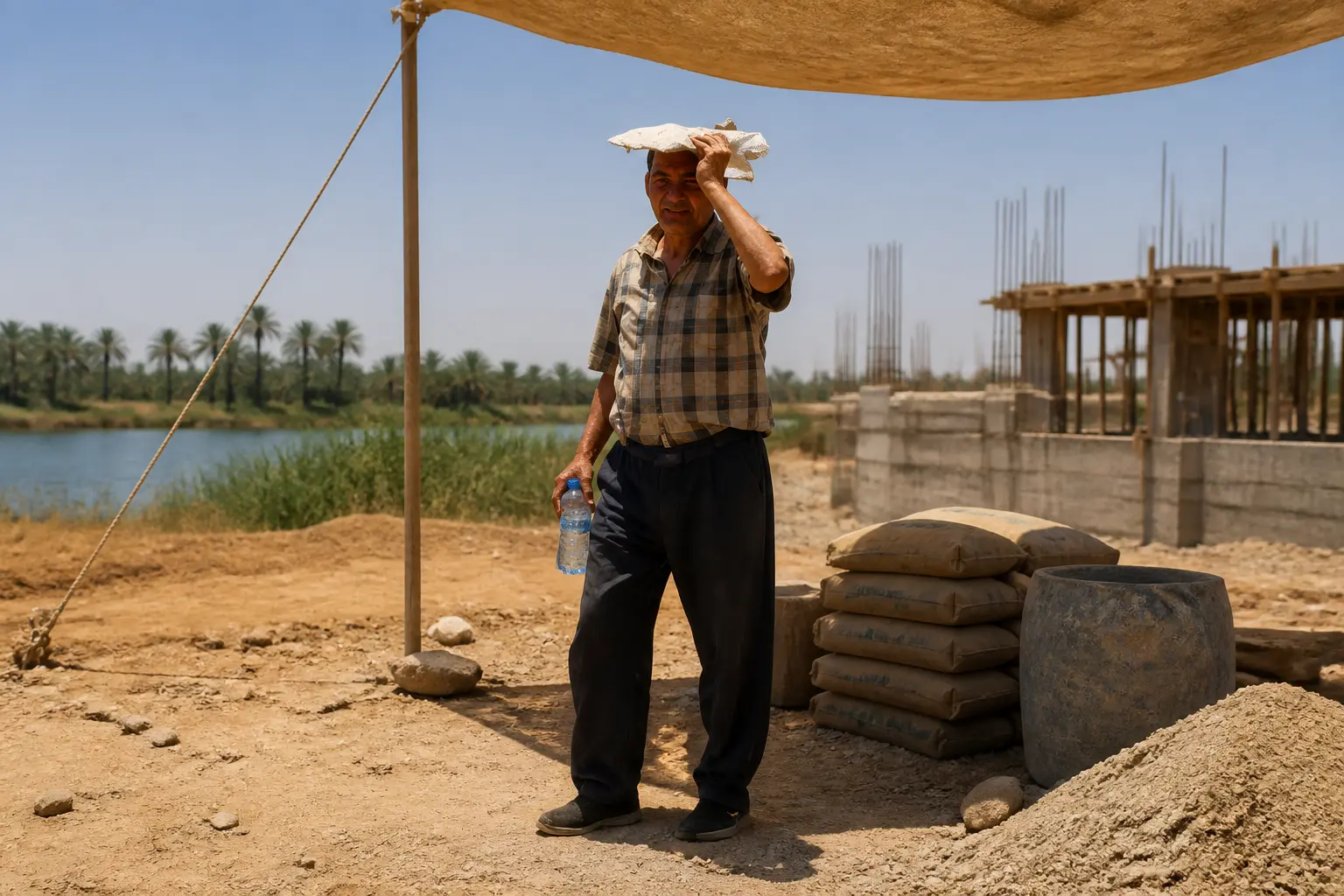
Construction, agriculture and tourism absorb the direct hit. In Alexandria earlier this summer a construction worker described eight-hour shifts that now require more frequent short breaks for water because longer pauses would leave daily targets unfinished. Company owners report moving crews to evening hours, adding shade and water stations, and cutting daytime exposure.
We work eight hours a day. It’s exhausting. Now we take more breaks than usual to have a drink, tea, water, but we can’t take long breaks as we have to finish tasks every day.
Aly Gamal, construction worker in Alexandria, speaking during the July heat.
Parallel pressures land on several groups at once:
- Outdoor laborers in construction and street work who cannot fully shift indoors
- Farm workers and harvest crews facing premature crop maturity and lower nutritional quality in fruit and vegetables
- Tour operators and guides at open-air sites in Luxor, Aswan and Cairo, where bookings have dropped in peak heat
- Low-income households that absorb higher food prices when supply tightens and that depend on subsidies when inflation rises
Wheat, rice, fruit and vegetable harvests weaken under heat stress. Less supply lifts prices and inflation. Analysts note the state then expands subsidies, which further strains the budget while lower productivity reduces revenue. Tourism traffic at monuments falls precisely when Cairo airport traffic patterns would otherwise support visitor volumes.
Records Keep Climbing Across the Decades
Egypt already sits near the top of regional heat risk. A 2023 Lancet Planetary Health assessment placed the country’s annual heat-related mortality burden at roughly 2591 heat-related deaths per year, the highest absolute number in the MENA region. Future projections under high-emissions paths rise sharply unless adaptation and mitigation accelerate.
- 1961, Previous national record 50.3°C set at Kharga
- June 2024, Aswan reaches 50.9°C, new national all-time high and highest reliable June temperature for Africa
- August 2015, Multi-day heatwave linked to more than 60 deaths in Egypt alone
- July-August 2025-2026, Successive load records on the power grid and repeated EMA multi-day extreme-heat alerts
The 2024 Aswan reading exceeded the old mark by 0.6°C and arrived early in the season. Climate assessments for North Africa show seasonal temperatures rising faster than the global average. Urban heat islands and limited green space in dense districts amplify the effect for city residents.
Health Guidance Stays Simple and Time-Critical
Deaths and hospital admissions linked to extreme heat cluster on the day of peak temperatures and the day after. That leaves little lag for response. WHO guidance on heat and health stresses rapid public messaging, protection of outdoor workers, cooling access for the elderly and those with heart, kidney or respiratory conditions, and avoidance of strenuous activity in the hottest hours.
Practical steps remain consistent: stay shaded or indoors through midday, drink water regularly, use light clothing, cool homes at night by opening windows when outdoor air is cooler, and check on vulnerable neighbors. Fans lose effectiveness above roughly 40°C air temperature. Never leave children or animals in parked vehicles.
Egypt has shortened some outdoor work windows and expanded renewable capacity targets. Heat-health action plans and early-warning systems still lag the pace of warming in many districts. The current five-day window offers a live test of how quickly those measures reach the people who need them most.
Southern Upper Egypt will carry the heaviest feels-like load through Tuesday. The rest of the country stays hot and humid. The thermometers will ease eventually. The tighter electricity balance, the health burden and the pressure on outdoor livelihoods will not reset as quickly.
