
A consortium led by Saudi Arabia’s Public Investment Fund completed its $55 billion acquisition of Electronic Arts on 4 August 2026, taking the publisher of Battlefield, The Sims and EA Sports FC private in the largest leveraged buyout on record. PIF holds about 93.4 percent of the new company, with Silver Lake and Affinity Partners holding the rest. Shareholders received $210 a share in cash.
The deal is the clearest signal yet of the Kingdom’s intent to turn gaming capital into lasting creative and commercial power under Vision 2030. Whether ownership of a major global publisher accelerates that shift, or simply adds another expensive asset, now depends on second-order effects that money alone cannot settle.
The largest take-private hands Riyadh the franchises
EA said the new ownership structure would supply long-term capital and strategic support for its next phase. Chairman and CEO Andrew Wilson called the moment recognition of the people who built the company and said the partners shared EA’s ambition to invest boldly and accelerate innovation for hundreds of millions of players.
Having been a minority investor in the company for more than five years, we have a deep understanding of EA’s unique platform, massive global sports and gaming franchises, and iconic IP.
Turqi Alnowaiser, PIF’s deputy governor and head of international investments, said entertainment and sports are priority sectors for the fund. Egon Durban of Silver Lake and Jared Kushner of Affinity Partners also pointed to long-term investment and the reach of EA’s brands. In fiscal 2026 EA posted roughly $7.5 billion in GAAP net revenue.
The transaction was announced in September 2025, approved by stockholders in December 2025 and financed with roughly $36 billion in equity plus more than $20 billion in debt arranged by JPMorgan. EA’s existing debt rose sharply as a result. The company has delisted from Nasdaq.
That path from announcement to close compressed a full cycle of stockholder approval, debt syndication and delisting into less than a year. The equity majority sits with PIF; the debt load sits on the operating company. Both facts now shape how freely management can fund multi-year projects.
- September 2025: consortium announces the take-private at $210 a share.
- December 2025: stockholders approve the transaction.
- 4 August 2026: deal closes; EA delists from Nasdaq.
- Financing mix: roughly $36 billion equity and more than $20 billion debt via JPMorgan.
National targets already set the 2030 clock
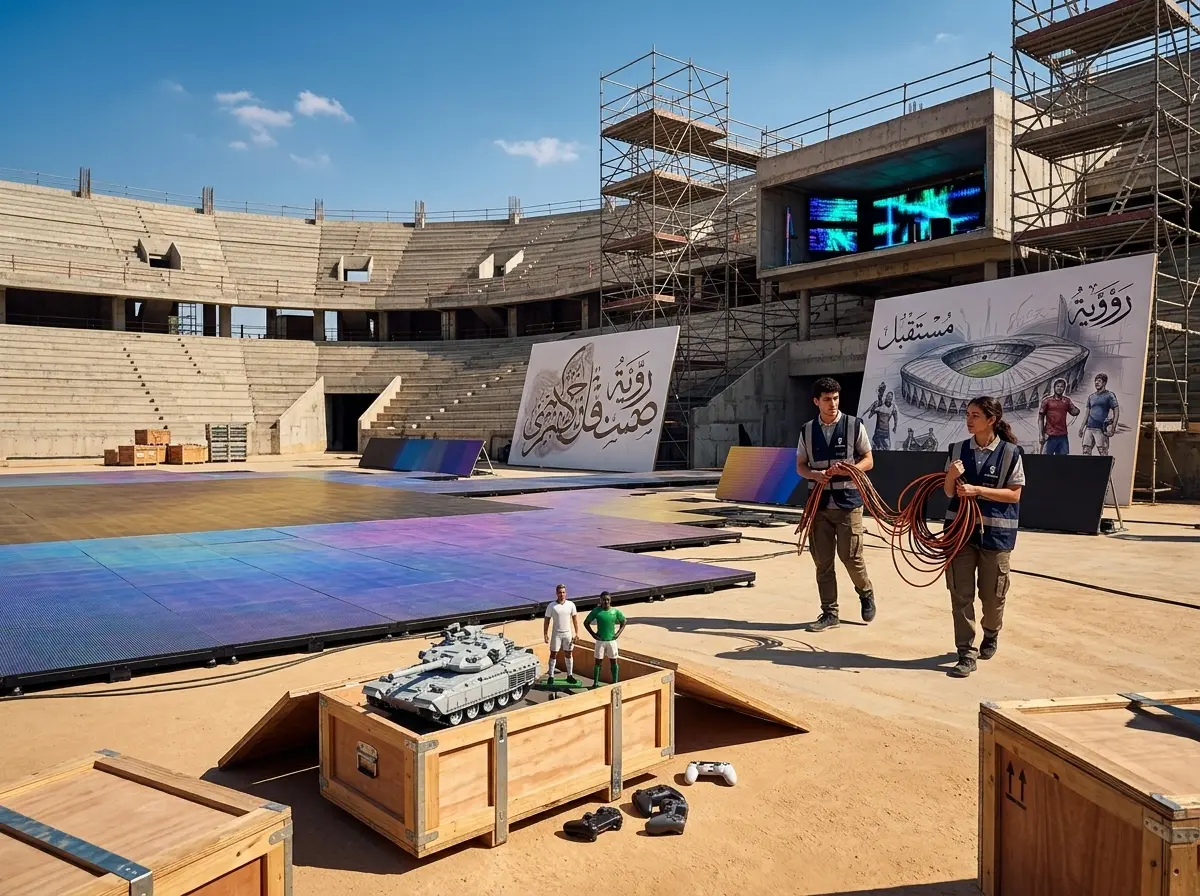
Gaming sits inside Vision 2030’s push to diversify away from oil. The National Gaming and Esports Strategy, launched in 2022, channels more than $38 billion through PIF and its wholly owned vehicle Savvy Games Group. Official targets include 39,000 sector jobs and 250 studios by 2030, plus roughly SAR 50 billion (about $13.3 billion) in direct and indirect GDP contribution and more than 30 globally recognised games produced in the Kingdom.
- ~15,000 gaming-sector jobs estimated by 2025, up from about 5,000 in 2022
- ~40 domestic game studios by 2025 against a 250-plus goal
- SAR 20 billion sector contribution by 2025 versus the SAR 50 billion-plus target
- 25 million-plus Saudi gamers already, heading toward 30 million-plus
Savvy, established in 2021, is the operational engine. Its mandate covers acquisitions, domestic studio building, esports infrastructure and talent programmes. The same diversification logic appears in other high-tech bets, including Saudi diversification into high-tech defence systems.
The 2025 checkpoints already show uneven distance to the 2030 line. Jobs and player counts moved faster than studio formation and GDP contribution. That gap is why university pipelines and incubators now matter as much as headline acquisitions.
| Measure | 2025 checkpoint | 2030 target |
|---|---|---|
| Sector jobs | ~15,000 (from ~5,000 in 2022) | 39,000 |
| Domestic studios | ~40 | 250-plus |
| Sector GDP contribution | SAR 20 billion | SAR 50 billion-plus |
| Saudi gamers | 25 million-plus | 30 million-plus |
| Globally recognised local games | Not yet at scale | More than 30 |
Savvy’s portfolio now spans mobile, esports and console IP
Before EA, Savvy and PIF assembled a string of platform assets. Scopely was bought for $4.9 billion in 2023; Scopely later acquired Niantic’s gaming business, including Pokémon GO, for $3.5 billion in 2025. Savvy agreed in 2026 to buy Moonton, the developer of Mobile Legends: Bang Bang, from ByteDance in a deal valued at more than $6 billion, giving deeper reach in Southeast Asian mobile markets. ESL FACEIT Group was acquired earlier for about $1.5 billion, adding the world’s largest esports organiser and platform.
| Asset | Type | Approximate value / stake |
|---|---|---|
| Electronic Arts | Full (PIF 93.4%) | $55 billion enterprise |
| Scopely | Full | $4.9 billion |
| Moonton | Full (agreed) | $6 billion-plus |
| ESL FACEIT Group | Full | $1.5 billion |
| Niantic gaming (via Scopely) | Full | $3.5 billion |
PIF also holds minority stakes in companies such as Nintendo, Capcom and Nexon. The portfolio supplies distribution, player bases measured in hundreds of millions, and tournament infrastructure. It does not automatically supply the next original hit.
Stacked together, the holdings cover console franchises, Western and Asian mobile scale, live-service audience tools and competitive circuits. Cross-promotion and shared live-ops know-how are the practical levers. Ownership alone does not force those levers to move in sync.
Jobs targets meet a thin local talent bench
Saudi Arabia has a young population, high smartphone penetration and strong purchasing power. What it still lacks in depth is the full stack of experienced programmers, designers, artists, producers, animators, writers and studio executives who turn capital into shippable games. Industry veterans note that even established hubs struggle with rising development costs and failed launches; a sovereign fund cannot guarantee hits.
Recent steps show the pipeline starting to move. In May 2026 Alfaisal University and Savvy launched a Games Lab under a Game Innovation Center to give students real-project experience and industry-aligned training. Scholarship programmes send Saudis to international development courses. Incubators and regulatory work by the General Entertainment Authority and the Ministry of Communications and Space Technology aim to lower barriers for startups.
The 39,000-job figure will only matter if a large share of those roles sit inside sustainable studios rather than event management, administration or investment offices. Universities and vocational programmes now carry more of the strategy’s weight than any single acquisition.
Senior creative leadership remains the scarce layer. Junior intake can grow through labs and scholarships; shipping veterans and franchise producers take longer to develop or attract. That timing mismatch is the binding constraint on studio count, not capital availability.
Esports already puts Riyadh on the global calendar
The Kingdom has poured resources into tournaments and venues. The Esports World Cup has made Riyadh a regular stop with large prize pools. ESL FACEIT’s five-year partnership with Qiddiya City is designed to turn the entertainment giga-project southwest of Riyadh into a permanent gaming and esports district covering 500,000 square meters of gaming space. The district is planned to house tournament venues, training centres, tech incubators and company headquarters, drawing on EFG’s 225 million-strong fan base.
Plans for the inaugural Olympic Esports Games in Riyadh in 2027 later unravelled; the IOC and Saudi partners ended their 12-year hosting arrangement by mutual agreement in late 2025, leaving the event’s future host open. The World Cup and Qiddiya work continue regardless. Large events bring players, audiences, sponsors and streaming revenue. Connecting that flywheel to locally made games remains the open commercial step.
Riyadh has used similar high-profile gatherings to position itself as a meeting point, as seen in earlier Riyadh forums drawing global industry leaders.
Event density builds brand and sponsor habits. It does not by itself create a development cluster. The commercial bridge is still content that travels after the lights go down on the arena calendar.
Private ownership and new debt rewrite the creative incentives
Going private removes quarterly earnings pressure. Wilson and the consortium have stressed patient capital and freedom to invest for the longer term, including AI tools for development and player experience. That structure can favour multi-year franchise investments over short-cycle live-service experiments.
It also loads EA with more than $20 billion in acquisition debt that must be serviced. Industry observers have long warned that large publishers under financial pressure tend to double down on proven brands and cut riskier new IP. For Saudi Arabia the strongest outcome is not simply higher extraction from Battlefield or EA Sports FC, but using EA’s experience, tools and distribution to lift the wider Savvy ecosystem and domestic studios.
Reputational questions travel with the capital. Human-rights groups and parts of the gaming community have described the investments as image management. Earlier political scrutiny in the United States raised foreign-influence concerns around the EA transaction itself. Those debates can affect talent recruitment, partnership appetite and audience goodwill even when commercial logic is sound.
Patient capital and heavy leverage pull in opposite directions. One invites longer creative cycles; the other rewards predictable cash flow from known brands. How the board balances those forces will show up first in greenlight decisions, not in press statements.
The Portfolio Can Feed Domestic Studios Only If Linked
EA brings console and sports franchise depth. Scopely and the Moonton agreement extend mobile reach, including Southeast Asian markets. ESL FACEIT supplies tournament operations and a large competitive audience. Qiddiya adds permanent physical space for events, training and company bases.
On paper those pieces complement one another. In practice, transfer of tools, middleware, live-ops discipline and producer talent into Saudi studios is a management choice, not an automatic result of common ownership. Without deliberate pathways, each asset can optimise for its own P&L and leave the domestic bench unchanged.
- Console and sports IP expertise from EA for long-cycle production habits
- Mobile live-service scale from Scopely, Niantic gaming assets and Moonton
- Competitive calendar and fan access through ESL FACEIT Group
- Physical district capacity at Qiddiya for training, incubators and headquarters
Minority stakes in firms such as Nintendo, Capcom and Nexon add observation points into other hit-driven cultures. They do not substitute for local teams that can ship.
Debt Service Will Test the Patience Narrative
More than $20 billion in acquisition debt sits alongside a publisher that posted roughly $7.5 billion in fiscal 2026 GAAP net revenue. Servicing that stack does not require crisis conditions to influence behaviour. It only requires routine caution in capital allocation.
The consortium’s public line stresses bold investment and AI-assisted development. The balance-sheet line stresses interest cover and franchise reliability. Both can be true in the same year if legacy titles fund experimentation elsewhere. Both can also collide if growth slows and cuts fall on unproven work first.
For Vision 2030 metrics, the risk is subtle. EA can remain commercially healthy while contributing little to the 250-studio or original-game targets. Domestic progress then rests again on Savvy’s incubators, the Alfaisal Games Lab model, scholarships and GEA and ministry rule-making rather than on the flagship take-private.
Original IP remains the only lasting proof
By 2030 the Kingdom may have the studios, venues, training programmes and international networks it set out to build. The decisive marker will be a game created primarily in Saudi Arabia that finds a global audience without depending mainly on Saudi funding, Saudi events or Saudi players. That test is harder than writing cheques for existing platforms.
The pieces now form a more coherent industry map than a scatter of separate bets: EA for console and sports franchises, Scopely and Moonton for mobile scale, ESL FACEIT for competitive infrastructure, Qiddiya for physical destination, university labs for people. Second-order pressure runs through every layer. Debt service at EA, competition for scarce senior talent, content standards, and the simple unpredictability of hit-driven entertainment all sit between today’s ownership and the creative powerhouse the strategy describes.
Riyadh has bought its seat at the top table. The next several years will show whether the same capital can grow the people and the original work that keep a seat permanent.
