
Peter Pan is flying again at the Tel Aviv Performing Arts Center through late August, with Lee Biran in the title role, Sasson Gabay back as Captain Hook, and original 1980s star Hanoch Rosen now directing the Hebrew musical he helped create. The two-hour show, complete with intermission, packs parents and children into the Israeli Opera house for one last burst of Neverland before the school year starts.
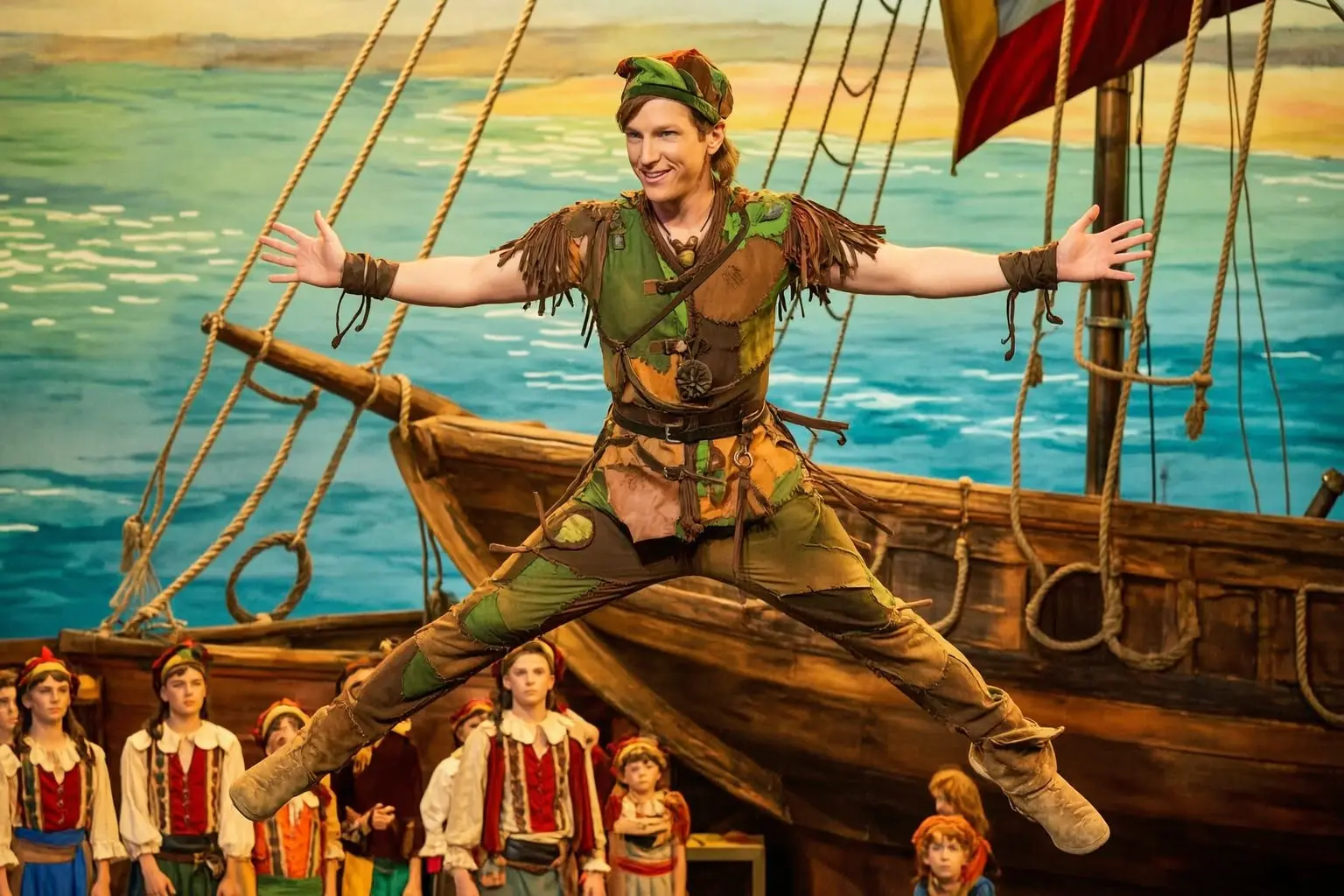
Gadi Zaig of The Jerusalem Post caught an early afternoon performance and found an energetic cast, catchy original Hebrew songs, impressive sets and costumes, plus flight technology that lifts the leads literally off the stage.
The revival arrives as a full-scale family production rather than a modest restaging. It leans on the same Hebrew book and score that first caught fire nearly four decades ago, then layers on modern stagecraft so the old songs still feel immediate in a large opera house.
Lee Biran leads a cast that never sits still
Biran brings constant charisma and physical drive as Peter. Meshi Kleinstein’s Wendy stands out for an angelic voice, especially on the opening number “He Must Come.” Ofir Weil’s Smee draws steady laughs with comic mannerisms as Hook’s sidekick. Linoy Cohen (sharing Tiger Lily with Tal Levi) shines in dance and stage physicality. Gabay steals scenes with pure villainous presence, closing a personal circle by returning to the role he played in the original production.
The ensemble works hard, doubling as pirates and tribe members while delivering multiple choreographed numbers. Jerusalem Post noted the whole company proves there are no small parts here.
| Role | 2026 cast | 1988 original |
|---|---|---|
| Peter Pan | Lee Biran | Hanoch Rosen |
| Wendy | Meshi Kleinstein | Hani Nahmias |
| Captain Hook | Sasson Gabay | Sasson Gabay |
| Smee | Ofir Weil | Tzachi Noy |
| Tiger Lily | Linoy Cohen / Tal Levi | Haya Samir |
John and Michael are played by Assaf Levi and Gilad Brown. The lost boys include Hanan Schwarzberg, Liam Pinto and Timothy Sennikov. Secondary director and choreographer Oz Morag keeps everyone moving.
That dual casting of Tiger Lily and the heavy doubling inside the ensemble show how the production stretches a large company across both Neverland factions. Morag’s choreography has to read clearly whether a performer is pirate or tribe member in any given number, which keeps the stage picture busy without muddying the story.
Gabay’s return as Hook gives the villain scenes a lived-in authority the younger leads can push against. Biran’s physical attack as Peter and Kleinstein’s vocal clarity as Wendy supply the forward energy; Weil’s comic Smee supplies the release. The balance is what lets the two-hour runtime, intermission included, stay light for mixed-age houses.
The 1988 show that defined a generation
Uri Paster and Hanoch Rosen adapted J.M. Barrie’s story into a Hebrew musical that premiered around 1988-1989 at the Haifa Theater. Rosen starred as Peter, Nahmias as Wendy, and Gabay as Hook. It ran more than 300 performances, won a Kinor David award, and spun off a video cassette, song album and book that entered countless Israeli homes.
Songs such as “Halayla Hu Hayav Lehagi’a” (He Must Come Tonight), “Anachnu Afim” (We Are Flying) and “Brit Damim” (Blood Oath) became cult favorites. A 1997 restaging with Gil Sassover and others scored even bigger commercial success. Earlier Israeli versions stretched back to 1965 at Haifa with Gila Almagor as Peter and a Nissim Aloni translation.
- 1965: Haifa Theater mounts a professional production with Gila Almagor as Peter Pan.
- 1988-89: Paster-Rosen musical opens, becomes a phenomenon with 300-plus shows and home-video afterlife.
- 1997: Paster’s new version with Sassover tops the original’s box office.
- 2009: Haifa and Orna Porat theaters revive a more text-faithful version.
- 2026: Rosen directs the big return at the Israeli Opera with Gabay and a new generation of leads.
An Israeli theater history of Peter Pan stagings traces how the boy who wouldn’t grow up kept returning in Hebrew adaptations that mixed fantasy, adventure and family escape.
The home-video and album afterlife mattered as much as the original Haifa run. Parents now in the opera house often first met the score on cassette, not in a theater seat. That is why an unchanged core text still lands: the songs already function as shared memory before the curtain rises.
Each later staging answered a different need. The 1997 version chased larger commercial reach. The 2009 revival leaned closer to Barrie’s text. The 2026 return, with Rosen directing and Gabay again in the hook, treats the Paster-Rosen musical itself as the classic worth restoring at full scale.
Sets, costumes and the ticking crocodile
Production designer Bambi Friedman and costume designer Ella Kolesnik deliver the visual scale. Video art by Shai Bonder and lighting by Yaniv Surik add layers. The crocodile that haunts Hook lands as a clever mechanical and performance effect that caught reviewers’ eyes.
Jerusalem Post praised how the staging pulls off the immersion into Neverland. Makor Rishon noted the upgraded effects enrich the experience while the core text stays loyal to the 1980s version, which some parents can still recite from memory.
- Book and lyrics: Uri Paster (with Rosen)
- Music: Ilan Gilboa
- Direction: Hanoch Rosen
- Choreography: Oz Morag
- Musical production: Ben Shofen
- Flying system: Kirby flying, imported specially
The result feels grand without losing the playful spirit that made the original stick.
Friedman and Kolesnik’s work has to serve both the pirate ship and the tribal sequences while leaving enough clear air for the flying cues. Bonder’s video art and Surik’s lighting fill the Israeli Opera’s large frame so the same Hebrew scenes that once played in Haifa now hold a bigger room. The crocodile effect sits at the comic-threat hinge of Hook’s arc: mechanical enough to startle, theatrical enough to stay inside the show’s playful tone.
Imported flying gear lifts the leads
Kirby flying technology, brought from abroad for this run, lets Biran and Kleinstein soar in sequences that earlier Israeli productions could only suggest. Official materials describe it as unique and innovative for the local stage. Combined with giant sets, it aims at international standards while keeping the Hebrew songs intact.
Rosen told a rehearsal presentation he once played Peter nearly 300 times and watched tens of thousands of children leave believing he had really flown overhead. “I enter this work with sacred awe. What makes the show is the story, the emotion, the characters and their meaning,” he said, according to a first look at rehearsals with Rosen.
An album of the 2026 performances is already streaming, giving families the soundtrack before or after the show.
The flying gear is the clearest upgrade from the versions that could only imply flight. When Biran and Kleinstein leave the deck, the old promise inside songs such as “Anachnu Afim” becomes a visible event rather than a suggested one. That shift explains why official materials stress the system’s local rarity: the production wants the spectacle to match the memory parents already carry.
Rosen’s rehearsal remark ties the new technology back to the old effect on children. He is not selling hardware. He is protecting the same belief he once created from the air, night after night, across those nearly 300 performances.
Parents and kids fill the house before school
Audiences are mostly families. Children respond with cheers and laughter; some even root for Hook. Parents who grew up on the old video get the double hit of nostalgia plus watching their own kids discover the story. Demand forced organizers to add seven performances after the first 23 sold strongly. Shows run multiple times a day on peak dates.
פיטר פן המחזמר היה מ ה מ ם מושקע, מרגש, מצחיק, עם כבוד לשחקנים וללהקה המדהימה וכבוד לקהל. נהנינו ממש!!!
That front-row reaction on X from theatergoer Leehee captured the common vibe: invested production, funny, emotional, respectful of both cast and crowd. Another viewer called it pyrotechnic and loud yet enjoyable. The spectacle lands even for non-Hebrew speakers who know the Barrie plot and can follow the physical comedy and flight.
Makor Rishon enjoyed the magic and nostalgia but flagged that the unchanged text shows its age on Wendy’s role and the tribal characters’ dialogue. Kids still laughed through the battles, though the youngest sometimes startled at the louder fights. Overall the house stayed active and happy.
The sales pattern tells the practical story. Strong uptake on the first 23 dates, then seven more added, plus multiple shows on peak days, points to a narrow summer window families are trying to catch before school resumes. Nostalgia fills adult seats; the flying and the comic battles fill the children’s half of the bargain.
The Cult Songs Still Pull Crowds
The score remains the production’s strongest bridge between 1988 and 2026. Ilan Gilboa’s music and the Paster-Rosen lyrics never left family rotation after the original cassette and album cycle. Hearing “Halayla Hu Hayav Lehagi’a,” “Anachnu Afim” and “Brit Damim” inside a full pit and cast arrangement reactivates that private history in public.
The new streaming album extends the same loop. Families can learn or relearn the numbers before they arrive, then leave with the 2026 textures already on their phones. That pre- and post-show access turns a two-hour visit into a longer household event.
- “Halayla Hu Hayav Lehagi’a” (He Must Come Tonight): early emotional hook, showcased by Kleinstein
- “Anachnu Afim” (We Are Flying): the flight anthem now matched to Kirby technology
- “Brit Damim” (Blood Oath): cult favorite that binds the lost boys’ world
Because the core text stays loyal to the 1980s version, parents who can still recite lines meet children who are meeting the plot cold. The songs do the translation work between those two experiences. They also give non-Hebrew speakers recognizable peaks once the physical storytelling and flight sequences take over.
Commercial logic follows the music. The 1997 restaging already proved a fresh cast could outsell the first run when the songs stayed put. The 2026 team is running a related playbook: keep the cult catalog, upgrade the frame, and let recognition do part of the marketing.
Rosen Directs the Story He Once Flew
Rosen’s shift from star Peter to director is the production’s quiet center of gravity. He helped create the Hebrew adaptation, played the title role through the long original run, and now shapes how a new company delivers the same material at the Israeli Opera.
His rehearsal comment about sacred awe and about story, emotion, characters and meaning sets the priority order. Effects and flying support those elements; they do not replace them. That stance keeps the revival from becoming only a technology showcase.
| Capacity | Rosen’s link to the show |
|---|---|
| Co-adaptor | Helped shape the Hebrew book and lyrics with Uri Paster |
| Original Peter | Starred in the 1988-89 Haifa run and its long performance tally |
| 2026 director | Stages the return with Gabay and a new generation of leads |
Gabay’s parallel return as Hook deepens the continuity. One original lead guides from the director’s chair; the other still owns the villain’s comic menace onstage. Around them, Biran, Kleinstein, Weil, Cohen, Levi and the lost-boys cast supply the generational handoff the timeline has been building toward since 1965.
The expected tour after Tel Aviv would carry that handoff beyond the opera house. If the pattern of earlier decades holds, the songs and the flying images will travel farther than any single cast list, which is how this particular Peter Pan has always survived in Hebrew.
August dates, prices and the circle that closed
Performances continue at the Israeli Opera / Tel Aviv Performing Arts Center through August 28. Runtime is two hours including intermission. Ticket prices run 139 to 259 shekels, with various credit-card discounts available; some mid-August slots already list last tickets. Full schedule and purchase sit on the tickets starting at 139 shekels page, also linked from the Israeli Opera production details and cast.
After Tel Aviv the production is expected to tour. Rosen directing the piece he once headlined, Gabay back in the hook, and a new cast carrying the songs forward closes one long loop while opening Neverland for the next wave of Israeli kids racing the end of summer.
For families still hunting a slot, the combination is straightforward: a known Hebrew score, a cast that stays in motion, flying that finally matches the lyrics, and a closing date of August 28 before the school year claims the calendar. The circle closes in Tel Aviv first, then opens again on the road.
