
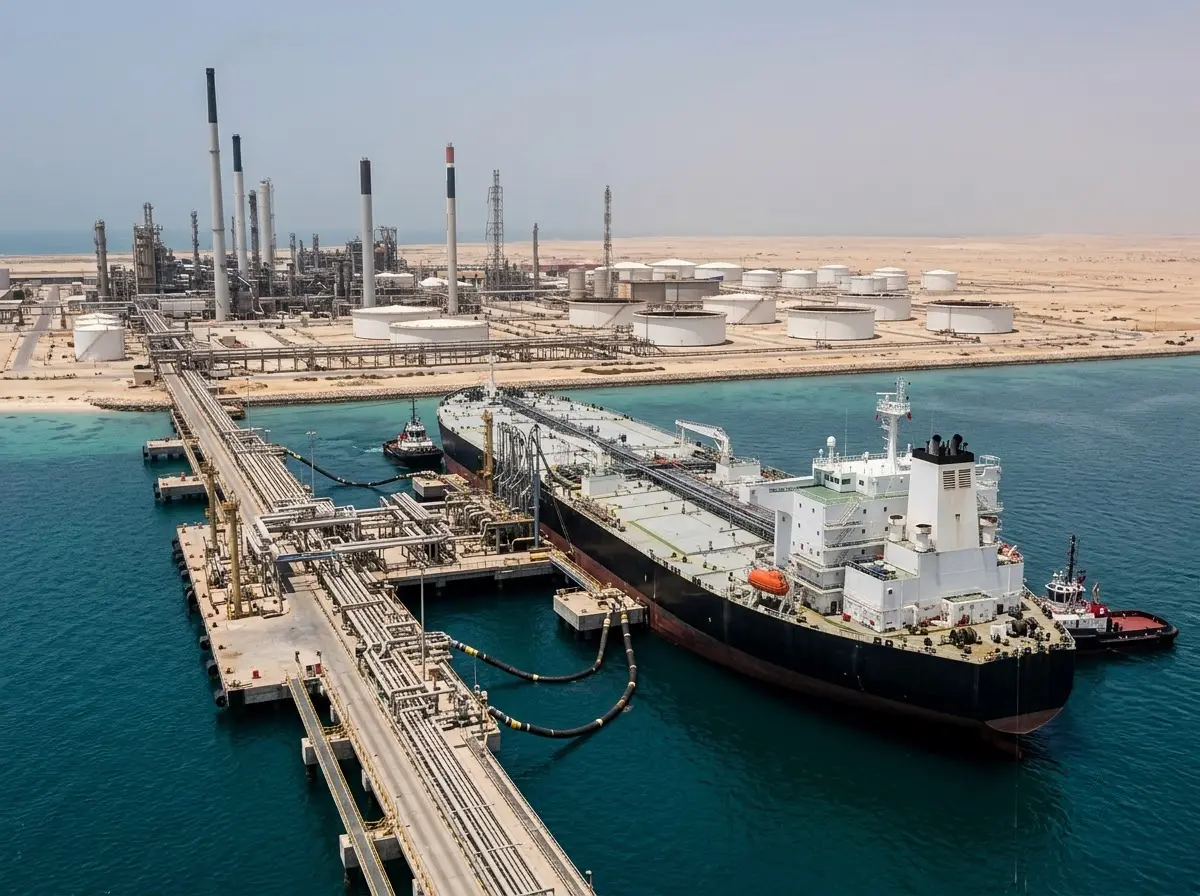
Saudi Aramco loaded 6 million barrels of crude onto three very large crude carriers from its Juaymah and Ras Tanura terminals inside the Strait of Hormuz between August 12 and 16, ending a three-week gap in commercial loadings after attacks on its tanker fleet. The world’s top oil exporter is now offering spot Arab Medium and Arab Heavy cargoes to Asian refiners via ship-to-ship transfers off Fujairah in the UAE, shipping data from Vortexa and Kpler and trade sources show.
The move puts some heavier barrels back into the market. It does not restore full Saudi export capacity. Yemen’s Houthis continue to blockade Red Sea routes that Aramco had used as its main alternative, leaving volumes fragmented and freight costs elevated.
Three VLCCs Break a Three-Week Silence
Malaysia Prosperity, Algeria Prosperity and Singapore Prosperity each took on 2 million barrels at the two Saudi terminals last week. Shiptrackers recorded no loadings there for the prior three weeks. Provisional Kpler data point to six more VLCCs that could load inside the strait later this month.
Aramco declined to comment. Sinokor, the owner of the three loaded tankers, did not respond to requests for comment. Traders said the company may also deploy vessels from its own Saudi fleet for Hormuz transit.
| Tanker | Load window | Volume | Terminals |
|---|---|---|---|
| Malaysia Prosperity | Aug 12-16 | 2 million barrels | Juaymah / Ras Tanura |
| Algeria Prosperity | Aug 12-16 | 2 million barrels | Juaymah / Ras Tanura |
| Singapore Prosperity | Aug 12-16 | 2 million barrels | Juaymah / Ras Tanura |
Seven Bahri-owned VLCCs were floating off the UAE and Oman on Tuesday, with two more heading toward Fujairah, according to LSEG shipping data. The pattern shows readiness to move more oil once buyers accept the residual risk of the waterway.
Three liftings after a clean three-week blank on the schedule mark a tactical reopening, not a return to normal Gulf throughput. Controlled and friendly tonnage is doing the early work while commercial owners stay on the sidelines.
The Red Sea Wall Still Blocks the Bigger Volumes
Saudi exports remain curtailed because of the Houthi blockade in the Red Sea. Aramco had diverted cargoes to the port of Yanbu earlier in the Iran conflict. Pre-blockade loadings from Yanbu ran near 4 million barrels per day. That route is now under sustained pressure.
- Hormuz terminals: partial commercial loadings restarted after three-week halt
- Yanbu / Red Sea: Houthi blockade active since late July, dark loadings common
- Sidi Kerir (Egypt Mediterranean): alternative offers running at roughly 670,000 barrels per day for Asia this month
- Fujairah STS: new private offers of Medium and Heavy grades outside the strait
About 670,000 barrels per day of Middle Eastern crude are expected to load at Sidi Kerir for Asia in August, Kpler data showed, up from zero in the prior three months. That volume is a fraction of the lost Yanbu flow. Additional shipping costs and longer voyages are deterring purchases.
The dual choke points leave Aramco unable to return to pre-war export patterns even as some Gulf loadings resume. Earlier Houthi strikes on Saudi energy targets and the wider conflict forced the shift west; the blockade has locked it in place.
Yanbu once absorbed the bulk of the diversion when Hormuz risk spiked. With that outlet constrained, every barrel now has to find a narrower path: limited Hormuz sailings, Mediterranean reloads, or STS handoffs outside the strait.
Why the Heavy Grades Matter Right Now
The resumed barrels and the Fujairah offers focus on Arab Medium and Arab Heavy. Those grades yield more residue fuel oil, which bunkers ships or can be cracked into gasoline and diesel. Supply of heavier Middle East crude has been tight since the broader Hormuz disruptions began.
6 million barrels already lifted. Six more VLCCs potentially loading this month. Spot offers via STS. The combination could loosen the residue market and give complex Asian refiners more feedstock options. Brent has hovered near $92 a barrel in recent sessions amid the wider conflict, with August OSPs for Asian grades already cut sharply earlier to stay competitive.
Full restoration of flows through the strait would matter far more. In 2025 roughly 25 percent of the world’s maritime oil trade moved through Hormuz, according to a Congressional Research Service assessment updated in early August. Residual risk and Iran’s asserted control keep many owners cautious.
Heavier barrels matter first because the disruption hit them hardest. Complex refiners that depend on residue-rich feedstock have fewer easy substitutes than plants built around lighter crudes.
Who Is Willing to Load and Who Is Not
Sinokor vessels made the first commercial liftings. Bahri tonnage is positioned nearby. Traders expect Aramco to lean on Saudi-flagged or controlled ships for Hormuz legs when needed. Many commercial owners still refuse to send hulls into the strait after the July escalation of US-Iran exchanges that hit tanker traffic.
The STS route off Fujairah copies a model ADNOC has used successfully. Buyers take title outside the danger zone. Aramco moves the oil out somehow, then transfers. The arrangement lets Asian refiners avoid sending their own tankers through the strait. It also adds handling cost and complexity.
Chinese state shippers have been deploying tonnage outside the Gulf and avoiding the chokepoints where possible. Market share that Aramco once held in India and other Asian markets has slipped toward other suppliers during the disruptions.
- Sinokor: first commercial Hormuz liftings after the three-week gap
- Bahri: seven VLCCs holding off UAE and Oman, two more bound for Fujairah
- Saudi-controlled fleet: expected backup for strait transit when charters stay away
- Broader commercial owners: still declining Hormuz calls after the July tanker hits
Willingness splits along flag and ownership lines. Controlled tonnage absorbs the early risk. Open-market owners wait for clearer security signals before committing hulls.
Freight Costs and Buyer Pushback Keep Volumes Soft
The Sidi Kerir alternative has drawn limited interest precisely because of the economics. Longer voyages and higher freight outweigh the security of the Mediterranean load port for many Asian buyers.
This shows that the Sidi Kerir offering to Asia is likely not working, as its Asian customers, at least the Chinese, are not happy with the long voyages and high freight cost.
Emma Li, Vortexa’s China market analyst, said. The same friction applies to any route that replaces a direct Hormuz sailing. Even with loadings restarting inside the strait, the total barrels Aramco can place into Asia remain constrained by insurance, war-risk premiums, and owner willingness.
Seafarers carry the residual risk on every Hormuz transit. Shore-side desks see the loadings as progress. Crews on the water face a waterway where Iran has repeatedly struck vessels it deems noncompliant since the conflict reignited in July. That gap between paper relief and physical risk is why the restart has not produced a larger wave of fixtures.
Every workaround carries a cost stack: longer ton-miles, STS fees, war-risk cover, and time. Buyers that can switch grades or delay purchases use that leverage. The result is soft volumes even when some barrels become physically available again.
Dual Choke Points Keep Export Paths Split
Aramco now works three imperfect outlets at once rather than one primary Gulf system. Hormuz handles limited commercial loadings again. The Red Sea path through Yanbu stays under Houthi pressure. Mediterranean reloads at Sidi Kerir and STS transfers off Fujairah fill only part of the gap.
| Path | Indicated volume | Constraint |
|---|---|---|
| Hormuz (Juaymah / Ras Tanura) | 6 million barrels lifted; six more VLCCs possible | Owner caution, residual strike risk |
| Yanbu / Red Sea | Near 4 million bpd pre-blockade | Houthi blockade since late July |
| Sidi Kerir to Asia | Roughly 670,000 bpd in August | Long voyages, high freight |
| Fujairah STS | Spot Medium and Heavy offers | Extra handling cost and complexity |
Pre-war Saudi exports ran near 6.7 to 7 million barrels per day, the bulk through Gulf terminals. No single alternative now matches that scale. The East-West pipeline to Yanbu was ramped hard in the early months of the war, then lost reliability when the Red Sea blockade took hold.
Fragmentation raises the administrative and freight burden on every cargo. It also keeps Asian buyers comparing Saudi barrels against other suppliers that can still offer cleaner logistics.
STS Offers Shift Risk Outside the Strait
Ship-to-ship transfers off Fujairah let title pass in safer waters. Aramco or its nominated tonnage still has to bring the crude out of the Gulf. The buyer’s vessel never enters the strait.
The model mirrors a pattern ADNOC has already used with success. It lowers the political and insurance barrier for Asian refiners. It does not remove the physical risk on the first leg, and it adds a second handling step that shows up in the delivered cost.
Private spot talks for Arab Medium and Arab Heavy fit this structure. Grades that complex refiners still want can move without forcing those refiners to put their own ships at risk inside Hormuz. The trade-off is higher friction and a smaller pool of barrels than a clean Ras Tanura loading program would supply.
- Late July – Houthi blockade tightens on Red Sea routes; Yanbu alternative loses reliability.
- July escalation – US-Iran exchanges hit tanker traffic; many commercial owners pull back from Hormuz.
- August 12-16 – Three Sinokor VLCCs lift 6 million barrels at Juaymah and Ras Tanura.
- This month – Provisional data flag six more VLCCs; Sidi Kerir Asia program runs near 670,000 bpd; Fujairah STS offers continue.
Each step shows adaptation under pressure rather than a restored export system. The sequence also explains why freight and differentials still favor buyers who can wait.
How Far the Numbers Can Move in Coming Weeks
Six additional VLCCs would add another 12 million barrels if they all load and sail. Combined with the first three, that is meaningful for the heavy-grade complex in a tight market. It is still small against the multi-million-barrel daily shortfall created when Hormuz traffic collapsed and the Red Sea alternative came under fire.
Pre-war Saudi exports ran near 6.7 to 7 million barrels per day, the bulk through Gulf terminals. The East-West pipeline to Yanbu was ramped hard during the early months of the war. Houthi action then cut that escape valve. Iran’s earlier moves to control the strait set the original diversion in motion; the dual pressure has kept it going.
Aramco’s private STS talks and the use of controlled tonnage show a company adapting to a prolonged period of elevated risk rather than waiting for a clean reopening. Asian refiners that need heavy feedstock will take what is offered on workable terms. Those that can wait or switch grades will keep pressure on freights and differentials.
The three VLCCs that loaded last week prove commercial oil can move again from Ras Tanura and Juaymah. The empty space on the loading schedule for the weeks before them, the thin Sidi Kerir program, and the Bahri fleet still holding position outside show how much of the old system remains offline.
Near-term upside depends on how many of the six provisional VLCCs fix and sail, and on whether more buyers accept Fujairah STS terms. Even a full set of those liftings would leave daily export capacity well below the pre-war 6.7 to 7 million barrel range while the Red Sea wall holds.
