
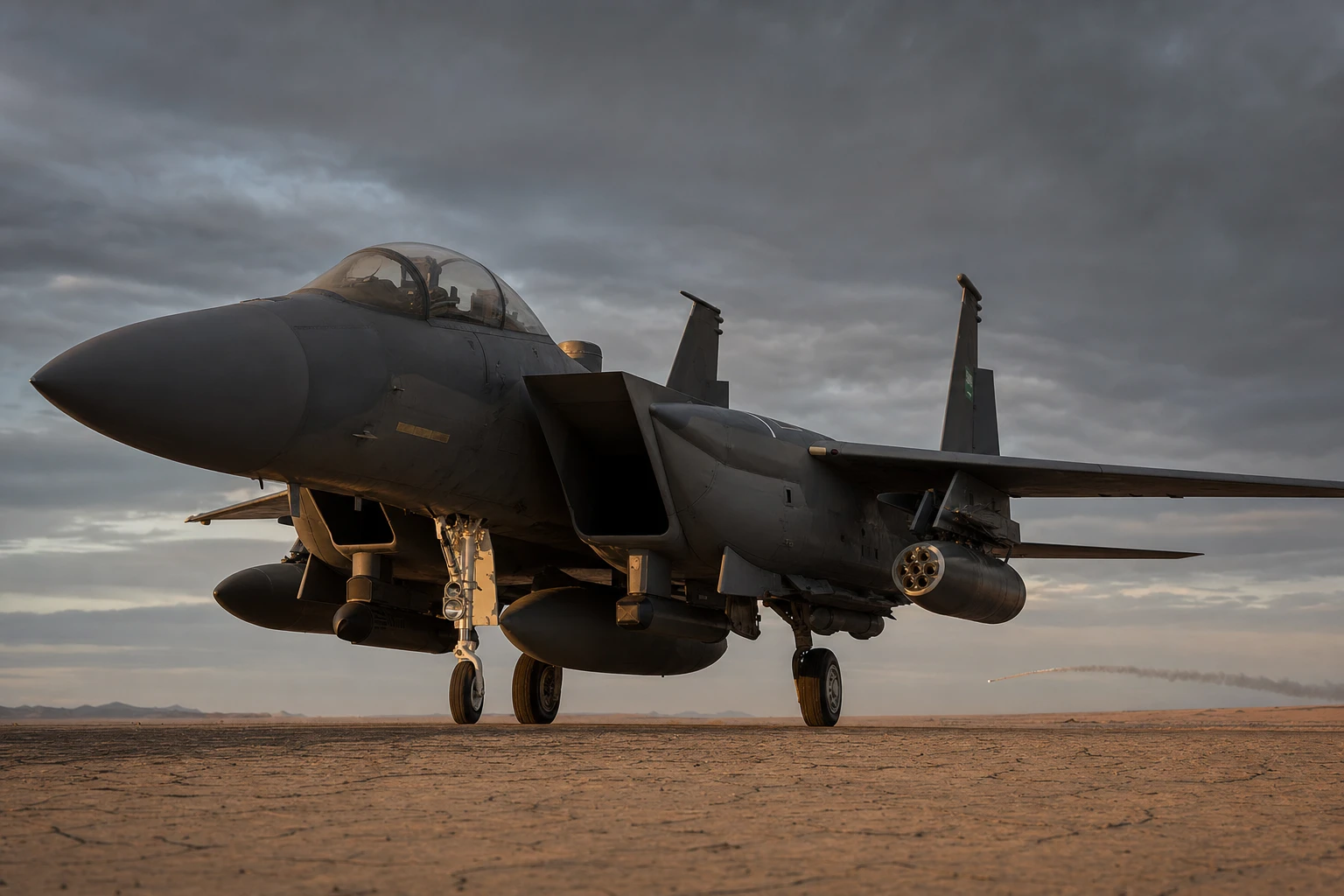
The U.S. State Department cleared a $1.96 billion rocket sale to Saudi Arabia this week, days after Houthi missiles hit Abha airport and ended a four-year truce. The package covers up to 20,000 Advanced Precision Kill Weapon System (APKWS-II) guidance kits built by BAE Systems, split evenly between air-to-air and air-to-ground versions.
Each kit costs a small fraction of the missile it is meant to replace. Riyadh just ordered ten times as many as it did sixteen months ago.
A $1.96 Billion Order for 20,000 Rocket Kits
The Defense Security Cooperation Agency (DSCA), the Pentagon office that manages foreign arms sales, notified Congress of the possible sale this week. The kingdom is asking to buy up to ten thousand APKWS-II air-to-air guidance sections, plus an equal number configured for air-to-ground missions.
“This proposed sale will support the foreign policy and national security objectives of the United States by improving the security of a Major non-NATO Ally that is a force for political stability and economic progress in the Gulf Region,” the State Department said in its notification. Saudi Arabia carries that formal designation, a status that eases arms and technology transfers to a short list of close partners outside the NATO alliance.
The full package includes:
- 10,000 APKWS-II air-to-air guidance sections for downing drones and cruise missiles
- 10,000 APKWS-II air-to-ground guidance sections for precision strikes on ground targets
- LAU-131 A/A launchers that mount the rockets on fixed-wing aircraft
- Mk-152 high-explosive warheads, MK66 rocket motors and proximity fuzes
- Spare parts, test equipment and contractor training support
Officials closed the notice with the boilerplate line attached to nearly every such sale: it will not alter the regional military balance and carries no adverse impact on U.S. defense readiness. Word of the deal spread fast in defense circles, with one tracking account, Defence Index breaking down the 10,000 and 10,000 split within hours of the notification going public.
The Truce That Ended at Abha Airport
The approval landed four days after Yemen’s Saudi-backed government struck Sanaa International Airport, in what it said was an effort to stop an Iranian charter flight from landing. The Houthi movement, which controls Sanaa and much of northern Yemen, retaliated on Monday with missiles and drones aimed at Abha International Airport in Saudi Arabia’s southern Asir region.
No casualties were reported. Wire reporting called it the sharpest Houthi Saudi escalation in years, the group’s first claimed strike on the kingdom since an informal truce took hold in March 2022. The Houthis also warned airlines to avoid Saudi airspace until what they called a siege of Sanaa’s airport is lifted.
- March 2022: An informal truce takes hold between Saudi Arabia and the Houthis, quieting cross-border fire for four years.
- July 13, 2026: Yemen’s government strikes Sanaa airport to block an Iranian flight. Houthi forces respond with missiles and drones aimed at Abha airport.
- July 15, 2026: The State Department notifies Congress of the $1.96 billion APKWS sale to Saudi Arabia.
Riyadh was already on edge before Monday. Saudi Arabia absorbed Iranian strikes earlier this year after the United States and Israel attacked Iranian territory, a fight that reignited in the past few days. That conflict has spilled into the Strait of Hormuz, where the US and Iran have traded strikes for a third straight night, giving the kingdom a second front to worry about beyond its southern border.
Why a $20,000 Rocket Beats a $1 Million Missile
APKWS-II is not a missile so much as a conversion kit. It slots into the middle of an ordinary 70 millimeter Hydra rocket, a decades-old, unguided munition the U.S. military has stockpiled by the millions, and turns it into a laser-guided precision weapon.
The arithmetic is what makes it attractive at scale. A single guidance kit runs between $15,000 and $20,000. A comparable air-to-air missile costs far more.
| Weapon | Type | Approximate Unit Cost | Primary Role |
|---|---|---|---|
| APKWS II guidance kit | Laser-guided rocket kit | $15,000 to $20,000 | Drone and light target intercept |
| AIM-9X Sidewinder | Air-to-air missile | About $450,000 | Close-range air-to-air intercept |
| AIM-120 AMRAAM | Air-to-air missile | About $1 million | Beyond visual range intercept |
Zafer Al Ajami, a retired Kuwaiti Air Force colonel and defense analyst, said the kits “convert cheap, unguided rockets into precise, low-cost interceptors,” and called the wider package a “pragmatic reset in relations” between Washington and Riyadh.
By providing cost-effective, precise air-to-air and air-to-ground capabilities, the US directly strengthens Saudi homeland defense and improves battlefield interoperability with American forces in the Gulf.
Al Ajami made that case shortly after the notification became public, tying the purchase directly to the Houthi drone threat along Saudi Arabia’s southern border.
Twenty Thousand Kits, Sixteen Months
Saudi Arabia’s appetite for APKWS did not start this week. In March 2025, the State Department cleared a far smaller order, 2,000 guidance kits worth $100 million, for the Saudi Arabian Army’s Apache attack helicopters.
This week’s package is roughly twenty times the value and ten times the unit count of that order. The jump signals a shift from testing the system in small batches to building a stockpile meant to outlast a single procurement cycle.
Analysts who track the program say the leap mirrors a lesson the Saudis have learned fighting Houthi drones for years: intercepting cheap, disposable threats with expensive missiles does not scale once the attacks come in volume.
Can Congress Block the Sale?
Rarely, and never against a president willing to veto. Since the Arms Export Control Act gave lawmakers formal power to review major foreign arms sales, Congress has passed joint resolutions of disapproval against Saudi Arabia only a handful of times, and every one has died at a presidential desk or failed to reach the two-thirds needed to override a veto.
The pattern is decades old. In 2019, both chambers passed resolutions to block a package of Saudi weapons sales tied to the war in Yemen and the killing of journalist Jamal Khashoggi. President Trump vetoed them, and the Senate could not override.
Human rights advocates keep pushing anyway. The Washington Institute tracked about 41 civilian deaths tied to Saudi military action outside Yemen between July 2022 and July 2024, down from 100 in the two years before, a decline the administration has cited to justify continued sales. The Center for International Policy counted 4,221 approved arms sales to Saudi Arabia between January 2017 and August 2020 alone, even as evidence of civilian harm in Yemen mounted.
The objections are not new. When a previous administration proposed a similar package in 2017, then Representative Tulsi Gabbard called Saudi Arabia a country with a “devastating record of human rights violations at home and abroad.” The sale went through regardless.
The Kingdom’s Other Bets Face the Same Risk
The rockets are meant to protect more than airports and oil fields. Saudi Arabia has spent years courting foreign capital and tourists under its Vision 2030 diversification drive, a push that assumes a quiet southern border.
That assumption just took a hit. A separate one billion dollar Saudi commitment tied to Canadian Prime Minister Mark Carney now confronts the same Houthi missile risk that just ended four years of relative calm on the Yemeni border.
Regional researchers had already flagged the cost of a wider war. ACLED projected in April that Saudi Arabia’s economy could shrink by roughly 3 percent if the broader conflict with Iran dragged on, a smaller hit than the double-digit contractions forecast for Qatar and Kuwait but still a real cost for a kingdom trying to wean itself off oil.
The congressional review clock on the $1.96 billion sale started this week, with the Houthi threat it is meant to counter still very much alive on Saudi Arabia’s southern border.
Frequently Asked Questions
What Is the APKWS-II System?
The Advanced Precision Kill Weapon System (APKWS-II) is a laser guidance kit built by BAE Systems that fits into a standard 70 millimeter Hydra rocket. The kit uses a seeker called DASALS, split across four fold-out wings, to steer the rocket toward a laser-designated target, turning a decades-old unguided munition into a precision weapon at a fraction of a missile’s cost.
Is the $1.96 Billion Sale Final?
No. The State Department’s approval and the DSCA’s notification to Congress start a review period, not a signed contract. Final terms, pricing and delivery schedules are negotiated afterward between the Pentagon, BAE Systems and Saudi Arabia, and the package can still be modified or shelved before then.
Has Congress Ever Blocked a Major Saudi Arms Sale?
Not permanently. Lawmakers passed joint resolutions of disapproval against Saudi arms packages in 2019 over the Yemen war and the killing of Jamal Khashoggi, and President Trump vetoed both. No such resolution against a Saudi arms sale has ever survived a veto.
How Does This Order Compare to Saudi Arabia’s Last APKWS Purchase?
The March 2025 sale covered 2,000 guidance kits worth $100 million for the Saudi Arabian Army’s Apache attack helicopters. This week’s package is ten times the unit count and about twenty times the value, and it arrives with launchers built for fixed-wing jets rather than helicopters, pointing toward the Royal Saudi Air Force’s Eurofighter Typhoon and F-15SA fleets instead of the Army’s Apaches.
Why Did the Sanaa Airport Strike Happen?
Yemen’s Saudi-backed government said it struck the runway to stop an Iranian charter flight from landing in Houthi-controlled Sanaa. The flight was meant to carry a Houthi delegation home from the funeral of Iran’s Supreme Leader, who was killed earlier in the war among Iran, the United States and Israel. The Houthis called the strike an act of war and retaliated at Abha the same day.
