
Egyptian cinema has spent six decades returning to the same stretch of coastline that just handed Egypt a record 6.1 million tourists in the first four months of 2026. Eight films made between 1960 and 2007 built an entire genre out of the Red Sea, the North Coast and the particular chaos of a family holiday.
None of the eight were pitched as a matching set. A 1967 musical, a 2006 fake kidnapping comedy and a 2007 drama about class in Agami share almost nothing except the season and the shoreline. Egyptian film kept returning to that coastline years before it became the country’s biggest tourism story.
Why Does Egyptian Cinema Keep Returning to the Coast?
Egyptian filmmakers have used the Red Sea coast and the North Coast as a recurring stage since the 1960s. The beach removes Cairo’s usual chaperones.
On the coast, a guardian can fall for the person he is supposed to be watching. Two cousins can fall in love before their families notice. A con artist can go straight, all without a disapproving relative walking in.
Look across the eight films and the same handful of moves keeps resurfacing.
- A seaside job, whether a cafeteria, a dive shop or a tour route, that becomes its own small economy for the length of a season
- A romance that crosses class lines, because a wealthy visitor and a local with nothing share the same shoreline but never the same table
- An adult sent to supervise someone else’s holiday who ends up falling for the person he was sent to watch
- A scheme, a con, a fake kidnapping or a runaway bride, that starts as a hustle and turns into something closer to love
Every one of those shows up somewhere in the eight films below, spread across six decades and every major stretch of Egyptian coastline.
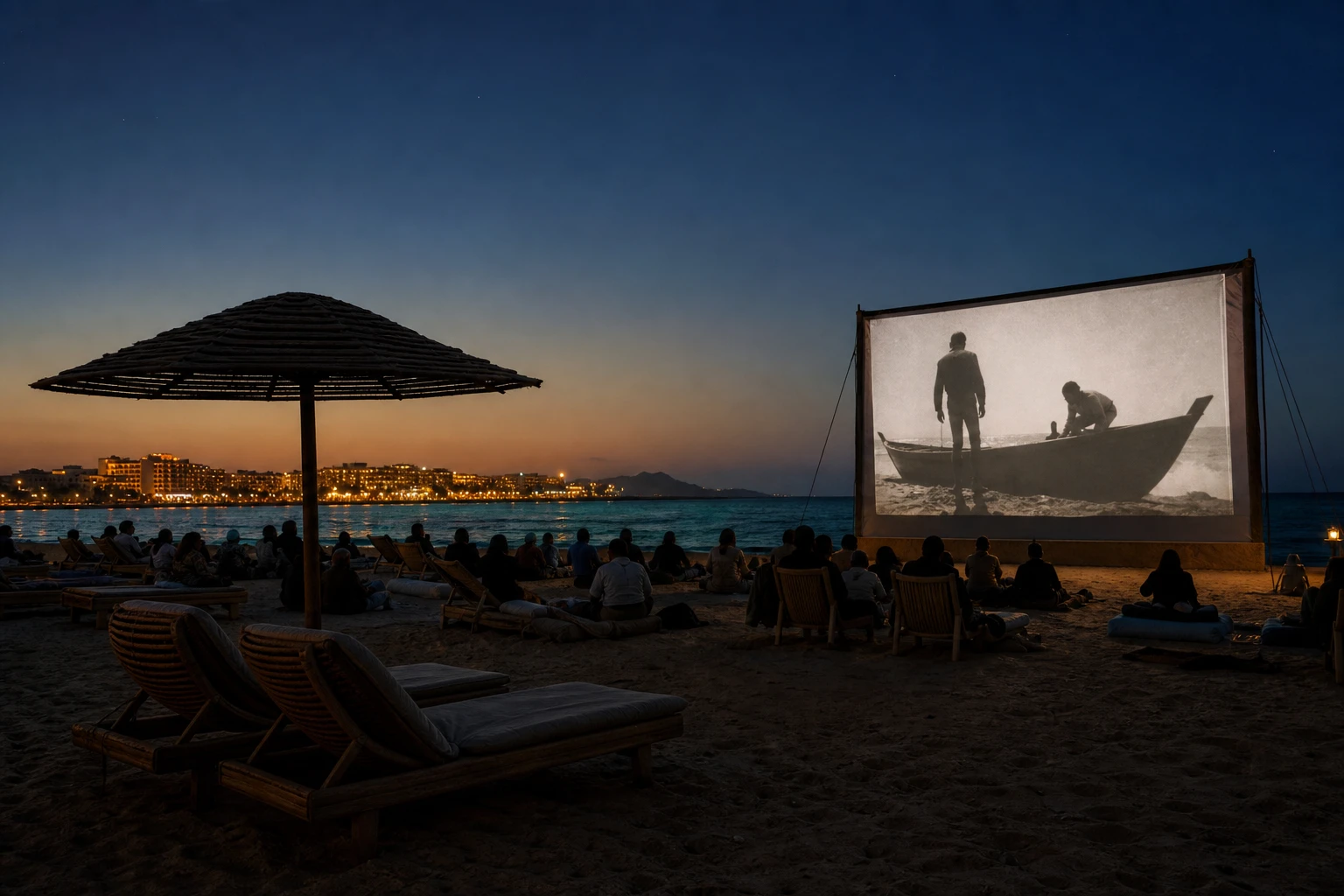
Eight Films, Six Decades, One Coastline
The list runs chronologically, from a black-and-white anthology in 1960 to two coastal dramas that both opened in 2007.
| Film | Year | Coastal Setting | The Hook |
|---|---|---|---|
| El Banat wel Sayf | 1960 | An unnamed beach town, shot in black and white | Three directors and one script tell three stories of summer infidelity |
| Shate’ El Marah | 1967 | A Mediterranean seaside resort | A secretly assigned chaperone falls for the girl he is sent to watch |
| El Zawag Ala El Taree’a El Hadeesa | 1968 | A university beach camp | Soad Hosny leads two cousins into a romance their families resist |
| Short w Fanella w Cap | 2000 | Sharm El-Sheikh | Three friends run a cafeteria economy that spirals into a runaway bride chase |
| Sana Oula Nasb | 2004 | Hurghada | Two unemployed graduates turn a tourist con into an honest hospitality venture |
| Ga’alatny Mogreman | 2006 | A North Coast chalet | A faked kidnapping turns five days of forced company into real affection |
| Aagamesta | 2007 | Agami, Alexandria | A writer and a homeless young man cross Agami’s class line |
| Khaleeg Ne’ma | 2007 | Naama Bay, Sharm El-Sheikh | A survivor reopens her father’s studio and stages a beachfront concert |
Read top to bottom, the list also tracks where Egyptian tourism itself was expanding. The 1960s films stay vague about location: a resort town, a beach, a camp. By the 2000s, the films name the exact destination, and Sharm El-Sheikh, Hurghada, Agami and Naama Bay each carry their own separate tourism identity.
The Golden-Age Blueprint, 1960 to 1968
The three oldest films set the template everything after them would borrow from. El Banat wel Sayf split its beach-town setting across three separate stories from three different directors, all adapted from one script by Egyptian writer Ihsan Abdel Quddous. Shot in black and white, it paired singer Abdel Halim Hafez with actress Soad Hosny in a season built around infidelity, forbidden attraction and unrequited longing.
Shate’ El Marah leaned into the era’s musical instincts, built around numbers from composer Mohamed Abdel Wahab and songwriter Naguib El Sayed, two of the most recognizable names in Egyptian popular music at the time. El Zawag Ala El Taree’a El Hadeesa moved the setting to a university camping trip, with Soad Hosny playing a cousin whose romance survives family resistance and a rival suitor.
The 2000s Coastal Revival
By 2000, the genre had swapped musical numbers for hustle comedy. Short w Fanella w Cap follows three friends working as a tour guide, a diving instructor and a cafeteria manager in Sharm El-Sheikh. The setup escalates into a runaway bride and a car chase, but it is built on top of an accurate picture of early-2000s dive-school tourism.
Sana Oula Nasb sends two unemployed graduates to Hurghada to con wealthy tourists. The con collapses into an honest hospitality business once they fall for two women who complicate the plan.
Ga’alatny Mogreman stages its fake kidnapping at a family chalet on the North Coast, the same shoreline where Mediterranean mega-projects such as Ras El Hekma are now reshaping the coast. Khaleeg Ne’ma uses Naama Bay’s beachfront in Sharm El-Sheikh as a literal stage, built around original songs performed by its own cast. Aagamesta, meanwhile, sends a wealthy writer to Agami chasing inspiration, only for him to find it in an unlikely friendship with a homeless young man, a pairing that turns the beach town’s rich-and-poor mythology into the whole plot.
Soad Hosny Carried Two of the Coast’s Best Summers
Two of the eight films rely on the same actress. Soad Hosny plays the romantic lead in El Zawag Ala El Taree’a El Hadeesa and appears in El Banat wel Sayf’s ensemble, at the very start and the early middle of a career that would make her Egyptian cinema’s most enduring star.
Born in Cairo in 1943, she debuted on screen in 1959 and worked across 83 films over roughly three decades, earning the nickname the “Cinderella of the Screen.” Nine of those films are still counted among Egyptian cinema’s 100 greatest.
She died in London in June 2001, at 58, after a fall from a friend’s balcony. British authorities ruled it a suicide. Her family and many in Egypt never accepted that finding, and the case remains unresolved a quarter century later.
Soad was incredibly talented; she had the ability to perfectly play any role whether it is comedic or tragic. She had charisma and charm. Yet, she was unappreciated and died alone.
Hasan Youssef, a director and actor who made fifteen films with her, gave that assessment to Egypt Today, recalled years later in a Google Doodle tribute marking her birthday.
Egypt’s Beach Economy Just Had a Record Year
The coastline these films kept filming is now the backbone of Egypt’s tourism economy. Egypt received 6.1 million tourists between January and April 2026, and government data puts first-quarter revenue near 5.1 billion dollars.
Egypt’s Tourism Minister Sherif Fathy reported arrivals up 15.6 percent year on year in the first quarter, with revenue climbing from 3.8 billion dollars the year before. The government wants roughly 21 million arrivals for the full year, about 10.5 percent above 2025’s record of 19 million, and it is chasing 30 million a year by 2030.
A weaker Egyptian pound has made those holidays cheaper in euros and dollars. Yearly arrivals had already climbed 20.5 percent in 2025 alone, and the Grand Egyptian Museum, which opened that November, is now pulling in about 15,000 visitors a day.
Beach holidays are only half of the pitch. Egypt’s heritage tourism is pulling its own weight, from the new museum to discoveries like a 1,600-year-old fragment of Homer’s Iliad found wrapped inside a mummy, the kind of find that keeps drawing visitors who never touch the sand.
Not every indicator is climbing in a straight line. The IMF recently trimmed Egypt’s broader growth forecast even as tourism kept outperforming, a reminder that one strong sector cannot carry the whole economy. Morocco, Turkey and the Gulf are chasing the same European travelers with new resort capacity of their own, and regional tension remains the risk that can empty a resort within weeks.
- 6.1 million tourists arrived in Egypt between January and April 2026, up from 5.7 million a year earlier
- 5.1 billion dollars in tourism revenue for the first quarter, up from 3.8 billion the year before
- 30 million annual visitors is the government’s target by 2030, building on 2025’s record of 19 million
Every one of those numbers traces back to the same coastline the eight films used as a backdrop, from Hurghada’s dive shops to the North Coast’s chalets.
The Same Formula Is Still Booking Egyptian Cinemas
The genre never really stopped. Recent North Coast releases still lean on the same class-crossing romance the 1960s films invented, just with new stars and a modern soundtrack instead of a chaperone.
Egypt’s wider film industry is having a strong year too. Comedy stars Mohamed Henedy and Mona Zaki are reuniting more than 25 years later in El Gawahergy, while Ahmed El Sakka and Yasmine Abdelaziz are pairing up again in Khali Balak Men Nafsak, more than two decades after they first shared a stage together.
Egyptian cinema is still writing new chapters set on the same beaches. Whatever opens in cinemas this August, the coastline behind it is on pace to host a share of the 21 million tourists Egypt is chasing this year alone.
Frequently Asked Questions
Which Egyptian Summer Film on This List Came First?
El Banat wel Sayf, released in 1960, is the oldest of the eight. It predates Soad Hosny’s more famous 1972 role in Khally Balak Men Zouzou by twelve years, showing how early in her career she was already working the beach-set genre that would define much of Egyptian cinema’s golden age.
Is Sharm El-Sheikh’s Naama Bay Used in More Than One Film?
Only Khaleeg Ne’ma is set there directly, using Naama Bay’s beachfront as a literal stage for its cast of musicians. The bay sits on the southern tip of the Sinai Peninsula, surrounded by protected marine parks, part of why Sharm El-Sheikh became a diving and desert-safari hub in the first place, the same economy Short w Fanella w Cap documents from its cafeteria’s side of the counter.
How Fast Is Egypt’s Coastal Tourism Growing This Year?
Separately from the January-to-April count, ratings agency Fitch forecasts 18.6 million tourists for the full year, a 4.6 percent annual increase, with arrivals continuing to rise toward 20.8 million by 2029. Fitch also expects Egypt’s accommodation and food services sector to grow 16.7 percent in 2026 alone.
How Has Soad Hosny’s Story Been Retold Since Her Death?
In 2013, Lebanese filmmaker Rania Stephan built an archival project entirely from snippets of Hosny’s own films, retracing her career and the arc of Egyptian cinema’s golden age at the same time. The piece screened during Berlin’s Art Week and is treated by critics as a serious record of her work, not just a tribute.
Is This Coastal Genre Still Being Made Today?
Yes. Egyptian studios have kept releasing North Coast and Red Sea set films in most recent summers, usually swapping the 1960s chaperone plot for a modest suitor chasing a wealthy love interest at a lavish Sahel-style party, the same class-crossing setup with a new cast every few years.
