
Germany’s Bundesrat voted on July 10 to criminalize publicly denying Israel’s right to exist, a measure that could send offenders to prison for up to five years. The upper chamber, representing the country’s sixteen state governments, passed the bill drafted by the state of Hesse and forwarded it to the Bundestag for review once its summer recess ends.
The vote lands amid the worst antisemitism numbers Germany has recorded since tracking began. It also lands inside a legislative pipeline where bills that start in the Bundesrat rarely finish there. In the current term, the chamber has sent 45 bills to parliament. Not one has become law.
What the Bundesrat’s Bill Would Ban
The bill would expand Section 130 of Germany’s Criminal Code, the statute long used to prosecute Holocaust denial, so that it also covers what lawmakers call existential denial of Israel. Anyone who publicly, or at a public assembly, denies the State of Israel’s right to exist or calls for its destruction would face criminal liability, with a maximum sentence of five years in prison or a fine.
The offense only applies in narrower circumstances than a blanket speech ban. Hesse ties punishment to conduct capable of encouraging antisemitic violence or discriminatory treatment, not to holding the opinion alone. Hesse’s justice minister, Christian Heinz, a member of the center-right Christian Democrats, told the chamber Germany could no longer “stand by helplessly” while hatred of Jews plays out in public. He called the draft “very deliberately drafted in narrowly defined terms.”
- Criticism of Israeli policy stays legal under the bill’s own text.
- Debate over a Middle East settlement is explicitly carved out as protected discussion.
- Art and academic work keep the separate constitutional protections they already have.
- Low-risk statements fall outside the law unless they could reasonably encourage antisemitic violence or arbitrary treatment.
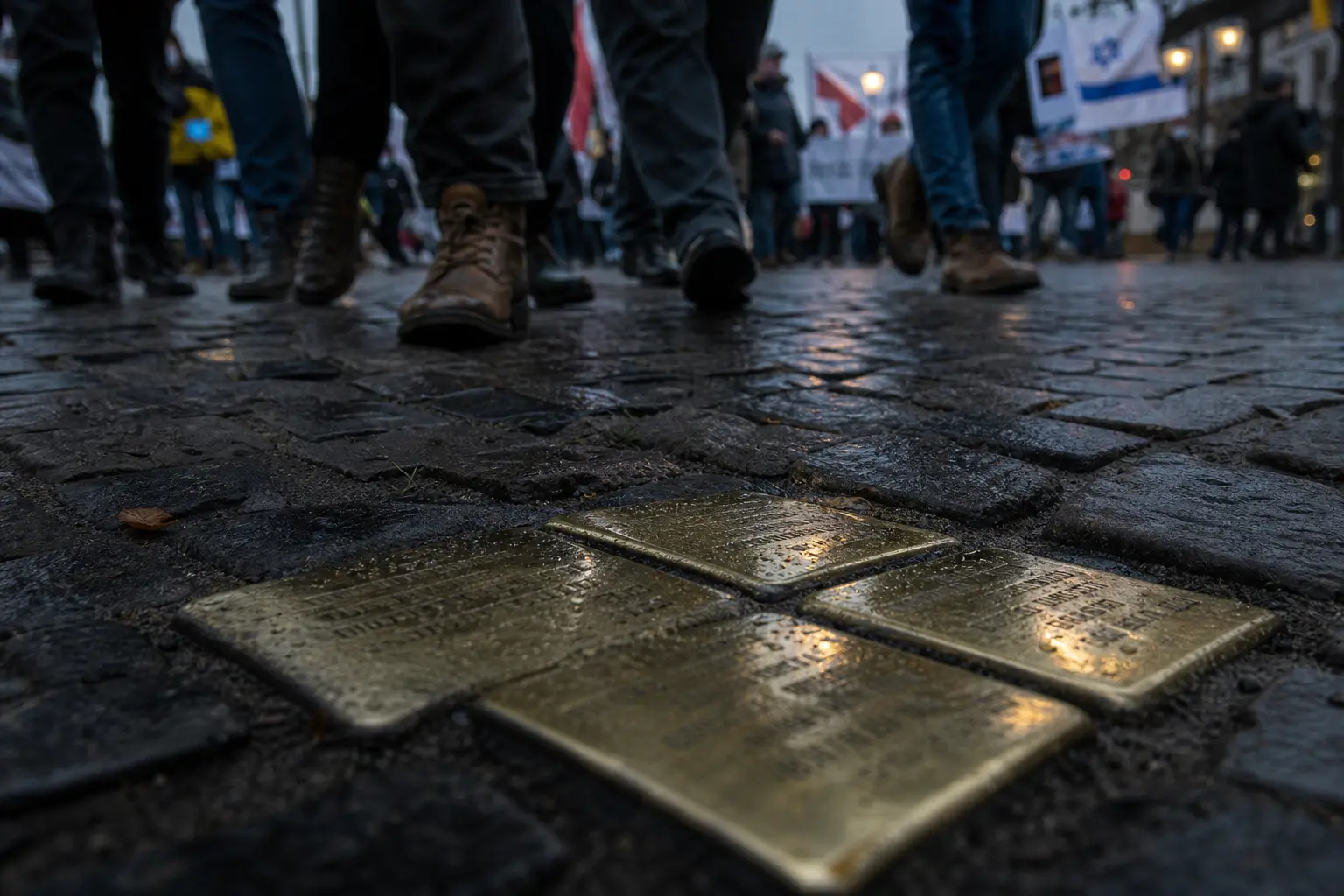
Boris Rhein, Hesse’s state premier and a fellow Christian Democrat, has been described as the political force behind the push. Pointing to the brass memorial markers set into German sidewalks for murdered Jews, Heinz said protesters have been “marching across the brass Stolpersteine that you all know from our streets and cities, openly shouting these slogans and this hatred of Jews.”
Antisemitic Incidents Hit a Record 8,725 Last Year
Germany recorded 8,725 antisemitic incidents in 2025, an average of 24 a day and the highest total since nationwide monitoring began in 2020, according to the annual tally from Germany’s RIAS monitoring network. The report counted 178 physical attacks, 257 threats and four cases of extreme violence, including a knife attack at Berlin’s Memorial to the Murdered Jews of Europe in which a Spanish victim was wounded and the attacker later sentenced to 13 years in prison.
Right wing extremist incidents alone reached 807 cases, also a record, while researchers found Israel related hostility present in 68 percent of everything tracked nationwide.
The bill’s home state has its own numbers to point to. Hesse logged 1,099 antisemitic incidents in 2025, up 18 percent from the year before and nearly six times the pre October 7 baseline. “The threat to Jewish life is worse than at any time since the Holocaust,” Hesse’s antisemitism commissioner, Uwe Becker, said after the report came out. In one case documented there, a rabbi was shoved in a supermarket in front of his children and had his phone snatched.
RIAS executive director Benjamin Steinitz said the trend points somewhere specific. “The continuing normalization of antisemitism threatens democratic culture as a whole,” he said, adding that the country needs “a resilient civil society” alongside state action. The pattern is not confined to Germany. Israel’s envoy in Canberra has separately described an antisemitism surge he called unprecedented in Australia, part of a wider spike Jewish communities report across the West since the Gaza war began.
Where Free Speech Advocates and Israel’s Allies Split
Support for the bill is not universal, even among people who agree antisemitism is a genuine crisis. The dispute centers on Article 5 of Germany’s Basic Law, which allows free expression to be restricted only by general laws, not ones aimed at a single opinion.
- Ron Prosor, Israel’s ambassador to Germany, welcomed the vote, saying anyone who denies Israel’s right to exist “will not get away with it without consequences.”
- Daniel Cohn-Bendit, a Franco-German former Green member of the European Parliament who is of Jewish descent, called the initiative “fundamentally misguided,” arguing that sharp critics of Israel, including Israelis themselves, are “not all” antisemites.
- Luke Hoß, a Left Party lawmaker, described the bill as “obviously unconstitutional” symbolic politics that would undermine, rather than strengthen, the fight against antisemitism.
Amnesty International took a similar position, saying protecting Jewish life matters while adding that the bill, in its own words, “massively endangers freedom of expression.” Human Rights Watch made a related argument months earlier, warning that Germany’s approach already chills legitimate criticism of Israeli policy. The criticism reaches beyond this one bill. In October 2025, four UN special rapporteurs and two independent legal experts said German authorities had been “criminalising, punishing, and suppressing legitimate Palestinian solidarity activism,” a warning issued before Hesse’s proposal ever reached the Bundesrat floor.
Bundesrat Bills Rarely Survive Contact With the Bundestag
Passing the Bundesrat is the easy part. Getting a Bundesrat-initiated bill all the way into German law is the part that almost never happens.
| Bundestag Term | Bills Forwarded by the Bundesrat | Bills Enacted Into Law |
|---|---|---|
| 21st term, since spring 2025 | 45 | 0 |
| 2021 to 2025 | 49 | 2 |
| 2017 to 2021 | 66 | 7 |
Those seven bills enacted between 2017 and 2021 were a sliver of the era’s lawmaking. Germany passed 542 separate laws in that same stretch, meaning Bundesrat-originated bills accounted for a small share of everything that reached the books.
The pattern holds because introducing a bill through the Bundesrat, after the federal government issues its opinion, is a routine maneuver. Turning it into an actual statute is not. Hesse’s proposal must now clear the Bundestag on its own, a chamber with different political dynamics than the one that just approved it.
Different Courts, Different Lines
German courts have been litigating pieces of this question for years, and their rulings do not point one direction. A top administrative court in North Rhine-Westphalia ruled in November 2025 that questioning Israel’s right to exist does not, by itself, constitute a criminal offense, partly overturning a ban on a pro-Palestinian demonstration in Düsseldorf.
The same ruling upheld bans on other slogans, including “Yalla, Yalla, Intifada” and “From the River to the Sea,” while allowing a separate chant rejecting the legitimacy of Israel’s 1948 founding. Earlier, in August 2024, a Berlin court fined a protester 600 euros, about $650, for leading the river to the sea chant at a demonstration held days after the Hamas attacks.
Heinz has pointed to older precedent too. In 2009, Germany’s Federal Constitutional Court upheld, in what is known as the Wunsiedel decision, a law criminalizing public glorification of Nazi rule through violence, reasoning that Germany’s history justified a narrow exception. Heinz argues that same logic extends to denying Israel’s existence, given the historical link between the Holocaust and the state’s founding. Not everyone agrees the analogy holds. A federal administrative court already found that Munich’s blanket ban on BDS discussion crossed a line, a ruling that predates this bill but shows how narrowly German courts read exceptions to Article 5.
Could Karlsruhe Strike This Law Down?
Constitutional lawyers say the bill’s biggest problem is design, not intent. Because it singles out denial of one state’s legitimacy rather than a general category of incitement, legal scholars argue it risks functioning as a ban on a specific opinion, something Article 5 of Germany’s Basic Law does not allow.
The Bundestag’s own Research Services reached a similar conclusion in an assessment completed in May. The opinion warned the bill could create “a special right against a specific opinion” and found that “both the rejection of the right of the State of Israel to exist and the call for the elimination of the state are likely to constitute subjective value judgments.” Extending the Wunsiedel exception to that kind of judgment, the assessment said, would be “difficult to justify.”
About 30 law professors raised similar objections before the Bundesrat vote. They acknowledged rising antisemitism as a genuine problem, then argued a generally applicable law cannot be used to outlaw one particular opinion, however repugnant.
None of that guarantees the bill dies even if the Bundestag passes it. Germany’s Federal Constitutional Court, based in Karlsruhe, tends toward restraint on speech cases and has not yet ruled on this specific question. It may eventually have to.
What Happens After the Summer Recess
The Bundestag is expected to take up the bill once its break ends, though no date has been set. Passage there is a separate vote from the one the Bundesrat just held, and the two chambers do not always agree.
Even lawmakers who back the goal have hedged on the text. At the July session, several federal states entered a statement into the official record asking the federal government to draft a version that is “legally sound and constitutionally compliant,” backing the push in principle while stopping short of endorsing Hesse’s exact wording.
The asymmetry has not gone unnoticed either. Germany would criminalize denying Israel’s existence while continuing to withhold recognition of a Palestinian state, a gap critics link to how Israel’s regional standing has unraveled since the Abraham Accords. Supporters counter that the bill targets violence-adjacent speech at home, not foreign recognition abroad.
If the Bundestag passes it largely unchanged, Germany would become the first country in Europe to criminalize denial of another state’s right to exist, a step Israel’s government has pushed for since October 7, 2023, and one Germany’s own legislative record suggests is still far from guaranteed.
Frequently Asked Questions
What would the new law actually criminalize?
Publicly denying the State of Israel’s right to exist or calling for its destruction would become a criminal offense carrying up to five years in prison or a fine. The rule explicitly covers online statements as well as speech at public assemblies, though only when the conduct could reasonably encourage antisemitic violence or discriminatory treatment.
Does the bill restrict criticism of Israel’s government?
No. The bill’s text excludes criticism of Israeli government policy and debate over a peaceful Middle East settlement, and it separately preserves existing constitutional protections for art and academic work.
When could the Bundestag actually vote on it?
No date has been set. The Bundestag is expected to take the bill up after its summer recess, and it would still need to pass its own version before anything becomes law, a step the Bundesrat cannot take alone.
What did German police record in early 2025?
Germany’s Federal Criminal Police Office, known as the BKA, recorded 1,047 antisemitic crimes in the first three months of 2025 alone, including two attempted murders and 422 instances of incitement to hatred, according to federal statistics.
Would this make Germany the first country to pass such a law?
Yes, according to multiple outlets tracking the bill. If the Bundestag approves it, Germany would become the first country in Europe to specifically criminalize denying another state’s right to exist, distinct from the Holocaust-denial statutes several European countries already enforce.
