
Farideh Golbahar was a child in a Tehran garden when she first picked up a brush. Eight decades later, that garden hangs on the walls of Tel Aviv’s Artists House, where her exhibition Beyond Garden opened this spring and runs through July 11. The show gathers the oil-on-paper landscapes the 84-year-old painter has built over roughly six decades, each one a Persian garden remembered, magnified and split into panels.
The timing gives the flowers an edge their maker never planned. Golbahar’s family left Iran more than half a century ago, and during Israel’s recent fighting with the country of her birth, the gardens she keeps painting read as both home and elegy.
A Tehran Garden, Repainted in Tel Aviv
The works on the walls are not literal flowers. Golbahar, who signs her paintings simply as Farideh, breaks each sheet of paper into four or six sections, then loads every panel with a different view of the same imagined garden. One square holds a single blossom blown up to fill the frame. The next is a dense weave of petals, closer to a woven carpet than a flowerbed.
Born in 1942 in Tehran, Golbahar has spent her career inside this one obsession, returning to the garden the way other painters return to a face. Her studio sits in a storeroom near the underground parking lot of her Jerusalem building, fitted with a table, her paints and a radio for the news and music she keeps on while she works.
The relationship with Israel’s artist houses goes back to her first years in the country. She showed at the Jerusalem Artists’ House as early as 1975, and the Tel Aviv institution has hosted her before. Readers can trace a biography that runs from Tehran through London and Karlsruhe to the Jerusalem apartment where she and her husband have lived since the early 1970s.
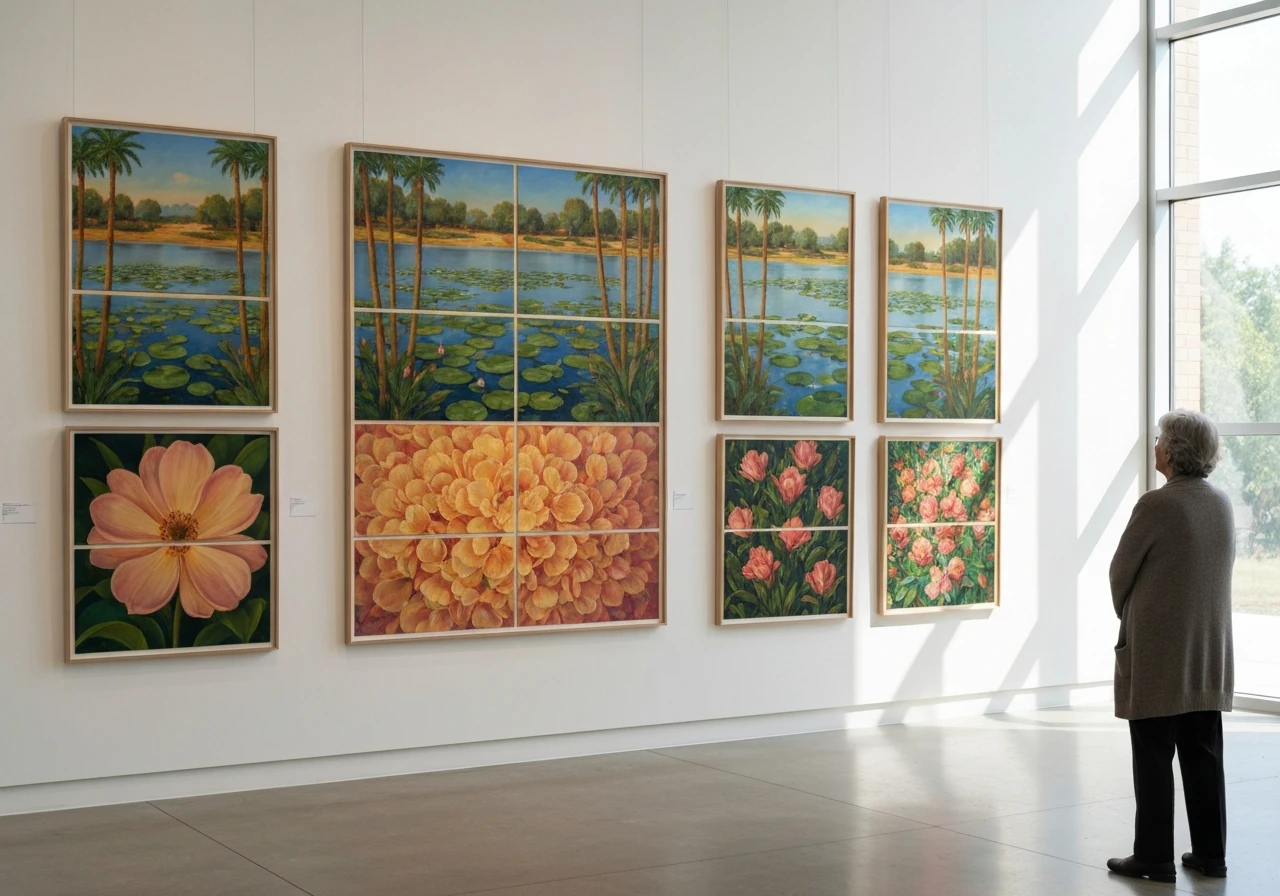
The Panel Method Behind ‘Beyond Garden’
Golbahar paints in oil on paper, a pairing she settled on as a girl in Tehran and never abandoned. Most artists who work in oils move to canvas. She stayed with paper because, she says, it drinks the color in a way canvas does not.
The grid structure is the signature. A larger rectangle often stretches across the top of a sheet, holding a small lake studded with lily pads. Below it, smaller cells switch between the microscopic and the magnified, so a viewer reads the same garden at several distances at once. Critics have placed her somewhere between Persian miniature painting, French Impressionism and American action painting, a span the painter herself does not bother to resolve.
The recurring cast inside the panels is small and consistent:
- A single flower enlarged until it fills an entire section
- Dozens of blossoms laid out in a Persian-rug pattern
- A shallow lake dotted with lily pads across the upper band
- Date palms, the trees she never saw until she reached Israel
The light is the other constant. The strong Israeli sun saturates the later work, bleaching and brightening colors that started as Tehran memory. You can see the older end of the method in her garden series from the late 1980s, where the same panelled logic is already in place.
From a Munich Street Fair to a Lifetime of Flowers
The flowers were not always there. Golbahar painted constantly as a child, on walls, doors and whatever surface she could reach, but not gardens. That began around 1966, when she and her husband, Eli Said Golbahar, now 86, were living in Germany while he studied economics. On a visit to Munich they stopped at a street exhibition and found a lush painting of flowers. “I said to Farideh, ‘Let’s buy this painting,'” Eli recalled of the moment. Her answer set the next sixty years: “What? I’ll make one just like it.”
They bought supplies instead of the painting, and the obsession started there. The coincidence is hard to miss, given that Golbahar in Persian means spring flower. A show now hanging in the Jerusalem survey tradition of her oil paintings grew out of a single afternoon at a German fair.
A Secular Jewish Childhood in a Failing Iran
Golbahar was the eldest of five children. Her father was a lawyer, and the family was well-to-do and secular, the kind of household that said the blessing over wine some Friday nights and kept matzah in the house at Passover.
She remembers her mother making marzipan for the holiday. She also remembers being one of two Jewish pupils in her class and studying the Quran alongside everyone else.
Art was not the plan her family had in mind. Like her siblings, she was expected to take a white-collar profession, as her father had. By the late 1960s, the country around that expectation was buckling, with deepening poverty and unrest under a fading monarchy.
Israel’s victory in the 1967 Six Day War reached the couple in Germany and stayed with them. They returned to Iran in 1969 with a baby daughter, already weighing a move. “We were proud that there was an Israel, that we were Jews, and we wanted to live somewhere where we wouldn’t be a minority,” Eli said.
They arrived in Israel in 1971 and settled in Jerusalem, where they have stayed. After the 1979 fall of the shah and the Islamic Revolution, the rest of the family scattered to London and the United States, and the Golbahars were left with no relatives or friends in Tehran at all.
Six Decades of Shows, From the 1957 Biennale to Now
The Tel Aviv exhibition is one stop in a long record. Golbahar first showed publicly at the 1957 Iran-Italy Biennale in Tehran, then carried her career across continents as her life moved. The arc reads cleanly when the venues are laid side by side.
| Year | Exhibition or venue | City |
|---|---|---|
| 1957 | Iran-Italy Biennale | Tehran |
| 1976 | Gallery Sullivan | Tehran |
| 1991, 2001 | Museum of Israeli Art | Ramat Gan |
| 2010 | Tel Aviv Artists’ House | Tel Aviv |
| 2012 | Mansour Gallery | London |
| 2026 | Beyond Garden | Tel Aviv |
The institutional recognition came with it. She won the Ministry of Education and Culture’s creativity prize in 2005 and the Jerusalem Artists’ House prize in 2007, and her work entered the collections of the Israel Museum in Jerusalem, the Jewish Museum in New York and the Skirball Museum in Los Angeles. The full sweep is set out in her record of solo and group shows reaching back to the 1950s.
For the couple, art was also a business. They ran Gallery Gimmel in Jerusalem for close to twenty years, showing Israeli names such as Pinhas Cohen-Gan, Rafi Lavie, Yair Garbuz and Moshe Kupferman, while Golbahar kept painting on the side that never stopped.
Gardens as Memory in a Time of War
Displaced painters have long turned lost places into idealized ones, and Golbahar’s gardens sit squarely in that lineage. The flowers are not a postcard of Tehran. They are memory rendered as refuge, the Iran of a secular Jewish childhood fused with German exhibitions, Israeli light and the date palms of her adopted country. The result has felt newly charged as Israel and Iran have traded blows, with Israeli strikes reaching military targets inside Tehran and public warnings to evacuate the city reaching the world’s screens. The Golbahars have no one left there, yet they think about the Iranian people and the regime those people have endured for nearly five decades.
They have the look of Monet and Tehran, but they’re mine. It’s all of my worlds together.
That was Golbahar, in the storeroom where she stacks her paintings, describing what the gardens actually hold. In a Jerusalem workspace off a parking garage, radio on, she is still adding flowers to paper at 84. The garden in Tehran is gone. On her walls in Tel Aviv, it is still in bloom.
Frequently Asked Questions
Where can I see Farideh Golbahar’s ‘Beyond Garden’ exhibition?
The show is open at the Tel Aviv Artists’ House and runs through July 11. It gathers oil-on-paper garden works from the recent years and earlier decades of her career.
Who is Farideh Golbahar?
She is an Iranian-born Israeli painter, born in Tehran in 1942 and known professionally as Farideh. She has built a six-decade career around panelled, garden-themed paintings and has lived in Jerusalem since 1971.
What materials does Golbahar paint with?
She works in oil on paper rather than canvas, a combination she adopted as a child in Tehran. She says paper absorbs the color in a way that suits her layered garden compositions.
Which museums hold her work?
Her paintings are in the collections of the Israel Museum in Jerusalem, the Jewish Museum in New York and the Skirball Museum in Los Angeles. She has also shown at the Museum of Israeli Art in Ramat Gan.
When did Golbahar leave Iran for Israel?
The family settled in Israel in 1971 after years spent studying and painting in London and Germany. Her wider family later dispersed to London and the United States following the 1979 Islamic Revolution.
