
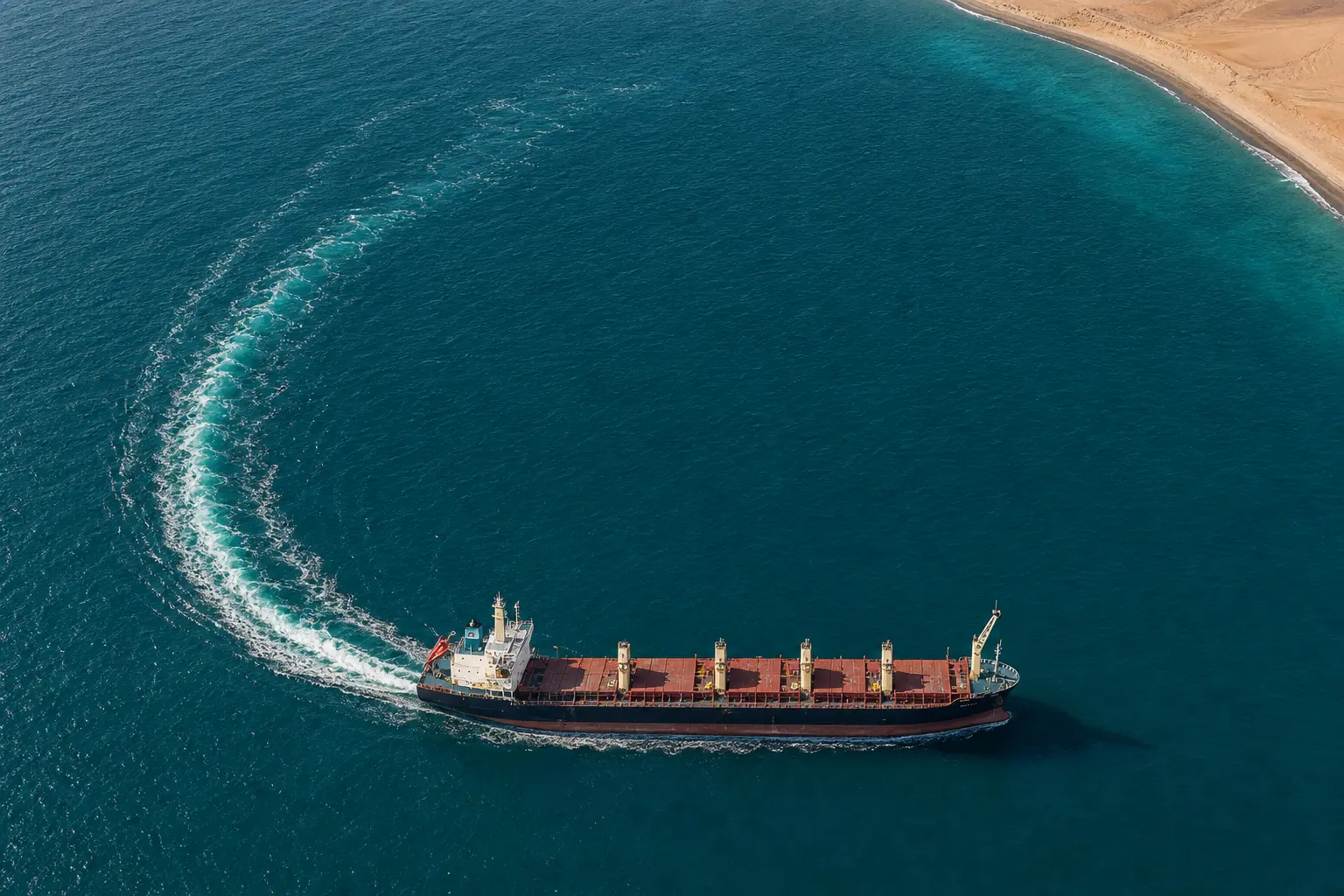
Two Saudi crude oil tankers spun around in the Red Sea on Tuesday, abandoning routes to China and India for the Suez Canal instead. The reversal came a day after Yemen’s Houthi movement threatened to attack any vessel calling at a Saudi port.
The Singapore-flagged Xin Long Yang had been sailing for Zhenjiang, China, and the Liberia-flagged Rodos for New Mangalore, India, before both changed course, according to MarineTraffic and LSEG vessel-tracking data cited by Reuters. Now both ships are angling toward the one waterway Egypt has spent all of 2026 trying to coax traffic back into.
Two Tankers Break Off Mid-Voyage
The Xin Long Yang, a very large crude carrier, left Yanbu port on July 20 at 04:31 UTC. Its declared destination was Zhenjiang, on China’s eastern coast. Instead, it reversed in the southern Red Sea as it sailed south, according to Bloomberg, which reviewed the same tracking data.
The Rodos left Yanbu later that day, at 23:40 UTC, originally bound for New Mangalore, India. Hours earlier, at 09:17 UTC, its declared destination had already flipped to the Suez Canal.
Both ships were carrying loaded Saudi crude, Reuters reported, citing LSEG shipping data. Saudi Arabia’s Red Sea port of Yanbu kept operating normally through the reversal, sources told Reuters.
What Exactly Does the Houthi Blockade Ban?
The Houthi movement’s Sanaa-based Humanitarian Operations Coordination Center emailed shipping companies on Monday with a blunt order: stop loading or discharging cargo at any Saudi Red Sea port. Vessels that ignore the warning risk sanctions, the group said, and possible military action if they sail within range of Houthi forces.
Vessels are banned from loading or discharging cargo at or from any Saudi ports.
That line came from the Houthis’ Humanitarian Operations Coordination Center, in the email to shipping companies reported by Al-Monitor.
A separate message seen by Bloomberg made clear the order covers every ship, not just Saudi-flagged ones, warning that vessels calling at Saudi ports “may be subject to targeting.” Riyadh condemned the threat and said it would take “all necessary measures” to protect its ships, according to Al-Monitor. The Houthis describe the blockade as retaliation for what they call Saudi Arabia’s own restrictions on Yemeni airports and seaports.
A Runway Strike on July 13 Set This in Motion
The clash traces back eight days. Here is how it escalated:
- February 28, 2026: Iran’s Supreme Leader Ali Khamenei is killed at the start of the US-Israeli war on Iran, according to Al Jazeera.
- July 13, 2026: Forces loyal to Yemen’s internationally recognized government strike the runway at Sanaa International Airport, trying to stop an Iranian Mahan Air flight from landing with a Houthi delegation returning from Khamenei’s funeral.
- July 13, 2026, hours later: Houthi forces fire ballistic missiles and drones at Abha International Airport in southern Saudi Arabia. No casualties are reported.
- July 20, 2026: The Houthi movement announces the naval blockade and emails shipping companies directly.
- July 21, 2026: The Xin Long Yang and Rodos reverse course. Brent crude jumps to a five-week high.
Rashad al-Alimi, who leads Yemen’s Presidential Leadership Council, said his government had denied Iran’s request to fly the delegation home, arguing the Houthis wanted the flight “outside the legal and sovereign frameworks governing civil aviation.” Yemen’s defense minister, Gen. Taher al-Aqili, said on X that his forces hit the Sanaa runway to stop that plane from landing.
Houthi military spokesperson Yahya Saree said his forces struck Abha with “a number of ballistic missiles and unmanned aerial vehicles” and that the operation had “successfully achieved its objectives.” It was the first attack the Houthis have claimed against Saudi Arabia itself since an informal truce took hold in March 2022, following earlier Houthi strikes on Saudi energy infrastructure.
The Long Way into a Canal Egypt Has Been Wooing Back
Neither tanker turned for the long route around Africa, the detour hundreds of vessels took during the worst of the Red Sea crisis in 2023 and 2024. Both pointed toward Suez instead, the very canal that crisis gutted.
Egypt’s Suez Canal Authority has spent this year discounting transit fees to lure carriers back, and the numbers had been moving its way.
| Period | Vessels Transited | Net Tonnage | Revenue |
|---|---|---|---|
| Jan 1 to Feb 8, 2025 | 1,243 ships | 47 million tons | $368 million |
| Jan 1 to Feb 8, 2026 | 1,315 ships | 56 million tons | $449 million |
| April 2026 (full month) | 1,182 ships | Not disclosed | $425 million |
Suez Canal Authority chairman Osama Rabie has credited the gains, an 18.5% jump in revenue and a 5.8% rise in transits during the first half of the 2025 to 2026 fiscal year, to a calmer Red Sea following the Gaza ceasefire. Oil tankers led that rebound, with tanker transits alone up 27.8% year over year in April, to 529 vessels.
Rabie has projected close to $8 billion in canal revenue for the full fiscal year, nearly double the roughly $4.2 billion the waterway earned during the worst of the disruption. Traffic still runs below pre-crisis levels, but the direction had been unmistakable, until this week handed the canal two extra transits for the worst possible reason.
Yanbu Was Never Built to Move This Much Oil
Saudi Arabia built its Red Sea escape route specifically to dodge the Strait of Hormuz, where the US-Iran war has throttled tanker traffic for months, funneling crude west through a pipeline lifeline now facing its own chokepoint risk.
- 7 million barrels a day: the design capacity of the East-West Pipeline linking Saudi Arabia’s eastern oil fields to Yanbu on the Red Sea coast.
- 4 to 4.5 million barrels a day: the real limit, capped by loading capacity at Yanbu’s export terminal itself, according to OilPrice.com.
- 4.19 million barrels a day: the record volume Yanbu actually loaded last month, as Saudi Aramco, the kingdom’s state oil company, rushed crude west ahead of the escalation.
Overall Saudi crude exports fell for a third straight month in May, to a record low, according to Joint Organisations Data Initiative (JODI) figures cited by Reuters. The Gulf side of the kingdom’s export machine was already struggling. The Red Sea route had been absorbing the difference. That is the same route the Houthis are now threatening to choke off.
Crude Climbs to a Five-Week High
Oil markets moved fast. Brent crude jumped to near $91 a barrel on Tuesday, its highest close since June 10, while US benchmark West Texas Intermediate climbed to around $85, according to Reuters data.
“The threats of a naval blockade on Saudi Arabia by the Houthis are significant because they raise the risk of disruption to another major oil exporter,” said Tim Waterer, a market analyst at KCM Trade.
Brent had averaged around $70 a barrel before the US-Israel war on Iran began, and briefly spiked to $126 at the conflict’s outbreak, according to Al Jazeera. Saudi Arabia’s crude exports were worth $187 billion in 2024, its single largest export category. Any sustained hit to that flow lands on a market already unsettled elsewhere: the Caspian Pipeline Consortium had separately stopped receiving Kazakh oil after attacks on tankers at its Black Sea terminal, Reuters reported the same day.
Mediation Collapsed Before the Blockade Could Be Stopped
Oman, Qatar and UN Special Envoy for Yemen Hans Grundberg spent the days after the Sanaa strike trying to head off exactly this outcome. The push failed.
Qatar and Pakistan carry their own exposure to the standoff, separate from the Oman-Grundberg diplomatic track that just collapsed, as the blockade’s costs fall on the mediators themselves.
Grundberg’s office said only that it was monitoring the situation and watching for wider escalation. Yanbu’s terminal kept loading Tuesday. The blockade order still stands.
Frequently Asked Questions
How Many Ships Have Actually Rerouted Because of the Blockade?
As of Tuesday, tracking data confirmed two tankers, the Xin Long Yang and the Rodos, had diverted toward the Suez Canal. Yanbu port itself continued normal operations, and no other confirmed reroutes had been reported yet, though shipping companies were still absorbing Monday’s warning.
Is There a UN Resolution on Houthi Attacks in the Red Sea?
Yes. The UN Security Council adopted Resolution 2722 demanding an immediate end to Houthi attacks on merchant shipping, with monthly reports on further Houthi attacks required from the Secretary-General. It passed 11 votes to zero, with four abstentions, and has been renewed every six months since.
How Does Yanbu’s Oil Capacity Compare With the Strait of Hormuz?
Yanbu’s practical ceiling sits around 4 to 4.5 million barrels a day. The Strait of Hormuz normally carries about 20 million barrels of oil and petroleum products a day, so Saudi Arabia’s Red Sea bypass can only ever replace a fraction of what a fully blocked Hormuz would take offline.
Why Did the Houthis Target Saudi Arabia Instead of Israel-Linked Shipping This Time?
The 2023 and 2024 campaign targeted vessels tied to Israel, in stated solidarity with Gaza. This blockade grew out of a different, bilateral dispute over Yemeni airspace and the Sanaa airport strike, not the Gaza war.
