
Saudi Arabia will hand the UNCCD COP presidency to Mongolia on Monday in Ulaanbaatar, closing an 18-month term that launched the Riyadh Global Drought Resilience Partnership and mobilized more than $12 billion for land restoration and drought work.
The move comes as COP17 opens under the theme Restoring Land, Restoring Hope and places the convention’s agenda in the hands of a nation whose own steppes and herders now stand at the center of the story.
What Saudi Arabia Leaves Behind
Saudi Arabia hosted COP16 in Riyadh in December 2024, the largest session in UNCCD history. Nearly 45,000 delegates from 197 parties (196 countries plus the European Union) adopted 39 decisions. The summit secured more than $12 billion in pledges, including roughly $10 billion from the Arab Coordination Group.
Those figures sit alongside a cluster of concrete launches that the Kingdom will showcase this week.
- Riyadh Global Drought Resilience Partnership (RGDRP): now connecting 74 vulnerable countries with readiness, investment and knowledge pillars.
- Riyadh Action Agenda: grown from 35 to more than 100 initiatives.
- International Initiative for Early Warning for Sand and Dust Storms.
- Business4Land: private-sector engagement vehicle that recorded record business participation at COP16.
The scale of COP16 gave those launches a political weight smaller sessions rarely achieve. Nearly 45,000 delegates meant finance, science and negotiating tracks ran in parallel, so pledges and institutional design advanced together rather than in sequence.
Saudi Arabia will run a national pavilion in the Blue Zone with more than 40 side events plus a dedicated Middle East Green Initiative pavilion. It will chair the final COP Bureau meeting and convene RGDRP steering and assembly sessions before the formal handover.
| Initiative | Key metric or status |
|---|---|
| COP16 finance | More than $12 billion pledged |
| Riyadh Action Agenda | Expanded from 35 to over 100 initiatives |
| RGDRP countries | 74 vulnerable nations linked |
| Business finance share historically | About 6 percent of land restoration funding |
Domestic Saudi efforts under Vision 2030 and the Saudi Green Initiative target restoration of 40 million hectares and planting of 10 billion trees. Those national numbers will appear alongside the global ledger at the national pavilion.
Presenting domestic targets next to the global pledge total is deliberate. It lets the outgoing presidency argue that the same government that raised international finance is also accountable for hectares and trees at home.
Mongolia’s 77 Percent Reality
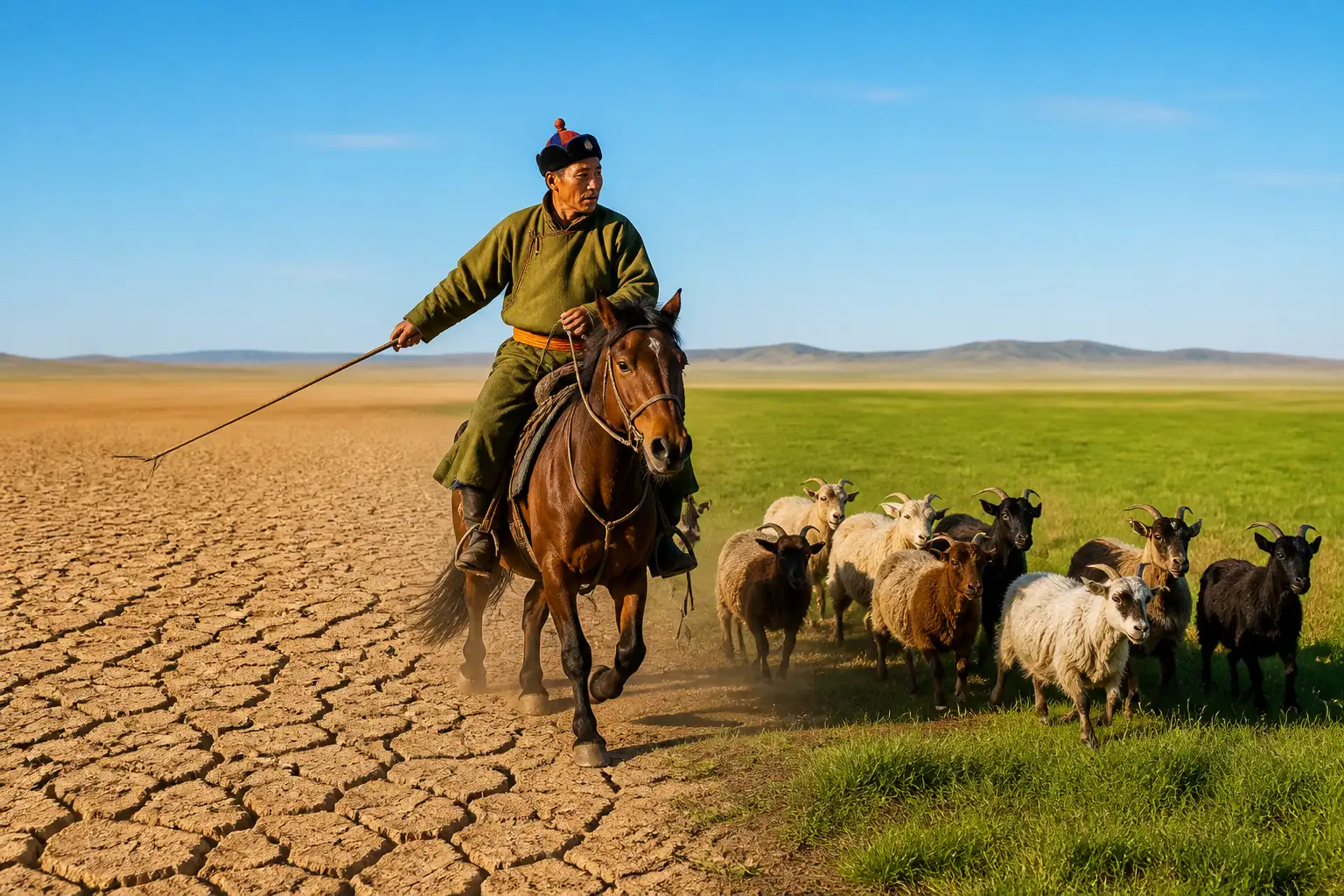
Mongolia brings a different kind of authority. Nearly 77 percent of its 1.56 million square kilometers is already degraded. Roughly 120 million hectares show impact, with about 23 percent rated severe. Average temperatures have risen more than 2 degrees Celsius since the 1940s, more than twice the global average.
| Mongolia land pressure | Figure already on the record |
|---|---|
| Share of territory degraded | Nearly 77 percent of 1.56 million km² |
| Area showing impact | Roughly 120 million hectares |
| Share rated severe | About 23 percent |
| Warming since the 1940s | More than 2°C, over twice the global average |
The main drivers are climate shifts, overgrazing and unsustainable land use, including mining pressure. Hosting COP17 turns the country into a living laboratory rather than a conference venue. The UNCCD COP17 host page details underscore that the conference will spotlight approaches that protect livelihoods and food security in dryland regions.
When nearly four-fifths of a national territory is already degraded, every agenda item on drought, rangelands or restoration maps onto a visible domestic condition. That is the source of Mongolia’s authority in the room: the presidency speaks from exposure, not only from mandate.
Mongolia has run its own Billion Trees National Campaign since 2021, aiming for one billion trees by 2030, and held Youth4Land forums to widen public engagement. The presidency arrives after the Mongolian prime minister’s earlier Saudi visit, which helped cement bilateral environmental ties that now feed into the formal handover.
The tree campaign and the youth forums give the host a ready domestic narrative. Restoration is already framed as a public project that reaches past ministries into rural communities and younger cohorts.
Rangelands Finally Own the Agenda
COP17 coincides with the United Nations International Year of Rangelands and Pastoralists 2026, a designation Mongolia championed. Rangelands cover more than half the Earth’s land surface, support about 500 million people directly, and supply one-sixth of global nutrition needs. They remain among the most overlooked and degraded ecosystems.
- More than half of Earth’s land surface is rangeland.
- About 500 million people depend on these landscapes directly.
- Rangelands supply one-sixth of global nutrition needs.
- Droughts have increased nearly 30 percent since 2000.
- Restoring 150 million hectares could feed 200 million people.
Land is our most vital infrastructure, underpinning food security, water, livelihoods and stability. When land fails, insecurity rises, through lost livelihoods, forced displacement and increased competition over scarce resources.
UNCCD Executive Secretary Yasmine Fouad said those words ahead of the conference. Restoring 150 million hectares (an area the size of Mongolia) could provide food for 200 million people, according to UNCCD messaging circulating in the final days before the opening. Droughts have increased nearly 30 percent since 2000. The herders who manage these landscapes become the hidden stakeholders whose knowledge and vulnerability now shape the two-week agenda of ministerial dialogues, science-policy sessions and finance talks.
Crowd observation on X and travel notes already flag practical strains: fuel queues and calls to defer non-essential travel in the host city. Those logistics sit beside the larger point that the people who live on the land are no longer background color for a capital summit.
The International Year supplies more than a slogan. It locks pastoral land use into the same two-week window as the COP, so ministerial dialogues and science-policy sessions must treat herders as principals in the land system, not as a side theme.
The Finance Architecture That Travels With the Gavel
Saudi Arabia’s term did not end with a single pledging moment. The RGDRP moved into a preparatory phase after its June 2025 inaugural conference. Countries chose UNCCD to host the secretariat in Bonn and endorsed the UN Multi-Partner Trust Fund as trustee. A twelve-member Steering Committee now includes donors, beneficiaries, UN agencies, civil society and the private sector.
The three pillars are concrete:
| Pillar | Function |
|---|---|
| Readiness Facility | Build national capacities |
| Investment Facility | Finance drought resilience projects |
| Knowledge Platform | Share innovations and best practices |
Readiness without investment leaves plans unfunded. Investment without knowledge repeats failures. The three-pillar design is meant to keep capacity, capital and learning moving together under one Steering Committee rather than in separate silos.
The full Riyadh Global Drought Resilience Partnership structure will be tested under Mongolian leadership. Business4Land sits beside it. Private finance still supplies only a small share of land work. At COP16 the initiative hit record private participation. In 2026 it launched a Champions’ Council of twelve corporate leaders, chaired by the sitting COP presidency and already including a vice-chair from the Business Council Mongolia.
The three Business4Land private sector pillars cover operations and value chains, finance solutions such as the Drought Resilience Investment Facility, and advocacy. A Business4Land Forum is scheduled for 24 August in the Blue Zone. Annual global losses from land degradation and drought reach an estimated $878 billion. Every dollar invested in restoration can return roughly eight dollars in social, economic and environmental gains, per UNCCD estimates.
That loss-to-return contrast is the core finance argument the outgoing presidency leaves behind. A historical private share of about 6 percent of land restoration funding shows how wide the gap remains; the Champions’ Council and the August forum are the vehicles meant to narrow it during the Mongolian term.
Blue Zone Pavilions and the Final Bureau Session
Saudi Arabia’s national pavilion and the Middle East Green Initiative pavilion will keep the Kingdom’s programs visible even after the gavel passes. More than 40 side events will run alongside formal negotiations. The Kingdom will also hold the second Steering Committee meeting and the inaugural assembly of the RGDRP after earlier preparatory rounds in Panama, Bonn, Cairo and Nairobi.
These sessions lock in continuity. The Riyadh Action Agenda’s expansion past 100 initiatives and the sand-and-dust early-warning work give Mongolia ready tools rather than a blank slate. Bilateral cultural threads, including a record Mongolian falcon sale at Saudi expo, illustrate the wider relationship that now carries an environmental presidency.
Pavilion programming matters because the formal gavel change lasts only minutes. Side events, steering sessions and the national displays keep Saudi-origin initiatives in daily view while Mongolian ministers set the tone for implementation.
- December 2024: COP16 closes in Riyadh with 39 decisions and more than $12 billion pledged.
- June 2025: RGDRP inaugural conference sets secretariat, trustee and Steering Committee.
- 17 August 2026: COP17 opens in Ulaanbaatar; Saudi Arabia chairs final Bureau meeting.
- Monday handover: Presidency passes to Mongolia’s Foreign Minister Battsetseg Batmunkh as President-designate.
- 24 August 2026: Business4Land Forum in the Blue Zone.
- 28 August 2026: COP17 scheduled close.
Mongolia’s Foreign Minister Battsetseg Batmunkh, as President-designate, has pledged an inclusive, balanced, transparent and action-oriented conference that builds trust and advances implementation. The host’s own national initiatives already link restoration to rural livelihoods, giving the presidency an immediate domestic test bed.
The Partnership Faces Its First Field Test
Institutional design is only half the story the handover tells. The RGDRP now links 74 vulnerable countries through readiness, investment and knowledge pillars, with a Bonn-based secretariat and a Multi-Partner Trust Fund trustee already named. Mongolia must show that this machinery can move from committee language to projects that alter outcomes on degraded ground.
The test is sharper because the host’s own map is so heavily marked. With nearly 77 percent of national territory degraded and about 23 percent of affected land rated severe, success metrics will be read against steppe conditions that delegates can see outside the venue.
Business4Land adds a second pressure point. Private finance still accounts for only about 6 percent of land restoration funding on the historical record, even after record business participation at COP16. The Champions’ Council of twelve corporate leaders, including a vice-chair from the Business Council Mongolia, gives the new presidency a direct channel into firms that have so far stayed at the margin of land work.
Annual global losses estimated at $878 billion, set against returns of roughly eight dollars for every dollar invested in restoration, keep the economic case plain. The question for the next two years is whether readiness plans, investment facilities and private champions can close even a fraction of that gap in the places counted among the 74.
How the International Year Steers Two Weeks
Mongolia championed the United Nations International Year of Rangelands and Pastoralists 2026, and COP17 opens inside that calendar. The overlap is structural, not decorative. Rangelands that cover more than half the Earth’s land surface and support about 500 million people directly now share the same negotiating fortnight as drought finance and land restoration decisions.
Herders therefore enter the agenda as managers of a global asset class, not only as local witnesses. One-sixth of global nutrition needs already flows from these landscapes. When land fails, the Fouad warning on displacement and competition over scarce resources becomes a pastoral story as much as an urban or farming one.
UNCCD messaging that restoring 150 million hectares, an area the size of Mongolia, could feed 200 million people gives ministers a single paired image: host-country scale on one side, food-security yield on the other. Science-policy sessions can use that pairing without reaching for new studies.
Fuel queues and calls to defer non-essential travel in Ulaanbaatar are early reminders that hosting carries city-level strain. They also underline the conference theme from another angle. The people and places that depend on rangelands are no longer remote from the summit’s daily logistics.
Continuity Meets the Front Line
The Saudi term elevated drought finance and private engagement to levels the convention had not previously reached. Mongolia inherits that machinery and places it inside a country where land degradation is not an abstract global statistic but a daily condition for herders and rural communities. The International Year of Rangelands supplies the thematic frame. The 197 parties arrive with the Riyadh tools already in hand.
What follows is two weeks of negotiation plus two years of Mongolian presidency. The herders who manage half the planet’s land surface now sit closer to the microphone than at any previous COP. The money and partnerships launched in Riyadh will be judged by whether they reach the steppes that need them most.
