
The Multinational Maritime Defense Alliance held its latest planners’ sessions in Jeddah this week, locking command posts and expanding signatures after the July 30 founding in Riyadh. Fourteen countries started the charter under Saudi leadership; the measure of whether commercial ships return to the Red Sea will be set by insurance desks more than by hull counts.
Rear Adm. Abdullah bin Salem Alshehri now heads the effort. The second-order question is simple: can a regional coalition lower realized risk enough for underwriters to cut premiums that still price most carriers around the Cape of Good Hope?
Fourteen Flags and a Riyadh Headquarters
On July 30 the founding states issued a founding states joint declaration that set the alliance as a purely defensive framework. It covers the Bab al-Mandab Strait, the Red Sea and the Gulf of Aden. Headquarters sit in Saudi Arabia. Joint Command, a Command and Control Center, a Combined Maritime Operations Center and a General Secretariat form the core bodies.
Activities listed include intelligence sharing, operational planning, joint exercises, capacity building and maritime operations. Participation in any operation remains a sovereign choice. The text invites further accessions and stresses compliance with the UN Charter and international law.
- Founding focus: freedom of navigation, trade routes and energy supply lines
- Command location: permanent Saudi lead and Riyadh base
- Open architecture: additional states complete national procedures then sign the charter
- Defensive limit: no targeting of any state or alliance
Representatives from 43 of 51 invited countries attended the launch. An EU delegation was present even as Operation Aspides continues separately.
That open architecture is deliberate. Sovereign choice on each operation keeps political thresholds low enough for states that will not accept automatic tasking. The same design also means the alliance cannot promise continuous coverage until enough capable navies choose to stay on station.
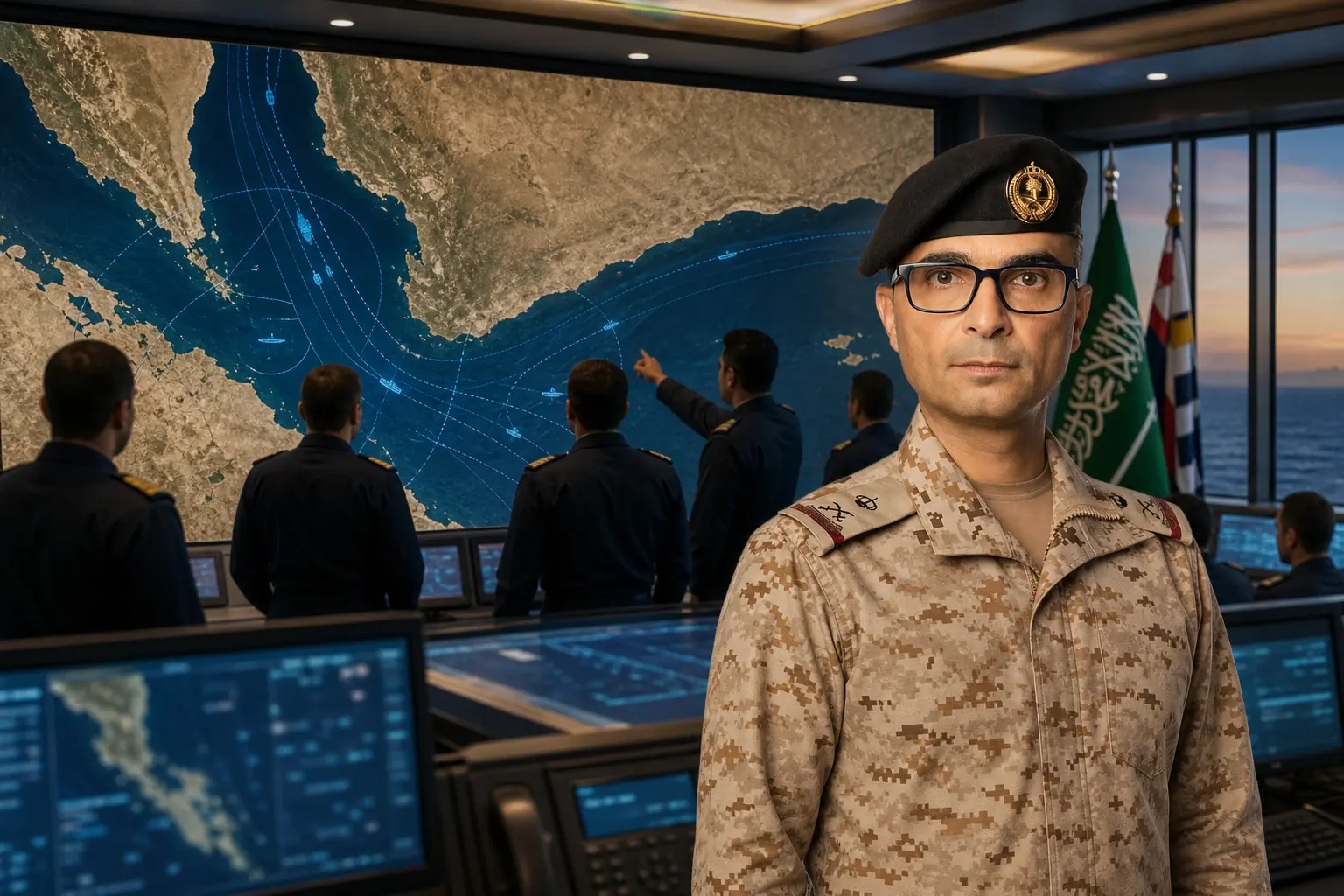
The Jeddah Planning Round That Activated Command
Saudi officials appointed Alshehri in early August to oversee the joint naval command, coordinate planning and supervise operations. The appointment of Rear Admiral Alshehri completed a key piece of the structure. A Pakistani officer takes the deputy slot for the first term.
The August 12-13 planners’ meetings, followed by a third session in Jeddah with 39 countries present, moved the coalition from paper to activation. Fifteen states have signed the joint statement. Thirteen have completed national procedures and signed the charter. Officers and cadres are preparing to fill the joint command, operations center and intelligence center.
- July 30: founding declaration issued in Riyadh under Saudi leadership
- Early August: Alshehri appointed to head joint naval command
- August 12-13: first planners’ meetings shift work from paper to staffing
- Third Jeddah session: 39 countries present as command posts lock in
The Saudi Ministry of Defense described the step as the effective launch of institutional and operational work. Emblem, headquarters designation and reference documents are now set. The door stays open for more members.
Staffing the Combined Maritime Operations Center and the intelligence center is the hinge. Without filled billets and shared procedures, the charter remains a political signal rather than a working watch floor.
Egypt, Pakistan and the Missing Gulf Navies
Core early participants include Bahrain, Bangladesh, Djibouti, Egypt, Jordan, Kuwait, Pakistan, Qatar, Somalia, Sudan, Turkiye, Yemen and others that have completed or are completing accession. Lists have varied slightly on Nigeria and Comoros as the roster solidifies.
| Country / role | What it brings | Status note |
|---|---|---|
| Saudi Arabia | Lead, HQ, command | Founding host |
| Egypt, Turkiye, Pakistan | Credible naval platforms | Key capability states |
| Djibouti, Somalia | Geography and local access | Chokepoint proximity |
| UAE, Oman | Capable navy / Houthi channels | Not yet joined |
Neil Quilliam, managing director of Azure Strategy, told Arab News that five or six states with complementary strengths matter more than a long paper roster. Egypt, Turkiye and Pakistan supply naval weight. Djibouti and Somalia supply position. The UAE’s experienced navy and Oman’s channels to the Houthis would strengthen the set if they join later.
Their absence is already noted in regional commentary. It leaves a gap in local knowledge and Gulf coordination at the exact moment the coalition must prove it can operate across both shores of the Red Sea.
Geography alone does not close that gap. Patrol craft and aircraft need basing access, logistics and political clearance on both coasts. Djibouti and Somalia help on the western shore; without UAE or Omani depth, the eastern side stays thinner than the threat picture requires.
Why Prosperity Guardian and Aspides Fell Short
US-led Operation Prosperity Guardian ran from late 2023 into May 2025. It conducted extensive airstrikes and escorts yet never restored pre-crisis traffic volumes. A ceasefire announcement did not end attacks on commercial shipping. Political disunity among partners limited coherence.
The EU’s Operation Aspides has protected hundreds of vessels and monitored thousands of transits with a small average force of roughly three warships. Escort-on-demand created queues. Many carriers still preferred the longer Cape route. Traffic stayed well below the pre-2023 average of roughly 70-plus ships per day.
| Effort | Force shape | Limit that stuck |
|---|---|---|
| Prosperity Guardian | US-led strikes and escorts | Disunity; traffic never fully returned |
| Aspides | Small EU escort force, ~3 ships | Queues; carriers kept using the Cape |
| New alliance | Regional roof, Saudi command | Still proving continuous presence |
Burak Sakir Seker, associate professor at Ankara Haci Bayram Veli University and a retired navy lieutenant, warned Arab News that the new coalition risks repeating those limits. Western efforts suffered from divided command and insufficient continuous presence against asymmetric threats.
A former Royal Navy commander, Tom Sharpe, told The National that multiple overlapping task groups created “tactical stupidity.” Shared intelligence under one regional roof could avoid that friction. The Saudi design answers Washington’s preference for partners to carry more of the operational load while the US stays an intelligence and enabling partner.
Underwriters Still Price the Drones
Houthi attacks with inexpensive drones and missiles have forced reroutes since late 2023 and intensified around the current wider conflict. Last month they struck in the Bab al-Mandab. Claims of attacks on Saudi-linked tankers continue. Debris from a Houthi strike on Mocha port on August 10 underlined the land-side reach as well.
Marine insurance is actuarial. Leading mutuals withdrew war-risk cover or raised premiums more than 1,000 percent. Typical voyage premiums that once sat near $10,000-20,000 climbed into the $150,000-500,000 range when cover was available. Seker noted that a $40 billion US political-risk reinsurance backstop has not unfrozen private underwriting. “It is the mathematical odds of a hull loss, not a political safety net, that drives the underwriting price,” he said.
Cost snapshot of the Cape detour
- +10-14 days Asia-Europe transit time
- +25-40% freight rate impact on key lanes
- $200-400 per TEU extra operating cost cited in supply-chain research
- ~6% of global fleet capacity absorbed by longer routes
Quilliam framed the imbalance cleanly: cheap drones force expensive naval presence and higher insurance. The only hard success metric is vessels returning in greater numbers and costs falling. That is the second-order gate the alliance must pass.
Underwriters will not reprice on declarations alone. They watch claim frequency, near-miss reports and whether escorts arrive before threats, not after. Until those inputs move, the Cape surcharge stays rational even if warships multiply on paper.
What Five or Six Capable Partners Must Deliver
Quilliam listed the practical package: naval patrols, intelligence sharing, surveillance and early warning, port and infrastructure protection, and coordination across the Red Sea. The 2020 Red Sea Council showed that assembling names is easy; sustained intel fusion and joint ops are hard.
Sanjoy Paul, associate professor at the University of Technology Sydney, told Arab News that supply chains hate the Cape alternative. Delays, fuel, insurance and disrupted schedules raise prices for businesses and consumers. A safer Red Sea shortens cycles and cuts those costs.
One freight forwarder noted that CMA CGM has already moved ships through Suez with French naval escorts. Any credible expansion of military presence raises the chance carriers will test the lane again. The coalition’s early emphasis on information sharing and a single Combined Maritime Operations Center is aimed exactly at that confidence problem.
- Patrol tempo steady enough that gaps do not reopen attack windows
- Intel fusion fast enough to cue escorts before drones reach the lane
- Port and infrastructure cover so land-side strikes do not spook schedulers
- Cross-shore coordination so both Red Sea banks stay in one picture
The wider backdrop includes wider US-Iran spillover into the region and earlier Houthi pressure on Saudi positions. Regional ownership is the stated response.
A Single Roof Replaces Overlapping Task Groups
Sharpe’s critique of overlapping task groups points to the mechanism the Riyadh design tries to fix. Separate national and coalition chains produced friction even when ships shared the same water. One Combined Maritime Operations Center and one intelligence center are meant to collapse those handoffs.
Prosperity Guardian and Aspides ran in parallel with different rules of engagement and different escort models. Carriers faced queues under the EU on-demand approach while US-led strikes did not by themselves restore pre-crisis volumes. A regional roof does not automatically solve asymmetric drone and missile risk, yet it can cut the command seams that wasted presence.
Seker’s warning still applies. Continuous presence matters more than peak ship counts on a launch day. The Pakistani deputy slot and the cadre pipeline into the joint command are early tests of whether the structure can hold a watch through successive rotations.
Washington’s preference for partners to carry more of the load fits this shape. The United States remains an intelligence and enabling partner while Saudi Arabia holds permanent lead and the headquarters. That split only works if regional hulls and sensors stay on station long enough for underwriters to notice.
Why Breadth Alone Will Not Move Premiums
Thirty-nine countries at Jeddah and fifteen joint-statement signatures show political reach. Quilliam’s five-or-six capable partners standard shows what actually changes risk. Paper breadth reassures ministries; premium sheets respond to hull-loss odds.
The 2020 Red Sea Council already proved that name lists form faster than fused operations. This alliance starts with a clearer command slate and a named operations center, yet it still must convert those boxes into patrol patterns and shared warning that carriers can schedule against.
CMA CGM’s Suez transits under French escort offer a narrow proof of concept. If the coalition can widen that kind of predictable cover, more lines may trial the lane. If presence stays episodic, the Cape route keeps absorbing roughly six percent of global fleet capacity and the freight premiums that come with it.
When Carriers Will Trust the Lane Again
Analysts treating a gradual Red Sea return as the 2026 watchpoint still put insurance first. Premiums must fall or voyages must receive clear underwriting approval before schedules flip back from the Cape. Capacity freed by shorter routes would ease rates after an initial period of port congestion in Europe.
Alshehri has described the mission as protecting the global economy and shared maritime interests. Saudi officials present the coalition as open and defensive. Thirty-nine countries at the latest Jeddah session signal political breadth. Thirteen charter signatures and a filled command slate signal the start of real staff work.
The decisive evidence will arrive on the water and on the premium sheets. If key navies deploy, intel moves in real time, and hull-loss odds drop, ships will follow. If the structure stays thin or asymmetric attacks continue unabated, the Cape route remains the default and the alliance joins the list of partial answers. That is the test now underway.
