
Yemen’s Houthi rebels declared a naval blockade against Saudi Arabia overnight, opening a second maritime front in the war between the United States and Iran. Brent crude broke above $90 a barrel before settling at $89.22 Monday, a 1.3 percent gain, as traders tried to work out how real the threat actually was.
The declaration’s real target is Bab al-Mandab, the strait Saudi Arabia has leaned on since the Strait of Hormuz effectively shut down months ago. That Red Sea route was supposed to be Riyadh’s insurance policy against this exact war. Now it is the war’s newest front line.
Houthis Declare the Embargo, Saudi Arabia Vows a Response
Houthi military spokesman Yahya Saree announced the embargo in a statement describing it as “a maritime embargo against the criminal Saudi enemy, based on the equation of ‘an eye for an eye’, effective immediately.” He said it was retaliation for Saudi Arabia’s blockade of Houthi “ports and airports” and for strikes on Sanaa’s airport.
Saudi Arabia’s foreign ministry condemned the Houthi statements, rejecting accusations that Riyadh was “besieging” the Yemeni people. The Saudi-led coalition fighting in Yemen said it would answer threats to shipping with force, and it has begun new safety measures for vessels crossing Bab al-Mandab.
The declaration follows the first exchange of fire between Saudi Arabia and the Houthis in years. Last week, Houthi forces fired missiles at Saudi Arabia’s Abha airport after strikes hit Sanaa’s airport, a flare-up that put a 2022 truce at real risk even though it had already expired.
That exchange began when an Iranian plane tried to land in Sanaa, testing Saudi Arabia’s long hold over Yemeni airspace. For more than a decade, aircraft entering Yemeni skies have needed clearance from the Saudi-led coalition, which enforces the restriction for Yemen’s internationally recognized government. The Houthis have fought that government since 2014, in a civil war that has killed hundreds of thousands of people.
What we know:
- Saree declared the blockade effective immediately without detailing how it would be enforced.
- Saudi Arabia’s foreign ministry has formally condemned the announcement.
- The Saudi-led coalition has started new safety measures for ships in Bab al-Mandab and threatened force.
What’s unconfirmed:
- Which vessels count as fair game, whether only Saudi-flagged ships or any cargo bound for Saudi ports.
- Whether the group intends to strike tankers at all or is using the threat itself as leverage.
- How much of the decision reflects direct Iranian direction, since the Iran-backed group retains what analysts call considerable autonomy.
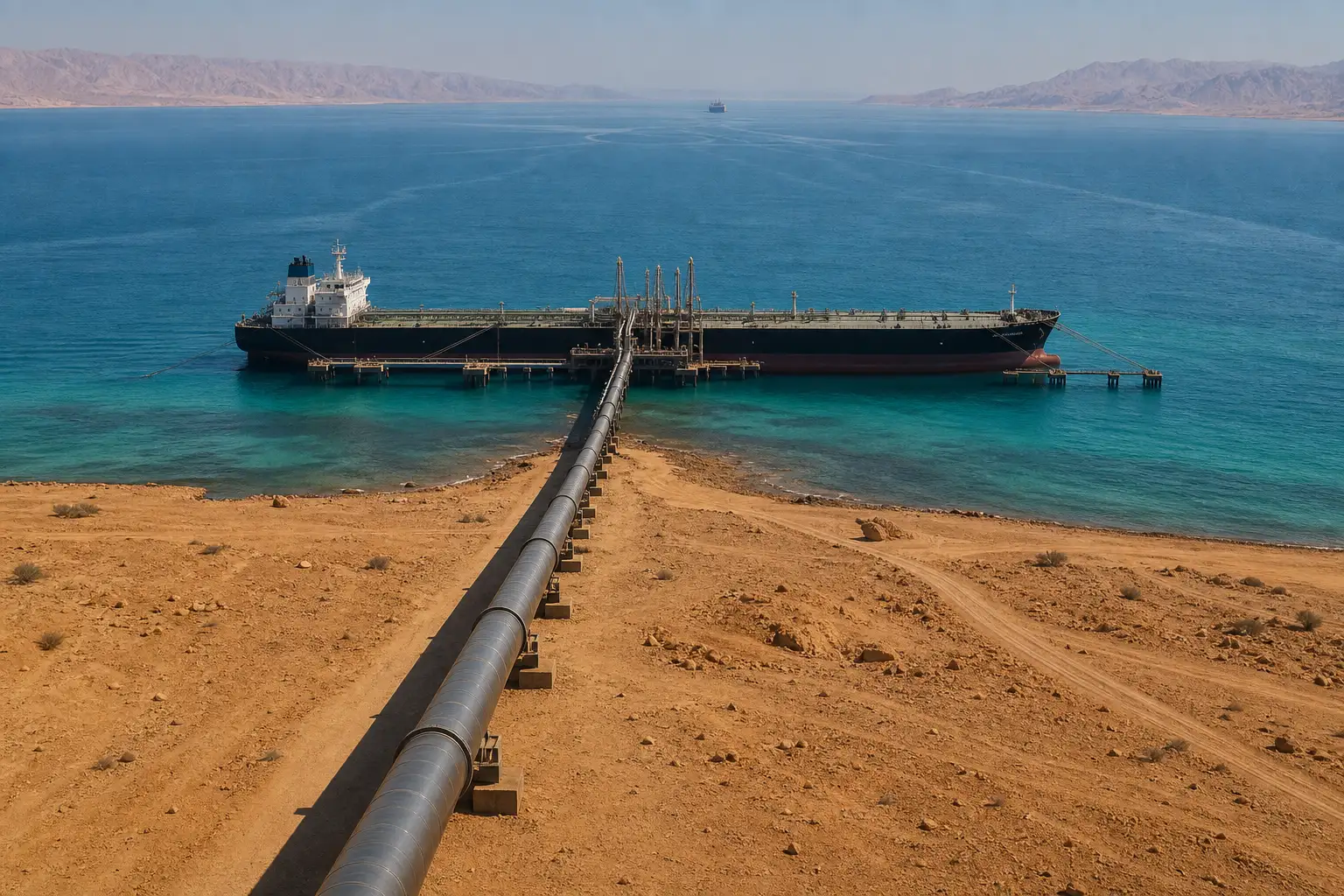
Saudi Arabia’s Escape Valve From Hormuz Runs Through One Door
Saudi Arabia has spent months routing around the Hormuz war using a piece of infrastructure most of the world had forgotten about. The East-West Pipeline, known in the industry as Petroline, was built in 1981 and runs 745 miles from the Abqaiq processing hub on the Gulf coast across the Arabian Peninsula to the Red Sea port of Yanbu. Its capacity was expanded to a 7 million barrel emergency ceiling back in 2019.
Since the Strait of Hormuz effectively closed after US and Israeli strikes on Iran began on February 28, Saudi Aramco has pushed that pipeline to its full 7 million barrels a day. Roughly 5 million barrels a day of that crude now loads onto tankers at Yanbu, on top of 700,000 to 900,000 barrels a day of refined products, while about 2 million barrels a day are held back for domestic refineries.
That flow has kept the kingdom’s exports running at an estimated 85 percent of pre-war volume, acting as a relief valve for a market already short on supply. Yanbu’s importance had already been rising before this year’s war: the terminal handled a record 18% of seaborne exports in the second quarter of 2024, according to the US Energy Information Administration.
Riyadh’s backup option is thin. A smaller link running north to Egypt’s Sumed system can carry only an estimated 2 million to 2.5 million barrels a day toward the Mediterranean, far short of what Yanbu handles and nowhere near enough to replace it. That leaves the kingdom’s oil lifeline facing new risk narrowed to a single functioning route, one that ends at a strait now under direct threat.
Andreas Krieg, a security analyst at King’s College London, said Tehran could ask the Houthis to “prepare the Bab al-Mandab front and may provide the strategic trigger, particularly if US pressure is degrading Iran’s position around Hormuz,” even if the rebels retain “considerable autonomy.”
Who Actually Buys Saudi Arabia’s Oil?
Saudi Arabia sold $187 billion in crude oil abroad in 2024, and most of it went to Asia. China alone bought $47.9 billion worth, ahead of South Korea, Japan and India. The United States bought a small fraction by comparison, which is why a Red Sea closure is mostly an Asian problem wearing a Middle Eastern disguise.
| Buyer | 2024 Crude Imports From Saudi Arabia | Share of Saudi Arabia’s Crude Exports |
|---|---|---|
| China | $47.9 billion | about 26% |
| South Korea | $29.5 billion | about 16% |
| Japan | $28.7 billion | about 15% |
| India | $19.6 billion | about 10% |
| United States | $8.35 billion | about 4% |
Add China, South Korea, Japan and India together, drawn from $187 billion in crude exports in 2024, and they bought well over half of everything Saudi Arabia shipped that year, more than ten times what the United States purchased. Saudi Arabia still supplied 14% of China’s crude imports last year, ranking second only to Russia among Beijing’s suppliers.
Those barrels reach Asia by sailing down the Red Sea and through Bab al-Mandab, the strait the Houthis just threatened to close.
This Time, the Safety Net Under the Red Sea Is Gone
The Houthis have shut this door before. Beginning in November 2023, during the Gaza war, the group attacked commercial vessels transiting the Red Sea, eventually hitting more than 100 ships and forcing container lines to sail around Africa instead.
The damage back then hit container shipping hardest. Suez Canal transit volume fell 50% within two months of the campaign’s start, according to the International Monetary Fund, while traffic around the Cape of Good Hope surged an estimated 74 percent as carriers rerouted.
Crude oil mostly kept moving that time. Tankers, unlike container ships, largely stayed on their normal routes because Gulf oil could still flow freely through Hormuz. This time, Hormuz is not open.
A repeat now would land differently, with Hormuz effectively closed and Yanbu carrying the load:
- Asia-bound tankers from Yanbu would face the same weeks-long detour around the Cape of Good Hope that container lines took in 2024, adding well over a week to each voyage.
- War-risk insurance premiums for tankers, already elevated from the Hormuz standoff, would climb further, echoing the surge insurers imposed on Red Sea container traffic in 2024.
- Suez Canal revenue, still below its pre-crisis level, would fall again, deepening a fiscal strain Egypt has leaned on for military and welfare spending.
- Some analysts estimate only 2 million to 2.5 million barrels a day could instead move north through Egypt’s Sumed pipeline, a fraction of what Yanbu currently handles.
A simultaneous crisis at Hormuz and Bab al-Mandab would produce a much larger shock than either blockade alone.
Andreas Krieg told Agence France-Presse. “Hormuz disruption constrains Gulf oil and liquefied natural gas exports, while Bab al-Mandab disruption interrupts the principal maritime connection between Asia, the Gulf and Europe,” he said. With the strait closed, he added, tankers “would have to sail north through Suez, cross the Mediterranean, pass Gibraltar and travel around Africa before reaching Asia.”
Crude Climbs, Then Pulls Back
Combined, a full Bab al-Mandab closure and the existing Hormuz standoff would strand roughly 17 percent of the world’s oil supply, a level the market has not had to price in for decades. Monday’s trading showed a market that still cannot decide how frightened to be.
- $91.42 a barrel: Brent’s overnight peak, its highest since June 11, before the rally faded.
- $89.22 a barrel: where Brent settled Monday, up 1.3 percent, after paring most of the overnight spike.
- 18%: the rise in US crude prices so far this month, according to AAA.
- $4 a gallon: the US national average gasoline price Monday, a level last seen on June 17.
Supertanker crossings through the Strait of Hormuz fell to an average of two a day last week, down from eight a day in late June and early July, according to satellite imagery reviewed by Reuters. Overall vessel crossings are down roughly 85 percent from pre-war levels, Quartz reported, citing the commodity flow monitor Kpler.
Amrita Sen, founder and director of research at Energy Aspects, warned oil could climb past $100 a barrel if the Hormuz slowdown persists alongside depleted global inventories. “The market is still quite complacent despite the price increase we have seen,” she told CNBC.
Mohammed al-Basha, an analyst with the US-based risk advisory Basha Report, said even an unenforced threat does damage. “Even if no ships are attacked, the announcement alone is likely to disrupt shipping and create uncertainty for Saudi ports,” he said. “Whether the Houthis move from threats to direct action remains the critical issue.”
A Ten-Day Ceasefire Proposal Races the Clock
Diplomats are racing to contain the wider war before the blockade turns from threat to reality. A senior Iranian official told Reuters on Monday that Tehran had received a proposal from mediators for a 10-day ceasefire, an effort to salvage an interim deal meant to pave the way toward a lasting settlement. No further details on the talks were given.
Two Pakistani government sources said separately that Iran’s interior minister, Eskandar Momeni, had asked Islamabad to resume its mediation role in the conflict. He later arrived in Pakistan’s capital for further talks.
The diplomatic push followed a ninth consecutive night of US strikes on Iranian cities and attacks by Iran’s Revolutionary Guards on US military assets across the region. President Donald Trump, facing political pressure at home over rising gasoline prices, defended the latest strikes as payback for the deaths of up to three American service members in recent Iranian attacks.
“Every time Iran kills an American Soldier they will pay for that killing many times over!” Trump wrote on Truth Social. “This directive has been passed on to Secretary of War, Pete Hegseth, Chairman of the Joint Chiefs of Staff, Daniel Caine, and every Leader in the Military.”
Stephane Dujarric, the spokesman for the United Nations secretary-general, warned that the Houthi threat risked an “even wider” regional conflict, a caution that lands as Gulf neighbors absorbing the brunt of the US-Iran war already report strikes on their own territory.
For now, the Houthis have not fired on a single tanker. Whether that changes may hinge less on Sanaa than on whether Tehran and Washington can hold a ceasefire together for even ten days.
