
Venezuela and Israel agreed this week to open a formal consular coordination channel, the first official mechanism between the two countries in 17 years. The step follows Israeli rescue teams that arrived after June’s twin earthquakes and a sharp July diplomatic protest Caracas lodged against Tehran.
Full embassies stay closed. Yet the move lands as a clear second-order signal: once post-Maduro Venezuela regained Western options, Iran’s long-cultivated partner in the Americas began to look less indispensable. The sequence is compact. Aid on the ground, a written rebuke of Tehran, then a joint statement with Jerusalem. Each step narrows the space Iran once occupied without ceremony.
Consular coordination is limited by design. It does not restore ambassadors or reopen chanceries. It does create a standing path for paperwork, citizen services and the technical work already under way after the quakes. For a relationship frozen since 2009, that path is the first formal opening in nearly two decades.
A Consular Channel After 17 Years
Foreign Minister Félix Plasencia and Israeli Foreign Minister Gideon Sa’ar concluded talks that produced a joint statement. Both sides will set up a dedicated mechanism so citizens of each country can obtain consular services. They will also keep the technical cooperation that started with the earthquake response.
Plasencia said the countries agreed “to allow the continuation of bilateral technical cooperation arising from the emergency and recovery efforts following the double earthquake.” A shared statement added that both governments recognize “the importance of the relationship between the State of Israel and the Jewish community in Venezuela, which constitutes an important historic bridge of friendship.”
- Coordination mechanism for consular services to citizens living in the other country
- Continuation of emergency and recovery technical cooperation launched after the June quakes
- Explicit recognition of Venezuela’s Jewish community as a living bridge
- No announcement of embassy reopenings or full diplomatic restoration
Dr. Miguel Truzman, national coordinator of the Confederation of Jewish Associations of Venezuela, called it the start of “a new era” and a first step toward eventual full relations. Jewish residents in Caracas described practical relief for families who had waited years for routine paperwork and contact.
The joint text keeps expectations tight. Technical cooperation is framed as a continuation of work already begun, not a blank check for new programs. The Jewish community is named as a bridge, which matches how the rescue teams first entered the country. Nothing in the statement commits either side to a calendar for embassies. The channel is real. The ceiling remains low for now.
Chavez Closed the Door in 2009
Hugo Chávez broke relations during Operation Cast Lead. He expelled Israel’s ambassador and declared on television, “Damn you, State of Israel.” Earlier he had compared Israeli actions in Lebanon to a “new Holocaust” and called for genocide trials against Israeli leaders.
At the same time he deepened ties with Mahmoud Ahmadinejad. The two leaders visited each other’s capitals three times each between 2005 and 2007. Chávez received Iran’s highest state honor from Ayatollah Ali Khamenei and publicly backed Iran’s nuclear program at the United Nations. By the end of Chávez’s presidency the two countries had signed hundreds of agreements in energy, banking, housing, agriculture and automobiles. The Center for Strategic and International Studies later put Iranian investments and loans in Venezuela between $15 billion and $20 billion by 2012, though many projects under-delivered.
Under Nicolás Maduro the relationship became more transactional. Mutual sanctions isolation turned each into a market and technical supplier the other could still reach.
The arc from warmth to rupture to utility can be read in sequence:
- 2005-2007 – Chávez and Ahmadinejad exchange three visits each and lock in early political alignment.
- 2009 – Caracas severs ties with Israel during Operation Cast Lead and expels the ambassador.
- By 2012 – Iranian loans and investment reach the CSIS range of $15-20 billion, with many projects already stalling.
- Maduro years – sanctions isolation keeps the partnership alive as a transactional supply channel rather than an ideological project.
That history still shapes the present. Hundreds of agreements and years of technical presence do not vanish because a consular channel opens. They do, however, lose the monopoly they once held when Caracas had fewer alternatives.
The Oil Swaps and Combat Drones Iran Built
When Venezuela’s refineries collapsed, Iran shipped fuel, condensate and technicians. Shipping data cited by Reuters showed Venezuela taking roughly 73,000 barrels per day of Iranian crude and condensate in 2022 and about 40,000 barrels per day in 2023. Tehran agreed to a roughly €110 million overhaul of the El Palito refinery and eyed the larger Paraguana complex.
In June 2022 Maduro and Ebrahim Raisi signed a 20-year cooperation plan covering oil, petrochemicals, defense, agriculture and culture. Raisi praised Venezuela’s “exemplary resistance.” Khamenei said the two countries possessed “such close ties with no other country.” Maduro replied that Iran had helped “when no country was helping us.”
Defense cooperation ran deeper. Four days before U.S. forces captured Maduro on January 3, 2026, the U.S. Treasury sanctioned ten Iranian and Venezuelan individuals and entities. Among them was Venezuela’s Empresa Aeronautica Nacional SA (EANSA). According to the millions of dollars’ worth of Mohajer-6 combat drones designation, EANSA oversaw assembly of Iranian Qods Aviation Industries Mohajer-series UAVs inside Venezuela, rebranded as ANSU models. The ANSU-100, derived from the Mohajer-2 (locally Arpia), could launch Iranian Qaem guided bombs. EANSA’s chairman had coordinated directly with Iranian and Venezuelan military officers.
| Year / Period | Milestone | Scale or Detail |
|---|---|---|
| 2006 onward | Mohajer UAV production begins in Venezuela | Arpia / ANSU-100 line with Qaem bombs |
| By 2012 | CSIS estimate of Iranian loans and investment | $15-20 billion (many projects stalled) |
| 2020-2023 | Oil and condensate swaps, refinery help | Peak ~73,000 bpd Iranian crude/condensate in 2022 |
| June 2022 | 20-year cooperation agreement | Oil, defense, petrochemicals, agriculture |
| Dec 30, 2025 | U.S. Treasury EANSA and related sanctions | 10 individuals and entities, combat UAV focus |
By 2024 the economics had already frayed. Reuters reported PDVSA falling behind on swap obligations; Iran halted some cargoes. Active business dropped below $10 billion against earlier $25 billion ambitions. When Washington briefly eased sanctions, PDVSA preferred cash customers over Iranian swaps. Iran’s value peaked when Venezuela had nowhere else to turn.
The volume drop from roughly 73,000 barrels per day in 2022 to about 40,000 in 2023 already signaled strain before politics shifted. Refinery work at El Palito and interest in Paraguana kept a technical footprint, yet payment arrears and the lure of cash buyers eroded the swap model. Defense assembly lines and the 20-year plan still existed on paper. The commercial logic that once made Tehran indispensable was weakening on its own.
Twin Quakes and an Unexpected Lifeline
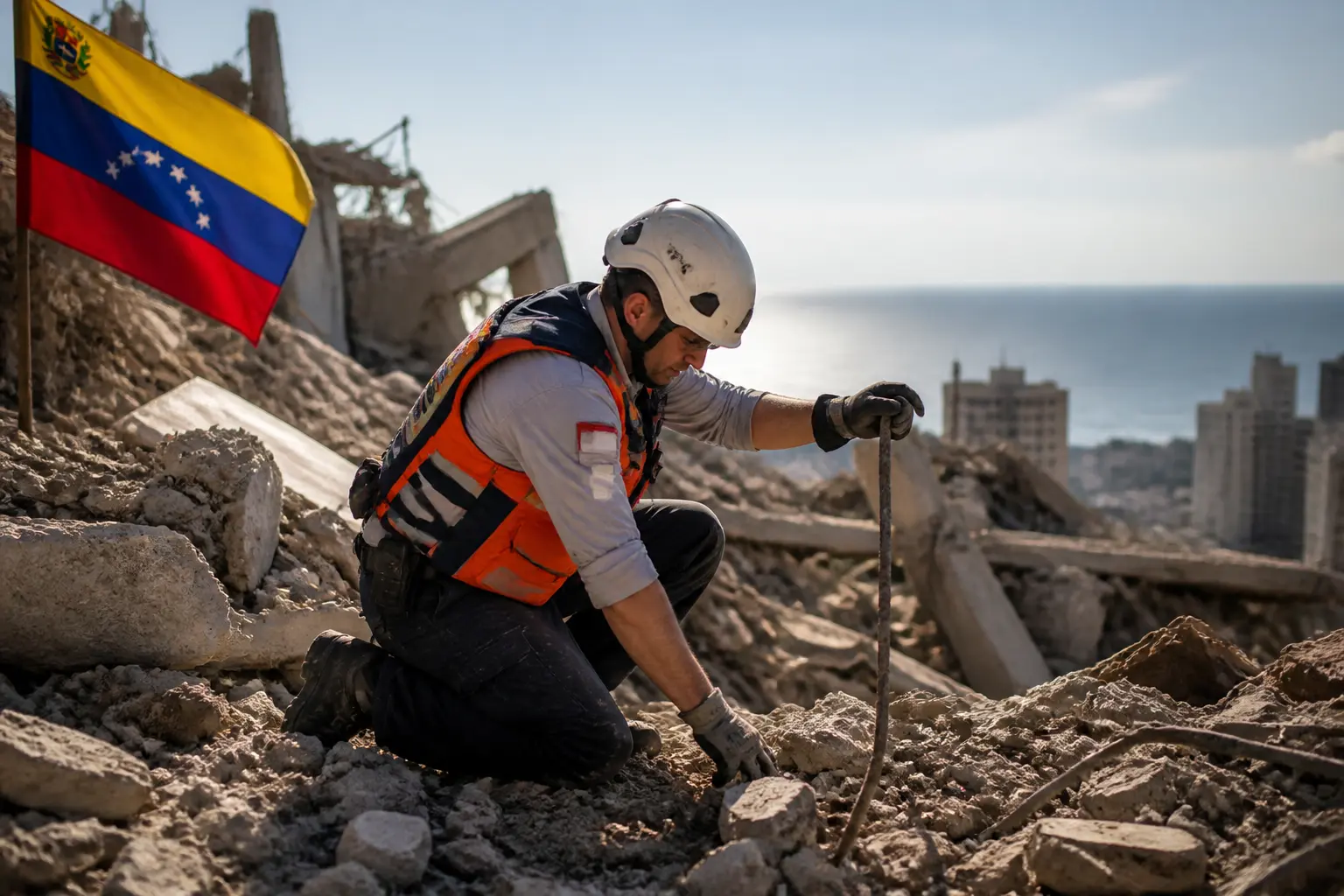
On 24 June 2026 two strike-slip earthquakes, Mw 7.2 and Mw 7.5, struck northern Venezuela 30 seconds apart. La Guaira saw roughly 80 percent of buildings collapse. Official figures released in August put the death toll at 6,301 and hospitalized at 73,356. Tens of thousands remained missing or displaced. Direct damage estimates ran into the tens of billions of dollars.
Stats snapshot
- 6,301 confirmed dead (official August figure)
- 73,356 hospitalized
- Mw 7.2 + 7.5 doublet on 24 June, strongest in Venezuela since 1900
- Israeli Home Front Command and Foreign Ministry team deployed within days via the local Jewish community
Acting President Delcy Rodríguez later thanked Israel for “a highly specialized and professional group” that assessed damaged buildings for survivors and remains. The team arrived through contacts opened by Venezuela’s Jewish community. That practical channel became the political bridge. Israel’s presence also included technology already familiar on the ground; Israeli drones already used in Venezuela rescue work had shown up in earlier operations, giving the aid mission an existing technical footprint.
Speed mattered. The team reached the disaster zone within days, not weeks, because community contacts already existed. Building assessment for survivors and remains is specialized work; public thanks from Rodríguez gave that work an official seal. Once a foreign team is thanked by name, treating the same country as untouchable becomes harder to sustain. The consular talks weeks later followed a path the quakes had already cleared.
Caracas Summons the Iranian Ambassador
Less than two weeks before the consular announcement, Venezuela’s Foreign Ministry summoned Iran’s ambassador. It delivered a formal note of protest over contemptuous remarks that authorities called “contemptuous and inappropriate.” The trigger was Iranian Foreign Minister Abbas Araghchi’s comment, made while discussing talks with Washington, that “Iran is not Venezuela.”
Iran is not Venezuela where you take one person and everyone else gets scared and backs down.
Araghchi’s line, reported from a Mehr News interview, referenced the January U.S. operation that removed Maduro. Caracas demanded an end to any comparison that undermined Venezuelan “dignity, sovereignty, institutional integrity, or good name.” Set against Khamenei’s earlier claim of uniquely close ties, the public rebuke marked a steep fall.
U.S. officials had pressed Rodríguez from the first days after Maduro’s capture to distance Caracas from Iran, Russia and China. In March, Venezuela and the United States agreed to restore diplomatic and consular relations. The July protest and August Israel step moved in the same direction. Analysts tracking Iran’s foothold in the Western Hemisphere had already flagged Venezuela as a key node for oil, defense industry cooperation and potential proxy access. That node is now under visible pressure.
A written protest is harder to walk back than a quiet complaint. It creates a record. Coming days before the Israel announcement, it also signals sequencing: first a public break in tone with Tehran, then a public opening with Jerusalem. The March restoration track with Washington supplies the wider frame. Distance from Iran is no longer only an American request; it is becoming Venezuelan practice.
Incentives Flip When Options Return
The partnership Khamenei once called unique rested on a simple condition. Venezuela needed suppliers and markets that sanctions had cut off. Iran needed a willing partner in the Americas for oil moves, industrial projects and defense assembly. When that condition held, praise flowed easily in both directions.
By 2026 the condition no longer holds in the same way. March brought a U.S.-Venezuela path back toward diplomatic and consular ties. June brought Israeli rescue teams and public thanks. July brought a formal protest against Tehran. August brought the consular channel with Israel. None of those steps requires Caracas to scrap every Iranian contract overnight. Together they show that exclusivity is gone.
| Measure | Earlier peak | Later reading |
|---|---|---|
| Iranian crude and condensate to Venezuela | ~73,000 bpd in 2022 | ~40,000 bpd in 2023 |
| Active bilateral business | $25 billion ambitions | Below $10 billion by 2024 |
| Political tone from Caracas | Maduro: Iran helped “when no country was helping us” | Formal protest over “contemptuous” remarks |
| Israel channel | Relations broken since 2009 | Consular mechanism and quake technical cooperation |
Oil volumes fell before the political turn. Business totals shrank against earlier ambitions. PDVSA’s preference for cash customers when sanctions eased showed the commercial pull of alternatives. The drone assembly lines and refinery technicians remain part of the inherited landscape. They no longer define the only available horizon.
A Thinner Network Across the Region
Iran’s position in the Western Hemisphere leaned on Venezuela as a durable node for energy trades, defense industry work and political cover. Analysts had already marked that role. The combination of a public rebuke, accepted Israeli aid and a new consular channel with Jerusalem puts that node under strain that is visible rather than speculative.
Parallel movement elsewhere sharpens the picture. Colombia’s own recent security tilt toward Israel shows Caracas is not the only capital recalibrating. When more than one government adjusts at once, the regional map changes faster than any single bilateral note can reverse.
None of this erases Iranian infrastructure already on the ground. Training links, assembly knowledge and any remaining technicians are facts of prior investment. What has changed is the cost of treating those facts as destiny. A government that can summon Iran’s ambassador, thank Israeli rescuers and open a consular channel is a government that can choose. Choice itself thins a network built on the absence of choice.
What Still Binds Them and What Does Not
Caracas has not torn up the 20-year agreement or announced an end to military-technical links. Physical infrastructure, training relationships and any remaining Iranian technicians cannot be dismantled by a consular memorandum. Yet the incentives have flipped.
In 2022 Maduro could say Iran alone helped when others would not. In 2026 Venezuela again has paths to Western markets, investment and partners. It has publicly rebuked Tehran and accepted Israeli rescue teams. The Jewish community that once operated under Chávez-era hostility now serves as the acknowledged bridge. Parallel shifts appear elsewhere in the region; Colombia’s tilt is one more data point in the same direction.
What we know
- Consular mechanism and technical cooperation are formal and public
- Israeli aid teams operated with government thanks and Jewish-community facilitation
- July protest was delivered in writing and demanded an end to demeaning comparisons
- U.S.-Venezuela diplomatic and consular restoration was agreed in March
What’s unconfirmed
- Any formal Venezuelan withdrawal from the 2022 20-year pact
- Status of remaining Iranian UAV or refinery technical personnel
- Timeline, if any, for full embassy reopenings with Israel
- Scale of remaining active oil-swap or investment contracts
On X and in regional commentary the reading is blunt: a leadership that once treated Israel as permanent enemy on Iran’s behalf now treats limited official contact as routine statecraft. Iran’s Latin American network just became thinner. Caracas still has Iranian infrastructure and history. It also has choices it lacked three years ago. Those choices are already rewriting the partnership Khamenei once called unique.
