
Saudi Foreign Minister Prince Faisal bin Farhan phoned his counterparts in Bahrain, Egypt and Turkiye on Tuesday to discuss regional security, using language nearly identical to a dozen other calls he has made since February. Developments were reviewed. Coordination was stressed. Diplomatic solutions were supported.
What that boilerplate skips over is which of the three capitals on his list has actually taken incoming fire. Bahrain’s capital, Manama, has been hit by Iranian missiles and drones twice since the war between the United States and Iran began, most recently claimed by Iran’s Revolutionary Guard barely a week before this call. Egypt and Turkiye have not been struck at all.
A Routine Wire Line Hides One Exposed Name
The calls happened on Tuesday with Bahrain’s Minister of Foreign Affairs Dr. Abdullatif bin Rashid Al Zayani, Egypt’s Minister of Foreign Affairs, International Cooperation, and Egyptian Expatriates Badr Abdelatty, and Turkiye’s Minister of Foreign Affairs Hakan Fidan. According to the Saudi Press Agency, Prince Faisal reviewed the latest regional developments and their impact on regional security in each call.
The three foreign ministries stressed the importance of continued coordination and consultation, and reaffirmed support for diplomatic efforts aimed at peaceful, comprehensive solutions. Nearly the same sentence has run under Prince Faisal’s name after calls with Kuwait, Qatar, India, Pakistan, Kyrgyzstan and Washington in recent months. The language does not change even when the facts on the ground do.
Day 144 of a War Riyadh Didn’t Start
By one open source military tracker’s count, Tuesday’s calls landed on the 144th day of the war between the United States and Iran. It began in the last days of February, when US and Israeli strikes on Iranian targets triggered a wave of Iranian retaliation across the Gulf. Iran’s supreme leader was killed in the opening salvo that stretched into March 1.
A ceasefire and memorandum of understanding between Washington and Tehran took hold on June 17. It did not last. By mid-July, President Trump had declared the truce “over” as new US strikes began, and by Tuesday, US Central Command had logged its tenth consecutive day of renewed bombing. The renewed campaign has widened well beyond Iran’s borders, part of a broader pattern of airstrikes and Gulf attacks escalating since February.
Iran has framed its own strikes on US allies as retaliation, warning that any country allowing its territory to be used against Iran becomes a legitimate target in return. That warning is why Prince Faisal is not just calling Washington. He is calling the neighbors sitting closest to the blast radius.
Bahrain Keeps Taking the Direct Hits
Bahrain is the smallest state on Tuesday’s call list by almost every measure, population, territory, military weight. It is also the only one that has been hit.
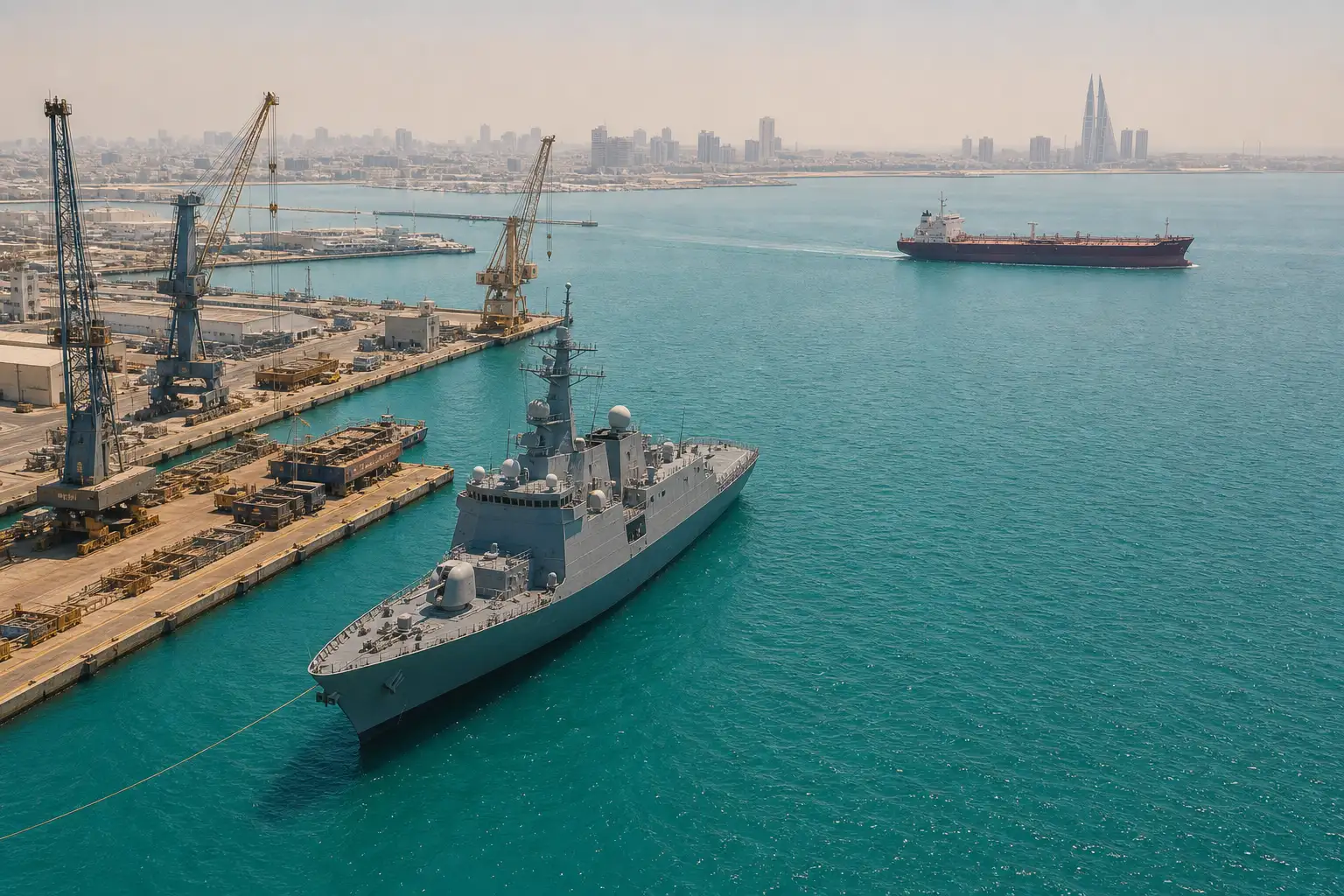
The kingdom hosts the headquarters of the US Navy’s Fifth Fleet in Manama, a command whose area of operations covers roughly 2.5 million square miles of water stretching from the Gulf to the Red Sea. That basing decision has made Bahrain a repeat target since the war’s opening days.
- February 28, 2026: Iranian missiles and drones struck Manama, hitting near the Fifth Fleet headquarters and residential towers including one in the Juffair district, according to Bahraini officials and Stars and Stripes reporting from the scene.
- March 1, 2026: Bahrain’s interior ministry said falling debris from an intercepted missile sparked a fire at Salman Port that killed a foreign worker and injured two others, while the military said it had intercepted 61 missiles and 34 drones since the weekend’s escalation began.
- Late June 2026: Prince Faisal called Egypt’s and Qatar’s foreign ministers specifically to discuss renewed Iranian attacks on Bahrain and threats to maritime navigation, according to Arab News, with both calls condemning the strikes.
- July 15, 2026: Iran’s Revolutionary Guard said it had destroyed the Fifth Fleet headquarters a second time and hit a US logistics site at Kuwait’s Abdullah Port, Middle East Monitor reported.
- July 21, 2026: Prince Faisal called Bahrain’s foreign minister again, this time bundled into the same short readout as Egypt and Turkiye.
Each entry in that timeline is a fact Bahrain has to live with that Egypt and Turkiye do not. The diplomatic language never distinguishes between them.
Cairo’s Red Sea Arithmetic
Egypt’s exposure runs through trade rather than missiles. Cairo depends on Suez Canal revenue that has already been squeezed by the Houthi blockade threatening its own Suez recovery, and a wider Gulf war raises the odds that shipping insurers and freight lines route even more traffic around Africa rather than through Egyptian waters.
That stake has pushed Cairo into an active diplomatic role rather than a passive one. On June 21, Prince Faisal chaired a meeting of foreign ministers from Egypt, Saudi Arabia, Turkiye and Pakistan at Tahrir Palace in Cairo, a standing quartet that has met repeatedly since the war began. Badr Abdelatty’s own late June call with Prince Faisal went further than Tuesday’s, explicitly condemning the strikes on Bahrain and threats to maritime navigation, the Saudi Press Agency reported at the time.
Why Ankara Wants to Talk to Everyone
Turkiye’s foreign minister has spent the war positioning Ankara as the one capital that can still speak to both sides. Hakan Fidan hosted Iran’s foreign minister, Abbas Araghchi, in Istanbul in late February, days after the fighting started, and has kept working the Gulf channel since.
We know everybody, we know the dynamics of every conflict.
Fidan told The National that Turkey is uniquely positioned to mediate regional disputes because of that history, adding that Ankara believes it is best placed to understand the conflict and help stop it. He has also directly criticized Israeli Prime Minister Benjamin Netanyahu, saying his government’s policies are a burden for the region and a threat to international security.
By mid July, speaking in Doha, Fidan was pushing for a return to the collapsed June memorandum, noting that Pakistan’s mediation, Qatar’s contributions and Turkiye’s support had built the original framework. He warned that continued hostilities have already damaged the regional economy and that a broader conflict risks further instability, a warning aimed as much at Ankara’s own exposure as anyone else’s.
Three Capitals, Three Different Kinds of Exposure
Lined up next to each other, the three names on Tuesday’s call sheet carry very different weight. So does a fourth Gulf state that did not make Tuesday’s list but has faced the same fire.
| Country | Foreign Minister | Direct Exposure Since February | Role In the Diplomacy |
|---|---|---|---|
| Bahrain | Dr. Abdullatif bin Rashid Al Zayani | Fifth Fleet HQ struck twice; a worker killed in a Salman Port fire | On Tuesday’s call list; repeatedly the subject of other capitals’ calls |
| Egypt | Badr Abdelatty | No strikes on its territory; Suez Canal revenue exposed to Red Sea disruption | Chairs a mediation quartet with Turkiye, Saudi Arabia and Pakistan |
| Turkiye | Hakan Fidan | No strikes; shares a long border with Iran | Self-described all-channel mediator; hosted Iran’s foreign minister in February |
| Kuwait | Sheikh Jarrah Jaber Al-Ahmad Al-Sabah | Abdullah Port logistics site struck in July; missiles intercepted over Mangaf | Held its own separate call with Prince Faisal, condemning what it called heinous Iranian attacks |
Kuwait’s foreign minister in a separate call made that condemnation days before Tuesday, underlining that Bahrain is not the only small Gulf state absorbing hits while larger neighbors coordinate policy by phone.
Washington’s Kharg Island Decision Looms Over the Diplomacy
None of this diplomacy happens in a vacuum. Every one of Tuesday’s calls took place while the Trump administration weighs whether to escalate the US campaign against Iran into something closer to a ground war. Options reportedly on the table include:
- Expanding the target set to Iranian energy plants and bridges
- Sending ground forces to seize the Kharg Island oil terminal, Iran’s main crude export hub
- Bombing the Pickaxe Mountain underground complex
- A ground operation short of full invasion that could involve thousands of troops over weeks or months, the Pentagon told the Washington Post
Iran has answered with its own warning. Brigadier General Mohammad Akrami-Nia, an Iranian army spokesperson, said on state television that Tehran would rather destroy its own territory than let it fall to American forces.
If America occupies our territory, we will even bomb our own territory. This is the logic of war.
A former member of Iran’s parliamentary national security committee, Ahmad Bakhshayesh Ardestani, went further, telling reporters Tehran could strike Kuwait and Bahrain, including Kuwait’s Bubiyan Island, if the United States moves onto Iranian soil. That is the scenario sitting behind Tuesday’s mild-sounding phone calls. Bahrain is already on the list of countries that have been hit once the shooting starts elsewhere. It has no reason to expect that changes.
Frequently Asked Questions
What is the US Navy’s Fifth Fleet and why is it based in Bahrain?
The Fifth Fleet is a US Navy command headquartered in Manama with an area of operations covering about 2.5 million square miles across 21 countries, including the Strait of Hormuz, the Suez Canal and the Bab el-Mandeb strait. Its presence in Bahrain, a decision made decades before this war, is the direct reason Manama keeps appearing in Iranian retaliation.
Is the US-Iran ceasefire from June still in effect?
Not in practice. The memorandum of understanding signed June 17, 2026 briefly paused hostilities, but President Trump declared it “over” in mid-July as new US strikes began, and by July 21 the renewed campaign had reached its tenth consecutive day.
Why does Kharg Island matter to the conflict?
Kharg Island is Iran’s principal crude oil export terminal. US officials have floated seizing it as a way to cut off Iran’s oil revenue, though Iranian officials have warned any such operation would draw immediate missile retaliation from the mainland.
Which Gulf countries has Iran struck since the war began?
Iran has hit or claimed strikes on US-linked sites in Bahrain, Kuwait, Qatar and Jordan since February, along with a reported strike in Dubai, as part of what Iranian officials describe as retaliation against any territory used against Tehran.
