
Yemen’s Houthi rebels claimed Thursday that two drones scored a precise hit on Saudi Aramco’s Jazan oil refinery, the latest strike on a facility already offline since late July. Riyadh issued no immediate comment as the US-Iran war kept both the Strait of Hormuz and Red Sea routes under strain.
The claim arrives six days after Saudi Arabia, Turkey and Pakistan signed the Mecca Joint Defence Agreement. So far the new partners have supplied no visible military response.
The Two-Drone Claim Lands on a Quiet Capital
A military source quoted by the Houthi-run Saba news agency said the group’s forces targeted the Aramco refinery in Jazan with two drones and that the strike was precise. The action was framed as retaliation for alleged Saudi airspace violations over Saada and Hajjah provinces in northwestern Yemen.
Saudi authorities offered no confirmation or denial by Thursday evening. That silence matches the pattern after an earlier claim on August 9, when the Energy Ministry reported a fire at the same site that was extinguished with no injuries and declined to state a cause.
- July 25: Houthis claim missile and drone strikes on Jazan and Yanbu facilities; damage reported to infrastructure.
- August 9: Single-drone claim; Saudi ministry confirms fire extinguished, no injuries.
- August 13: Two-drone claim; no Saudi statement yet.
On X, several accounts immediately asked where the new defense partners were. The absence of Turkish or Pakistani aircraft or statements of concrete support became its own story within hours of the claim.
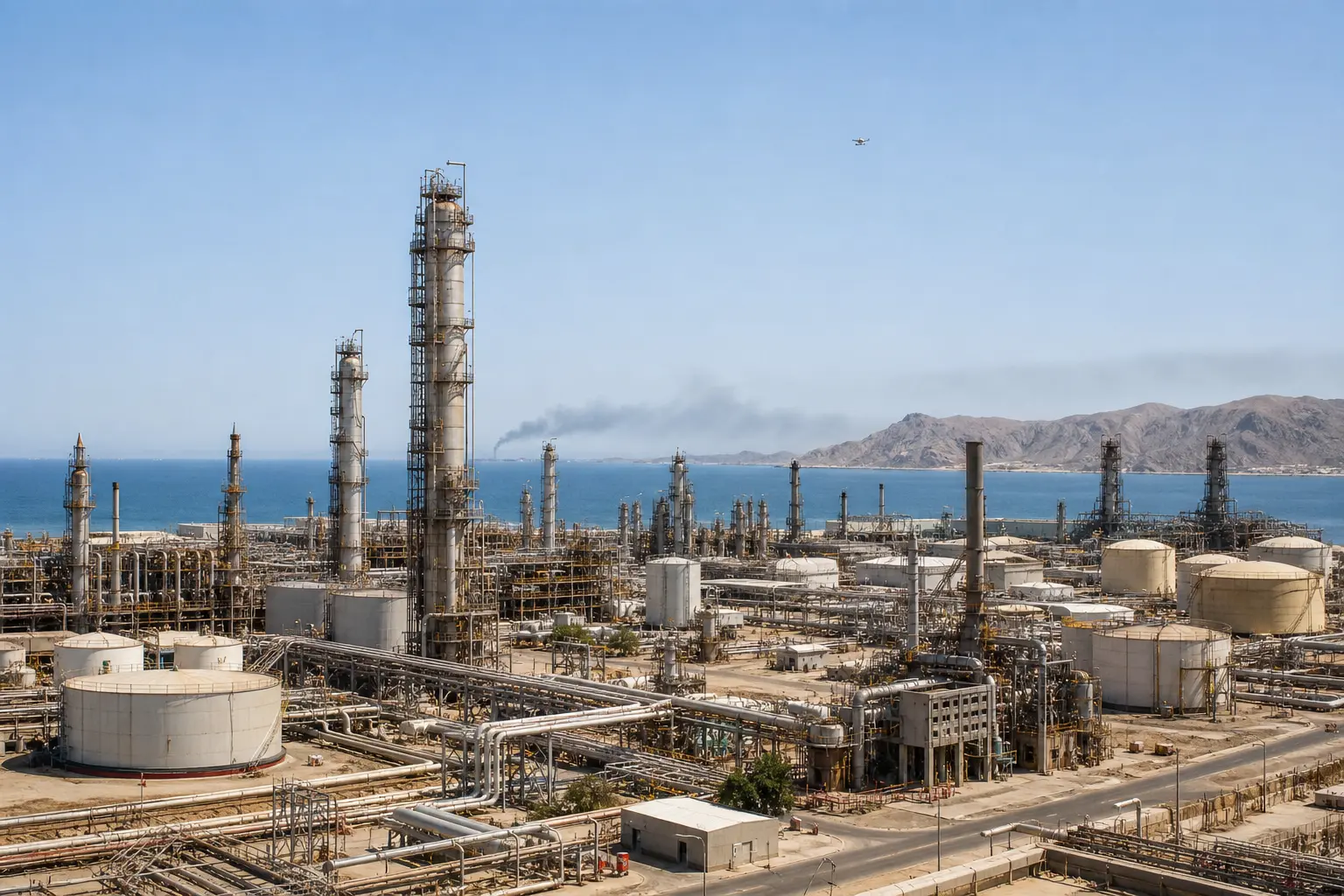
Jazan Has Been Dark Since Late July
The 400,000-barrel-per-day Jazan complex is a relatively new Aramco asset on the Red Sea coast designed to process heavy and medium crude into fuels and petrochemicals while generating its own power. It has sat idle since a late-July attack damaged key units, including parts of the integrated gasification complex and storage.
Industry notes at the time pointed to a gradual restart target around mid-August. Fresh claims now raise the chance that timeline slips further. Even without new confirmed damage, the repeated targeting keeps insurance rates elevated and forces Aramco to manage product supply from other plants.
| Date | Claimed action | Saudi response | Status noted |
|---|---|---|---|
| July 25 | Missiles and drones on Jazan and Yanbu | Operations suspended | Infrastructure damage, offline |
| August 9 | One drone on Jazan | Fire extinguished, no injuries | Cause not given |
| August 13 | Two drones on Jazan | No comment | Claim only |
An earlier Houthi drone hit on Jazan days after the Mecca signing already showed the group’s willingness to test the new alignment. Thursday’s claim continues that pattern against a plant that cannot currently contribute to Saudi export volumes.
Mecca Pact Meets Its First Real Test
On August 7 in Mecca, Crown Prince Mohammed bin Salman, Turkish President Recep Tayyip Erdoğan and Pakistani Prime Minister Shehbaz Sharif signed a joint defense agreement. Reports describe an Article 5-style clause: an armed attack on one would be treated as an attack on all. The text has not been released in full. Turkish officials stressed it is purely defensive, not aimed at any specific country, and open to others.
Forty-eight hours later the first Houthi claim on Jazan arrived. Saudi leaders did not publicly invoke the pact. Steven A. Cook of the Council on Foreign Relations noted the speed of the test and the lack of partner response.
After five decades, it is no longer possible to talk about a U.S.-led order in the Middle East.
Cook argued the agreement’s real weight lies less in immediate military guarantees than in signaling that regional powers are writing their own security arrangements. The end of the U.S.-led Middle East order, in his reading, is already underway.
Commentator Bobby Ghosh was blunter about the practical limits. A prior Saudi-Pakistan pact with nearly identical language produced only statements of solidarity and no soldiers when Iranian missiles hit Saudi soil earlier in the war. Adding Turkey’s signature, he wrote, does not automatically change that calculus. Pakistan shares a long border with Iran and a large Shia population; Turkey keeps its own hedges across NATO, the Gulf and energy routes.
Riyadh Weighs Sending Yemeni Forces Back to the Coast
While the pact sits unused, Saudi Arabia is weighing whether to back a ground campaign by Yemeni forces to push Houthis off the Red Sea coast. The Media Line reported that Riyadh has spent roughly seven months assembling rival militias into more coherent units under Saudi supervision, including Nation’s Shield and Emergency Forces.
The goal would be to secure the shoreline from Bab el-Mandeb north through Mocha and Hodeidah. Houthi control of that coast lets the group threaten shipping that has become even more critical once Hormuz traffic collapsed. A successful push would also reduce the launch pads used against Jazan and Yanbu.
Analysts caution that the internationally recognized Yemeni government’s army remains a patchwork of Saudi-backed and former Emirati-backed factions. Integration has accelerated since January, when Riyadh forced Emirati-linked southern forces to scale back after a weapons-shipment dispute. New commanders have been appointed, yet operational unity is unproven.
- Force assembly under Saudi Maj. Gen. Falah al-Shahrani folding southern units into defense and interior ministries.
- Repeated Houthi strikes on Mocha and al-Khokha aimed at degrading Joint Forces before any offensive.
- Inland pressure continuing around Marib, Yemen’s oil and gas hub, with casualty reports ranging into the dozens in early August.
Any major ground move would test whether Washington, already stretched by the Iran war, feels obligated to support a Saudi-enabled campaign. It would also test whether Turkey or Pakistan offer more than diplomatic cover. An Iranian flight that pushed Yemen toward war earlier showed how quickly external actors can reignite the front. The Ma’rib front and three-front pressure already stretch government resources.
Dual Chokepoints Squeeze the Kingdom’s Options
Jazan’s offline status is one piece of a larger logistics bind. The Strait of Hormuz remains heavily restricted. Tracking data has shown daily traffic at a fraction of the pre-war average of more than 130 vessels. Satellite images this week captured a very large crude carrier loading at Ju’aymah, part of the Ras Tanura complex, the first such sighting in nearly a month as Riyadh tries to keep volumes moving from Gulf terminals.
The East-West Pipeline to Yanbu on the Red Sea was built precisely to bypass the Gulf. Yanbu can move roughly 4 million barrels a day. But tankers leaving Yanbu for Asia must still transit the length of the Red Sea and exit via Bab el-Mandeb, where Houthis have declared a blockade and scored deadly hits. The commercial vessel Tihama was struck this week, killing crew members in the first such deaths in the strait in a year.
400,000 bpd offline at Jazan.
~4 million bpd potential at Yanbu still facing Red Sea risk.
First VLCC loading at Ju’aymah in weeks signals Gulf export effort.
July exports already slipped hundreds of thousands of barrels a day on dual threats.
Gulf states are expanding pipelines and seeking alternative buyers. Ships are rerouting around Africa. China has begun regular Arctic container sailings. None of those fixes restore cheap, short-haul crude quickly.
Markets Absorb the Noise While Fundamentals Stay Tight
Oil prices have reacted more to the broader Hormuz stalemate and refining outages than to any single Jazan claim. Diesel cracks in some hubs have run near records on middle-distillate tightness. Saudi Aramco is handling September Asia crude allocations on an ad-hoc basis, according to trading sources, a sign of continued caution.
The kingdom’s ability to maintain shipping volumes matters for both revenue and for the credibility of its energy diplomacy. Every additional week of dual-chokepoint friction raises the cost of the eventual restart at Jazan and keeps pressure on global product balances. A ground campaign that succeeds in pushing Houthis inland could ease the Red Sea leg. A campaign that stalls would leave Riyadh with higher military costs and the same maritime vulnerabilities.
For now the Mecca Pact has produced joint photographs and analytical essays about a shifting regional order. It has not produced aircraft over Jazan or troops on the Yemeni coast. That gap is the second-order fact the latest drone claim makes harder to ignore.
Saudi leaders can continue containing the Houthis from the air and sea while hoping the Iran war ends on terms that reopen Hormuz. Or they can green-light the ground option they have spent months preparing and discover exactly how much support their new partners and a busy Washington are prepared to give. Thursday’s claim did not decide that choice. It simply removed more time from the clock.
