
The African Development Bank approved up to $66 million on July 13 for the first phase of Egypt’s 500-megawatt Dandara solar project. The plant, paired with a 100-megawatt-hour battery system, will rise in Qena Governorate, southern Egypt. Every watt of power it produces already belongs to one customer under a 25-year contract: EgyptAlum, one of Africa’s largest aluminium producers.
By the numbers, that is climate progress. It is also a lesson in how Egypt’s solar boom spreads unevenly. Fast money chases deals with one committed industrial buyer locked in for 25 years. Power meant for the public grid still moves slower.
AfDB Puts $66 Million Behind Egypt’s Biggest Corporate Solar Deal
The African Development Bank Group’s board approved up to $66 million for the design, construction, operation and maintenance of Dandara’s first phase. The package covers the photovoltaic plant and its integrated battery storage system, which will store daytime solar output for release during Egypt’s evening demand peak.
The total project carries a price tag of more than $290 million. AfDB’s own money, $46 million, comes from its ordinary resources. Another $20 million is concessional financing from the Climate Investment Funds’ Clean Technology Fund (CTF), a multilateral pool that subsidizes the riskiest slice of clean-energy deals. The rest is expected from other lenders.
| Financing Source | Amount | Role |
|---|---|---|
| African Development Bank (ordinary resources) | $46 million | Senior financing approved July 13 |
| Climate Investment Funds’ Clean Technology Fund | $20 million | Concessional financing approved July 13 |
| European Bank for Reconstruction and Development (proposed) | Up to $80 million | Senior loan still under board review |
| Consortium of development finance institutions | Remaining balance of the $290 million-plus total | Additional debt still being mobilized |
Once built, the plant is expected to generate about 1,373 gigawatt-hours a year and cut roughly 500,000 tonnes of carbon dioxide annually. Construction should create around 2,500 jobs, with 23 permanent roles once the plant is running, and hiring targets set for women and young people.
“As the largest private corporate PPA in Egypt and the region, Dandara will establish an important benchmark for future private investment in industrial decarbonisation and in commercial and industrial renewable energy,” said Wale Shonibare, the AfDB’s director of energy financial solutions, policy and regulation.
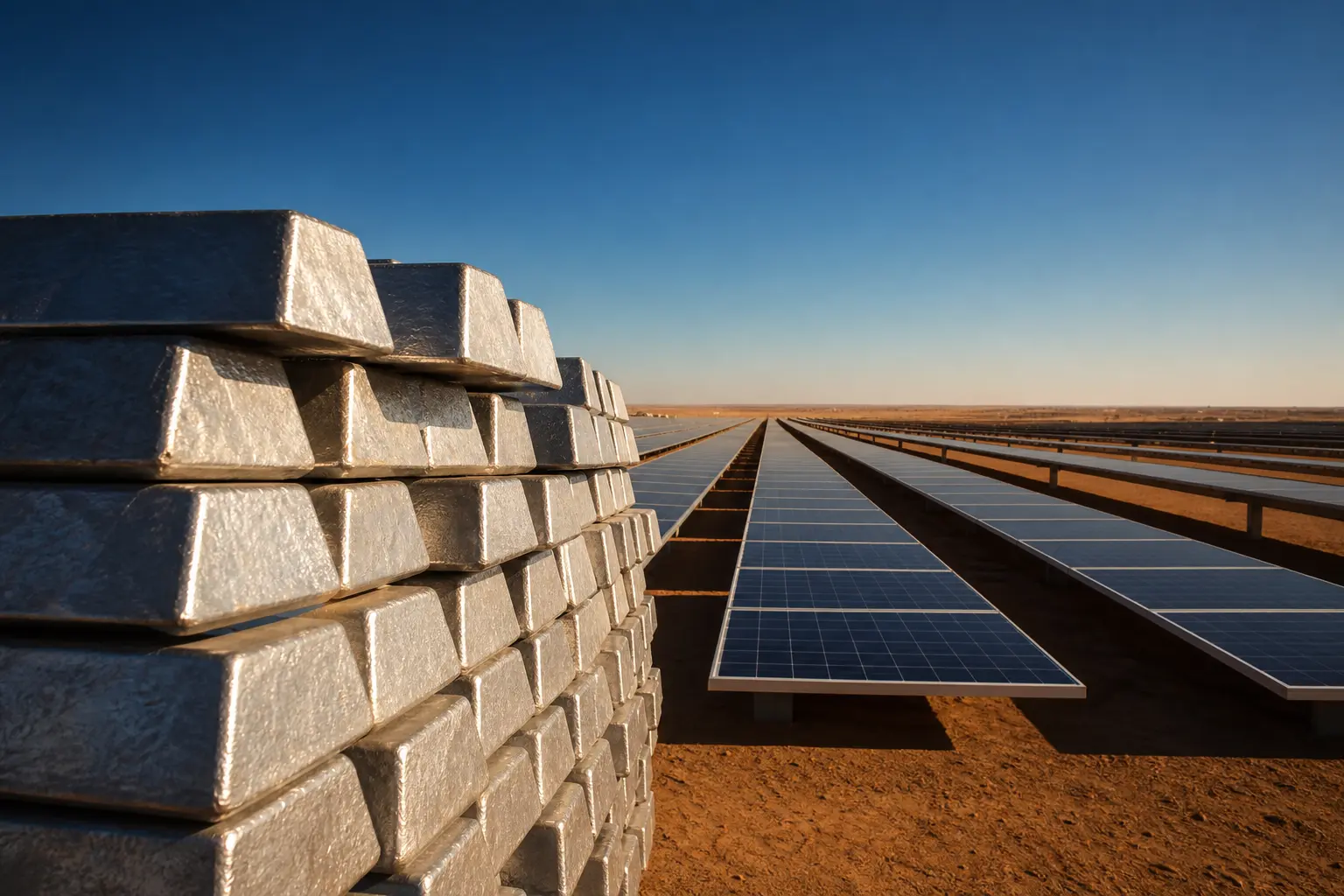
The EU’s Carbon Border Tax Is the Real Customer
Kevin Kariuki, the AfDB’s vice president for power, energy, climate and green growth, was direct about what is driving EgyptAlum to sign a 25-year solar contract in the first place.
It will enable EgyptAlum to safeguard its European aluminum market share while protecting more than 6,000 Egyptian jobs amid the European Union’s Carbon Border Adjustment Mechanism which took effect in January 2026.
Kariuki made that comment in the bank’s own announcement of the financing. The mechanism he is referring to, known as CBAM (the Carbon Border Adjustment Mechanism), is the European Union’s system for charging importers based on the carbon emitted while making goods like aluminium. It became active this year, and it turns a supplier’s power source into a line item on every invoice heading to Europe.
EgyptAlum sends around 60 percent of its exports to the European Union, and the company is the largest primary aluminium producer in North Africa, with roughly 320,000 tonnes of annual capacity. A carbon charge on that volume is not a rounding error. Kariuki said the plant will cut about 12.5 million tonnes of carbon dioxide over its lifetime, the kind of number a CBAM compliance officer can actually use in a spreadsheet.
One Buyer Gets the Power, Not the Public Grid
The plant exists to serve one address: EgyptAlum’s complex in Naga Hammadi, Qena Governorate. A wheeling agreement with the Egyptian Electricity Transmission Company moves the electricity there over the shared national grid, but the take-or-pay contract keeps every megawatt earmarked for EgyptAlum alone.
That structure creates a short, specific list of parties with something riding on this deal.
- EgyptAlum – locks in 25 years of contracted solar power and a hedge against carbon charges on its European sales
- Construction workers – about 2,500 temporary jobs during the build, plus 23 permanent operating roles once the plant runs
- The Egyptian Electricity Transmission Company – earns a wheeling role moving the power, without adding new supply for its own public customers
- Trafigura – the commodities trader that agreed in May to a $900 million expansion of EgyptAlum’s Naga Hammadi complex, a bet that gets safer as the plant’s carbon footprint shrinks
That last name rarely shows up in coverage of AfDB’s board approvals. Trafigura Group’s stake is in aluminium volumes, not solar panels, but its $900 million wager on EgyptAlum’s expansion only pencils out if the metal stays sellable in Europe under CBAM. Dandara’s power purchase agreement is part of what makes that math work.
From a 1.1-Gigawatt Plan to a Phased Build
Dandara did not start out this size. Scatec ASA, the Norwegian renewable energy developer building the plant through its Dandara Solar Power subsidiary, originally signed a 25-year power deal with EgyptAlum for a single 1.1-gigawatt solar-plus-storage complex.
The project has since been split into smaller, phased pieces as lenders did their own underwriting.
- March 2025: Scatec’s project company signs a 25-year power purchase agreement with EgyptAlum for an original 1.1-gigawatt design.
- October 2025: Dandara Solar Energy Company signs letters of intent with the EBRD, AfDB and the European Investment Bank to finance a revised, phased build.
- April 2026: The European Bank for Reconstruction and Development’s board begins formal review of a proposed loan for the first 500-megawatt phase.
- July 13, 2026: The AfDB board approves up to $66 million for that same first phase.
- Early 2028: Phase one is scheduled to reach full commercial operation.
The European Bank for Reconstruction and Development is weighing a loan of up to $80 million for the same first phase, a scaled-down version of a project that once carried an estimated $650 million construction bill. Splitting a single 1.1-gigawatt plan into smaller phases is a common way lenders de-risk a project before committing the full amount. It also means the headline “500 megawatts” approved this month is roughly half of what was originally announced.
Egypt’s Renewable Numbers Still Trail the Target
None of this happens in a vacuum. Egypt has spent years promising a much bigger renewable transition than any single solar plant delivers, and the national numbers have not kept pace with the pledges.
- 11 percent of Egypt’s electricity came from renewables in 2024, far short of the government’s 42 percent target set for 2030
- 7,750 megawatts of renewable capacity were installed nationwide by the end of 2024, below the government’s own goal for that year
- $14.5 billion in concessional finance has moved through Egypt’s NWFE platform into renewables since 2020, with roughly $3.9 billion of that reaching private developers like Scatec
- 500 megawatts is Dandara’s contribution so far toward the national platform’s 10-gigawatt renewable target for 2028
The mismatch is structural, not a failure specific to Dandara. Bankable projects need a creditworthy buyer willing to sign decades of contracts. The public grid, serving millions of subsidized households, rarely offers lenders that same certainty, and currency devaluation has made imported panels and turbines more expensive on top of that.
What Happens to Dandara Before 2028?
Phase one still needs the EBRD to formally close its proposed loan, construction to run through 2026 and 2027, and the plant to reach commercial operation in early 2028, the same year Egypt’s broader renewable targets come due.
Egypt has revised its national ambitions upward more than once, now aiming for 42 percent renewable electricity by 2030 and over 60 percent by 2040. Meeting either milestone requires far more than a handful of single-customer industrial plants, no matter how well financed. It requires grid upgrades, transmission capacity and projects that serve ordinary ratepayers rather than one aluminium complex.
Phase one alone is due online in early 2028, the same year Egypt’s NWFE platform has promised 10 gigawatts of new renewable capacity, a target to which Dandara’s contracted 500 megawatts adds roughly five percent.
Frequently Asked Questions
What is the Dandara solar project?
Dandara is a 500-megawatt solar plant with 100-megawatt-hour battery storage rising in Qena Governorate, in Upper Egypt. The wider site spans 2,335 hectares, with 1,130 hectares allocated to this first phase alone, according to an AfDB-published environmental impact study.
Why does the plant serve only one company instead of Egypt’s public grid?
Wheeling lets a private generator route electricity to a specific customer over the national grid’s shared infrastructure instead of building a private cable. The Egyptian Electricity Transmission Company transports Dandara’s output to EgyptAlum’s complex under that arrangement, while the electricity itself stays contracted solely to EgyptAlum for 25 years.
What is Egypt’s NWFE program?
NWFE stands for Nexus of Water, Food, and Energy, a national platform that has mobilized about $4 billion in concessional financing for private renewable projects totaling 4.2 gigawatts, working toward a 10-gigawatt target by 2028.
Will there be a second phase of Dandara?
The broader site is designed for 1,000 megawatts split into two roughly equal phases, but only the first 500-megawatt phase has financing lined up so far. A second phase would need its own separate round of lender approvals.
Does this deal lower electricity bills for ordinary Egyptians?
Not directly. Dandara’s output is locked into EgyptAlum’s private contract and never enters the public tariff system, though Egypt’s wider NWFE investments separately target grid stability for everyday consumers.
