
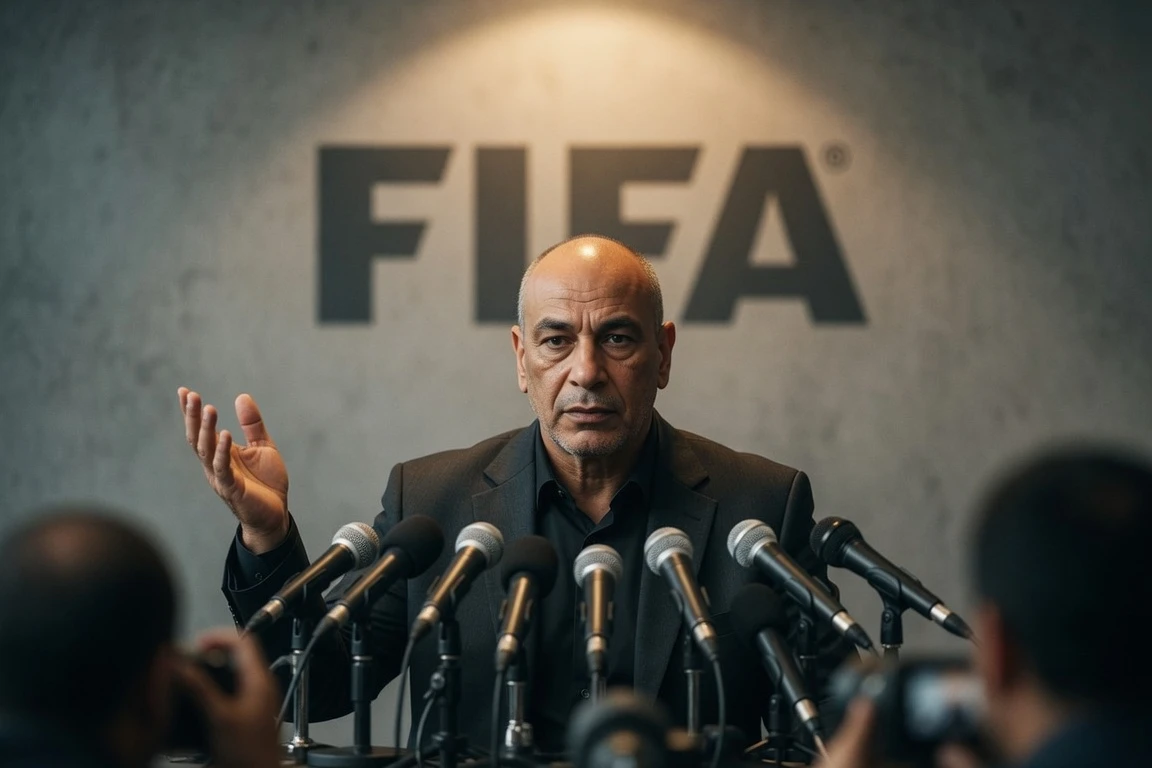
Egypt coach Hossam Hassan invoked FIFA’s “respect and fair play” rules on Thursday to defend Iran’s right to be treated equally at the 2026 World Cup. The Egypt coach made the comments at a Seattle press conference two days before his team’s decisive Group G fixture against Iran on Friday night. Iran coach Amir Ghalenoei said his side was “deprived of the right to arrive in time” for its first two matches in the United States, and praised FIFA’s efforts on Iran’s behalf. The US Department of Homeland Security eased restrictions on Tuesday, allowing Iran to enter Seattle two days before kickoff at Seattle Stadium.
Hassan said his team respects “the rules of respect and fair play that are there for everyone to abide by and any guidelines set by Fifa.” Ghalenoei, asked about Hassan’s message, said he was “very happy there are two teams playing together who have ancient civilisations.” The match in Seattle will determine who advances from Group G, with Egypt on four points and Iran on two.
Hassan Says FIFA’s Rules Must Apply to Every Team
We respect the rules of respect and fair play that are there for everyone to abide by and any guidelines set by Fifa.
Hossam Hassan, Egypt’s head coach, delivered the line through a club interpreter at a Thursday press conference in Seattle, two days before his side’s decisive Group G finale against Iran. Egypt players had been barred from answering Pride-related questions at their training session at Husky Soccer Stadium the same day, with team staffers stepping in to block reporters. “We are all focused on football,” Hassan said in Arabic. “This is all that we think about.” He pointed to FIFA’s respect and fair play rules rather than to the host nation’s role in shaping Iran’s tournament.
Iran coach Amir Ghalenoei returned the respect in Farsi, calling the Group G finale a meeting of “two teams playing together who have ancient civilisations.” “I said to you earlier we are here to play football. For nothing else,” Ghalenoei said. He commended FIFA president Gianni Infantino for doing the “utmost” to “minimize the challenges” Iran has faced. Ghalenoei added that Infantino “tried really hard to minimise the challenges we were facing” over the past six months, even though the constraints themselves “were not something that Mr Infantino expected.”
How Iran’s Travel Was Tightened for the Tournament
Iran’s tournament has been shaped by US travel restrictions from the moment the squad touched down in North America. In March, the Iranian Football Federation asked FIFA to move the team’s three group-stage matches to Mexico, citing diplomatic ties. FIFA granted the request to move Iran’s base camp from Tucson, Arizona, to Tijuana two weeks before the team arrived on the continent.
For the first two group matches, both staged near Los Angeles, the team was not permitted to travel into the United States until the day before kickoff. They were also required to leave for Mexico almost immediately after the final whistle. The Iranian delegation flew back to Tijuana within hours of their 2-2 draw with New Zealand on June 15, with no overnight recovery in the US. The same protocol applied for the June 21 meeting with Belgium, a 0-0 draw at SoFi Stadium. Andrew Giuliani, executive director of the White House FIFA Task Force, confirmed on June 20 that the restrictions would stay in place for at least that second match, as the White House FIFA Task Force’s earlier statement explained. Giuliani said the situation was “dynamic” and that future matches would be assessed in turn.
The restrictions eased on Tuesday, with the Department of Homeland Security announcing that Iran could enter Seattle two days before the Egypt match. The team must still leave the same day after the final whistle. Giuliani said the change was “planned on our end” and tied to how smoothly the first two movements had gone. The DHS announcement extended Iran’s travel window to two days. the DHS rule requiring Iran to leave the same day. The easing followed a weeks-long dispute, a tight travel window, and at least one visa mishap.
- March 2026: Iran asks FIFA to move its three group-stage matches to Mexico; base camp relocated from Tucson, Arizona, to Tijuana two weeks before arrival.
- June 15 (vs New Zealand, LA): Iran’s team enters the US the day before kickoff; the 127-mile flight from Tijuana takes five hours instead of the normal 27 minutes; the squad flies back to Mexico within hours of full time.
- June 21 (vs Belgium, LA): The same arrival-and-departure window applies; the match ends 0-0 at SoFi Stadium; Iran returns to Mexico the same day.
- June 26 (vs Egypt, Seattle): DHS extends the entry window to two days before kickoff; the team must still depart the US the same day after the match.
FIFA’s Standard Rule and Iran’s Hardship
The dispute has unfolded against FIFA’s own regulations on team movement. FIFA rules say each team “shall travel from its team base camp to the match venue one day before matchday (MD-1) and in exceptional cases on MD-2, and shall return to their team base camp after the match (on MD/MD+1).” Iran’s day-before entry into Los Angeles sat within that standard. The Tijuana-to-Los Angeles leg is roughly 127 miles and a 27-minute flight, Giuliani said. Iran captain Mehdi Taremi said the same flight took five hours the day before his team’s opener against New Zealand.
Iran captain Alireza Jahanbakhsh framed the request plainly after the Belgium draw. “We don’t ask for much. We just ask for the same procedure as for all the other 47 teams,” he said. Several team officials and members of the support staff were barred from traveling into the US with the squad.
The restrictions also caught individual players, with winger Mehdi Torabi’s entry visa expiring after the New Zealand match. Team officials confirmed they had secured him a new multiple-entry visa. US Homeland Security Secretary Markwayne Mullin told Fox News hours before the Belgium match that the Iranians had “tried to get somebody in yesterday” with direct ties to Iran’s Revolutionary Guard, a claim the Iranian federation called “an outright and undeniable lie.” Iran’s players wore gold-colored pins with the number 168 on their jackets when they disembarked in Mexico on June 7, referencing the number of people killed in an elementary school missile strike at the start of the war, mostly young girls.
After the Belgium match, Iran’s players left a goodbye note in the SoFi Stadium locker room, calling for peace “among all nations” and using the hashtags #168 and #minab, the name of the school. Four small flags bearing the number 168 were stuck into the turf at Iran’s last training session in Tijuana before departing for Seattle. “We are here for football, not politics,” Ghalenoei said before the Belgium match. His tone hardened after the 0-0 draw, when he told reporters “the conditions have been extremely hard for us.” “Right now we need recovery more than anything,” he added.
- 168: the number of people killed in the elementary school missile strike Iran referenced on its players’ pins and in its SoFi Stadium locker-room note
- 27 minutes: Giuliani-quoted flight time between Tijuana and Los Angeles
- 5 hours: the same flight took Iran five hours the day before its opener against New Zealand
- 47 teams: Jahanbakhsh’s reference to all other World Cup teams getting the same procedure
What’s on the Line in Seattle Tonight
Egypt arrives in Seattle with four points from two matches, atop Group G. A draw on Friday will be enough for Egypt to advance. Iran and Belgium are tied on two points each, with New Zealand on one.
Egypt opened with a 1-1 draw against Belgium at Seattle Stadium on June 15, with Emam Ashour opening the scoring before a Mohamed Hany own goal. The Pharaohs then beat New Zealand 3-1 in Vancouver on June 21, their first World Cup victory since their debut in 1934. Mohamed Salah, who captains the side, scored against New Zealand and has 65 goals in 114 caps. Iran drew 2-2 with New Zealand in their opener and 0-0 with Belgium, keeping their knockout hopes alive.
With a win, Iran could advance to the tournament’s knockout stage for the first time. The match kicks off at 8 p.m. local time at Seattle Stadium. It will air on FOX and stream on FOX One in the United States. Both teams enter with Egypt rooted in Spokane, a 45-minute flight from Seattle, and Iran two days into its Seattle window.
| Pos | Team | Pld | W | D | L | GF | GA | GD | Pts |
|---|---|---|---|---|---|---|---|---|---|
| 1 | Egypt | 2 | 1 | 1 | 0 | 4 | 2 | +2 | 4 |
| 2 | Iran | 2 | 0 | 2 | 0 | 2 | 2 | 0 | 2 |
| 3 | Belgium | 2 | 0 | 2 | 0 | 1 | 1 | 0 | 2 |
| 4 | New Zealand | 2 | 0 | 1 | 1 | 3 | 5 | -2 | 1 |
Egypt’s Own Travel Headache in Seattle
Egypt’s run to the Seattle fixture has not been friction-free. After the 3-1 win in Vancouver on June 21, Egypt asked to fly directly to Seattle rather than return to base camp. FIFA denied the request, citing a lack of security resources to accommodate the late demand.
Egypt returned instead to its base camp in Spokane, Washington, a 45-minute flight from Seattle Stadium. The travel pattern echoes the kind of compressed movement Iran’s squad has lived with for two weeks. Egypt’s national federation did not immediately respond to a request for comment on the FIFA decision. Hassan’s Thursday comments on Iran suggest he is not inclined to make travel logistics a public issue. The Egypt coach framed his team’s focus as football, with FIFA left to handle the rest.
The Pride Match Hanging Over the Game
Seattle’s organising committee has framed the Egypt-Iran fixture as the city’s “Pride Match” since the World Cup schedule was released, because the date overlaps with the local Pride weekend. Iran and Egypt both asked FIFA to cancel the surrounding LGBTQ+ events in December. FIFA rejected those requests and allowed the festivities to proceed.
Infantino moved to distance the federation from the branding this week. Fifa distancing itself from the Pride Match label came the same day Infantino told reporters: “There will be no ‘Pride Match’ at the World Cup. There will be a Fifa World Cup match in Seattle, and on the same day, events organised by external organisations will be taking place in the city.” FIFA separately confirmed that “general statements of human rights, including rainbow flags and other flags representing sexual orientation and gender identity, are permitted under the Fifa World Cup 2026 stadium code of conduct.”
Iran’s federation opened its Thursday press conference with a statement asking reporters to focus on football. “We fully respect the right of all journalists to ask questions. In this case, we ask you respect the rights of the federation here today to only answer questions in relation to the team, the tactics, the match, and so on,” FIFA executive director of public relations Daniel Marin said, reading the Iranian federation’s statement. Ghalenoei fielded questions about the Pride festivities and refused to be drawn in. “Our entire focus is going to be on tomorrow’s game, on succeeding in tomorrow’s game. And, anything else that is banned … we don’t want to speak about it,” he said. The Pride Match Advisory Committee earlier said the branding had been “scheduled to celebrate and elevate Pride events in Seattle and across the country” and “was planned well in advance.” The match on Friday will mark the first time these two sides meet since the 2000 LG Cup, a tournament Egypt won on penalties after a 1-1 draw.
Frequently Asked Questions
When is Egypt vs Iran at the 2026 World Cup?
Egypt face Iran at 8 p.m. local time on Friday, June 26, 2026, at Seattle Stadium, formally known as Lumen Field, in the final Group G fixture of the group stage.
Why has Iran faced US travel restrictions at the World Cup?
The US Department of Homeland Security imposed entry rules on Iran’s squad from the start of the tournament. For the first two group matches near Los Angeles, the team was only allowed into the country the day before kickoff and had to leave for Mexico immediately after the final whistle. The rules were eased on Tuesday to allow a two-day arrival window for the Seattle match.
What did Egypt’s coach say about Iran?
Egypt manager Hossam Hassan said his team respects “the rules of respect and fair play that are there for everyone to abide by and any guidelines set by Fifa,” adding “we are all focused on football.”
Who is Egypt’s head coach Hossam Hassan?
Hossam Hassan is the manager of the Egypt men’s national football team, the Pharaohs. He led Egypt through African qualifying and into their fourth World Cup appearance, where they opened with a 1-1 draw against Belgium before beating New Zealand 3-1 for their first-ever World Cup victory.
What’s Egypt’s path to qualify from Group G?
Egypt sit top of Group G with four points from two games. A draw against Iran on Friday will be enough to advance to the round of 32, where the Group G winner plays a third-placed team from another group and the runner-up faces the runner-up of Group D, Australia.
