
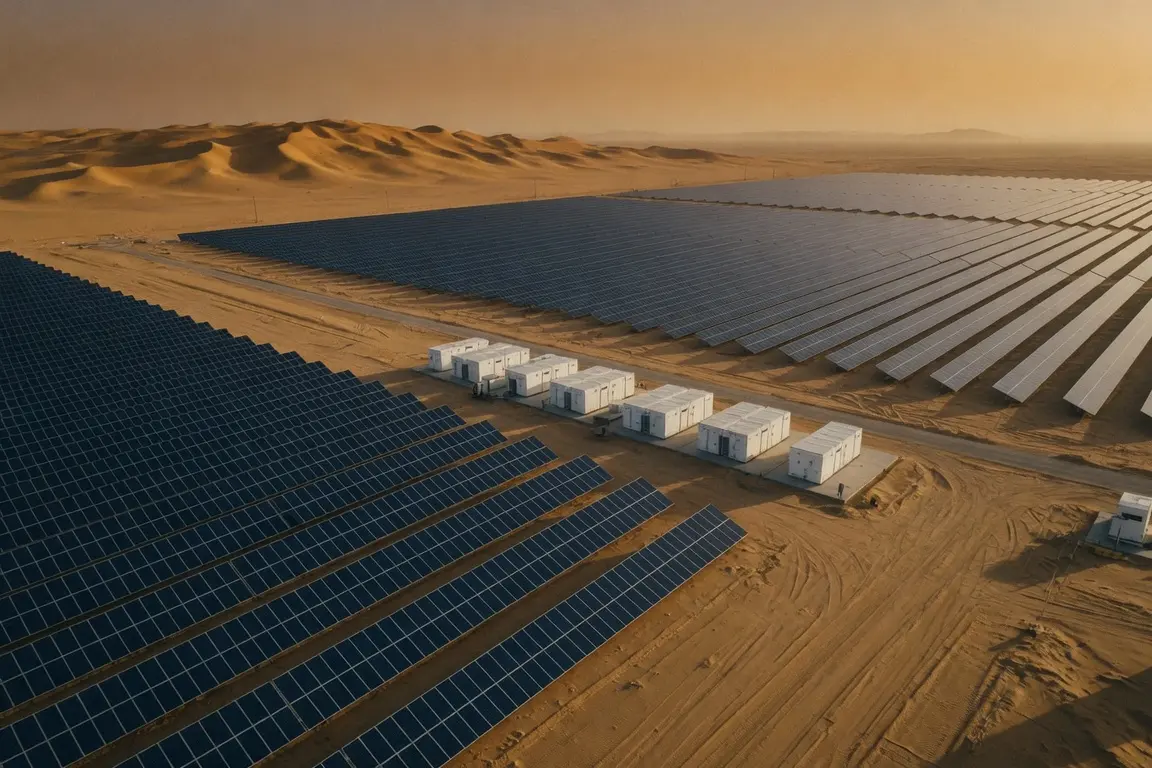
The European Bank for Reconstruction and Development is preparing up to $170 million in senior debt for the Nefer Minya solar-plus-storage project in Egypt, a 1.2 GWp photovoltaic plant paired with 600 MWh of batteries in the desert west of Minya. The bank’s board has scheduled final approval for July 22, 2026, according to the bank’s latest project disclosure. Co-financiers are expected to join the $764 million capital stack once the deal closes.
The project is 51 percent owned by Infinity Power Holding, a joint venture between Egypt’s Infinity Energy and Abu Dhabi’s Masdar, with the remaining 49 percent held by HAU Energy. Developers signed a 25-year power purchase agreement with the Egyptian Electricity Transmission Company in November 2025. Chinese module maker AIKO Energy holds a Letter of Award to supply the photovoltaic panels.
The $170M Senior Loan That Ties Off the Capital Stack
The EBRD facility, sized at up to $170 million, ranks among the largest single project finance commitments the bank has lined up for an Egyptian renewables project in 2026. The bank’s project disclosure says the loan cleared concept review and is pending final approval at the July 22, 2026 board meeting. The 600 MWh battery component is one of the larger storage blocks to be financed in Egypt to date.
The $170 million slice is roughly a fifth of the project’s total cost, and EBRD itself notes that other parties will co-finance the remainder. A separate disclosure lists the euro equivalent at EUR 148.3 million. Proceeds will fund procurement of solar PV modules, inverters, transformers, grid-interface systems, and battery power blocks, alongside site works and EPC readiness. The facility is structured as senior debt.
- Solar capacity: 1.2 GWp
- Battery storage: 600 MWh
- Total project cost: $764 million
- EBRD loan euro equivalent: EUR 148.3 million
- EBRD board final approval: July 22, 2026
The Developers Funding Nefer Minya
Ownership of the project sits with a two-party consortium on the developer’s side: Infinity Power Holding holds 51 percent, and HAU Energy holds 49 percent, according to EBRD’s project disclosure. HAU Energy is a vehicle set up in 2024 to invest in renewable energy projects in Egypt, with the bank taking a direct equity stake alongside the developer. Each party draws on its own procurement, contracting, and operational strengths to deliver the build.
Infinity Power Holding is itself a joint venture between Egypt’s Infinity Energy and Abu Dhabi-based Masdar. Masdar’s stake in IPH brings Abu Dhabi sovereign capital and Gulf renewables experience to a project sitting at the western edge of the Arab renewables corridor.
The pair of developers has built up a track record across Egyptian renewables, with EBRD’s $65 million loan to HAU Energy for a 200 MW solar and 120 MWh battery project at Benban as one recent data point. EBRD has separately financed the Obelisk hybrid project owned by Norway’s Scatec, where the bank put up $173.5 million of a $479.1 million package alongside the African Development Bank and British International Investment. EBRD’s cumulative investment in Egypt now totals more than €14.6 billion across 225 projects.
Where Nefer Minya Fits the NWFE Energy Pivot
Nefer Minya is among the first batch of battery energy storage projects in Egypt, developed under the 10 GW renewables target set under the EBRD-led Energy Pillar of the NWFE program. The Nexus of Water, Food and Energy platform, launched at COP27 in 2022, sits at the center of Egypt’s broader climate finance pitch, with EBRD serving as lead partner under the November 2022 launch announcement for the NWFE Energy Pillar.
The NWFE Energy Pillar set out two concrete targets: retire 5 GW of inefficient fossil-fuel capacity by 2025, and mobilize at least $10 billion of private investment to install 10 GW of solar and wind by 2028. The US and Germany pledged more than $250 million in political support at the launch, alongside a $500 million package announced by then-President Joe Biden. Donor pledges of more than $300 million in grant and concessional finance from the European Commission, France, the Netherlands, Denmark, and the United Kingdom were stacked on top.
EBRD has put its own balance sheet behind the program. The bank committed $1 billion of private renewable finance, $300 million of sovereign finance, and $3 million in grants from its Shareholder Special Fund to the NWFE energy pillar. Egypt has been a founding member of EBRD since operations began in the country in 2012. The Nefer Minya project sits inside that policy and financial frame.
Egypt’s national strategy targets 45 percent renewable electricity within the next two years. That calendar is what makes the July 22 board date more than a procedural step.
A 25-Year PPA With EETC
The commercial arrangement of Nefer Minya rests on a 25-year power purchase agreement the developers signed with the Egyptian Electricity Transmission Company in November 2025. EETC, the state grid operator, will buy every kilowatt the plant produces across the life of the contract. Long-tenor PPAs are the standard structure for utility-scale renewables in Egypt, where they let the off-taker lock in cost certainty and give the project the revenue visibility needed to raise senior debt. The same 25-year EETC template has been used on Obelisk, where the PPA is US dollar-denominated and backed by a sovereign guarantee.
A 25-year term is also long enough to absorb construction risk and amortize the upfront cost of the battery component. Battery storage raises the project’s capex per megawatt relative to a plain solar plant, and the multi-decade revenue stream is what makes that capex bankable. EETC’s role as state grid operator is the credit anchor for senior debt of this size in Egypt’s renewables market.
Egypt’s regulator has used the same EETC off-take template across Obelisk, Nefer Benban, and other recent utility-scale deals. Obelisk’s PPA includes a sovereign guarantee, while Nefer Minya’s EBRD disclosure does not state whether its PPA carries the same.
AIKO’s Letter of Award and the Hardware Chain
AIKO Energy announced a signed Letter of Award to supply the photovoltaic modules for the 1.2 GWp plant at the Africa Energy Forum in Cape Town on June 17, 2026. Infinity Power followed up with a ceremony recognizing the agreement earlier this week, per EBRD’s project disclosure. AIKO, headquartered in China, was selected as the sole module supplier after a competitive evaluation of module technology suited to Egypt’s desert conditions.
Module supply is the largest single procurement line on a utility-scale solar-plus-storage project, and AIKO’s all-back-contact modules are designed for higher power density and resilience to sand abrasion. The signed Letter of Award for Nefer Menya modules describes the Nefer Menya site as presenting extreme desert operating conditions, with high irradiance, elevated temperatures, and persistent sand abrasion. AIKO has separately been awarded the module contract for the Benban solar-plus-storage project, also owned by the Infinity Power and HAU Energy pairing. That earlier award, at the Nefer Benban solar-plus-storage module award, gives the developer a single Chinese module vendor across two flagship sites.
The Climate Footprint of Nefer Minya
Once operational, Nefer Minya is expected to supply electricity to approximately 1.4 million homes and avoid around 1.6 million tonnes of CO2 emissions annually, per EBRD’s project disclosure. The 1.4 million homes figure sits in a band consistent with the plant’s 1.2 GWp peak capacity at typical Egyptian residential demand. The CO2 figure depends on the grid mix the plant displaces, which Egypt is steadily shifting away from gas.
At 600 MWh, the battery block is what makes the plant’s dispatchable profile work. Battery storage lets the plant shift midday solar generation into evening peaks, when Egyptian demand is highest.
That firming role separates the project from flat solar farms where generation was not paired with storage. Egypt’s installed renewables pipeline has historically been dominated by flat solar farms. Nefer Minya’s 600 MWh block is the storage capacity that makes the dispatchable profile work.
AIKO’s announcement notes the Nefer Menya site presents extreme desert operating conditions, with high solar irradiance, elevated temperatures, and persistent sand abrasion. Those conditions drove the selection of AIKO’s all-back-contact modules, designed for resilience to thermal stress and abrasion over the plant’s 25-year asset life.
What the July 22 Board Date Decides
Concept review has passed; final approval has not. EBRD’s board is scheduled to consider the senior debt facility on July 22, 2026. That single vote is what converts the disclosed loan into a binding commitment.
Final approval is the moment co-financiers can sync their own credit committee timelines around EBRD’s. EBRD’s project disclosure notes the deal will be co-financed by other parties, and the lending club’s composition becomes clearer after the board sign-off. The 45 percent target inside two years is what puts a calendar weight on hybrid projects like Nefer Minya. The wider build-out runs on a tight calendar, and each flagship project’s lead time sets the pace for the next.
Construction, procurement of inverters and battery power blocks, and grid connection works will run after the loan closes. Senior lenders typically structure disbursements against milestones, so slippage on the build translates into delayed drawdowns rather than cancelled facilities. Each flagship project’s lead time runs on the same 45 percent renewable clock.
- November 2025: Developers sign 25-year power purchase agreement with EETC
- June 17, 2026: AIKO Letter of Award announced at the Africa Energy Forum in Cape Town
- June 2026: EBRD project disclosure confirms concept review passed
- July 22, 2026: EBRD board final approval scheduled
How Nefer Minya Compares With Egypt’s Other Hybrid Solar Bets
Nefer Minya is one of several large hybrid solar-plus-storage projects moving through Egyptian financing in 2026. Two of its closest analogues are Obelisk and the HAU Energy project at Benban. Each sits at a different point on the same hybrid curve, with different battery sizes and different lender structures. The three projects together cover a wide band of the Egypt hybrid market.
Obelisk Solar Power, a 1.1 GW photovoltaic plant paired with 200 MWh of battery storage at Nagaa Hammadi, closed a $479.1 million financing package in 2025 with EBRD, the African Development Bank, and British International Investment, per Obelisk’s 1.1GW solar and 200 MWh storage financing package. EBRD’s slice of that package was $173.5 million, with $101.9 million of it benefiting from a European Fund for Sustainable Development first-loss cover guarantee. The full lender split for that earlier deal sits at the AfDB-led 1GW Obelisk solar deal.
At Benban, the consortium’s other large project pairs a 200 MW solar plant with 120 MWh of battery storage. EBRD extended a $65 million construction bridging loan to HAU Energy for that project, under the 2026 HAU Energy loan for a Benban solar-plus-storage project. The Benban facility is expected to reduce CO2 emissions by up to 280,000 tonnes annually once operational. HAU Energy itself was set up in 2024 as a vehicle owned by Meridiam, Hassan Allam Utilities, and EBRD.
Nefer Minya’s 600 MWh battery block is the largest storage component among the three projects. The Infinity Power and Hassan Allam Utilities pairing is behind Nefer Minya, with the Benban HAU Energy project as the consortium’s other large Egypt deployment.
| Project | Solar Capacity | Battery Storage | Lead Lender Slice | Annual CO2 Cut |
|---|---|---|---|---|
| Nefer Minya | 1.2 GWp | 600 MWh | EBRD $170M (pending) | 1.6 million tonnes |
| Obelisk | 1.1 GW | 200 MWh | EBRD $173.5M | 1.4 million tonnes |
| Benban (HAU Energy) | 200 MW | 120 MWh | EBRD $65M | 280,000 tonnes |
Disclaimer: This article reports on a planned development finance facility and is provided for informational purposes only. Figures are accurate as of publication; consult qualified professionals for decisions related to specific project investments.
