
Egypt’s Foreign Ministry condemned Houthi drone strikes on the pipeline network feeding Saudi Arabia’s Red Sea export hub at Yanbu on Monday, the third hit on Saudi oil infrastructure in five days. Houthi military spokesperson Yahya Saree said drones struck crude supply and transport sites linking eastern Saudi Arabia to Yanbu, calling it retaliation for Saudi drone incursions into Yemeni airspace.
Aramco, the Saudi state oil giant, did not respond to requests for comment. Cairo has its own reasons to worry: Egypt’s Suez Canal revenue has already collapsed under the same Red Sea conflict now creeping toward Saudi Arabia’s last working export corridor.
Cairo Condemns Strikes on the Pipeline Feeding Yanbu
The Egyptian Ministry of Foreign Affairs said in a Monday statement, carried by Cairo-based outlet Daily News Egypt, that the strikes violate Saudi security and stability and amount to an escalation that undermines regional security. It called for an immediate halt to all attacks on Saudi Arabia and other Arab nations and voiced full support for whatever measures Riyadh takes to defend its sovereignty and territorial integrity.
The statement followed the Houthis’ own Monday claim: drones had hit what Saree called sensitive crude oil supply and transport sites linking eastern Saudi Arabia to Yanbu. It was the group’s second claimed strike on Saudi oil infrastructure in three days, and its third against the kingdom’s energy network in a week that also saw two tankers hit in the Red Sea.
Why Did the Houthis Hit the Pipeline Now?
Saree framed Monday’s drone strikes as retaliation for Saudi drone incursions into Yemeni airspace. But the strikes landed inside a five-day escalation that had already pushed oil markets into a scramble, with a blockade threat, two tanker attacks, a direct refinery strike, and now a hit on the pipeline itself.
- July 20: Houthi forces threaten to extend disruptions to global oil supplies, announcing a blockade of Saudi Arabia’s oil industry in the Red Sea.
- July 23: Houthi drones strike Saudi oil tankers Encelia and Layla in the Red Sea, setting Encelia ablaze. Brent crude tops $100 a barrel for the first time since May.
- July 25: Houthi missiles and drones hit Aramco facilities in Jizan and Yanbu directly, burning the Jizan refinery in the group’s first strike on Saudi oil infrastructure since 2022.
- July 27: Houthis claim drone strikes on crude transport sites linking eastern Saudi Arabia to Yanbu. Egypt’s Foreign Ministry condemns the attacks within hours.
Riyadh has not disclosed whether Monday’s strikes disrupted crude flow. Aramco’s silence leaves the extent of the damage unconfirmed even as the diplomatic fallout spreads across the region.
Saudi Arabia’s Only Alternative to a Closed Strait
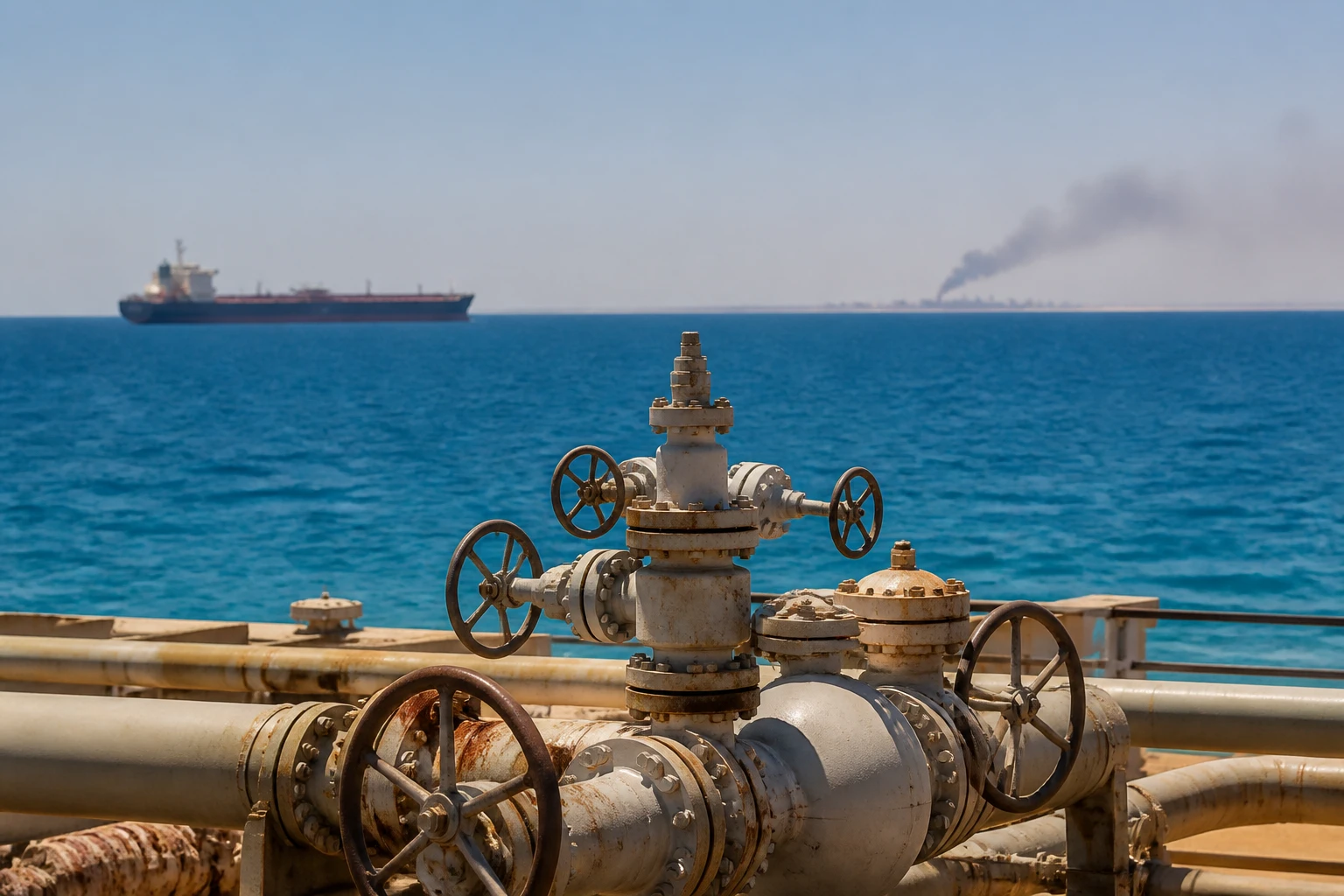
The pipeline the Houthis are now targeting is the East-West Pipeline, known inside Saudi Arabia as the Petroline. It runs 1,201 kilometers from the Abqaiq processing complex in the Eastern Province to the export terminal at Yanbu on the Red Sea coast, built decades ago to move crude across the peninsula without routing it through the Strait of Hormuz.
That design is exactly why it matters now. Iran has attacked shipping in the Strait of Hormuz since February, when the United States and Israel launched their war on Iran, and Saudi Arabia has leaned on a pipeline network already running near its designed limit, redirecting more than 4 million barrels a day, over 70% of the crude it once shipped from the Gulf.
Saudi Arabia now depends on two crude corridors, and both sit inside a war zone.
| Export Corridor | Normal Role | Status as of Monday |
|---|---|---|
| Strait of Hormuz | Historically Saudi Arabia’s primary crude export route | Under Iranian attack on shipping since February |
| East-West Pipeline (Petroline) to Yanbu | 1,201 km from Abqaiq to the Red Sea; designed maximum of 5 million barrels per day | Carrying over 4 million bpd; struck by Houthi drones July 25 and July 27 |
Even at full capacity, the Petroline was never designed to fully replace Hormuz-routed exports. Houthi drones have now put that ceiling under direct fire.
Cairo’s Canal Math
Egypt’s Foreign Ministry statement uses standard diplomatic language. Cairo is also not a bystander to Red Sea security: the Suez Canal, one of Egypt’s largest sources of foreign currency, has been gutted by the same conflict now reaching Saudi Arabia’s oil infrastructure.
Canal revenue fell from $9.4 billion to $7.2 billion in the fiscal year spanning 2023 and 2024, as the first Houthi attacks on shipping began. It kept falling through the following calendar year, dropping to roughly $4 billion in 2024, a decline of nearly two-thirds from the $10.3 billion record Egypt collected in 2023.
- $10.3 billion: Suez Canal revenue in 2023, a record, before Houthi attacks on shipping began
- Roughly $4 billion: what the canal collected in 2024, down nearly two-thirds
- $800 million a month: what President Abdel Fattah al-Sisi has said the disruption costs Egypt
- 13,213 ships: canal transits in 2024, about half the 26,434 recorded in 2023
Singapore has issued its own condemnation of the Houthi campaign, citing its refining industry’s dependence on the same Red Sea route Saudi crude now relies on. Cairo’s own petroleum trade carries similar exposure: a $2.3 billion jump in petroleum exports followed Egypt’s recent payoff of oil debt, a rebound now exposed to the same Red Sea conflict. Egypt had also been working to rebuild canal traffic before Monday’s strikes widened the war further up the coast.
Echoes of 2019
Saudi Arabia has faced a bigger single shock before. On September 14, 2019, drone and missile strikes hit the Abqaiq and Khurais processing facilities, the same Abqaiq complex that now feeds the Petroline, and knocked out more than half the kingdom’s oil production in one morning.
The Congressional Research Service put the disruption at 5.7 million barrels a day, about 5% of global supply at the time, and it produced the largest single-day oil price jump on record. Satellite imagery documented the strikes hitting Abqaiq within hours. Saudi crews restored 2 million barrels a day of production within 48 hours; full recovery took weeks.
The 2019 attack was a single concentrated strike widely blamed on Iran directly. The current campaign is a sustained run of Houthi attacks across tankers, refineries and now the pipeline itself, with the group publicly promising more.
Riyadh Strikes Hodeidah as Brent Crude Tops $100
Saudi Arabia has answered with airstrikes on what it describes as Houthi military facilities at Yemen’s Hodeidah port, part of a campaign Riyadh says is meant to protect commercial shipping through the Red Sea and hit the launch sites behind the strikes on its oil infrastructure.
Oil markets have already priced in the risk. Brent crude climbed past $102 a barrel this week, its highest level in eight weeks, after the tanker strikes and blockade declaration pushed prices above $100 for the first time since May. Goldman Sachs has forecast Brent could climb above $120 a barrel by the fourth quarter if the disruptions continue.
Much about Monday’s strikes remains unverified.
- What we know: Houthi forces claim drone strikes on crude transport sites linking eastern Saudi Arabia to Yanbu; Egypt’s Foreign Ministry condemned the attacks; Saudi Arabia has struck Houthi facilities at Hodeidah port.
- What’s unconfirmed: Aramco has not said whether the strikes damaged the Petroline or disrupted crude flow to Yanbu, and no independent damage assessment has been released.
As of Tuesday, Aramco had issued no public statement. Saudi Arabia’s two crude corridors, the Strait of Hormuz and the Red Sea route built to avoid it, both now sit inside active conflict zones for the first time since the war on Iran began in February.
