
Egypt’s economy grew 5.0 percent year on year in the first quarter of 2026, up from 4.8 percent in the same quarter last year, even as a closely watched survey shows private business activity shrinking for a sixth straight month. The Purchasing Managers’ Index (PMI), a monthly gauge of non-oil business conditions compiled by S&P Global, has stayed below the 50-point growth line since January and hit its weakest reading since January 2023 in June.
Growth like that usually shows up on factory floors and in shop tills. This time, it is showing up mostly in remittance transfers, tourist arrivals and canal toll receipts.
Growth Outpaces a War-Shocked Quarter
Gross domestic product expanded 5.0 percent in the January to March quarter, Egypt’s Ministry of Planning reported, accelerating from 4.8 percent growth a year earlier. The pickup came despite the outbreak of the US-Iran conflict late in the quarter, which disrupted regional supply chains and pushed global oil prices higher.
Household consumption did most of the work. Government spending added the next-biggest push. Private investment contributed only modestly, and net exports were a drag as the conflict pushed up import costs.
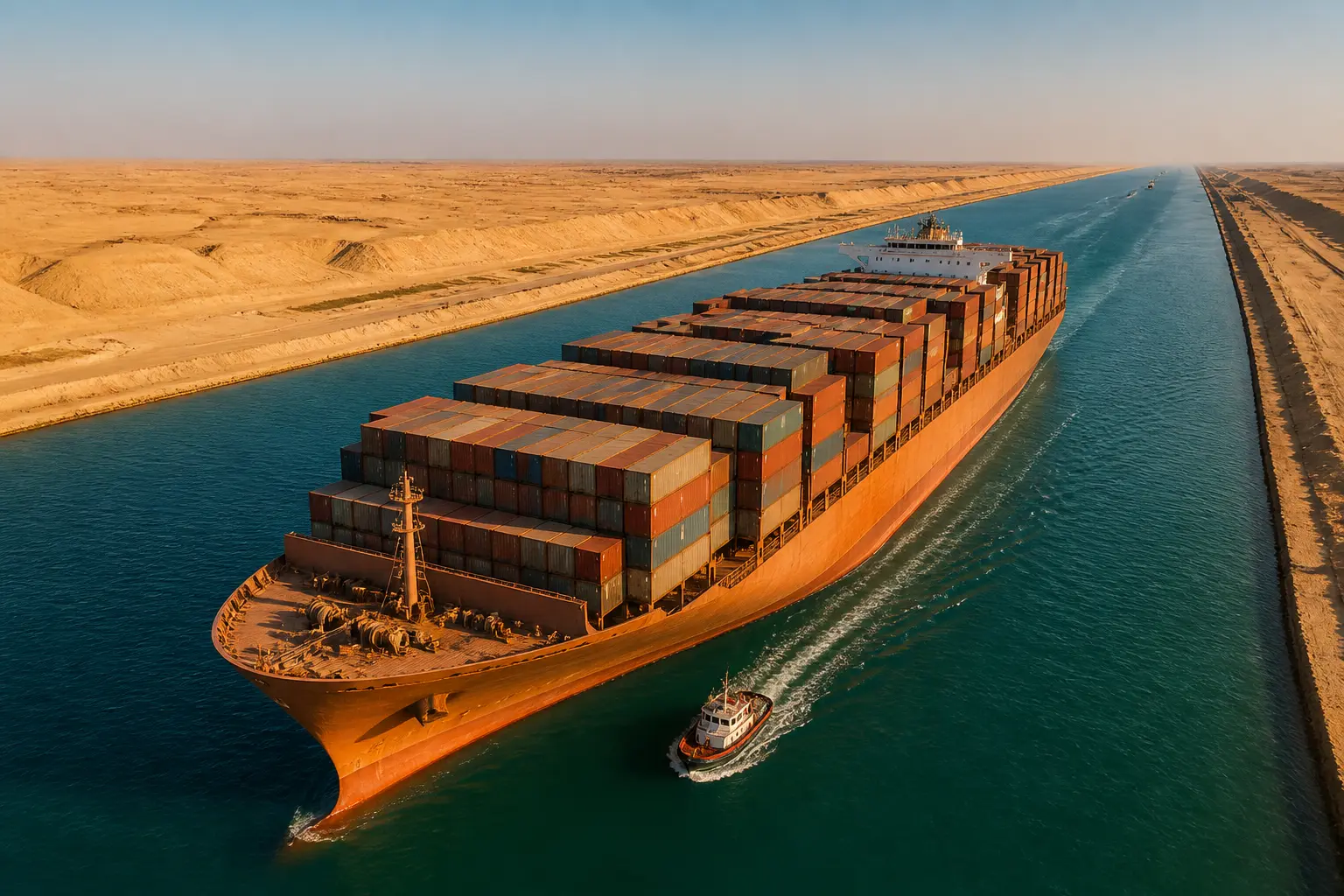
Sector by sector, the details were broadly upbeat. Suez Canal activity jumped 24 percent year on year, and tourism grew 8.3 percent. Construction rose 5.2 percent, snapping back after a contraction the previous quarter as infrastructure and urban expansion projects moved forward.
Refining output surged 15 percent after international energy companies resumed operations, following Cairo’s push to settle outstanding arrears, the same debt cleanup that fueled a $2.3 billion jump in petroleum exports earlier this year.
The World Bank takes a more cautious view of the year ahead, projecting a shallower rebound: 4.3 percent growth in FY25/26 rising to 4.8 percent in FY26/27.
The Non-Oil Economy Shrinks for a Sixth Straight Month
Egypt’s private sector tells a rougher story. The S&P Global Purchasing Managers’ Index fell to 46.0 in June, down from 47.1 in May, the sixth straight month below the 50-point line that separates growth from contraction and the weakest reading since January 2023.
New orders fell at the fastest pace since November 2022, the survey found, a slide steep enough that annual GDP growth could slow to around 3.8 percent by the end of the second quarter.
- Non-oil business activity contracted for a fifth straight month, the sharpest drop since early 2023
- Employment kept falling, though firms blamed natural attrition rather than active layoffs
- Firms cited liquidity shortages among clients and scarce raw materials
- Slower supply chains and weaker regional trade tied to the Gulf conflict added further strain
There was one bright spot. Input costs and selling prices both eased from the multi-year highs they hit in May, and firms told surveyors they expect conditions to improve if the regional conflict cools.
Remittances Carry the Current Account
Egypt’s external accounts show the same split. The current account deficit widened to $14.6 billion in the first nine months of fiscal year 2025/26 (July 2025 through March 2026), as a jump in import costs pushed the trade deficit to $14.8 billion.
Three traditional sources of foreign currency kept the gap from widening further, alongside a rebound in foreign investment.
| Source | Amount (First 9 Months, FY25/26) | Change Y/Y |
|---|---|---|
| Workers’ remittances | $34.9 billion | +32% |
| Tourism revenue | $14.4 billion | +14.9% |
| Suez Canal receipts | $3.2 billion | +22% |
| Net FDI inflows | $13.0 billion | +33% |
| Portfolio investment | $4.4 billion net outflow | reversed |
Canal receipts held up even as Houthi attacks in the Red Sea push many container lines to reroute around Africa. Singapore, which relies on that same corridor for its own trade, has warned that Houthi strikes threaten a route it depends on.
Net foreign direct investment jumped 33 percent year on year to $13 billion. Qatari Diar, the real estate arm of the Qatar Investment Authority, is behind much of it. The fund signed a $29.7 billion partnership to develop Alam El Roum, a 4,900-acre North Coast site between Marsa Matrouh and Ras El Hekma.
Portfolio investors moved the opposite way, pulling money out after Gulf hostilities broke out in the first quarter. Even so, the broader balance of payments, which also captures capital and financial flows, showed a narrower deficit of $1.8 billion for the period, an improvement credited to the stronger FDI and resilient currency earnings.
Reserves Climb to a Record as the Pound Keeps Sliding
Currency markets stayed choppy. The Egyptian pound ended the first half of 2026 down 3.3 percent against the US dollar, despite a recovery in foreign portfolio inflows.
That recovery did not last long. Net portfolio inflows into Egyptian government debt peaked at $8.4 billion in June, the strongest month of the year, as appetite for emerging-market debt rebounded after the United States and Iran signed a memorandum of understanding. Cumulative inflows into the secondary market reached $11.6 billion for the first half of 2026, down from $12.2 billion in the second half of 2025. The trend reversed again in July as US-Iran tensions flared back up.
Net foreign assets in the banking system stood at $22.9 billion at the end of May, down from a 14-year high of $29.5 billion in January. The central bank’s own foreign assets held steady at $15.2 billion. Commercial banks absorbed nearly the entire shock: their net foreign assets fell to $7.7 billion in May from $14.5 billion in January, before the US-Iran war began.
Official net international reserves at the central bank still reached a record $55.1 billion at the end of June, covering around six months of imports. An additional $11 billion in unofficial reserves, made up of securities and deposits held outside the official tally, gave the financial system extra cushion.
Why Is Egypt’s Central Bank Still Holding Rates?
The Central Bank of Egypt held its overnight deposit and lending rates at 19 percent and 20 percent for a third straight meeting in July. Headline inflation is cooling, but core prices, which strip out food and energy, just ticked higher, and policymakers want a broader, steadier decline before cutting again.
Urban headline inflation slowed for a third straight month to 14.3 percent year on year in June, down 0.4 percent from May. That followed 14.6 percent in May and 14.9 percent in April. Lower food prices did most of the work: vegetable prices fell 12 percent, meat and poultry dropped 5.2 percent, and dairy slid 2 percent.
Core inflation, which excludes food and energy, also stood at 14.3 percent year on year, up slightly from May. That suggests underlying price pressure has not eased as much as the headline figure implies, and real interest rates remain close to 6 percent.
The London research firm Capital Economics says the central bank still has room to cut rates further this year.
The outlook calls for the CBE to hold rates through most of 2026 before resuming cuts with a 100 basis point reduction in the fourth quarter. Another 300 basis points would follow in 2027, bringing the lending rate to 16 percent. A faster drop in inflation, toward a 12 to 13 percent range by year-end, could pull that timeline forward. Inflation itself is now expected to average around 14 percent in the second half of 2026, down from an earlier call of 16 percent, with the full FY26/27 forecast easing to 11.6 percent.
Fiscal Progress Still Hinges on a Calmer Gulf
Egypt’s public finances are healing on paper. The fiscal deficit is projected to narrow from an estimated 7.5 percent of GDP in FY25/26 to 6.8 percent in FY26/27 as lower borrowing costs work through the budget.
Around 75 percent of public debt is held domestically. Nearly 40 percent of that domestic debt matures within a year, so falling rates should reach government accounts quickly once easing resumes.
Subsidy costs could fall further if Brent crude trades below the government’s budget assumption of $75 a barrel, though the US-Iran conflict has already pushed prices the other way at times. Planned reforms to food and fuel subsidies are meant to contain spending, though they also carry the biggest upside risk to the inflation forecast.
Revenue collection is falling short of ambition. Stronger activity and tax administration reforms should keep collections rising, but they are likely to land near EGP 3.9 trillion, about 2.5 percent below the government’s original EGP 4 trillion target.
| Metric | FY25/26 (Estimate) | FY26/27 (Forecast) |
|---|---|---|
| Real GDP growth | 5.1% | 5.3% |
| Fiscal deficit (% of GDP) | 7.5% | 6.8% |
| Public debt (% of GDP) | 87% | 82.5% |
| Current account deficit (% of GDP) | 4.4% | 3.2% |
The 5.3 percent pace would be Egypt’s strongest since FY21/22. Public debt is still headed down, extending its decline from a peak of 95.7 percent of GDP in FY22/23.
External financing looks manageable for now. Egypt has drawn $1.6 billion from the IMF and $1 billion from the World Bank recently, alongside $1 billion in social bonds and $500 million in Samurai bonds sold in international markets.
IMF staff and Egyptian officials reached staff-level agreement on the program’s seventh review in late June, a step toward unlocking the next loan tranche under an arrangement the fund had already stretched into mid-December after completing its fifth and sixth reviews in February.
Risks still run mostly one direction. A longer regional war would raise Egypt’s oil import bill, widen subsidy costs and push up its sovereign risk premium. A weaker pound would stoke inflation and strain public finances, and a slower recovery in tourism or canal traffic would weigh on growth and the external accounts. Faster privatizations and stronger investor sentiment, if the regional picture improves, would work the other way.
Some pieces of this outlook are settled. Others are not.
- Confirmed: GDP grew 5.0 percent year on year in the March quarter, and the PMI has stayed below 50 for six consecutive months.
- Confirmed: CBE reserves reached a record $55.1 billion at the end of June, and public debt is on a downward path from its FY22/23 peak.
- Unconfirmed: Whether the US-Iran conflict eases enough to protect the 5.3 percent growth forecast.
- Unconfirmed: Whether the central bank actually delivers its projected fourth-quarter rate cut.
- Unconfirmed: Whether Egypt lines up a successor IMF arrangement before the current one expires.
Egypt’s current IMF arrangement runs out on December 15, 2026. Whatever happens next in the Gulf will decide whether the 5 percent growth print or the sub-50 PMI reading holds up better over the rest of the year.
