
Egypt’s Foreign Ministry threw its weight behind Saudi Arabia on Tuesday, condemning a Houthi threat to blockade the kingdom’s ports as a breach of international maritime law. The statement landed a day after Yemen’s Houthi movement vowed to choke off Red Sea shipping bound for Saudi Arabia, calling it retaliation for what the group describes as a Saudi siege on Yemen.
Cairo framed its response as Gulf solidarity, standing behind Riyadh and the wider Gulf Cooperation Council (GCC, the six nation bloc of Gulf Arab monarchies). Egypt has its own stake in this water, too. The same stretch the Houthis are threatening carries the traffic Cairo needs to rebuild a canal economy the same conflict has already gutted once.
Cairo’s Statement Leans on the Language of International Law
The Egyptian Ministry of Foreign Affairs statement, issued Tuesday, called the blockade threat an irresponsible escalation that undermines regional stability. It warned that the move endangers the safety of maritime navigation, international trade and the waterways that carry both.
Egypt said the threat amounts to a blatant violation of international law, including the United Nations Convention on the Law of the Sea (UNCLOS, the 1982 treaty governing maritime boundaries and shipping rights) and relevant UN Security Council resolutions. That legal framing echoes Riyadh’s own response. Saudi Arabia’s Foreign Ministry rejected the Houthi accusations the same day, citing UN Security Council Resolution 2216 on Yemen and Resolution 2722 on Red Sea navigation rights, and affirmed it would take all necessary measures to protect its ships under the same 1982 convention.
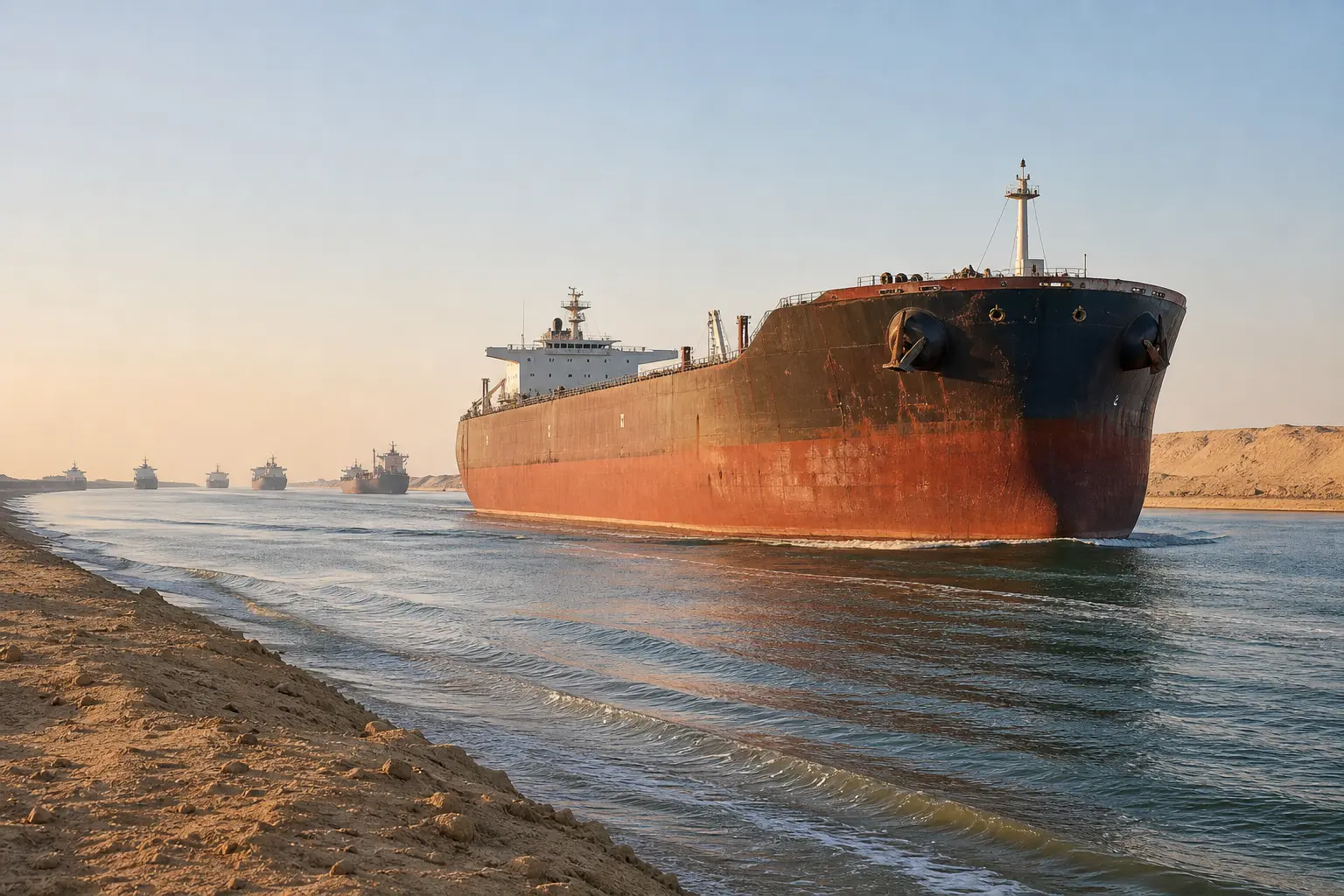
The Blockade Traces Back to a Strike on Sanaa’s Airport
The Houthis’ armed forces announced the blockade Monday in a video statement, declaring what they called a maritime embargo against the Saudi enemy, based on the equation of an eye for an eye, effective immediately. They said the move answered an unjust and oppressive siege they claim Saudi Arabia has imposed on Yemen.
The trigger traces back to Sanaa International Airport. Houthi leaders were flying home from Iran, where they had attended the funeral of Supreme Leader Ali Khamenei, when the airport came under attack last week. Houthi officials blame the Saudi-led coalition. Yemen’s internationally recognized government has claimed responsibility for that strike instead, leaving the actual chain of command murky.
The Saudi-led coalition rejected the blockade threat and vowed to hit back.
Such threats are a blatant violation of international law and fall under acts of maritime piracy.
The coalition said in a statement, adding that protective measures for commercial vessels transiting Bab el-Mandeb were already underway.
What we know:
- The Houthis declared the blockade Monday in a video statement citing retaliation for what they call a Saudi siege on Yemen.
- Egypt condemned the threat Tuesday, backing Saudi Arabia and the GCC and urging diplomacy.
- The Saudi-led coalition vowed to respond with force and says protective measures for shipping are already active.
What is unconfirmed:
- Who actually struck Sanaa airport, since the Houthis blame the Saudi coalition while Yemen’s internationally recognized government has claimed responsibility.
- Whether the Houthis can enforce a real blockade beyond missile and drone threats against passing vessels.
- How much relief Saudi Arabia’s pipeline workaround can offer if tanker traffic through Bab el-Mandeb actually stops.
The Canal Egypt Cannot Afford to Lose Again
Egypt’s own numbers explain the urgency behind Tuesday’s statement. Houthi attacks on Red Sea shipping, running since late 2023, have already cost the Suez Canal, Egypt’s single largest source of foreign currency, a fortune.
Canal revenue hit a record $10.3 billion in 2023. It then collapsed to about $4 billion in 2024, a drop of roughly 61%, as container lines rerouted around Africa’s Cape of Good Hope rather than risk the Red Sea. Vessel transits fell by half, to 13,213 ships from more than 26,000 the year before. The canal’s share of global maritime traffic slid from 12% to 9% of world shipping volume, according to trade credit insurer Coface.
President Abdel Fattah al-Sisi said in March that cumulative canal losses since the start of the decade had reached $10 billion, calling the toll a “historic crossroads” for the economy. Suez Canal Authority chief Osama Rabie said in November he expected 2025 revenue to edge above $4 billion and hoped the canal could claw back to its old $10 billion peak as soon as this year.
| Period | Suez Canal Revenue | Traffic Note |
|---|---|---|
| 2023 (record year) | About $10.3 billion | More than 26,000 vessels transited |
| 2024 | About $4 billion, down roughly 61% | 13,213 vessels, down 50% |
| 2025 outlook (Rabie, November) | Expected to top $4 billion | Hoped to near $10 billion again by 2026 |
| Cumulative, per al-Sisi (March 2026) | $10 billion lost since the decade began | Called a “historic crossroads” |
A new Bab el-Mandeb blockade, even a partial one, threatens to erase that recovery timeline just as it was starting to look real.
Saudi Arabia’s Hormuz Workaround Runs Through the Same Water
Bab el-Mandeb matters more than usual right now because Saudi Arabia has almost nowhere else to send its oil. The kingdom’s usual route through the Strait of Hormuz, a key waterway for oil and gas exports to world markets, has been largely closed since a war erupted between the United States, Israel and Iran in late February. A 60-day ceasefire briefly reopened the strait in June, but the truce collapsed on July 8, and strikes resumed. The conflict has already cost the United States an estimated $37.5 billion, Defense Secretary Pete Hegseth said this week.
To keep exporting, Saudi Arabia leaned on an old workaround. Middle East Eye reported the kingdom is sending roughly 4.5 million barrels a day through pipelines to Red Sea terminals, and The Hill put the diverted share at about 70% of Saudi energy exports. That pipeline route runs through the kingdom’s last working route around the Strait of Hormuz, its East-West Pipeline to the Red Sea port of Yanbu.
A full closure of Bab el-Mandeb would halt Saudi oil exports to Asia entirely and could cut global oil supply by another 7%, on top of the disruption Hormuz has already caused.
Egypt Has Played This Part Before
This is not new territory for Cairo. In 2020, after Houthi missiles and bomb-laden drones were intercepted over Saudi Arabia, Egypt’s Foreign Ministry issued a strikingly similar statement, backing Riyadh, supporting its defensive measures and invoking the same legal framework it reached for this week. The original Monday naval blockade declaration against Saudi Arabia simply gave Egypt another occasion to repeat it.
- Solidarity language, both statements open by declaring Egypt’s support for Saudi Arabia against the Houthis.
- The same UN resolution, both cite Security Council Resolution 2216, which backs Yemen’s internationally recognized government.
- A call for de-escalation, both close by urging a political and diplomatic track over further fighting.
What is different this time is the size of the bill Egypt itself is running up while it waits for that diplomacy to work.
Could the Houthis Actually Close Bab el-Mandeb?
Probably not completely, but they do not need to. Maritime security firm Ambrey has assessed that Saudi-flagged vessels and companies calling at Saudi ports face a heightened risk of missile and drone attack, even short of a full naval blockade, enough on its own to scare insurers and shipping lines away from the route.
That is exactly what happened to the Suez Canal after 2023. The Houthis never had to sink every ship. A little more than 100 attacks over two years was enough to convince the world’s biggest container lines to add two weeks to their sailing time rather than gamble. The kingdom now faces that same calculation twice over, with a second global shipping chokepoint exposed at the same time Hormuz remains unresolved.
Egypt’s own answer is the one it tends to give in these moments: back Riyadh publicly, then push everyone toward the negotiating table. Cairo’s Tuesday statement closed by stressing the priority of political and diplomatic solutions over further escalation, the same call it has made every time this fight has flared since the Saudi-led coalition first intervened in Yemen in 2015.
Frequently Asked Questions
What Is the Bab el-Mandeb Strait?
Bab el-Mandeb sits between Yemen and the Horn of Africa, linking the Red Sea to the Gulf of Aden and the Indian Ocean beyond. Its name is commonly translated as the Gate of Tears. Nearly all shipping between Asia and the Suez Canal passes through it, which is why a blockade there threatens both Saudi exports and Egyptian canal traffic at once.
How Does Bab el-Mandeb Compare to the Strait of Hormuz?
Hormuz normally carries a far bigger share of world oil, around a fifth of global seaborne crude, compared with the 7% of global supply a full Bab el-Mandeb closure could remove. With Hormuz already disrupted by the Iran war, losing Bab el-Mandeb too would compound the damage rather than simply add to it.
What Is Saudi Arabia’s East-West Pipeline?
It is a cross-country pipeline that carries crude from Saudi oil fields near the Gulf coast to the Red Sea export terminal at Yanbu, letting tankers load without ever entering the Strait of Hormuz. Riyadh has leaned on it harder since the Hormuz conflict began in February.
Has Egypt Ever Closed the Suez Canal Before?
Yes. Egypt closed the canal for eight years after the 1967 war, rerouting world shipping around Africa for nearly a decade. That history is part of why Cairo treats any threat to Red Sea shipping lanes as a direct economic concern, not just a diplomatic one.
