
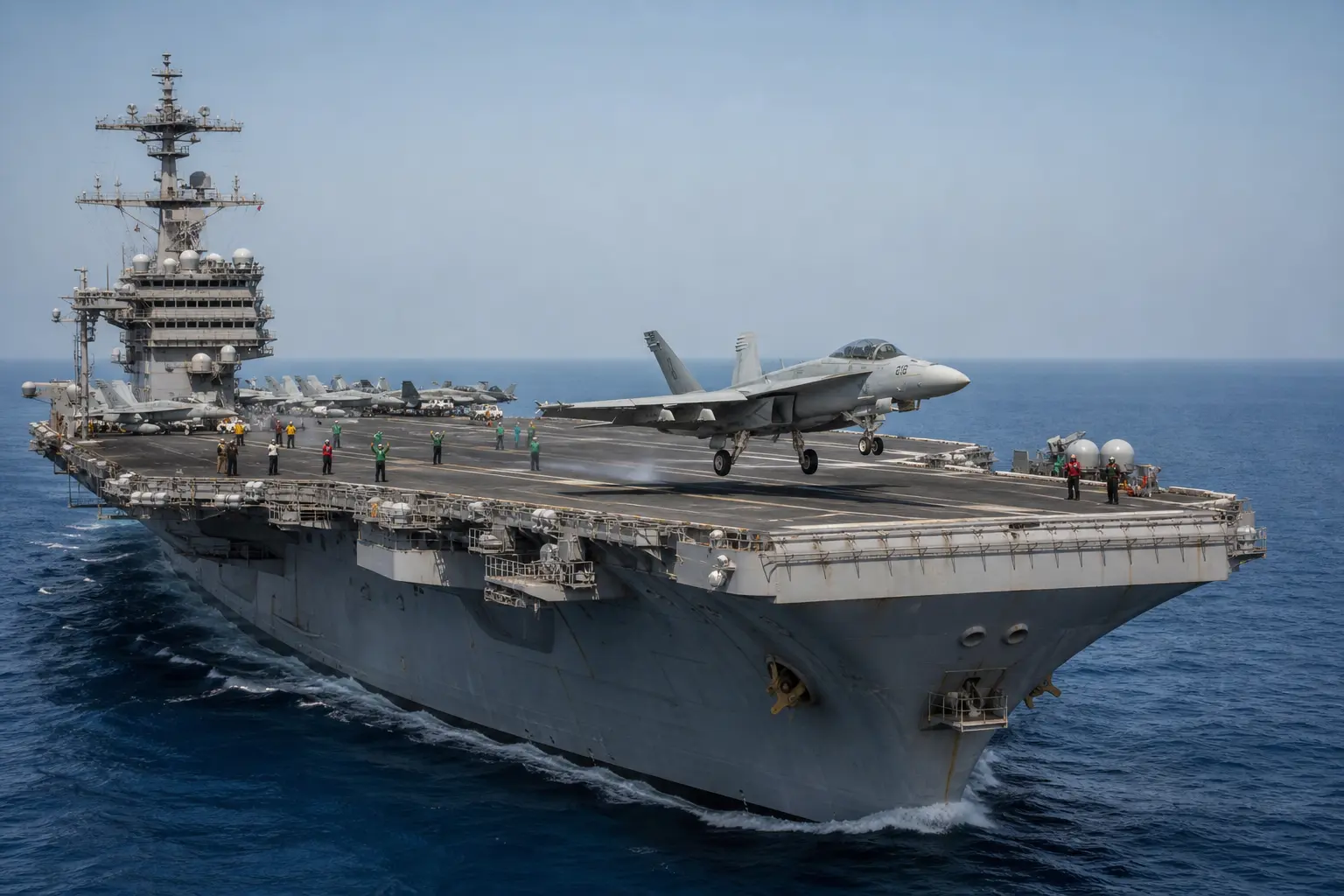
Adm. Brad Cooper visited the USS Abraham Lincoln in the Arabian Sea as his 10-day Middle East trip ended Aug. 15, praising a crew that has logged more than 260 days at sea, roughly 10,000 aircraft flights and 1.5 million pounds of ordnance. The San Diego-based carrier strike group has backed Operation Epic Fury, regional security and the U.S. naval blockade of Iran since arriving in January.
Cooper called the deployment one of the most operationally intense and consequential of the modern era. The visit came as the Navy prepares to rotate the ship home and as family reports of tough conditions met a sharp CENTCOM rebuttal of death and suicide claims.
Ten Thousand Flights and a Record Stretch at Sea
The Abraham Lincoln Carrier Strike Group left for deployment in November 2025 and reached the Middle East in January. CENTCOM says the group has kept among the highest reenlistment rates of any U.S. Navy aircraft carrier at 84.4 percent.
AP reporting put the uninterrupted time at sea past 240 days, a modern record stretch for the carrier under combat conditions. The war with Iran began Feb. 28 with U.S. and Israeli strikes; the blockade followed Iran’s moves on the Strait of Hormuz.
| Metric | Figure |
|---|---|
| Days at sea (current deployment) | More than 260 |
| Aircraft flights | About 10,000 |
| Ordnance expended | 1.5 million pounds |
| Crew reenlistment rate | 84.4 percent |
Those numbers sit at the center of Cooper’s praise. “The Lincoln Carrier Strike Group is a strong team of high-achieving Americans standing tall with immense, justified pride in everything they accomplished,” he said in the CENTCOM release on the 10-day trip.
What CENTCOM Says the Reports Got Wrong
Multiple outlets carried claims of seven sailors dead in a brawl and a spike in suicidal thoughts. CENTCOM labeled them false.
What We Know
- No service members aboard the carrier have died during the deployment.
- One sailor fell overboard Aug. 3 and was quickly and safely recovered.
- Reenlistment sits at 84.4 percent, among the highest for Navy carriers.
What’s Unconfirmed or Denied
- Any deaths from a shipboard fight.
- A verified spike in suicidal ideation or attempts above normal levels for the force.
- Precise current numbers of overboard attempts beyond family accounts and the single confirmed recovery.
The command posted an official fact-check on the false claims that drew more than a million views. It called the coverage rampant misreporting and a disservice to the crew and families.
Family members and some reporting have described mold, food problems, long hours and sailors trying to go overboard. Those accounts continue even after the denial.
Mental Health Ranked Among the Lowest Cases
After the visit Cooper released a further statement. Of the Navy’s 11 active aircraft carriers, the Lincoln currently has among the lowest number of cases related to mental health, he said.
“This doesn’t mean that all is perfect,” Cooper added. “Find any of the nearly 4 million Navy veterans in America today and they will likely tell you that service at sea for long periods isn’t for everyone.”
He called the visit awe-inspiring and praised senior enlisted leaders in the Chief Petty Officers Mess for making mental health and crew resilience a leadership priority. He has long treated mental health as another aspect of individual readiness alongside physical and spiritual health.
- Cooper’s second visit of the year to the same ship
- Awards presented to deserving sailors and Marines during the stop
- Meetings with junior service members as well as the full crew address
- Explicit credit to chief petty officers for the resilience focus
Acting Navy Secretary Hung Cao said the mission demanded the extension past the original May end date and accused some coverage of painting warriors as victims. President Trump, asked if the deployment had run too long, answered no and said “not nearly long enough.” Defense Secretary Pete Hegseth called the reports completely misrepresented.
Six Countries Plus the Carrier Deck
The Lincoln stop closed a swing that took Cooper to Bahrain, Iraq, Israel, Jordan, Saudi Arabia and the United Arab Emirates. More than 50,000 U.S. service members remain across the region.
- Aug. 11, Presided over the Combined Joint Task Force-Operation Inherent Resolve change of command in Jordan; Maj. Gen. Kevin Lambert handed over to Rear Adm. Liam Hulin.
- Mid-trip, Meetings with senior civilian and military leaders in the six countries; recognition and reenlistments for troops ashore.
- Aug. 15, Second visit of 2026 to USS Abraham Lincoln in the Arabian Sea; full crew address and junior-member sessions.
His first Lincoln visit came in February with special envoy Steve Witkoff and Jared Kushner. The current trip also produced video and imagery of Cooper with air wing units including Helicopter Sea Combat Squadron 14 and Marine Fighter Attack Squadron 314.
Families, Lawmakers and the Dual Picture
Senators Richard Blumenthal and Ruben Gallego have pressed for a bipartisan visit to the carrier. Sen. Kirsten Gillibrand called for hearings and accountability, describing a reckless war with no clear end. House Democrats have questioned the acting Navy secretary on conditions.
On X and in family channels the CENTCOM fact-check drew pushback. Some replies argued that dismissing family reports as misreporting was the wrong approach. Others tied the long deployment to broader strain on the force. The high-engagement official post still left room for those competing accounts.
The same pattern of public visibility around CENTCOM activity has appeared before, including earlier tracking of CENTCOM base patterns that outlasted tighter rules on fitness apps.
History will record this deployment as one of the most operationally intense and consequential of the modern era.
Cooper said that in the official release after addressing the crew.
George Washington Heads In as Lincoln Turns for Home
The Navy has said the USS George Washington is moving to take the Lincoln’s place in a planned rotation. Cao announced the homecoming steps as the ship prepares to leave the Arabian Sea after the extended combat tour.
The strike group’s output (thousands of combat sorties, the blockade enforcement that redirected dozens of commercial vessels, and sustained presence) now sits beside the human-cost questions that families and some lawmakers refuse to drop. Cooper’s two visits, the reenlistment figure and the relative mental-health ranking form the command’s case that the crew met the demand. The dual public record remains the lasting mark of the deployment.
The carrier that left San Diego in late 2025 returns with a combat log few modern ships can match and a debate over what that log cost its sailors that has not ended with the admiral’s praise.
