
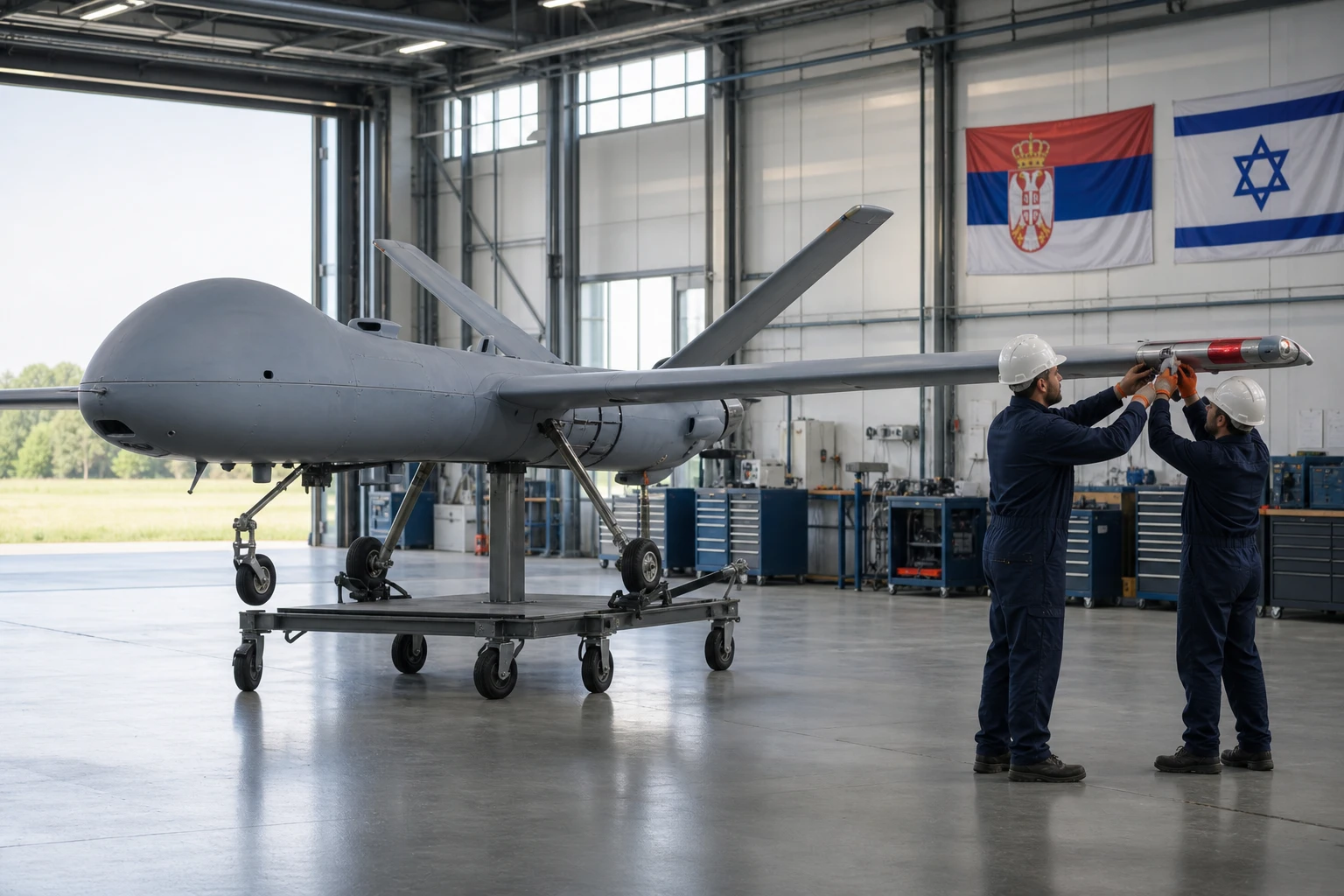
Serbia plans to open a joint combat drone factory with Israeli firm Elbit Systems around September 15 or 20, with Elbit holding a 51 percent majority stake alongside state-owned SDPR. President Aleksandar Vučić announced the timetable during Ukrainian President Volodymyr Zelensky’s visit to Belgrade, framing the plant as a step to modernize Serbian forces and expand unmanned exports.
The facility sits in the Simanovci industrial zone roughly 30 kilometers west of the capital. It grows directly out of earlier multi-hundred-million and billion-dollar contracts that already put Elbit systems into Serbian inventory.
The Plant and the September Window
Vučić first flagged a joint drone plant in March 2026, calling for “the most serious” UAVs. The partner identity and mid-September window arrived later. Elbit declined further comment when asked by The Times of Israel.
Ownership splits 51 percent Elbit and 49 percent Serbia’s Jugoimport-SDPR. Engineers from SDPR-owned aircraft maker Utva are expected to take part. Production targets short-range attack combat drones plus longer-range unmanned systems and advanced electronic warfare gear.
- Opening window: around September 15 or 20, 2026
- Location: Simanovci industrial zone near Belgrade
- Stake: Elbit 51 percent, SDPR 49 percent
- Scope: short-range high-payload rotary-wing combat drones, longer-range fixed-wing types, electronic warfare systems
Vučić invited Ukrainian representatives to the ceremony, citing Ukraine’s own drone manufacturing experience. He said the two sides did not discuss military cooperation during the wartime visit.
The invitation keeps the opening ceremony in a diplomatic frame even as the plant itself is a bilateral industrial project. Serbian officials present the date as firm enough to plan around, while leaving a few days of slack between the 15th and the 20th.
What the Larger Contracts Already Delivered
The factory is the industrial follow-through on deals already signed. In November 2024 Elbit announced contracts worth approximately $335 million for a European customer later identified as Serbia. Those covered PULS rocket launchers and Hermes 900 unmanned aircraft systems with advanced payloads, performed over three and a half years.
In August 2025 Elbit announced a far larger award: a five-year $1.635 billion contract for a European country. It includes long-range precision strike artillery-rocket systems, a broad spectrum of unmanned reconnaissance and loitering aerial combat systems from operational to tactical ranges (including personally operated drones), sophisticated ISTAR with SIGINT, COMINT and electronic warfare, electro-optical and night-vision systems, combat vehicle upgrades, protective systems, and full military digitalization with network combat solutions spanning strategic to tactical levels.
| Contract | Value | Key systems | Period |
|---|---|---|---|
| November 2024 | ~$335 million | PULS launchers and rockets; Hermes 900 UAS | 3 years 6 months |
| August 2025 | $1.635 billion | Long-range rockets; attack and recon UAVs; ISTAR/EW; EO/NV; vehicle upgrades; C4ISR digitization | 5 years |
Elbit President and CEO Bezhalel (Butzi) Machlis said the larger contract also includes industrial cooperation “aimed to strengthen the buyer’s national industrial capabilities.” The September plant is the visible expression of that clause.
This contract reflects the strong demand for Elbit Systems’ cutting-edge technologies in Europe and demonstrates our ability to deliver integrated, multi-domain solutions tailored to the needs of modern defense forces.
Machlis made the statement in the company’s August 2025 release on the $1.635 billion award.
Taken together, the two awards stretch across delivery windows that already overlap the factory’s planned start. Hardware arriving under the contracts and airframes built in Simanovci are meant to reinforce the same modernization track rather than run as separate programs.
Serbia’s Supplier Mix and the Autonomy Bet
Serbia is not an EU or NATO member. It has spent recent years replacing Soviet-era stocks while keeping multiple suppliers. SIPRI data for 2020-2024 show China supplying 57 percent of Serbia’s major arms imports, ahead of Russia at 20 percent and France at 7.4 percent. Chinese CH-92 and CH-95 armed drones plus FK-3 and HQ-17 air-defense batteries made Serbia the first European operator of several of those systems. Joint training with Chinese special forces followed in 2025.
France added a multi-billion-euro Rafale fighter package. Israel’s share has jumped through the Elbit contracts and a parallel surge in Serbian munitions and component exports to Israel. Those exports rose sharply after 2023 and reached tens of millions of euros annually, much of it through SDPR. The drone plant adds local production capacity on the Israeli line of that mix.
Analysts note the arrangement gives Belgrade technology transfer it could not generate alone while giving Israel a manufacturing and supply footprint outside the immediate Middle East conflict zone. Serbia’s ruling elite has also treated closer Israel ties as useful political insurance in Washington. At the same time the country continues Chinese air-defense and residual Russian equipment relationships.
- China: dominant recent importer share, armed drones, medium-range SAM batteries, joint drills
- Israel/Elbit: $335 million then $1.635 billion packages plus majority stake in new UAV plant
- France: Rafale multirole fighters and associated support
- Russia: legacy platforms and earlier donations, constrained by sanctions logistics
The result is a deliberately multi-vector force structure. Domestic production of advanced combat drones reduces pure import dependence on any single partner for that category.
Each supplier line covers a different layer of the force. China has dominated recent import share and air defense. France anchors the high-end fighter tier. Israel now supplies rockets, sensors, and the new UAV production base. Russia remains present mainly through legacy fleets whose sustainment is harder under sanctions logistics.
Two Drone Lines and the Transfer of Know-How
Documents and sources cited by BIRN and Haaretz in April described two families. One is a rotary-wing model built to carry heavy ammunition payloads on short-range attack missions. The second is a longer-range, higher-performance aircraft able to operate at altitudes up to 6,000 meters, described as more advanced than Serbia’s existing Pegaz (Pegasus) combat-reconnaissance drone in ceiling and endurance.
| Line | Configuration | Mission profile | Noted performance |
|---|---|---|---|
| First family | Rotary-wing | Short-range attack with heavy ammunition payloads | High payload focus |
| Second family | Longer-range fixed-wing | Higher-performance reconnaissance and combat | Ceiling up to 6,000 meters; above Pegaz in ceiling and endurance |
Serbian engineers will work alongside Elbit staff. Utva’s involvement is meant to embed design, production and sustainment skills inside the national industry. The plant is also expected to support electronic warfare systems that sit alongside the air vehicles.
That local capacity can feed Serbian inventory first. Over time it can support exports of unmanned systems and related equipment, an explicit goal Vučić has stated. Serbia already exports large volumes of conventional munitions; adding higher-end UAVs would move the portfolio up the value chain. Prior Serbia’s prior large munitions export work shows the industrial base is already oriented toward foreign customers.
Embedding Utva staff on the line is the practical route for retaining those skills after initial production batches. Design familiarity, depot-level repair, and later modification work all depend on engineers who have built the airframes rather than only received them as finished imports.
How Contracts Turned Into a Factory
The September opening is the latest step in a short, documented sequence rather than a stand-alone announcement. Each stage narrowed the relationship from catalog sales toward shared production.
- November 2024: Elbit announces approximately $335 million in contracts later tied to Serbia, covering PULS launchers and Hermes 900 systems over three and a half years.
- August 2025: Elbit announces the five-year $1.635 billion package, with an industrial cooperation clause aimed at the buyer’s national industrial capabilities.
- March 2026: Vučić publicly flags a joint drone plant and calls for the most serious UAVs.
- April 2026: Reporting describes the two drone families planned for local build; Israeli and Serbian foreign ministers advance trade and strategic dialogue tracks.
- June 2026: Small protests against the factory appear in Belgrade.
- Around September 15 or 20, 2026: Planned opening of the Simanovci plant with Elbit at 51 percent and SDPR at 49 percent.
The industrial cooperation language in the larger award supplies the contractual bridge. Majority Israeli ownership, Serbian state minority equity, and Utva engineering participation translate that clause into a physical line west of Belgrade.
Hardware deliveries under the earlier contracts and air vehicles built at Simanovci are scheduled on overlapping calendars. That overlap is how Belgrade converts purchase orders into retained production capacity instead of one-way imports alone.
Reactions Split Along Familiar Lines
Pro-Israel accounts on X highlighted the scale of the $1.63 billion package and Elbit’s controlling stake, with one widely shared post drawing more than 23,000 views in its first day. Critics focused on Elbit’s role in Israeli operations in Gaza and on the risk that technology or components could eventually reach adversaries of the West or of Israel itself. Small protests against the factory appeared in Belgrade in June, linking the project to the anniversary of the 1999 NATO campaign and to broader arms-industry opposition.
Spain earlier cancelled a large Elbit rocket-launcher purchase over Gaza policy. Some European pension funds and banks had already restricted Elbit investments years earlier over West Bank barrier systems. Serbia’s decision runs counter to those restrictions. Vučić’s government has dismissed external criticism of the partnership.
The Zelensky invitation added another layer. Some observers floated the idea of future Ukrainian expertise feeding a trilateral arrangement; Vučić publicly ruled out wartime military talks. The optics of inviting a war-torn drone innovator to an Israeli-majority plant opening still underline how crowded the unmanned systems market has become.
Domestic critics and foreign policy opponents therefore read the same facts in opposite ways. Supporters treat the controlling stake and contract scale as proof of serious technology access. Opponents treat those same features as exposure to political and diversion risk.
What Export Capacity Adds for Belgrade
Vučić has stated export of unmanned systems as an explicit goal once local lines are running. That ambition builds on an industrial base already selling conventional munitions abroad in large volumes, including the surge in munitions and component shipments to Israel that rose after 2023 and reached tens of millions of euros annually, much of it through SDPR.
Moving from shells and components into higher-end UAVs and related electronic warfare gear would lift the same export channel up the value chain. The Simanovci mix of short-range rotary-wing attack drones, longer-range fixed-wing types, and EW systems is structured for both national inventory and later foreign customers.
Local build also changes sustainment math for Serbian forces. Imported drones arrive as finished systems. Airframes assembled with Utva engineers on site create a path to domestic repair, spares, and incremental upgrades without a full return to the original supplier for every change.
None of that erases the multi-vector supplier pattern already in place. It does give Belgrade a produced-at-home option inside the unmanned category, where China had already supplied armed drones and where Israel now holds the majority stake in new capacity.
Deeper Bilateral Ties Beyond the Factory Gates
Defense is only one track. In April 2026 Israeli Foreign Minister Gideon Sa’ar and Serbian Foreign Minister Marko Đurić announced they were negotiating a free trade agreement, launching a strategic dialogue, convening a joint economic committee, and planning permanent Israeli economic representation in Belgrade. Đurić called the dialogue a concrete step that would open doors for companies on both sides.
Netanyahu and Vučić have met repeatedly, including on the sidelines of the UN General Assembly. Serbia has become one of Israel’s closer partners in Europe outside the EU and NATO frameworks. The industrial cooperation clause in the large Elbit contract, the majority stake in the Simanovci plant, and the trade talks all point in the same direction: longer-term institutional links rather than one-off sales.
Elbit itself continues to expand its global footprint. Separate European awards, including large PULS packages elsewhere, show demand for the same families of systems now heading into Serbian production. At the same time other governments have chosen different suppliers; Ireland’s recent jet acquisition, for example, Elbit FalconEye system omitted by Ireland in favor of alternatives. Inside Israel, startups rising in Israel defense rankings are also competing for attention and contracts alongside the established primes.
Trade talks, repeated leader meetings, and a majority-owned plant form a thicker relationship than successive equipment orders alone. Permanent economic representation in Belgrade would give that track a standing bureaucratic home on the Israeli side.
For Serbia the September opening converts paper contracts into physical lines, local jobs and retained know-how. For Elbit it places majority-controlled production capacity inside Europe at a moment when some traditional customers face political constraints. The drones that leave Simanovci will first serve Serbian modernization. What they enable next-exports, deeper joint development, or further shifts in Belgrade’s supplier balance-will be visible only after the lines are running.
