
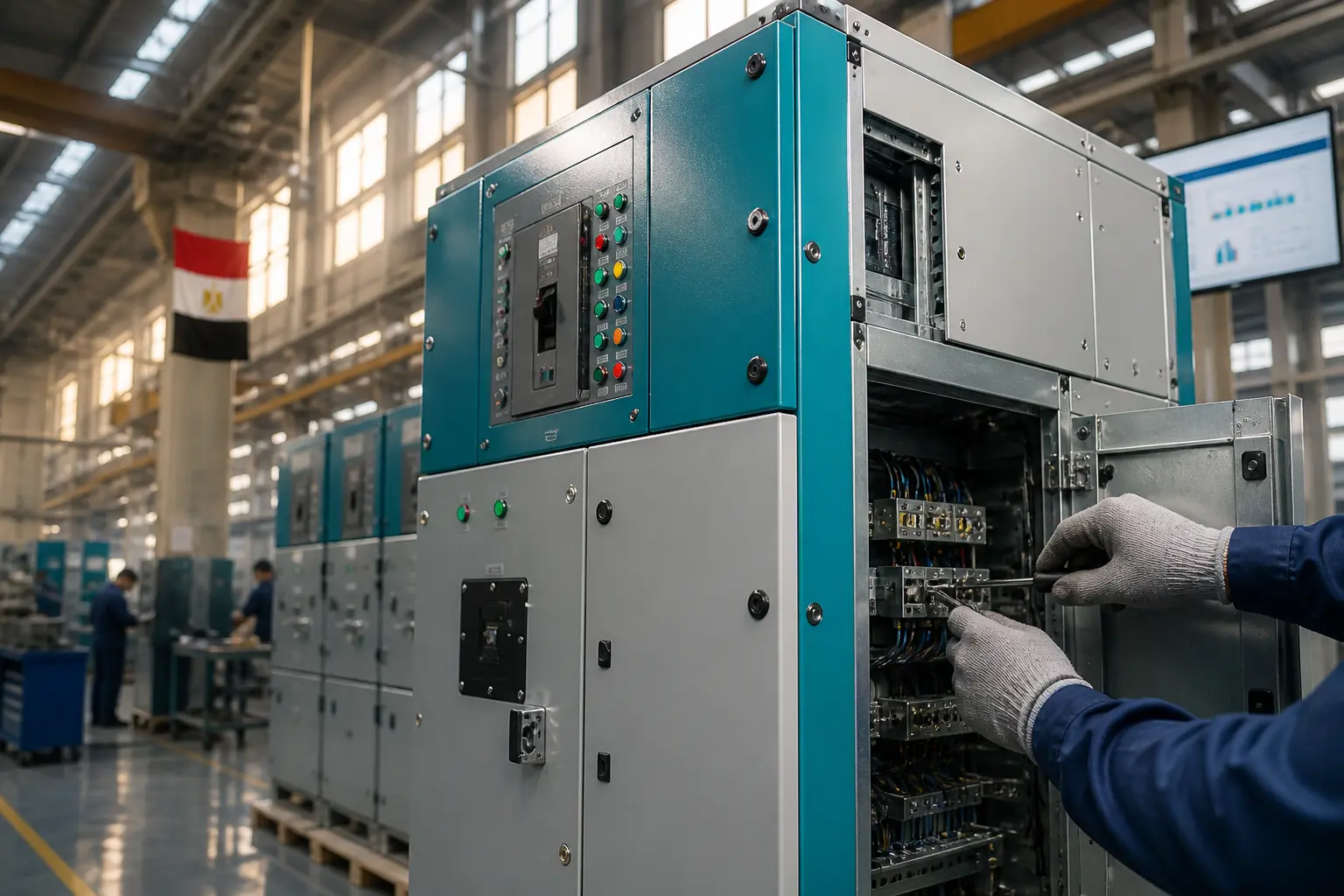
Siemens switched on a new factory east of Cairo this week that will build the switchgear and substation control systems Egypt needs to keep the lights on. Ministers Mahmoud Esmat and Khaled Hashem joined Siemens AG executives at the inauguration on July 28. It is the company’s first local production line for that hardware in a country that spent 2023 and 2024 rationing electricity by the hour.
Egypt’s electricity ministry now promises a summer with no rolling cuts at all, backed by a renewable energy target it just moved up by two years. The factory opening this week is one of the physical pieces behind that promise, built while the memory of three-hour blackouts is still fresh.
What Rolls Off Egypt’s New Assembly Line
The plant sits in Egypt’s industrial belt and will produce four categories of hardware that utilities and heavy industry need to run a modern grid, according to Siemens.
- Switchgear – the cabinets that route and interrupt high-voltage power to protect substations and factories from surges
- Substation control and monitoring systems – the digital layer that lets grid operators watch and adjust power flow in real time
- Protection systems – equipment that automatically isolates a fault before it cascades into a wider outage
- Embedded cybersecurity – security built into the control layer itself rather than added on afterward
Two more facilities sit beside the production line. The Siemens Power Academy has dedicated training rooms next to the factory floor, where engineers study live equipment instead of manuals alone. A separate Customer Experience Center lets utilities and contractors test Siemens’ digital twin and Internet of Things (IoT) tools for grid monitoring before they commit to buying them.
Three Summers Since Cairo’s Lights Flickered
Rolling blackouts began on July 22, 2023, after Egypt’s own gas fields came up short. Production at the giant Zohr field fell 11% in the 2022 to 2023 fiscal year, and analysts at Fitch Solutions tracked national gas output sliding to a three-year low. Gas deliveries from Israel, which fed a share of Egypt’s power plants, also paused when the war in Gaza began that October, exposing how little slack the grid had left.
The cuts started at roughly an hour a day and grew from there. By June 2024, households in some governorates were losing power for three hours at a stretch, with rural areas faring worse than Cairo. Human Rights Watch warned the cutbacks put access to water and health care at risk for households that could least absorb it. The outages also became a political liability for President Abdel Fattah al-Sisi’s government.
Egypt Spent Its Way Out of the Dark
The government’s answer was money and a faster clock. Egypt had been targeting a 42% renewable share of its electricity mix by 2030; the state’s own information portal recorded that goal before officials pulled it forward to 45% by 2028, two years earlier than planned.
The transmission upgrade behind that target costs roughly EGP160 billion, about $2.9 billion at current exchange rates. Egypt’s 2025 to 2026 development plan sets aside EGP136.3 billion for electricity and renewables, nearly double the EGP72.6 billion budgeted the year before. That spending is landing even as Egypt’s broader economy grew 5% while private-sector manufacturing surveys kept pointing to contraction, part of why officials are leaning on energy infrastructure to carry more of the industrial strategy’s weight.
| Metric | 2023 to 2024 | 2026 |
|---|---|---|
| Power supply | Rolling cuts of up to three hours a day | Ministry guarantees no load shedding this summer |
| Renewable energy target | 42% share by 2030 | 45% share by 2028 |
| Annual development-plan allocation for electricity | EGP72.6 billion | EGP136.3 billion |
| Local switchgear and substation manufacturing | None; fully imported | In production at Siemens’ new factory |
Egypt’s Ministry of Electricity and Renewable Energy says demand this summer is running about 8% above last year’s levels, and it has added a peak-hour surcharge for heavy commercial users rather than cut supply to meet it.
Egyptian Firms Chase the New Supply Chain
Egypt’s National Industry Strategy, adopted for 2024 through 2030, set a target of raising industry’s share of GDP from 14% to 20% and pushing local content in manufacturing to 60% to 80%. The International Energy Agency’s policy database lists electrical and electronic equipment among the strategy’s priority sectors, alongside cars, garments and pharmaceuticals.
Siemens said the factory will also feed Egyptian engineering, procurement and construction firms working on energy projects across North Africa and the wider continent, not only at home. That regional pipeline already has a track record: an Egyptian maintenance company recently won a gas turbine service contract at Jordan’s Arab Potash complex worth 46 million euros, proof that Egyptian energy contractors can already compete beyond their own borders.
The wager is that locally built switchgear shortens the lead times on those contracts and keeps more of the margin at home instead of paying for imported components shipped in from Europe or Asia.
A 125-Year Partnership Adds a Factory Floor
Siemens has operated in Egypt for 125 years, long enough to have helped build the country’s rail and power backbone more than once. Its Egyptian portfolio already includes electricity grid modernization work and the Middle East’s first Industry 4.0 Innovation Center, opened in the New Administrative Capital. On the transport side, the Velaro trains Siemens unveiled at Egypt’s TransMEA conference last year are built for the high-speed rail line the company is helping deliver.
What changes with this factory is the direction of the relationship. Siemens signed a memorandum of understanding with Egypt’s Industrial Development Authority in September 2024 to localize electrical product manufacturing, and this plant is the first result of it. The company now makes equipment in Egypt that it used to ship in from elsewhere.
Today reflects Siemens’ belief in Egypt’s future.
Mostafa El-Bagoury, chief executive of Siemens Egypt, said that future is built on innovation, sustainability and collaboration, and that the factory delivers technology made in Egypt, for Egypt, and for export beyond it.
Can Egypt Hit Its New Renewables Target?
Probably, if gas supply holds and grid spending keeps pace. Egypt has already moved this same target up once, from 2030 to 2028. The open question sits upstream of the wires: whether gas output and import contracts can keep up with a grid that is finally catching up on capacity and maintenance after two lean years.
Stephan May, chief executive of Siemens’ Electrification and Automation division, said localizing production is “key to building resilient infrastructure and competitive industries.” His argument is that equipment built closer to the customer arrives faster when a utility needs to expand or repair the grid under pressure, which matters more in a country that has already lived through one supply crunch than in one that has not.
Gas supply remains the government’s problem to solve on its own. Siemens controls a narrower piece of it: how quickly new gas and solar capacity turns into electricity that reaches a home or a factory floor without tripping a breaker somewhere in between.
The Power Academy’s first cohort of Egyptian engineers begins training on that factory floor this year, learning to run equipment the country used to buy from abroad.
