
Christopher Nolan’s “The Odyssey” just gave Homer’s 3,000 year old epic its biggest audience ever. It did not win Poseidon a single new prayer. The film opened to an estimated $264 million worldwide on a $250 million budget, shot entirely on IMAX 70mm film, and it kept selling tickets into a second weekend that added roughly $90 million more in North America alone, an unusually strong hold for a movie this size.
Essayist Benjamin Resnick watched all of it from a theater seat in Tel Aviv, and walked out with a harder question than any studio marketing plan wants asked. If a quarter billion dollars of craft can make Odysseus fascinating again, why has nobody prayed to him in two thousand years, while a much older, much plainer set of scrolls still gets kissed when it falls to the floor.
The Weekend Nolan Broke His Own Record
Universal Pictures released “The Odyssey” wide in the United States and the United Kingdom, and the opening became the biggest launch of Nolan’s career. The studio’s parent company, Comcast, said the film delivered Nolan’s career-best opening weekend, with domestic ticket sales landing around $124 million and the rest coming from overseas markets.
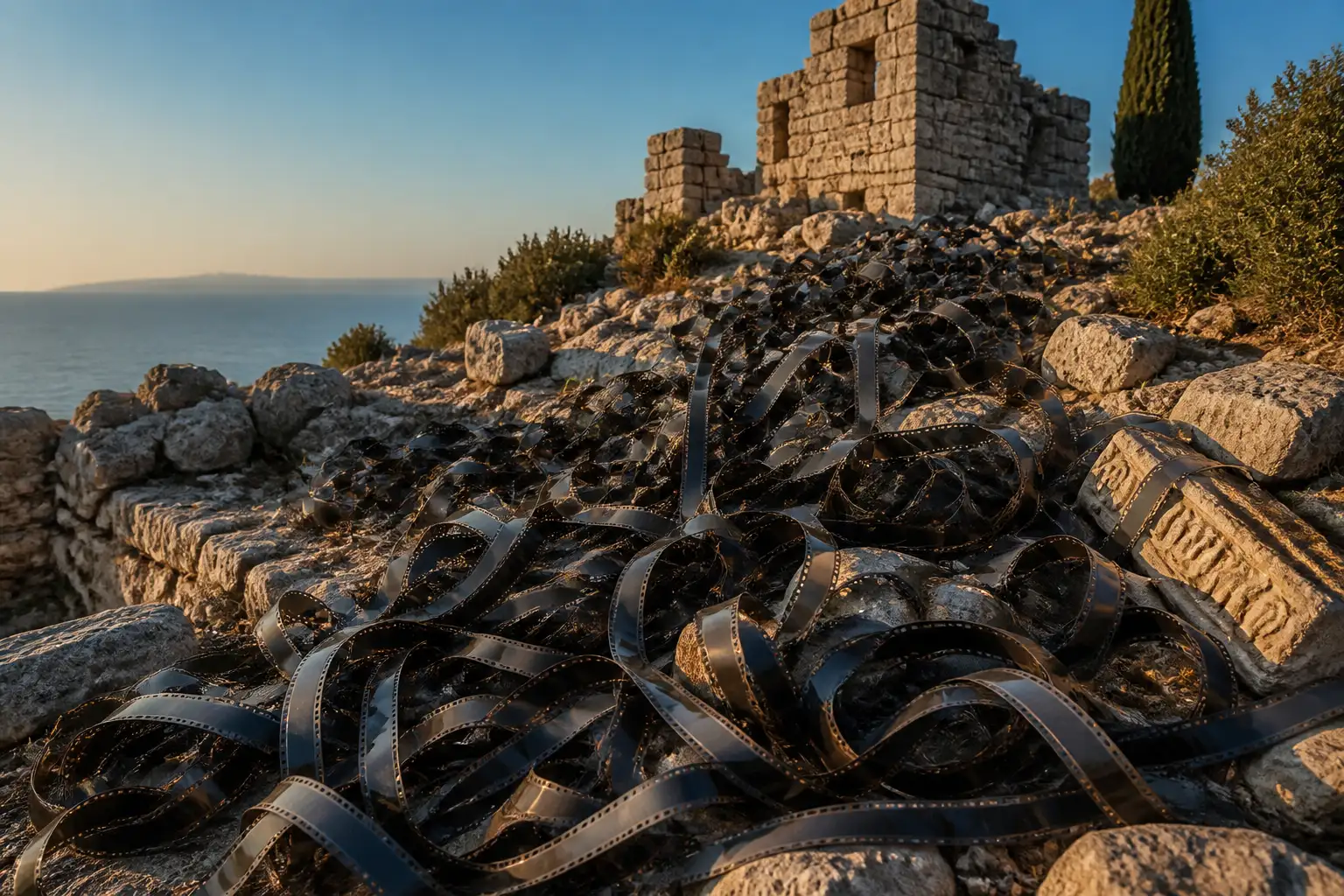
Premium large formats carried more than half of the domestic gross, and IMAX alone accounted for roughly $51.8 million of the global total, about 23 percent of every ticket sold. That is no accident. The production shot 2.1 million feet of film to become the first feature ever captured entirely on IMAX’s 70mm cameras, a technical bet as large as its budget.
The cast reads like an ensemble built for exactly this kind of spectacle:
- Matt Damon as Odysseus
- Anne Hathaway as Penelope
- Tom Holland as Telemachus
- Zendaya as Athena
- Charlize Theron as Circe
- Robert Pattinson as Antinous
Every one of those names is built to fill an IMAX screen. None of them, on their own, explains why a viewer would leave the theater thinking about scripture instead of box office.
A Tel Aviv Theater, Two Homecomings
Resnick sat with his wife and children a few blocks from Dizengoff Square, watching Damon swing a sword and string a bow while Hebrew subtitles ran under the frame. He described a dual narrative settling over him mid-film: a story about a homecoming, watched by a family that was itself living one.
Odysseus needed twenty years to reach Ithaca. In Resnick’s telling, the Jewish people waited roughly two thousand before the modern State of Israel gave that homecoming a country to land in, a framing he offered as personal reflection rather than a dated historical claim. He wrote in an essay explaining why no one worships Odysseus anymore, published by the Jewish Telegraphic Agency and cross posted to Times of Israel Blogs, that the theater he sat in would not exist, and the city around it would not exist, without the staying power of a much older book than the one Nolan filmed.
Two Scenes, One Argument From 1946
The comparison Resnick reached for belongs to Erich Auerbach, a Jewish philologist who fled Nazi Germany and wrote his most influential book from exile in Istanbul. Auerbach published “Mimesis: The Representation of Reality in Western Literature” in German in 1946, and its opening chapter, titled “Odysseus’ Scar,” sets a recognition scene from Book 19 of the Odyssey against nineteen sparse verses from Genesis.
Auerbach’s original chapter, still assigned in comparative literature courses today, argues that Homer’s world is “clearly outlined, brightly and uniformly illuminated,” men and things standing out with everything visible, a style that “knows only a foreground, only a uniformly illuminated, uniformly objective present.” The Binding of Isaac works by the opposite method, saying almost nothing and leaving the reader to fill the silence.
Yitzhak said to Avraham his father, he said: Father! He said: Here I am, my son. He said: Here are the fire and the wood, but where is the lamb for the offering-up? Avraham said: God will see-for-himself to the lamb for the offering-up, my son. Thus the two of them went together.
Those two verses come from Genesis 22:7 to 8. No description of a face, no stage direction, no explanation of what either man is feeling as they climb the mountain. Auerbach’s point was that the gaps are the engine. A story that withholds detail forces the reader back into the text again and again, hunting for what it refuses to say outright.
The Shrine That Ran a Thousand Years, Then Went Quiet
Odysseus once had exactly the kind of devotion Resnick found missing. Archaeologists from the University of Ioannina recently confirmed that a hillside complex at Agios Athanasios, on the northern end of Ithaca and long nicknamed Homer’s School, functioned as a working shrine to Odysseus for more than 1,000 years, from the Mycenaean era into the Hellenistic period.
Excavation leader Giannos G. Lolos described inscribed roof tiles, a miniature bronze bust and coins bearing the hero’s name as, in his words, conclusive evidence that the complex was the Odysseion, Ithaca’s long sought sanctuary of Odysseus. The sanctuary was cut into a natural rock formation, with a tower, a long building and terraces of rock hewn architecture. Greece’s Ministry of Culture has called the find one of the most significant of recent years.
- Circa 1600 to 1100 BCE: Ritual activity begins at the Agios Athanasios hillside site on Ithaca, according to the excavation team.
- Circa 31 BCE: The archaeological record of continuous offerings goes quiet around the conventional end of the Hellenistic period, after more than a millennium of use.
- 1946: Erich Auerbach publishes “Mimesis” in German, having written it in wartime exile in Istanbul.
- July 17, 2026: “The Odyssey” opens wide in the United States and the United Kingdom.
- July 19, 2026: Researchers detail the Ithaca findings publicly, describing over a thousand years of devotion to a hero now found only in ruins.
A thousand years of continuous ritual is not nothing. It is, however, a finite run that ended in silence long before anyone built a camera capable of filming it.
What Can a Quarter Billion Dollar Camera Not Do?
A camera can render every gesture, every wave, every drop of blood in trackable, well lit detail. What it cannot do, on Auerbach’s argument, is create the kind of gap that forces a viewer to keep interpreting a story for three thousand years, because full illumination leaves nothing hidden left to chase.
Nolan’s film is, by design, the most externalized version of Homer’s already externalized style: every costume, every coastline, every battle rendered at IMAX resolution. That achievement is real, and it is also the reason the comparison holds up rather than breaks down.
| Measure | Odysseus and His Cult | The Tanakh and Its Readers |
|---|---|---|
| Span of active devotion | More than 1,000 years, Mycenaean era to Hellenistic period, per the Ithaca excavation | Roughly 3,000 years, still ongoing in synagogues worldwide |
| Physical evidence today | Roof tiles, a bronze bust and coins recovered from a ruined hillside sanctuary | Handwritten scrolls read aloud weekly, mended by scribes, buried when unusable |
| 2026 cultural vehicle | A $250 million Nolan film shot entirely on IMAX 70mm | A Tel Aviv screening that produced a widely read essay on the Tanakh’s staying power |
| Narrative style, per Auerbach | Fully lit foreground, every gesture externalized | Gaps and silence that force continual interpretation |
Nothing in that table argues Nolan made a bad film. Reviewers and audiences clearly disagree, given the numbers. It argues that box office success and religious survival are measuring two different things, and only one of them shows up on a studio earnings call.
Why the Torah Still Gets Kissed When It Falls
Resnick’s essay lingers on a set of small, repeated acts: a scroll read on an endless annual loop, kissed if it slips from someone’s hands, buried with ceremony once it is too worn to use. Those practices, rooted in the tradition of retiring worn sacred texts rather than discarding them, have no equivalent anywhere in how modern audiences treat Homer.
Nobody pours wine for Poseidon before a flight. Nobody leaves an offering at Athena’s altar before a exam. The last confirmed offerings at Ithaca’s shrine predate the Roman absorption of Greece, while the Tanakh’s stories are still argued over in the same language they were first written in, in cities built on the ground they describe.
Auerbach’s own language for this gap is precise. Because so much of the biblical text stays dark and incomplete, and because the reader knows the God behind it is a hidden God, the effort to interpret it, in his words, constantly finds something new to feed upon. Homeric epic entertains. Biblical narrative recruits.
The Box Office Bet Hollywood Will Chase Next
None of this should read as a knock on Nolan’s gamble. An original, non franchise, R rated scale epic built around a 3,000 year old poem was always a risk for a studio, and the numbers say the risk paid off, with a second weekend hold strong enough that Deadline flagged it as its own kind of record.
What the run does confirm is narrower and, for anyone chasing the next ancient epic tentpole, more useful. Spectacle sells tickets on its own terms. It does not, by itself, convert admiration into devotion, and studios weighing the next mythological adaptation are betting on the former while a much cheaper, much older institution keeps quietly delivering the latter.
Nolan’s cameras can make three thousand years of myth look new again. They cannot make anyone pray to it, and on the numbers so far, nobody is trying.
Frequently Asked Questions
What Is Erich Auerbach’s “Mimesis” About?
“Mimesis: The Representation of Reality in Western Literature” is a work of literary criticism Auerbach wrote while exiled in Istanbul after fleeing Nazi Germany, published in German in 1946. Its opening chapter, “Odysseus’ Scar,” remains widely taught, and the University of Toronto’s comparative literature program hosts the full text for students today.
Is “The Odyssey” Christopher Nolan’s Biggest Opening Ever?
Yes. Comcast, Universal’s parent company, described the film’s roughly $264 million global opening as Nolan’s career best launch. The film then added about $90 million more in North America during its second weekend, an unusually small drop for a film of this scale.
Why Did People Stop Worshipping Odysseus?
Archaeological evidence from the Ithaca shrine shows continuous ritual activity for more than 1,000 years, from the Mycenaean era into the Hellenistic period, with the record going quiet around 31 BCE, the conventional endpoint scholars use for that era, as Rome absorbed the Greek world.
What Did Archaeologists Find at the Shrine on Ithaca?
Excavators at the Agios Athanasios site recovered inscribed roof tiles, a miniature bronze bust and coins bearing Odysseus’s name, built into a sanctuary cut from a natural rock formation with a tower, a long building and two rock hewn terraces, according to dig leader Giannos G. Lolos.
Who Stars in Nolan’s “The Odyssey,” and When Did It Open?
Matt Damon leads as Odysseus alongside Anne Hathaway, Tom Holland, Zendaya, Charlize Theron and Robert Pattinson, in a $250 million production shot on 2.1 million feet of IMAX 70mm film. It opened wide across the United States and United Kingdom on July 17, 2026.
