
Egypt reopened the tomb of Pharaoh Amenhotep III on October 4, 2025, unveiling a 3,400-year-old burial chamber near Luxor after more than two decades of conservation work by Egyptian, Japanese and UNESCO specialists. The ceremony closed out one restoration. It also marked a live test of a much bigger wager: that restored monuments can out-earn a Suez Canal battered by regional war.
Nine months on, the early numbers are in, and they cut both ways. Tourism revenue is setting records. Egypt’s foreign debt and its exposure to the next regional shock have not gone anywhere.
A 36-Meter Descent Back Into Amenhotep III’s Afterlife
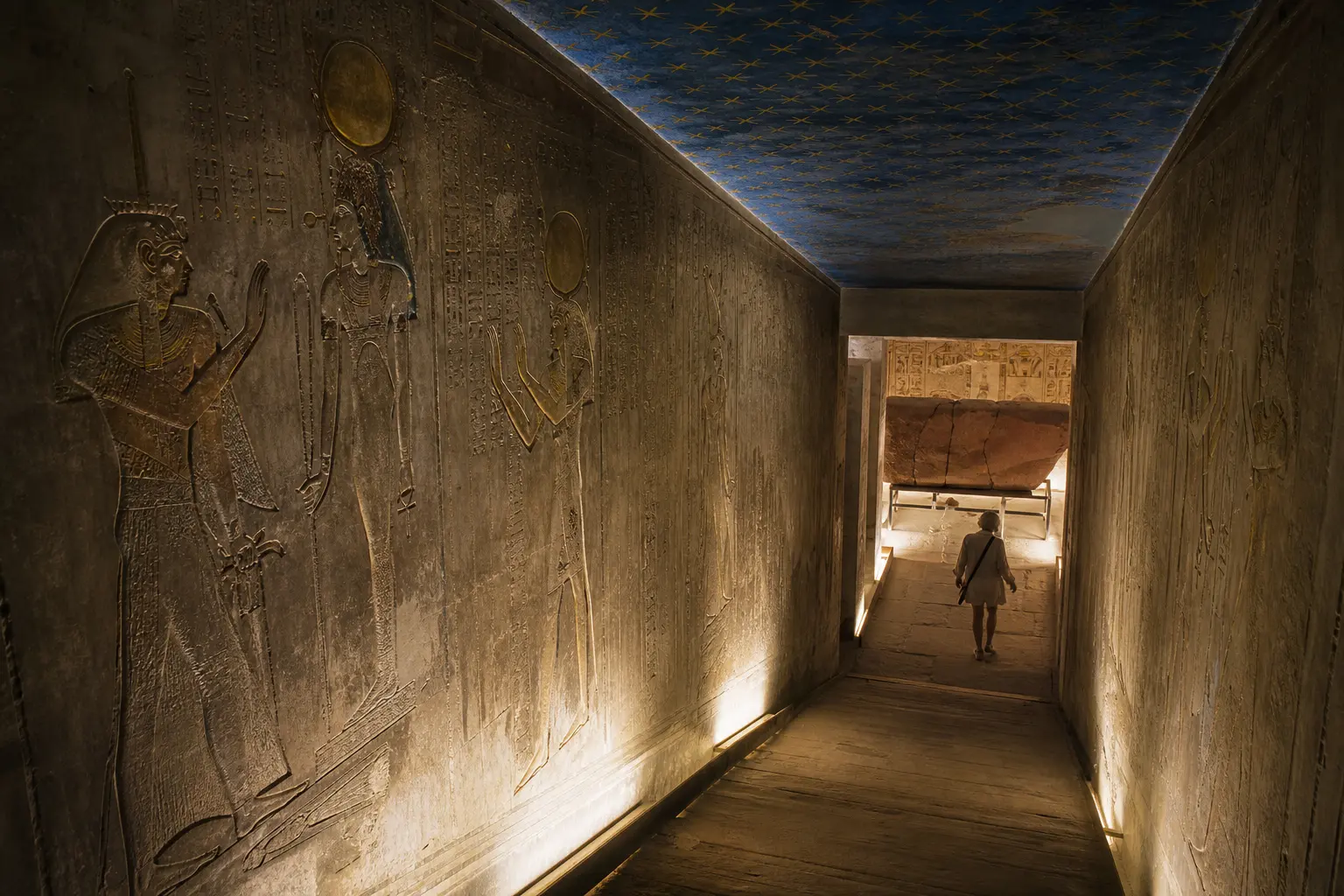
The tomb, catalogued as WV22, sits in the western arm of the Valley of the Kings on Luxor’s west bank. A 36-meter corridor drops down into three interconnected chambers built for Amenhotep III and members of his royal family, including Queen Tiye.
Amenhotep III ruled Egypt for nearly 38 years during the 18th Dynasty, from around 1390 to 1350 BCE, a reign remembered for monumental building, including the Colossi of Memnon that still stand near Luxor today. The tomb was rediscovered during Napoleon’s Egyptian campaign in 1799 and later excavated by British archaeologist Howard Carter in 1915, who found it had already been stripped of its treasures by ancient looters.
What survived was the architecture and the art: a ceiling painted deep blue and dotted with gold stars, painted scenes of the king before Osiris and Ra, and passages from the Book of the Dead meant to guide him through the underworld. His mummy is not inside. It was moved in antiquity for safekeeping and now sits in the National Museum of Egyptian Civilization in Cairo.
The restoration itself had to rebuild what looting and time had broken apart. Conservators worked through several distinct tasks:
- Sarcophagus reassembly – more than 200 fragments of Amenhotep III’s red granite sarcophagus lid were pieced back together and mounted on a new support so visitors can see it intact.
- Mural stabilization – painted scenes of the king with ancient deities were cleaned, reinforced and protected from further flaking.
- Structural reinforcement – engineers secured pillars and ceilings weakened by centuries of flooding, bat colonies and humidity.
- Modern monitoring – new lighting, ventilation and sensors were installed to track humidity and catch decay before it spreads.
Ancient Egyptian art is turning out to hold more than restorers first assumed. A separate project using holograms to reveal the true colors hidden in ancient Egyptian art has shown how much pigment survives beneath centuries of grime, the same kind of detail conservators had to work around inside WV22’s burial chamber.
Japan Was Restoring This Tomb Before Egypt Signed the Deal
The official project, titled Preserving the Murals of the Tomb of King Amenhotep III, ran in three phases from 2001 to 2024: 2001 to 2004, 2010 to 2012, and a final push from 2023 to 2024. But the work started earlier than the paperwork suggests.
Japan’s Waseda University began informal conservation on the site in 1989, more than a decade before Egypt, Japan and UNESCO formalized the joint project. Waseda and Higashi Nippon University eventually partnered with Egypt’s Supreme Council of Antiquities under the UNESCO Japan Trust Fund restoration of the tomb’s wall paintings, bringing in Italian specialists for stone work and 3D scanning along the way. More than 260 experts passed through the project over its life.
Decades of deterioration had left the structure at risk of collapse.
Japan’s UNESCO mission said that of the tomb’s condition before conservation began, underlining how close WV22 came to losing its murals entirely. Tourism and Antiquities Minister Sherif Fathy inaugurated the restored tomb alongside Dr. Mohamed Ismail Khaled, Secretary-General of the Supreme Council of Antiquities, and Dr. Nuria Sanz, director of UNESCO’s regional office in Cairo. Khaled called it simply a very fascinating tomb.
Why Is Egypt’s Tourism Revenue Suddenly Breaking Records?
Egypt’s tourism revenue hit an all-time high of $16.7 billion in fiscal year 2024/25, up 56.1 percent year on year, according to the government’s Information and Decision Support Center. That is the fastest growth rate the sector has posted in nearly a decade, and it lifted tourism’s share of GDP to 3.7 percent from 3.4 percent.
The momentum has carried into the following year. Egypt’s tourism revenue data tracked against a 2010 to 2025 baseline shows revenue climbing to $14.4 billion in the first nine months of fiscal year 2025/26, a 14.9 percent jump from $12.5 billion in the same period a year earlier, per a government statement covering July 2025 through March 2026. Arrivals in calendar 2025 reached 19 million, up from 15.8 million in 2024.
The reopened tomb and the Grand Egyptian Museum, which opened three weeks later, are part of why. Egypt has also been working the diplomatic angle: the country’s tourism ministry recently hosted Montenegro’s president for the first time in two decades, a visit built partly around tourism and investment ties between the two countries.
Where the Suez Canal Lost, Tourism Picked Up the Slack
The timing matters because Egypt’s other great hard currency engine broke down first. Houthi rebels in Yemen began targeting Red Sea shipping in November 2023 in solidarity with Gaza, and container lines fled the canal for the longer route around Africa.
| Revenue Stream | Peak Year | Peak Amount | Latest Reading |
|---|---|---|---|
| Suez Canal tolls | 2023 | $10.3 billion | $4 billion in 2024, down almost two thirds |
| Tourism receipts | FY2024/25 | $16.7 billion (record) | $14.4 billion through nine months of FY2025/26, up 14.9% |
Ship transits through the canal fell to 13,213 in 2024, roughly half of the more than 26,000 that passed through in 2023. Suez Canal Authority chairman Osama Rabie has said the waterway lost as much as 40 percent of its revenue in some months, and President Abdel Fattah el-Sisi has put cumulative losses since the crisis began at around $10 billion.
Tourism cannot fully replace a $10 billion canal on its own, but it is the one major foreign currency stream still growing while the other one bleeds.
A Second Billion-Dollar Wager Opened Three Weeks Later
On November 1, 2025, Egypt opened the Grand Egyptian Museum outside Cairo, a project first planned in 1992 and delayed for three decades by revolution, a coup, the pandemic and regional wars. President el-Sisi called it a new chapter in the history of the present and the future.
- $1 billion plus spent on construction across roughly two decades of building.
- 500,000 square meters of floor space, the largest museum built around a single civilization.
- 100,000-plus artifacts spanning seven millennia, including the full Tutankhamun collection gathered under one roof for the first time.
- Five million visitors targeted annually, against roughly 5,000 to 6,000 walking through the doors each day at launch.
Fathy told reporters at the opening that the museum was welcoming 5,000 to 6,000 visitors a day. We hope to increase that to 15,000 daily, he said, a rate that would still fall short of the five million a year Egypt is counting on.
The Bet Still Carries Real Downside
Egypt’s external debt stood at $164.5 billion as of September 2023, and the IMF expanded its loan program from a pledged $3 billion to $8 billion in March 2024 to help cover the gap left by the canal and currency shortages. Tourism revenue is helping close that gap, not erase it.
There are signs of real progress. Egypt’s current account deficit narrowed to about $9.5 billion in the first half of fiscal year 2025/26, and remittances from Egyptians abroad hit $22 billion over the same six months, according to the Central Bank of Egypt. But the tourism boom itself has a concentration problem: European visitors accounted for 69.2 percent of arrivals in the same nine-month window, meaning any downturn in European travel demand hits Egypt’s recovery directly.
Getting visitors to and around new sites is its own bet. Egypt has been adding helicopter routes above one of its most dangerous highways to move tourists faster between coastal resorts, a sign the government sees ground transport as a bottleneck too.
The Grand Egyptian Museum is still running at a fraction of its target crowd. The Suez Canal has not returned to its $10 billion peak. Amenhotep III’s tomb, at least, is finished and open, one restored asset in a ledger that is still being settled.
Frequently Asked Questions
What Is the West Valley of the Kings?
The West Valley, sometimes called Wadi al Gurud, is a separate, less visited branch of the Valley of the Kings on Luxor’s west bank. It holds only two known royal tombs, Amenhotep III’s WV22 and King Ay’s WV23, compared with more than 60 tombs in the main valley.
How Is Amenhotep III Related to Tutankhamun?
Amenhotep III was Tutankhamun’s grandfather and the father of Akhenaten, the pharaoh who briefly upended Egyptian religion before Tutankhamun’s own short reign restored the old order.
What Is the Colossi of Memnon’s Connection to the Tomb?
The two seated statues originally stood at the entrance to Amenhotep III’s mortuary temple, once the largest temple complex built in Egypt, most of which was later destroyed by flooding, earthquakes and stone robbing over the centuries.
Why Did Suez Canal Revenue Collapse in the First Place?
The crisis traces to November 19, 2023, when Houthi fighters attacked the Galaxy Leader cargo ship in the Red Sea. That strike opened more than a hundred attacks on merchant vessels over the following months, pushing major shipping lines to reroute around Africa instead of risking the canal.
Will Egypt’s Tourism Boom Keep Growing?
Egyptian officials have set a target of doubling annual tourist arrivals to roughly 30 million by 2030, building on the record 15 million visitors the country logged in 2024 before the current surge began.
