
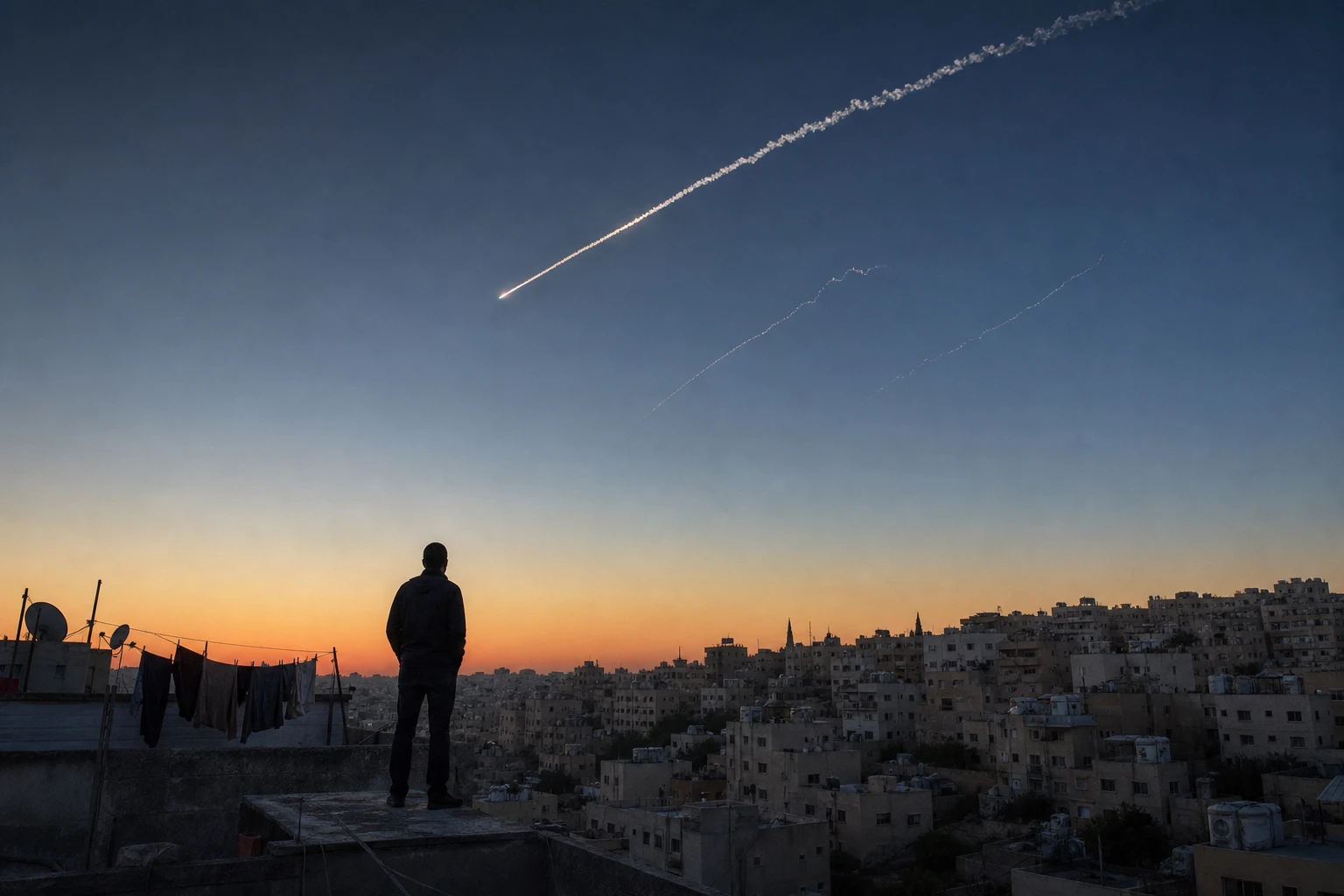
Jordanian air defenses shot down three Iranian missiles over the kingdom’s territory early Tuesday, the army said, the first clean intercept since an Iranian strike on a US air base killed three American soldiers last week. No injuries were reported this time.
That is the visible war. A quieter one is running underneath it, inside Jordan’s own borders, where a population that is majority Palestinian by heritage watches its king shield Israeli and American interests even as Amman outlaws the country’s largest opposition movement and the West Bank next door empties faster than at any point in decades.
A Clean Intercept, One Week After a Deadly Miss
“The air defense system intercepted and downed tonight three missiles coming from Iranian territory that entered Jordanian airspace and targeted the kingdom’s territory,” the Jordanian army said in a statement early Tuesday.
A week earlier, Jordan was not so lucky. Iranian missiles and drones struck Muwaffaq Salti Air Base, which hosts American troops and fighter jets, on back-to-back nights. The Pentagon has since confirmed three US Army soldiers died in that attack: Pvt. Isabella Gonzales, 19, of Carrollton, Texas; 1st Lt. Tyler James Feehan, 25, of Ewa Beach, Hawaii; and Sgt. Angel S. Rampersad, 28, of Ozone Park, New York, who had initially been listed as missing. A fourth American soldier was killed separately in northern Iraq when an unexploded Iranian drone detonated during a disposal operation, pushing the week’s regional toll to four.
“One leaked through,” Secretary of State Marco Rubio said, describing how an Iranian missile got past US defenses to hit the base. A CENTCOM spokesman later acknowledged that American and partner forces had intercepted dozens of missiles and drones aimed at Gulf countries that same night, but that a handful still made impact. The interceptor gaps behind that admission have already made Jordan the war’s deadliest front for American troops since the fighting widened.
The current barrage traces back to a fragile truce over the Strait of Hormuz that collapsed within days, reigniting daily exchanges between Washington and Tehran across Jordan, Kuwait and Bahrain alike. Here is how the last week unfolded for Jordan specifically.
- Late February 2026: The United States and Israel launch joint strikes on Iran, opening the war that would eventually reach Jordanian soil.
- Friday, July 17: Iranian missiles and drones hit Muwaffaq Salti Air Base, killing two soldiers outright and leaving a third missing.
- Saturday, July 18: A second wave strikes the same base overnight; Washington launches retaliatory strikes on Iranian targets.
- Sunday, July 19: Jordan summons Iran’s top diplomat in Amman, demanding an immediate end to what its foreign ministry calls unjustified attacks.
- Tuesday, July 21: The Pentagon confirms the missing soldier is dead, and Jordan’s air defenses intercept three more Iranian missiles before dawn.
Washington’s Price Tag
Jordan is one of eight Arab countries that host permanent US military facilities, and none of that hosting comes free. A seven-year Memorandum of Understanding signed in 2022 set US economic and military assistance at $1.45 billion a year. Congress raised that figure to $1.65 billion in 2025, roughly triple what Jordan received in 2010.
A separate Defense Cooperation Agreement, signed in January 2021, formalizes US access to Jordanian bases. Roughly 4,000 US troops are currently stationed in the kingdom, more than in previous years. Yet in March, Jordanian Foreign Minister Ayman Safadi insisted there were no foreign military bases on Jordanian soil at all, a claim that sits awkwardly next to the treaty text.
Kelly Petillo, program manager for Middle East and North Africa at the European Council on Foreign Relations, said the denial reflects anti-US sentiment at home. Jordan’s alliance with Washington, she told DW, does not just secure the kingdom. It also carries a domestic cost of hosting American troops that Amman would rather not advertise.
| Metric | Figure | What It Signals |
|---|---|---|
| US annual assistance (2025) | $1.65 billion | Triple the 2010 level, per the 2022 memorandum |
| US troops hosted | 4,000 | More than in previous years, per recent reporting |
| Islamic Action Front seats (Sept. 2024) | 31 of 138 | Largest opposition bloc since 1989 |
| Jordanians approving Trump’s foreign policy | 12% | Arab Barometer poll, 2026 |
| Palestinian refugees registered in Jordan | 2.4 million | UNRWA count |
Erwin van Veen, a senior research fellow at the Clingendael Institute in The Hague, put the bind plainly to DW. Iran, he said, has reserved itself the right to return fire on any state that hosts US military assets, “and Jordan is one of them.” The trouble, he added, is that King Abdullah II’s own options are limited given how tightly Jordan is bound to the Americans militarily and economically.
Why Did Jordan Just Outlaw Its Largest Opposition Party?
In April 2025, Jordan’s Ministry of Interior banned the Muslim Brotherhood outright, months before this latest round of missiles, after accusing a linked cell of building rockets and drones for an attack inside the kingdom. The Islamic Action Front, the Brotherhood’s political wing and the biggest bloc in the 2024 parliament, was not formally banned, but police raided its offices anyway.
- Islamic Action Front – Jordan’s largest opposition party, the political wing of the Muslim Brotherhood until the 2025 ban, drawing most of its support from Jordanians of Palestinian descent.
The IAF’s rise had already unsettled the palace. It won 31 of 138 seats in September 2024, tripling its prior representation and posting its best result since 1989. Oraib Rantawi, who heads the Amman-based Al Quds Center for Political Studies, called the scale of that win “astonishing in their magnitude.” IAF leaders described the result as a popular referendum on scrapping Jordan’s 1994 peace treaty with Israel.
Jordan’s General Intelligence Department has accused the men behind the alleged 2025 plot of manufacturing rockets and drones inside the kingdom, a claim the Brotherhood denies. Jordan’s Ministry of Interior formally outlawed the movement’s activities entirely that same month, criminalizing membership and promotion of its ideology.
A Population the War Didn’t Choose
More than half of Jordan’s population, including Queen Rania, has Palestinian roots. Around 2.4 million Palestinian refugees live in the kingdom, according to UNRWA figures cited by DW. That demographic reality is exactly why the missiles overhead and the crackdown at home land on the same nerve.
A 2026 poll by Arab Barometer, a nonpartisan public opinion research network, found that only 12% of Jordanians view President Donald Trump’s foreign policy favorably. Petillo said Jordan, like its Gulf allies, may be starting to question whether the US alliance stabilizes the kingdom or destabilizes it.
“Despite Jordan’s efforts to remain neutral in this war, existing alliances such as the one with the US not only affect Jordan’s fragile security but also cause public discontent,” Petillo told DW. Jordan has also absorbed a steep decline in USAID funding and the US pullback from UNRWA, she noted, at a moment when public debt and unemployment are already straining the kingdom.
The West Bank Empties Faster Than Ever
Van Veen pointed to a second pressure building next door. The current Israeli governing coalition wrote into its own 2022 coalition agreement an intention to eventually annex the West Bank, he told DW, leaving Jordan with almost no room to maneuver toward Israel, Iran or Washington at once.
The West Bank is a landlocked territory of roughly 5,655 square kilometers that Israel took from Jordan in the 1967 Six-Day War. The UN Security Council has held that Israeli settlements built there since 1967, including in East Jerusalem, carry no legal validity.
Save the Children found that 685 children were displaced by settler violence in the first three months of 2026 alone, versus an average of just 63 children over the same period in the three prior years, roughly a tenfold jump. By the first six months of 2026, more than 1,000 Palestinian children had been displaced this way, according to the aid group, half the total recorded across the entire preceding three-year period.
UN Secretary-General António Guterres has since warned of what he called a presumption of impunity across the occupied territory, and cautioned that any attempted annexation would carry no more legal weight than the occupation itself.
Colder Ties with Jerusalem
Jordan-Israel relations have cooled steadily since Hamas attacked Israel on October 7, 2023, an assault that triggered Israel’s war in Gaza. Hamas is designated a terrorist organization by the US, the EU and others. Jordan and Israel recalled their ambassadors that November after Amman condemned Israel’s conduct in Gaza’s early days, and Jordan has since pushed for a two-state solution alongside its Arab partners.
“The other risk for Amman is that Iran’s attacks could also place it in the same camp as Israel,” Petillo warned. That optics problem, she said, could deepen public discontent and revive the same street protests seen during the Gaza war, when demonstrators called for scrapping the 1994 peace treaty altogether.
Jordan has firmly rejected any new displacement of Palestinians into its territory, wary of the cost of hosting refugees whose return home is far from guaranteed.
Jordan is, in many ways, between a rock and a hard place, as it has little room for manoeuvre.
Van Veen offered that assessment to DW, and it applies to Jordan’s position toward Israel, Iran and Washington all at once, not just one of the three.
Jordan’s military intercepted every missile fired at it this week. Whether its politics can hold that same line is a separate question, and Amman has not yet answered it.
