
Egyptian President Abdel Fattah Al-Sisi hosted Montenegro’s president, Jakov Milatovic, in Cairo on Monday, Egypt’s first presidential-level meeting with Montenegro since the two countries opened relations in 2006. Presidential spokesman Mohamed El-Shenawy told Kuwait’s KUNA news agency that the leaders covered Gulf security, the Palestinian cause and Gaza’s reconstruction. That is the script Cairo reads out at nearly every state visit right now.
A narrower, more concrete agenda sat underneath it: tourism investment, trade routes and Montenegro’s push toward European Union (EU) membership, a relationship Egypt has been building in slow, uneven steps for two decades.
A Familiar Script for a New Visitor
Al-Sisi’s public comments matched what Egypt tells almost any visiting head of state these days. He reaffirmed support for the sovereignty and stability of Gulf Cooperation Council (GCC) states and repeated Cairo’s rejection of unjustified attacks on Arab countries, according to El-Shenawy’s statement. He also backed United States and Iran efforts toward a comprehensive, lasting agreement.
On Gaza, Al-Sisi restated Egypt’s standing position: a two-state solution, an independent Palestinian state under international law, no forced displacement of Palestinians, and faster reconstruction and aid deliveries. Cairo has repeated close to the same message at nearly every high-level meeting since the Gaza war began.
The Gulf language carries specific weight this year. Kuwait and its Gulf neighbors spent weeks last year absorbing strikes tied to the US-Iran war, and Cairo’s Gulf solidarity messaging has stayed close to constant since. Milatovic, for his part, praised Egypt’s role under Al-Sisi in promoting regional peace and reaffirmed Montenegro’s own support for the two-state solution.
Why Is Egypt Investing in Tiny Montenegro Now?
Montenegro is the European Union’s accession frontrunner among Western Balkan candidates, with an informal government target of full membership by 2028. Cairo is building ties early with a small Adriatic state that will soon carry EU trade rules, EU migration policy and a vote inside the bloc.
Montenegro’s government has made joining the European Union its defining foreign policy project since becoming a candidate in December 2010. The EU provisionally closed a fourteenth negotiating chapter with Montenegro in March 2026, and Podgorica wants the rest wrapped up by the end of the year.
- 33 chapters make up Montenegro’s full EU accession negotiation, and all of them are already open for talks.
- 2028 is the informal target Montenegro’s government has floated for full EU membership.
- 2010 is when Montenegro became an official EU candidate country, four years after independence.
Al-Sisi called Monday’s meeting significant because it marks the first presidential-level exchange since Egypt recognized Montenegro’s independence and opened relations on the same day in September 2006. Twenty years passed with foreign ministers, prime ministers and investors doing the actual relationship building. A presidential visit costs Cairo little, and it buys early standing with a country about to sit inside the EU’s tent.
Luštica Bay and a Slow-Build Investment Trail
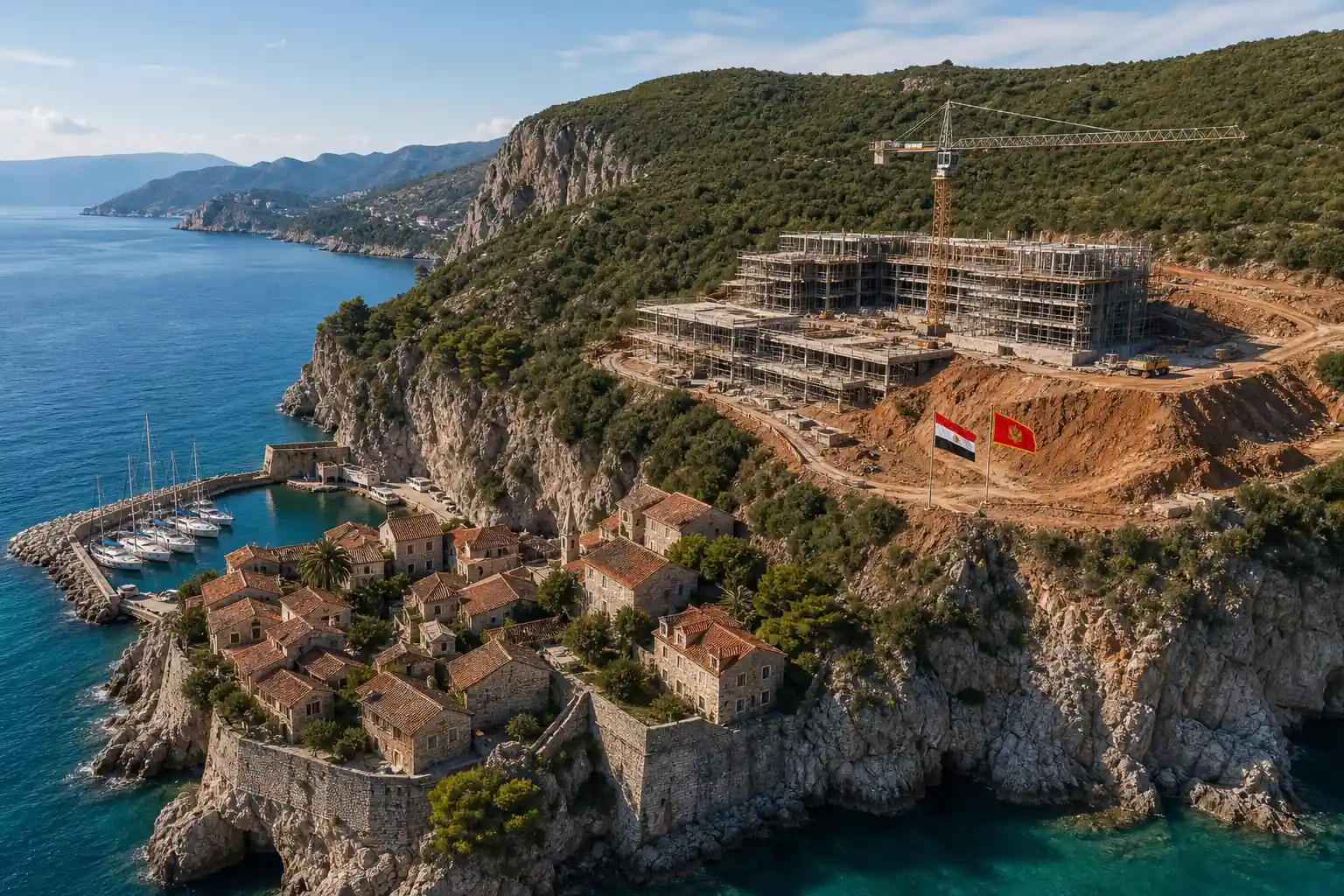
Egypt’s biggest footprint in Montenegro long predates Monday’s meeting. In 2009, a Swiss-Egyptian consortium, Orascom Hotels and Development, bought into Montenegro’s Luštica peninsula, a deal Montenegro’s government still calls one of Egypt’s largest direct investments in the country.
The visits and deals since then have followed an uneven rhythm:
- September 2006: Egypt recognizes Montenegro’s independence and the two countries establish diplomatic relations the same day.
- 2009: Orascom Hotels and Development buys into the Luštica peninsula project on Montenegro’s coast.
- 2010: Egyptian Prime Minister Ahmed Nazif and his Montenegrin counterpart, Milo Djukanovic, meet in Cairo to discuss trade and investment.
- October 2019: Montenegro’s then foreign minister, Srdjan Darmanovic, pays an official visit to Egypt.
- May 2025: Egypt’s foreign minister and his Montenegrin counterpart sign fresh memoranda of understanding, and Cairo discloses that its exports to Montenegro totaled just $4.6 million in 2024.
- August 2025: Montenegrin officials meet Egyptian investors over infrastructure and tourism projects in the municipality of Zeta.
- July 2026: Al-Sisi hosts Milatovic in Cairo, the first meeting between the two countries’ presidents.
Two threads run through that list. Egyptian trade delegations keep showing up in Montenegro’s coastal municipalities looking for tourism and infrastructure partners, and Cairo keeps running an identical play elsewhere. Trade teams pitched farm and port deals in Tanzania this year, hunting for markets that do not run through Gulf capitals.
A $4.6 Million Line Next to a $35 Billion Deal
Set next to Egypt’s real financial lifelines, Monday’s Montenegro visit looks small. Egypt’s foreign minister disclosed in May 2025 that Egyptian exports to Montenegro totaled just $4.6 million in 2024, barely a rounding error in Cairo’s trade accounts.
| Partner | Commitment | Value | Year |
|---|---|---|---|
| UAE sovereign fund ADQ | Ras El-Hekma coastal megaproject | $35 billion | 2024 |
| European Union | Strategic and Comprehensive Partnership | €7.4 billion | 2024 to 2027 |
| International Monetary Fund | Extended Fund Facility loan | $8 billion | 2024 |
| Montenegro | Egyptian goods exported there | $4.6 million | 2024 |
The gap between the two is enormous. The UAE’s ADQ fund committed $35 billion to the Ras El-Hekma coastal megaproject alone in February 2024, split between fresh cash and converted central bank deposits. Egypt’s own government called it the largest FDI in Egypt’s history at the signing.
Add the International Monetary Fund’s $8 billion loan and the European Union’s aid package, and Gulf and Western capital dwarfs anything Montenegro can offer. Egypt has chased dollar-earning fixes on several fronts at once, including a push to grow L’Oreal’s Cairo-made cosmetics exports for hard currency. Montenegro fits that same pattern, just at a far smaller scale.
Brussels Counts Egypt as a Migration Partner Too
Milatovic’s praise for Egypt’s handling of illegal migration echoes language the European Union itself uses about Cairo. In March 2024, the EU signed a 7.4 billion euro Strategic and Comprehensive Partnership with Egypt, built around energy sales, investment and migration control. About 200 million euros of that package was earmarked specifically for migration management, including border support and anti-smuggling work.
European Commission President Ursula von der Leyen described the deal as “a package ranging from trade and investment to low carbon energy, managing migration, and education, culture and youth” at the signing ceremony in Cairo.
Montenegro lies along the Balkan migration corridor into the EU, and as an accession frontrunner, it will eventually share responsibility for that same border policy. Praising Cairo’s migration record is one way Podgorica signals it is already thinking like a member state.
What Montenegro Still Wants From Cairo
Milatovic came to Cairo with a specific list. He told Al-Sisi that Montenegro wants Egyptian expertise in tourism, energy and infrastructure development, and he praised existing Egyptian investment in Montenegro’s tourism sector as a success worth expanding into new fields.
The two presidents also found easy agreement on process. Both favor diplomacy over conflict, both back a two-state solution for the Palestinian issue, and both used Monday’s meeting to talk up deeper political consultation going forward.
Milatovic invited Al-Sisi to pay an official visit to Montenegro, the Egyptian presidency said. Both leaders agreed Monday’s meeting marks the start of a new phase of political consultation between the two countries, twenty years after Cairo first recognized Montenegro’s independence.
